Buyer Enablement for SaaS: A Practical Guide for Startups
Buyer enablement for SaaS explained: what it is, how it differs from sales enablement, what content helps buyers, and how seed-stage teams can start live.
Published: October 29, 2026 · Updated: November 3, 2026
Author: OffBook Editorial Team

Buyer enablement is the work of giving B2B buyers the information, proof and next steps they need to finish a purchase on their own terms. Gartner defines it as providing information that supports the critical activities needed to complete a purchase. For a SaaS startup, that means your job does not end at “here’s the demo.” It extends to helping a champion explain, justify and defend the deal to people you may never meet.
This guide covers what buyer enablement is, why it matters more in software than almost anywhere else, what content and live behaviors actually help, and how a founder or small sales team can start without a marketing department.
TL;DR
- Buyer enablement helps buyers buy. Sales enablement helps sellers sell. Early-stage teams need both, but buyer enablement is the one most startups skip.
- Buying groups are big and indecisive: Gartner reports six to 10 stakeholders, and 95% of groups revisit decisions as new information arrives.
- The best enablement is not a PDF library. It is what you do on calls: listening for the buyer’s obstacles and arming the champion with what they need next.
- Measure buyer actions (who engaged, who approved, what was shared), not seller activity like proposals sent.
- Start with one deal, one champion and one mutual plan. Scale content after you see which questions repeat.
Table of Contents
- What buyer enablement means in B2B SaaS
- Buyer enablement vs. sales enablement
- Why it matters more in SaaS
- The six jobs your buyers are trying to finish
- What buyer enablement content looks like
- The part most guides skip: enablement happens on the call
- Our perspective
- How to start with a small team
- Measuring whether buyers are moving
- Where live coaching fits
- Common mistakes to avoid
- FAQ
- Sources
What buyer enablement means in B2B SaaS
Most definitions agree on the core idea. Buyer enablement equips the people buying from you with the knowledge, tools and support to move through their own internal process with confidence. It is less about pushing a product and more about simplifying a hard decision.
The key word is internal. When you sell software, the person on your call rarely holds the budget alone. They must build a case, line up a security review, win over finance and get a yes from someone who has never seen your product. Buyer enablement is everything you do to make that internal sale easier.
That can be content (a business case template, a security FAQ), a tool (an ROI calculator), or a behavior (asking the question that exposes a missing stakeholder). The third category is the one competitors’ guides underplay, and it is where small teams have the biggest edge.
Buyer enablement vs. sales enablement
The distinction is simple. In Gartner’s framing, buyer enablement helps buyers buy through practical support and prescriptive advice, while sales enablement helps sellers sell.
| Sales enablement | Buyer enablement | |
|---|---|---|
| Who it serves | Your reps and founders | Your prospect and their buying group |
| Typical assets | Playbooks, battlecards, training, call coaching | Business case templates, evaluation guides, role-specific FAQs, calculators |
| Success looks like | Reps who run better calls | Buyers who reach a decision with fewer gaps |
| Main risk | Reps who sound scripted | Content nobody asked for |
They are not rivals. A well-coached rep who listens closely is the best buyer enablement channel you have, because the rep can adapt in the moment. A founder who is trained to spot a missing stakeholder and who hands the champion exactly the right one-pager is doing both jobs at once. If you want the seller-side half, our guide to startup sales rep best practices covers it.
Why it matters more in SaaS
Software purchases are complicated in ways that hit startups hard.
Many people decide. Gartner says buying groups often include six to 10 stakeholders, and 95% report revisiting decisions as new information emerges. Forrester’s 2020 analysis found that 81% of B2B purchases involved a group of three or more people, and those groups often need business cases at several stages.
Buying feels hard. In a Gartner survey of more than 250 B2B customers, 77% rated their purchase experience as extremely complex or difficult.
Helpfulness pays. Gartner also found that customers are three times more likely to buy a bigger deal with less regret when suppliers provide information that helps them advance the purchase.
Buyers work alone. Forrester’s November 2024 report notes that business buyers complete many purchasing tasks independently, so vendors should supply workflow resources that help buying-group members discover, evaluate and purchase.
For a seed or Series A team, the implication is uncomfortable. You have no brand halo, a short list of references and a champion who has to vouch for an unfamiliar vendor. The champion carries your argument into rooms you are not in. If they cannot repeat it clearly, the deal stalls, and it stalls quietly. For more on how those rooms work, see how enterprise B2B buying works.
There is also a real-world signal worth noting. Built In reported a strategic account executive closing a deal in four months with a buyer enablement approach, against his usual nine to 15 months. One anecdote proves nothing about your results, but it shows the direction of the effect.

The six jobs your buyers are trying to finish
Gartner describes buying as a set of jobs rather than a linear funnel. Buying groups need to complete six: problem identification, solution exploration, requirements building, supplier selection, validation and consensus creation. They loop back and forth between them, which is why a neat stage-by-stage content calendar often misses.
Here is what each job looks like for a SaaS buyer, and what a small team can offer:
| Buying job | What the buyer is stuck on | What helps |
|---|---|---|
| Problem identification | “Is this worth fixing now?” | A short diagnostic or a cost-of-inaction worksheet |
| Solution exploration | “What kinds of tools exist?” | A plain explainer of approaches, including doing nothing |
| Requirements building | “What should we ask for?” | An evaluation checklist the buyer can adapt |
| Supplier selection | “Why you, and not the others?” | An honest comparison on criteria, plus references |
| Validation | “Will it work here?” | A scoped pilot plan, security answers, integration notes |
| Consensus creation | “How do we get everyone to yes?” | A champion kit: summary, business case, role-specific FAQs |
Gartner adds that useful enablement is credible and backed by data, easy to use, and relevant to the buyer’s challenges. Those four tests are a good filter for anything you consider publishing. If a page fails any of them, it is marketing, not enablement.
What buyer enablement content looks like
When people search for buyer enablement content, they usually want examples. The research gives a few concrete categories.
Interactive tools. Gartner’s list includes calculators, diagnostics, recommenders, advisors, benchmarks and simulators. An ROI calculator that lets a champion plug in their own headcount and call volume beats a static case study.
Decision documents. Forrester points to resources such as initiative proposals, discovery reviews, purchase recommendations and success plans, covering the status quo, requirements, alternatives, financials, risks, implementation and KPIs. Notice that these are documents the buyer would otherwise have to write from scratch. Drafting them for the champion is a gift.
Role-specific material. Finance wants payback and pricing mechanics. IT wants security and integrations. A department head wants adoption effort. A single page that tries to speak to all three speaks to none. Our guide on types of economic buyers in SaaS shows how different the approvers can be.
Audience clarity. Good content starts from knowing who reads it. If you have not written down your buyer roles yet, start by building buyer personas that name each person in a typical deal and what they need to hear.
A clear offer. Buyers cannot enable themselves around a fuzzy proposition. Tightening what you sell, to whom and for what outcome, is part of the job, and designing one clear offer is a useful exercise even for teams that sell to businesses.
Demos built for sharing. A demo the champion cannot re-explain is wasted. See how to run B2B demo calls effectively and the role of demo in B2B sales for how to structure them around the buyer’s questions.
The part most guides skip: enablement happens on the call
Most articles on this topic treat buyer enablement as a content and tooling project. For an early-stage team, that misses where the leverage is. You will not have time to build a library. You will, however, have a lot of conversations.
Forrester’s 2020 analysis says real-time enablement requires sensing and responding to buyer signals as new information and group dynamics appear. That is a description of good live selling. Signals include:
- A prospect saying “I’ll need to run this by security,” which is an invitation to ask who, when and what they will need.
- A champion going vague about budget, which usually means they have not yet found the person who owns it.
- A new name appearing for the first time on call three.
- A stakeholder objecting to something your champion cannot answer, which tells you what to prepare.
Each one is a chance to enable. Each one is also easy to miss when you are demoing, taking notes and thinking about your next slide. This is why disciplined discovery matters. Qualification frameworks such as MEDDIC and MEDDPICC are, read the right way, buyer enablement checklists: they force you to find the economic buyer, the decision process and the paper process before the buyer has to.
Listen first, then equip
The habit that separates enabling reps from pitching reps is active listening: hearing the obstacle behind the question and mapping it. When a prospect pushes back, treat it as information about their situation, not a verdict on you. Then offer the specific thing that removes the obstacle: a security summary, a reference in their industry, a pilot scope, a two-slide recap for the CFO.
That is the same instinct Built In describes when it quotes the view that the best reps coach and support buyers instead of only pitching. For more on identifying those moments, read about the types of sales coaching moments for B2B SaaS teams.
Our perspective
We build live coaching software, so we will say where we think buyer enablement goes wrong at startups.
Founders hear “buyer enablement” and picture a content project: a resource hub, a calculator, a gated guide. Those can help. But in our experience with the founder-led teams we serve, the deals that stall rarely stall for lack of a PDF. They stall because nobody asked, on the call, who else needs to approve, what they care about and what happens if nothing changes. The information needed to enable the buyer was available. It just went by unnoticed.

That is why we believe enablement is a live skill first and a content asset second. The moment a champion mentions a legal review is the moment to ask about timing and requirements. Hours later, in a recap email, it is a weaker moment. Post-call notes tell you what you missed. They cannot fix it.
So our advice is blunt. Before you build anything, review your last five stalled deals and write down the one question that, if asked on the call, would have changed the outcome. Build your first enablement assets around the answers. Then make sure whoever runs calls, whether founder or first rep, has those questions in front of them when it counts.
Neil
How to start with a small team
You do not need a program. You need a repeatable habit. Here is a sequence that fits a team with one or two sellers.
- Pick one live deal. Identify the champion, the likely economic buyer and anyone with veto power (security, legal, procurement). Write down what you do not know.
- Ask the missing questions on the next call. Who else is involved? What does your process look like from here to signature? What would make this a no? The goal is to map the buying group, not to interrogate.
- Build a champion kit for that deal. One short summary the champion can forward, a business case draft with their numbers, and answers to the three questions you expect from IT and finance.
- Agree on a mutual plan. A shared list of steps, owners and dates replaces “let me know when you’re ready.” Keep it editable by the buyer.
- Log what repeated. After five deals, the questions that come up every time become your standard assets: a security FAQ, a pricing explainer, a pilot template.
- Turn the repeats into pages. Publish what you have already proved useful. It will serve self-guided buyers who never talk to you before they shortlist.
This order matters. Content built from real deal friction beats content built from a brainstorm. For the broader timeline these steps sit in, see the B2B sales cycle explained for founders and reps.
Measuring whether buyers are moving
Pageviews and downloads are seller metrics. Buyer enablement should show up in what buyers do. A sound measurement approach tracks:
- Whether you have identified a champion, and whether they have engaged with what you sent
- Which other stakeholders have appeared, and whether you have spoken to them
- Whether materials are being shared internally, and by whom
- Which buying jobs each stakeholder seems to have completed
- Whether approvals are happening, such as security sign-off or budget confirmation
Then compare those signals with how deals actually progress, and forecast from what customers have done rather than from what you have done. A proposal sent is your action. A proposal forwarded to finance with questions attached is theirs. The second belongs in your forecast.
For a team of two or three sellers, a simple column in your CRM for “stakeholders engaged” and “buyer-confirmed next step” does most of the work. Avoid inventing precise benchmarks you cannot support. Watch the trend across your own deals: do cycles shorten, and do fewer deals die in silence?
Where live coaching fits
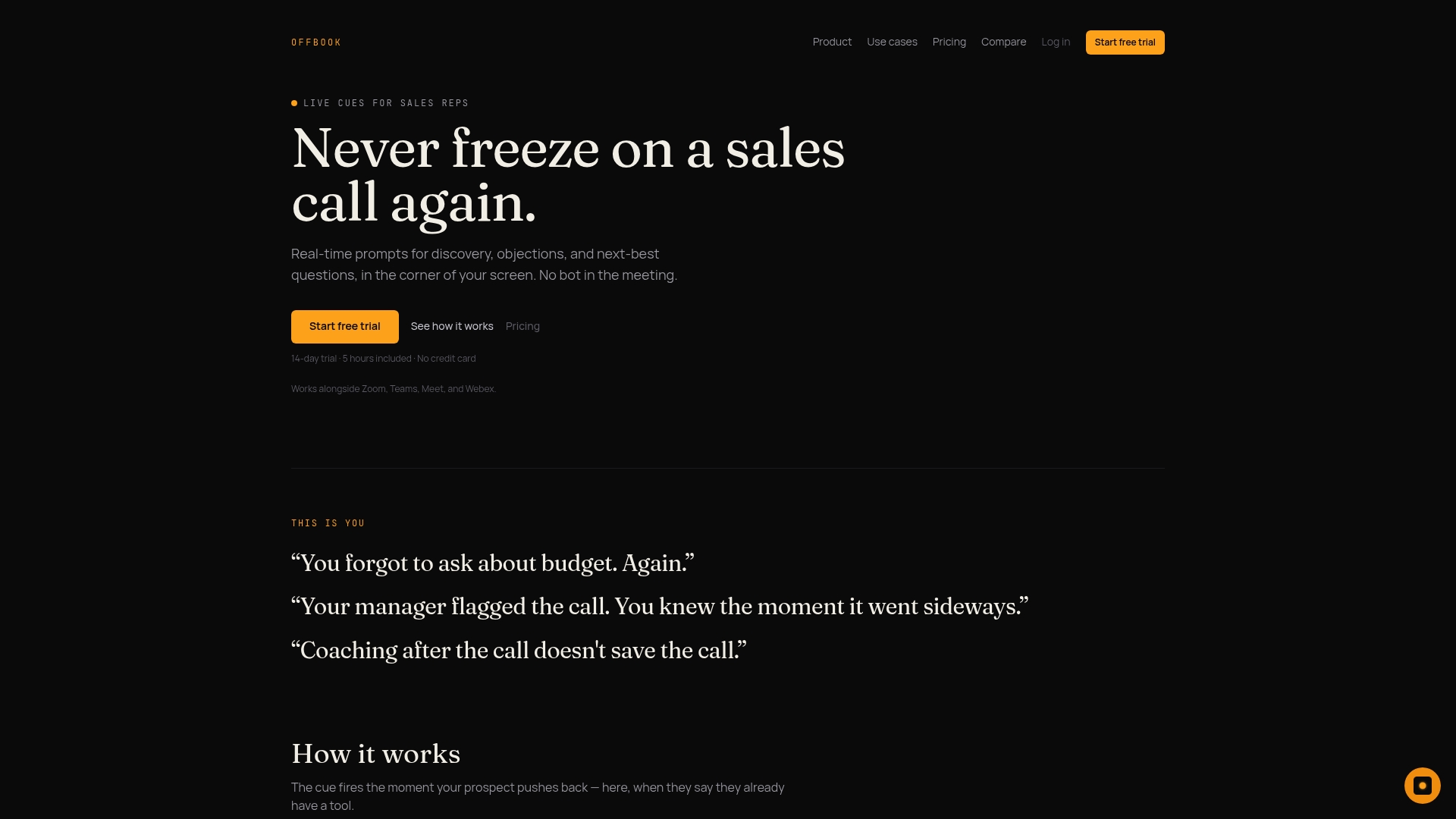
Because so much buyer enablement depends on what happens in the conversation, we built OffBook to help reps and founders at that exact point. It listens during video calls and shows on-screen cues, such as the question to ask or the qualification gap to close, structured around methodologies like MEDDIC and MEDDPICC. No bot joins the meeting. Before calls, it generates briefs on the company and people you are about to meet, and afterward it produces debriefs and follow-up drafts you can adapt into a champion summary.
The Power plan costs $59 per month or $590 per year. The Team plan is $1,000 per year per seat. You can see the details on the pricing page, or read how AI call coaching for sales works for founder-led teams.
If you want to understand the approach first, our pieces on in-call sales guidance and how AI cues improve sales performance explain what live prompts do and where they do not replace judgment.
Common mistakes to avoid
Treating it as gated content. A guide behind a form helps you collect leads, not help buyers. Put the useful material where champions can forward it.
Writing for one persona. Group decisions need role-specific answers. Check each asset against the question: which stakeholder is this for?
Overbuilding early. A library of 40 assets nobody has validated is worse than five that came from real deals.
Ignoring the champion’s risk. Your champion is staking their reputation on you. Give them evidence, a clear implementation story and an honest view of risks. Overselling makes it harder for them to defend the choice.
Measuring the wrong thing. If your dashboard only shows emails sent and demos booked, you are measuring your own effort.
FAQ
What is buyer enablement in SaaS?
It is the practice of giving software buyers the information, tools and support to complete their purchase decision, including the internal selling their champion must do. It covers content, tools and live behaviors such as mapping stakeholders on calls.
How is buyer enablement different from sales enablement?
Sales enablement equips your sellers with training, playbooks and coaching. Buyer enablement equips the buyer with resources and advice that help them decide. A strong team does both, because a well-coached rep is also your best enabler of buyers.
What is an example of buyer enablement content?
Common examples include ROI calculators, evaluation checklists, business case templates, success plans, security FAQs and role-specific summaries a champion can forward. Each should be credible, easy to use and relevant to the buyer’s own situation.
Do early-stage startups need buyer enablement?
Yes, probably more than larger vendors. With no brand recognition, your champion bears more risk and must justify more. You can start small: one deal, one champion kit and one mutual plan, then build from the questions that repeat.
How do you know it is working?
Look at buyer actions: stakeholders engaged, materials shared internally, approvals completed and next steps the buyer confirmed. If those increase and deals stop going silent, your enablement is helping.
Sources
- Gartner: Buyer Enablement
- Forrester: Buyer Enablement: A Vital New Discipline For B2B Sales And Marketing
- Forrester: Why Marketing Should Build Better Buyer Enablement Content
- Forrester: Meaningful Momentum: Defining Real-Time Buyer Enablement in B2B
- Built In: The Future of Sales Is Buyer Enablement