Real Time Sales Coaching Explained for Startup Teams
Discover real time sales coaching explained. Learn how live guidance transforms sales calls, boosts performance, and seals more deals.
Published: June 25, 2026
Author: OffBook Editorial Team

Real-time sales coaching is defined as live, in-call guidance delivered to sales reps during active conversations, giving them the right prompt at the exact moment it changes the outcome. This practice, also called live sales training or in-call coaching, sits at the intersection of sales methodology and AI technology. Tools like Offbook surface on-screen cues tied to frameworks like MEDDIC and MEDDPICC without a bot ever joining the meeting. The result is a rep who handles objections, qualifies deals, and controls talk time better, all in the moment when behavior actually shifts.
What is real time sales coaching, and why does it matter?
Real-time sales coaching is the practice of delivering feedback and guidance to a sales rep while the conversation is still happening, not after it ends. Traditional post-call reviews tell a rep what went wrong. Live coaching tells them what to do before the deal slips. That timing difference is the entire argument for adopting this approach.
The technology behind it moves fast. Modern AI coaching systems operate with total latency under 1 second from speech to coaching card display. The system listens in under 500ms, analyzes in under 200ms, and surfaces a prompt in under 300ms. At that speed, the rep sees a relevant nudge before the conversation has moved on.

For startup sales teams, this matters more than it does for enterprise. Founders and early reps rarely have a seasoned manager sitting beside them on every call. Live coaching fills that gap without adding headcount. It gives a rep the equivalent of a co-pilot who has read every battle card and knows every objection cold.
What are the measurable benefits of real-time sales coaching?
The data on coaching frequency is striking. Sales reps coached weekly hit quota at 76%, compared to 47% for reps coached quarterly or less. That is a 29-percentage-point gap driven entirely by how often feedback reaches the rep. Frequency beats intensity every time.
Manager behavior matters just as much as rep behavior. Sales managers who dedicate at least 1 hour per week to structured coaching win 19% more deals than those who skip that cadence. The implication is clear: coaching is not a soft skill investment. It is a direct driver of revenue.
Real-time feedback coaching compresses the learning loop from days to seconds. A rep who hears a missed discovery question on a Friday review call cannot fix it until the following week. A rep who sees a prompt during the call fixes it in the next sentence.
The compounding effect on ramp time is significant. New reps at seed-stage B2B SaaS companies typically take months to reach consistent quota performance. Live coaching accelerates that curve by giving reps structured guidance on every call, not just the ones a manager happens to review. Skill gaps close faster when feedback is constant rather than episodic.
Pro Tip: Track quota attainment separately for reps receiving weekly live coaching versus those relying on monthly reviews. The gap will make the case for your next coaching investment without any additional argument.
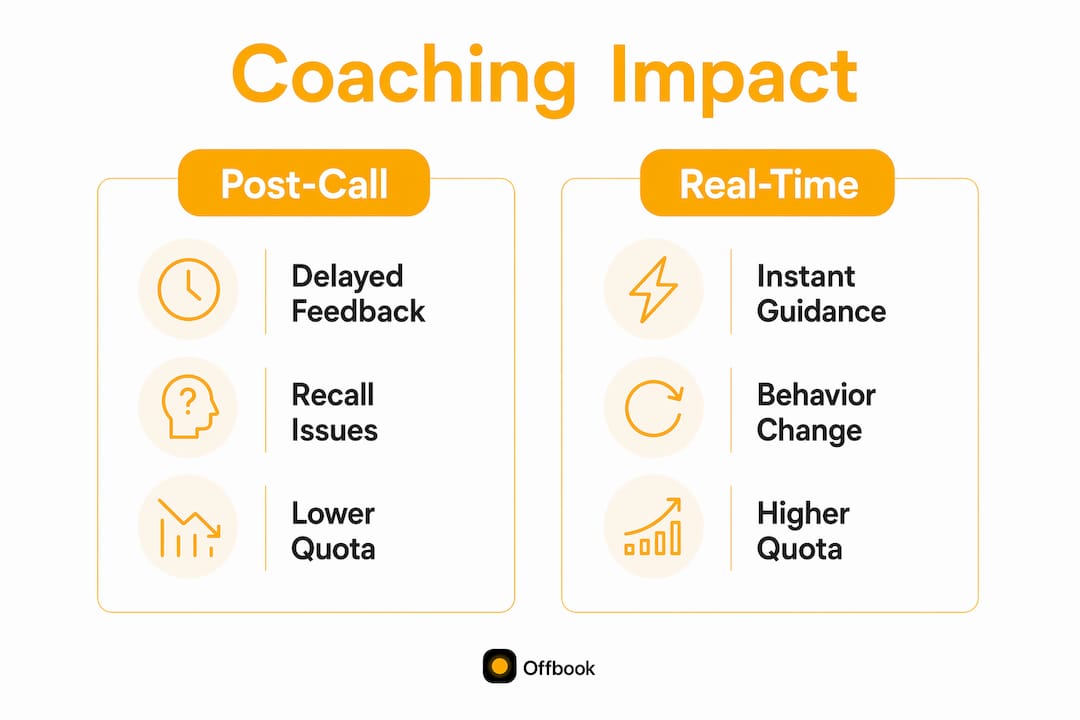
How does real-time coaching differ from traditional post-call coaching?
Post-call analytics is an autopsy. Real-time coaching is a co-pilot. Both tools use call data, but only one of them can change the outcome of the deal being discussed.
| Dimension | Post-call coaching | Real-time coaching |
|---|---|---|
| Timing | After the call ends | During the live conversation |
| Feedback loop | Days to a week | Under 1 second |
| Rep action | Recall and apply next time | Adjust in the current call |
| Manager involvement | Required for review | Optional, AI handles prompts |
| Impact on current deal | None | Direct and immediate |
The behavioral difference is just as important as the timing difference. Post-call feedback asks a rep to remember a moment they experienced under pressure and reconstruct it in a low-stakes review. Real-time feedback asks them to act on a prompt while the pressure is live. The second approach builds muscle memory faster because the learning happens in context.
Delayed feedback also suffers from a recall problem. A rep reviewing a call three days later is working from a compressed memory of the conversation. A rep receiving a nudge mid-call is working from full situational awareness. The nudge lands differently because the context is intact.
For startup teams running AI-assisted sales conversations, the shift from post-call to in-call guidance is the single highest-leverage change available without hiring another manager.
What are practical strategies for implementing real-time sales coaching?
Start small. Rolling out a full AI coaching stack to an entire team on day one creates overload and resistance. Begin with one use case, such as surfacing qualification gaps during discovery calls, and expand from there. Reps need time to integrate prompts into their natural conversation flow before you add more triggers.
The most effective implementation strategies share three characteristics:
- Automate CRM logging. Adoption fails when tools add admin work. When AI automatically logs competitor mentions, flags follow-up tasks, and updates opportunity records, reps see the tool as a time saver rather than a burden.
- Separate coaching from pipeline reviews. Coaching experts recommend keeping deal triage meetings distinct from coaching sessions. Pipeline reviews focus on forecast accuracy. Coaching sessions focus on behavior change. Mixing the two dilutes both.
- Keep sessions rep-specific and deal-anchored. Effective coaching runs 45–60 minutes weekly, targets one skill per session, and ends with a rep-owned action item. That structure applies whether the coaching is human-led or AI-assisted.
- Frame AI as a safety net, not a monitor. Reps who feel watched perform worse. Reps who feel supported perform better.
- Assign rep-owned experiments. Give each rep one specific behavior to test on the next three calls, then review the outcome together. This creates accountability without micromanagement.
Pro Tip: When introducing AI coaching tools to your team, lead with the commission angle. Show reps how better objection handling and qualification directly increase their close rate and earnings. Self-interest is the fastest path to adoption.
What are the core sales coaching techniques enhanced by real-time feedback?
The most widely used coaching frameworks in B2B sales are PRAISE (Probe, Reflect, Acknowledge, Identify, Suggest, Encourage), GROW (Goal, Reality, Options, Will), and SBI (Situation, Behavior, Impact). Each of these works better when paired with live data from actual calls rather than reconstructed memories.
Here is how real-time feedback strengthens each phase of a structured coaching approach:
- Discovery question quality. AI prompts surface missing qualification criteria mid-call, such as budget authority or timeline, so reps ask the right questions before the call ends rather than realizing the gap in a post-mortem.
- Objection handling. When a prospect raises a specific objection, the system surfaces a relevant battle card instantly. The rep does not need to recall the script under pressure. It appears on screen.
- Talk-time balance. Real-time systems track who is speaking and for how long. A prompt appears when the rep is dominating the conversation, nudging them to ask a question and listen.
- Methodology adherence. For teams running MEDDIC or MEDDPICC, AI tracks which criteria have been confirmed and which remain open. The rep sees a live checklist rather than guessing what they have covered.
- Closing signals. When a prospect uses language that signals buying intent, the system flags it so the rep can respond with a next-step ask rather than continuing to pitch.
The types of coaching moments that benefit most from real-time feedback are the ones where timing is everything: objections, qualification gaps, and closing signals. These are exactly the moments where a delayed review is too late.
What are common challenges when adopting real-time sales coaching?
Prompt fatigue is the most common failure mode. When AI fires a coaching card every 90 seconds, reps start ignoring all of them. The fix is minimalist triggers. AI should intervene only on specific danger signals, such as a competitor mention, a price objection, or a silence that runs too long. Fewer, higher-quality prompts outperform constant nudges.
The perception problem is equally serious. Reps who believe the AI is recording and reporting their every mistake become defensive and less authentic on calls. Framing AI coaching as a safety net designed to help reps hit their commission targets, rather than a surveillance tool for management, reduces resistance significantly. Transparency about what data is collected and how it is used is non-negotiable.
Common adoption challenges and their solutions:
- Information overload. Limit active prompts to three or fewer categories per call phase.
- Rep resistance. Involve reps in selecting which prompts appear. Ownership reduces pushback.
- Manager over-reliance on AI data. Use AI output as a conversation starter in coaching sessions, not as a performance verdict.
- Inconsistent cadence. Schedule weekly coaching sessions as fixed calendar blocks, not as meetings that get bumped for pipeline reviews.
Pro Tip: Run a 30-day pilot with two or three volunteer reps before rolling out to the full team. Volunteers become internal advocates, and their results give you the internal case study that convinces skeptics.
Key takeaways
Real-time sales coaching outperforms post-call review because it delivers feedback in the moment when rep behavior can still change the outcome of the deal.
| Point | Details |
|---|---|
| Coaching frequency drives quota | Weekly coached reps hit quota at 76% versus 47% for those coached quarterly or less. |
| Speed is the core advantage | AI coaching systems surface prompts in under 1 second, keeping guidance in sync with live conversation. |
| Automate admin to drive adoption | Automated CRM logging removes the friction that causes reps to abandon coaching tools. |
| Minimize prompts to maximize impact | Minimalist AI triggers prevent prompt fatigue and keep reps focused and authentic. |
| Frame AI as support, not surveillance | Reps who see AI as a commission-boosting safety net adopt it faster and use it more consistently. |
What startup sales leaders consistently get wrong about live coaching
Real-time coaching is not a technology problem. It is a behavior change problem that technology makes easier to solve. I have watched startup teams buy sophisticated AI coaching tools and then use them as glorified call recorders because no one changed the coaching cadence or the session structure around them.
The teams that see results do one thing differently: they treat the AI output as raw material for a human conversation, not as a replacement for it. A rep who gets a live prompt during a call still needs a 45-minute weekly session with their manager to understand why that prompt appeared and what it means for their development. The AI surfaces the moment. The manager gives it meaning.
The other mistake I see constantly is deploying live coaching without pre-call preparation. A rep who walks into a call without knowing the prospect’s company stage, recent funding, or likely objections will ignore even the best real-time prompts because they are already behind. Offbook addresses this directly by generating pre-call briefs alongside live cues. That combination, preparation plus in-call guidance, is where the real performance gains live.
Startup founders who run their own sales calls benefit from this more than anyone. You cannot coach yourself in the moment without a system that surfaces what you are missing. Real-time feedback coaching gives founders the structured discipline of a trained rep without requiring them to already be one.
— Neil
Offbook brings real-time coaching to every sales call
Startup sales teams running on instinct leave deals on the table. Offbook’s AI call coaching for sales surfaces live prompts during video calls without a bot joining the meeting, so reps get guidance on objections, qualification gaps, and next steps exactly when they need it.
Offbook structures every prompt around MEDDIC and MEDDPICC, automates CRM logging after each call, and generates pre-call briefs so reps walk in prepared. For seed and Series A B2B SaaS teams, it is the difference between a rep who improvises and one who runs a disciplined process on every call. See how Offbook fits your team at offbook.pro/for/sales.
FAQ
What is real-time sales coaching?
Real-time sales coaching is the practice of delivering live guidance to sales reps during active calls, using AI to surface prompts on objections, qualification gaps, and next steps in under 1 second.
How does real-time coaching improve quota attainment?
Reps who receive consistent weekly coaching hit quota at 76% versus 47% for those coached quarterly or less, making coaching frequency one of the strongest predictors of sales performance.
What is the difference between real-time and post-call coaching?
Post-call coaching reviews what happened after the deal moment has passed. Real-time coaching delivers guidance during the call, giving reps the chance to adjust before the conversation ends.
How do you prevent prompt fatigue with AI coaching tools?
Use minimalist triggers that fire only on specific signals like competitor mentions or price objections. Fewer, targeted prompts keep reps engaged rather than overwhelmed.
What sales methodologies work best with real-time coaching?
MEDDIC and MEDDPICC work especially well because they define clear qualification criteria that AI can track live, surfacing gaps as the conversation unfolds rather than after the call ends.