Sales Coaching Programs: A Startup Team Leader's Guide
Discover what a sales coaching program is and how it drives revenue growth for startup teams. Boost skills and win rates today!
Published: June 14, 2026
Author: OffBook Editorial Team

Sales Coaching Programs: A Startup Team Leader’s Guide
A sales coaching program is defined as an ongoing, structured process that improves sales reps’ skills, behaviors, and mindset through consistent, personalized feedback grounded in real work. It is not a quarterly training event or a pipeline review. Formal coaching programs deliver 16.7% higher revenue growth and 28% higher win rates compared to teams with no structured coaching. For startup sales leaders working with small teams and tight resources, that gap is the difference between hitting your number and missing it entirely. Frameworks like GROW and methodologies like MEDDIC give these programs structure and repeatability.
What is a sales coaching program, exactly?
The industry term is sales coaching, and it describes a repeatable development system built around one-on-one sessions, real call recordings, and specific behavioral goals. A sales coaching program is the formal version: a designed system with defined cadence, measurable outcomes, and documented progress over time.
Most startup leaders confuse coaching with two adjacent activities. The first is sales training, which transfers knowledge in group settings on a quarterly or episodic basis. The second is sales management, which tracks pipeline health and quota attainment on a daily basis. Coaching sits between them. It is weekly, individual, and focused entirely on changing how a rep behaves on a call or in a deal.

The distinction matters because training and managing rarely produce lasting behavioral change. A rep can pass a product certification and still fumble discovery calls. A manager can review every deal in Salesforce and never address why a rep struggles to handle pricing objections. Coaching targets the specific behavior, uses a real example from that rep’s own work, and builds a plan to change it.
Here is how the three approaches compare:
| Approach | Frequency | Format | Primary Goal |
|---|---|---|---|
| Sales Training | Quarterly | Group sessions | Knowledge transfer |
| Sales Management | Daily | Pipeline reviews | Quota accountability |
| Sales Coaching | Weekly | 1:1 sessions | Behavioral change |
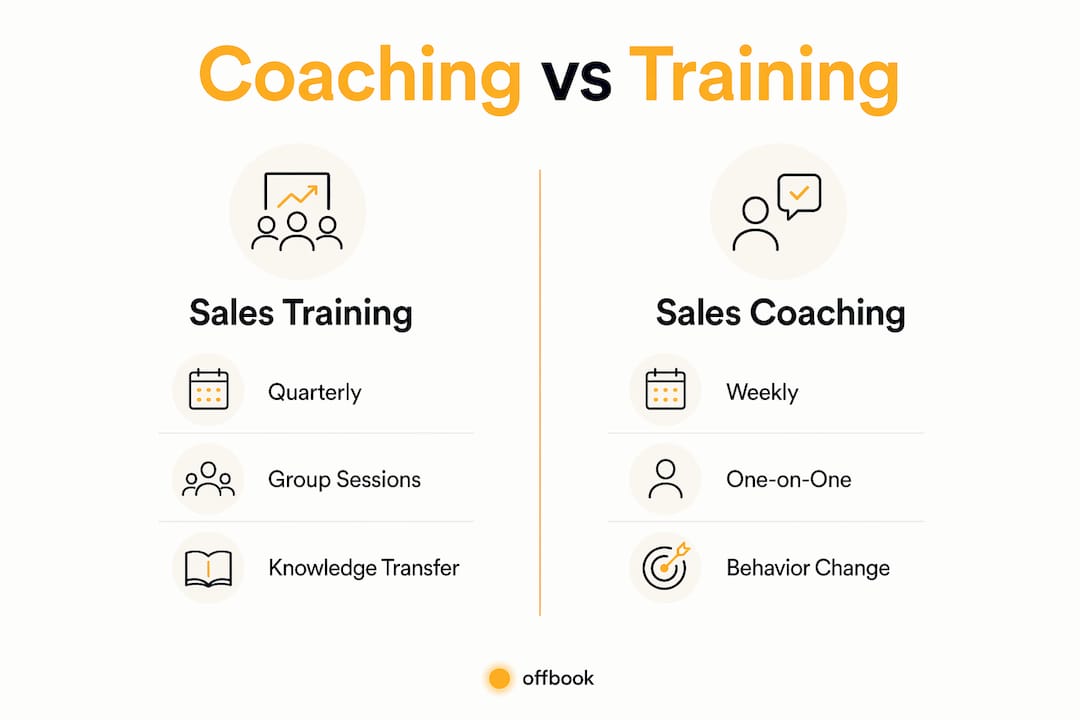
The table makes the separation clear. Coaching is the only approach designed to change what a rep actually does on a live call.
What frameworks and techniques drive effective coaching?
The GROW model is the most widely adopted coaching framework in sales. GROW stands for Goal, Reality, Options, and Will. A GROW coaching session runs about 20 minutes and follows a structured question sequence rather than a lecture format. That structure matters because it shifts the dynamic from manager telling to rep discovering.
Here is how a GROW session works in practice:
- Goal: Ask the rep what specific skill or outcome they want to improve this week. “What do you want to get better at on your next discovery call?”
- Reality: Explore the current state using a real artifact. Pull up a recorded call and ask, “What did you notice about how you handled the pricing question at the 14-minute mark?”
- Options: Generate possible approaches together. “What are three ways you could have responded differently there?”
- Will: Commit to one specific action. “Which approach will you try on your next call, and how will we know it worked?”
The shift from telling to asking is not just a technique preference. Asking questions helps reps take ownership of their own development, which increases their commitment to actually changing the behavior. A manager who lectures gets compliance. A coach who asks gets conviction.
Two other frameworks worth knowing are SBI (Situation, Behavior, Impact) and OSKAR (Outcome, Scaling, Know-how, Affirm, Review). SBI is useful for giving structured feedback on a specific moment in a call. OSKAR works well for longer-term development arcs across a quarter. Most startup teams do not need all three. Start with GROW and add SBI for call-level feedback once the cadence is established.
Pro Tip: Limit every coaching session to one named skill and one deal or call artifact. Trying to fix discovery, objection handling, and closing in a single 30-minute session produces zero lasting change in any of them.
What measurable benefits do startups gain from formal coaching?
The data on formal sales coaching programs is direct. CSO Insights research shows teams with structured coaching programs achieve 16.7% higher revenue growth and 28% higher win rates than teams without them. For a seed-stage startup closing 10 deals a quarter, a 28% lift in win rate is not a rounding error. It is three or four additional deals per quarter from the same team.
“Coaching investments outperform other productivity measures in raising rep performance and retention.” — Zendesk Sales Research
Beyond revenue, formal coaching reduces rep churn and raises morale. Reps who receive regular, personalized development feel invested in rather than managed. That feeling translates directly into retention. Replacing a B2B SaaS rep costs between 50% and 200% of their annual salary when you factor in recruiting, onboarding, and ramp time. Coaching is cheaper than turnover.
Quota attainment also improves. Teams with formal programs see more reps consistently hitting their numbers, not just the top performers carrying the team. That consistency matters at the Series A stage when investors are evaluating whether your sales motion is repeatable and scalable.
The secondary benefits compound over time. Reps who are coached regularly develop stronger qualification habits, shorter sales cycles, and better pipeline hygiene. Those behaviors show up in your CRM data within one to two quarters of launching a structured program.
How do you build a sales coaching program at a startup?
Building a repeatable coaching system is the right starting point. Ad-hoc coaching conversations are better than nothing, but they do not produce consistent results. A system has four components: assessment, goal-setting, session cadence, and measurement.
Start by assessing each rep’s current skill gaps. Use recorded calls, CRM data, and direct observation to identify where performance breaks down. Is the problem in discovery? Qualification? Handling objections? Closing? Pick the one area with the highest impact on that rep’s pipeline and start there.
Set a specific, measurable goal for the quarter. “Improve discovery” is not a goal. “Ask at least three open-ended questions before presenting the product on every call this quarter” is a goal. The specificity makes it coachable and trackable.
Here are the core practices for a startup-friendly coaching program:
- Set a fixed weekly cadence. Block 30 minutes per rep per week and protect it from being bumped by pipeline reviews or all-hands meetings.
- Use real call recordings as your primary artifact. Tools like Offbook surface live call data you can review together, grounding feedback in actual behavior rather than memory.
- Document commitments after every session. Write down the one behavior the rep committed to changing and review it at the start of the next session.
- Track progress quarterly, not just weekly. Measure win rate, call quality scores, and quota attainment before and after each coaching cycle.
- Separate coaching from deal reviews. Never combine a coaching session with a forecast call. They serve different purposes and mixing them kills both.
Pro Tip: Use your sales call preparation checklist as a baseline assessment tool. If a rep consistently skips steps on the checklist, that gap tells you exactly where to start coaching.
What pitfalls kill coaching programs before they take hold?
The most common failure mode is blending coaching with pipeline reviews. When a manager opens a coaching session by asking “Where does this deal stand?”, the conversation immediately shifts to deal inspection. The manager becomes a traffic cop, not a coach. The rep learns nothing about their behavior. This pattern is so common in startups that many teams believe they are coaching when they are actually just doing a second pipeline review each week.
The second failure mode is coaching overload. Trying to address multiple behaviors in a single session produces shallow feedback on everything and deep change on nothing. Limiting coaching scope to one skill per session is not a constraint. It is the mechanism that makes coaching work.
Other pitfalls to watch for:
- Coaching as punishment. If reps associate coaching sessions with being called out for failures, they will disengage. Frame every session as development, not correction.
- No measurement. Without tracking behavioral change over time, you cannot tell whether the program is working or whether you are just having pleasant conversations.
- Inconsistent cadence. Skipping sessions when things get busy signals that coaching is optional. It is not. Protect the time the same way you protect a board meeting.
- Generic sessions. A defined system with measurable outcomes prevents sessions from drifting into vague career conversations that feel good but change nothing.
Evaluate your program every quarter. Ask whether reps are hitting the behavioral goals set at the start of the cycle. If not, the issue is usually one of the four pitfalls above.
Key takeaways
A sales coaching program works because it targets specific behaviors using real work artifacts, runs on a consistent cadence, and measures change over time rather than just tracking pipeline.
| Point | Details |
|---|---|
| Coaching differs from training | Training transfers knowledge in groups; coaching changes individual behavior through weekly 1:1 sessions. |
| GROW model structures sessions | Goal, Reality, Options, Will gives every session a repeatable format that takes about 20 minutes. |
| Formal programs lift win rates | CSO Insights data shows 28% higher win rates for teams with structured coaching versus none. |
| One skill per session | Limiting focus to one behavior per session produces deeper change than addressing multiple issues at once. |
| Separate coaching from pipeline reviews | Mixing the two causes managers to default to deal inspection, which eliminates coaching value entirely. |
What i’ve learned coaching startup sales teams
The biggest misconception I see in early-stage teams is that coaching is something you do when a rep is struggling. The best teams I have worked with treat coaching as a weekly operating rhythm, the same way they treat their Monday pipeline review. It is not remedial. It is how you build a sales team that compounds over time.
The cultural piece is underrated. At seed and Series A, the founder is often still selling. When the founder models coachability by asking for feedback on their own calls, the entire team follows. When coaching is top-down and one-directional, reps treat it as surveillance. That distinction shapes whether your program produces real change or just compliance.
Technology changes what is possible here. Tools like Offbook that surface live AI cues during calls give you coaching moments in B2B SaaS that you can reference in your next session with full context. You are not coaching from memory or from a manager’s notes. You are coaching from what actually happened. That specificity is what separates programs that produce 28% win rate lifts from programs that produce good intentions.
Consistency beats intensity every time. A 25-minute session every week for a quarter outperforms a two-day offsite followed by nothing. Build the cadence first. The quality of the conversations will follow.
— Neil
How Offbook supports your coaching program in real time
Most coaching happens after the call, when the moment has already passed. Offbook changes that by coaching reps during the call itself, surfacing live AI cues on-screen without a bot ever joining the meeting.
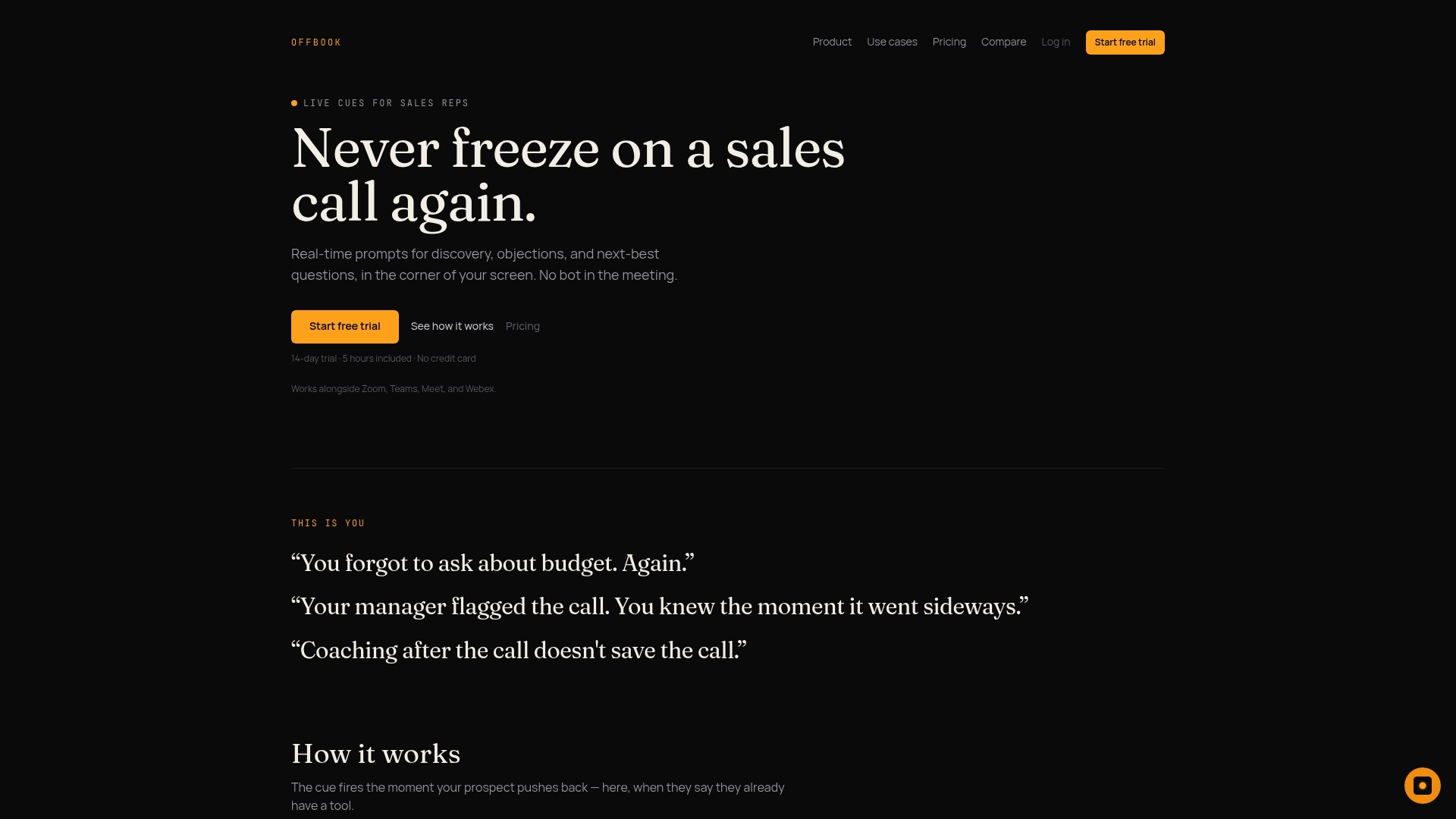
Offbook listens to your sales conversations and prompts reps with the right questions to ask, objections to handle, and qualification gaps to close, all structured around MEDDIC and MEDDPICC. It also generates pre-call briefs so reps walk into every meeting prepared. For seed and Series A teams building their first formal coaching program, Offbook gives you the real work artifacts your sessions need and the in-call support that makes behavioral change stick. See how it works for your team at Offbook’s sales coaching platform.
FAQ
What is a sales coaching program?
A sales coaching program is a structured, ongoing process that improves individual rep skills and behaviors through personalized, feedback-driven sessions using real work examples like recorded calls and live deals.
How does sales coaching differ from sales training?
Sales training transfers knowledge in group settings on a quarterly basis. Sales coaching is weekly, one-on-one, and focused on changing specific behaviors rather than delivering new information.
What does a sales coach do in a session?
A sales coach uses a framework like GROW to ask questions, review a real call or deal artifact, and help the rep commit to one specific behavioral change before the next session.
How long does it take to see results from a coaching program?
Most teams see measurable changes in call quality and pipeline behavior within one to two quarters of launching a consistent weekly coaching cadence.
Can a startup with a small sales team benefit from formal coaching?
Yes. Startups with even two or three reps benefit from structured coaching because the win rate and revenue growth improvements documented by CSO Insights apply regardless of team size.