Types of Sales Coaching Moments for B2B SaaS Teams
Discover the key types of sales coaching moments that empower B2B SaaS teams. Enhance performance and drive success with targeted strategies.
Published: June 8, 2026
Author: OffBook Editorial Team

Sales coaching moments are defined as distinct, time-sensitive interaction points where targeted feedback can change a rep’s behavior on the next call. In B2B SaaS, these moments fall into four recognized categories: Deal Coaching, Skills Coaching, Performance Coaching, and Career Coaching. Research confirms that most sales leaders focus on only one or two of these types, leaving entire coaching channels untapped. Understanding all four, and knowing when to deploy each, is the difference between a team that plateaus and one that compounds its performance quarter over quarter. Tools like Offbook and frameworks like MEDDIC and SBI exist precisely to make these moments more frequent, more specific, and more effective.
1. What are the main types of sales coaching moments in B2B SaaS?
Effective sales leadership requires four distinct coaching moment types, each targeting a different layer of rep development. Treating them as interchangeable is the most common mistake B2B SaaS managers make.
-
Deal Coaching focuses on a specific open opportunity. The manager and rep examine the deal together: who are the stakeholders, what is the economic buyer’s priority, and what is blocking progression? In MEDDIC terms, this is where you pressure-test Metrics, Economic Buyer access, and Decision Criteria. A deal advancement session on a stalled Series A prospect might reveal the rep has never spoken to the CFO, which is a coaching moment with immediate revenue impact.
-
Skills Coaching targets repeatable behaviors: discovery questioning, objection handling, and executive presence. Unlike Deal Coaching, Skills Coaching is not tied to one deal. It applies across the pipeline. A rep who consistently fails to uncover business impact during discovery needs structured practice on discovery questions, not just deal-by-deal feedback.
-
Performance Coaching holds reps accountable to activity targets and behavioral standards. This is the coaching moment most managers default to, often because it is the most visible. It covers missed call quotas, low conversion rates, and pipeline hygiene. The risk is treating it as punitive rather than diagnostic.
-
Career Coaching is the most neglected type. It addresses where a rep wants to go, what skills they need to get there, and how the manager can support that trajectory. Skipping this type signals to high-potential reps that the company sees them as quota-fillers rather than future leaders.
Pro Tip: Audit your last ten coaching conversations and categorize each one. If nine are Deal Coaching and one is Performance Coaching, you are leaving Skills and Career development entirely to chance.
2. How in-the-moment coaching transforms sales performance

In-the-moment coaching is defined as feedback delivered within a narrow time window after a specific observable event, close enough to the event that the rep can connect the feedback to the exact behavior. The timing criteria are precise: recognition within 2 hours for wins, and tactical corrections within 24 hours for skill gaps. Feedback delivered two weeks later at a team meeting registers as obligation, not coaching.
The scenarios where this matters most in B2B SaaS include:
- Midweek activity dips. A rep’s outbound volume drops Tuesday afternoon. A 30-second check-in that afternoon, not Friday’s pipeline review, is the moment that prevents a full-week slump.
- Recognition windows. A rep closes a competitive displacement deal against a well-funded incumbent. Calling them within two hours to name exactly what they did well, the specific question that unlocked the economic buyer, cements that behavior permanently.
- High-performer streaks. When a rep books five qualified meetings in three days, that streak is a coaching trigger. Micro-signals like these tell you what is working so you can replicate it across the team.
- New-rep ramp signals. A rep in their second month lands their first discovery call without prompting. Immediate, specific reinforcement accelerates ramp time more than any onboarding module.
Frequent micro-coaching moments embedded in daily work sustain faster learning and higher engagement than scheduled long sessions. The mechanism is simple: the brain consolidates learning when feedback is proximate to the behavior.
Pro Tip: Run a five-minute huddle drill twice per week. Pick one rep, one specific call moment, and give one piece of feedback. Keep it under five minutes. Done consistently, this builds a coaching culture faster than any quarterly review process.
3. Coaching strategies and feedback frameworks that maximize each moment
The SBI model, which stands for Situation, Behavior, Impact, is the most widely validated feedback structure for sales coaching conversations. It works because it removes ambiguity. Instead of “your discovery calls need work,” you say: “On the Acme call this morning (Situation), you moved to the demo before confirming their current process (Behavior), and the prospect disengaged in the first ten minutes (Impact).”
Open-ended questions alone often fail when reps do not perceive a problem. A rep who thinks their discovery was fine will not generate useful answers to “what could you have done differently?” The fix is a Direct Ask after the SBI statement: “On your next discovery call, I want you to confirm their current process before opening the demo. Can you commit to that?” This creates a specific, observable commitment rather than a vague intention.
Three elements make this framework stick:
- Psychological safety. Without it, reps do not engage honestly in coaching conversations. They perform compliance rather than genuine reflection. Building safety means separating coaching conversations from performance reviews and making it clear that identifying a gap is not a disciplinary event.
- Objective data as the anchor. Call recordings, pipeline coverage ratios, and follow-up response rates remove the “I thought it went well” defense. When the data is in the room, the conversation shifts from opinion to observation.
- Written follow-up within 24 hours. Behavioral change sticks when a structured written recap lands within 24 hours of the conversation. The format is three bullets: what was discussed, what the rep committed to, and when the next check-in occurs. Without this, verbal coaching rarely produces measurable change.
“Direct, behavioral feedback anchored in specific situations drives behavior change. Vague open-ended questions leave reps without a clear path forward.”
Offbook’s AI call coaching surfaces real-time cues during live calls, giving reps the behavioral prompts they need in the moment rather than waiting for a post-call debrief.
4. Comparing coaching moment types: when to prioritize each
Different coaching moments deliver different returns depending on the rep’s experience level, performance segment, and current engagement. The table below maps each type to its optimal timing, key signals, and recommended action.
| Coaching moment type | Optimal timing | Key signals | Recommended action |
|---|---|---|---|
| Deal Coaching | Weekly, deal-specific | Stalled pipeline, missing stakeholders, no next step | Joint call review using MEDDIC or MEDDPICC framework |
| Skills Coaching | Bi-weekly, behavior-specific | Repeated pattern across multiple deals | Role-play drill targeting one specific behavior |
| Performance Coaching | As signals emerge | Missed activity targets, declining conversion | SBI feedback + written commitment within 24 hours |
| Career Coaching | Monthly or quarterly | High performer plateau, expressed ambition | Structured career conversation with 90-day development plan |
| In-the-moment coaching | Within 2 to 24 hours | Activity dip, win, streak, ramp signal | 30-second recognition or one-question check-in |
Middle performers comprise 60% of sales teams and represent the largest untapped revenue pool on any B2B SaaS team. Yet most coaching attention flows to struggling reps or top performers. The middle-performer disengagement signal, a subtle drop in pipeline coverage or follow-up rates, is the most commonly missed coaching trigger in the entire framework.
For new reps, Skills Coaching and in-the-moment recognition dominate the first 90 days. For tenured reps showing a plateau, Career Coaching unlocks motivation that Performance Coaching cannot reach. For top performers, the highest-value coaching moment is often a high-visibility executive call where specific, immediate feedback on their executive presence compounds their trajectory.
The prioritization principle is this: match the coaching moment type to the rep’s current constraint. A rep with a skills gap does not need a career conversation. A rep who is disengaged does not need deal-level scrutiny. Diagnosing the constraint first determines which moment type to deploy.
Key takeaways
Effective sales coaching requires matching the right coaching moment type to the right rep at the right time, with feedback delivered within hours, not weeks.
| Point | Details |
|---|---|
| Four coaching moment types | Deal, Skills, Performance, and Career Coaching each target a different layer of rep development. |
| Timing is the critical variable | Recognition within 2 hours and tactical corrections within 24 hours drive lasting behavior change. |
| SBI plus written follow-up | The SBI model with a direct ask and a 24-hour written recap produces measurable, durable change. |
| Middle performers are the priority | The 60% of reps in the middle of the performance curve represent the highest-ROI coaching investment. |
| Real-time tools close the gap | AI coaching platforms like Offbook surface in-the-moment cues that managers physically cannot provide at scale. |
Why most sales managers are coaching the wrong moments
I have reviewed hundreds of sales team coaching logs over the years, and the pattern is almost universal. Managers spend 80% of their coaching time on deals and performance, and almost none on skills or careers. The result is a team that can talk about pipeline but cannot improve the behaviors that fill it.
The shift I have seen work is treating coaching as a daily micro-habit rather than a scheduled event. A 30-second call after a strong discovery session, a one-line Slack message naming exactly what a rep did well on a competitive call. These moments compound. They build the psychological safety that makes reps willing to be coached on harder things later.
The resistance I hear most often is “I don’t have time.” But the managers who say this are usually spending three hours in pipeline reviews that could be 45 minutes if the underlying skills were stronger. Investing in Skills Coaching now reduces the Deal Coaching load later. That is the trade most managers have not made yet.
Technology changes the calculus here. Offbook coaches reps in real time during calls, which means the in-the-moment coaching burden on managers drops significantly. The manager’s job shifts from catching every missed question to reviewing patterns and running the Career and Skills conversations that require human judgment. That is a better use of a sales leader’s time, and it is a more sustainable coaching culture.
— Neil
See how Offbook coaches your reps in real time
Understanding the types of sales coaching moments is the first step. Acting on them at scale is where most teams fall short, not because managers lack intent, but because the window closes before they can respond.
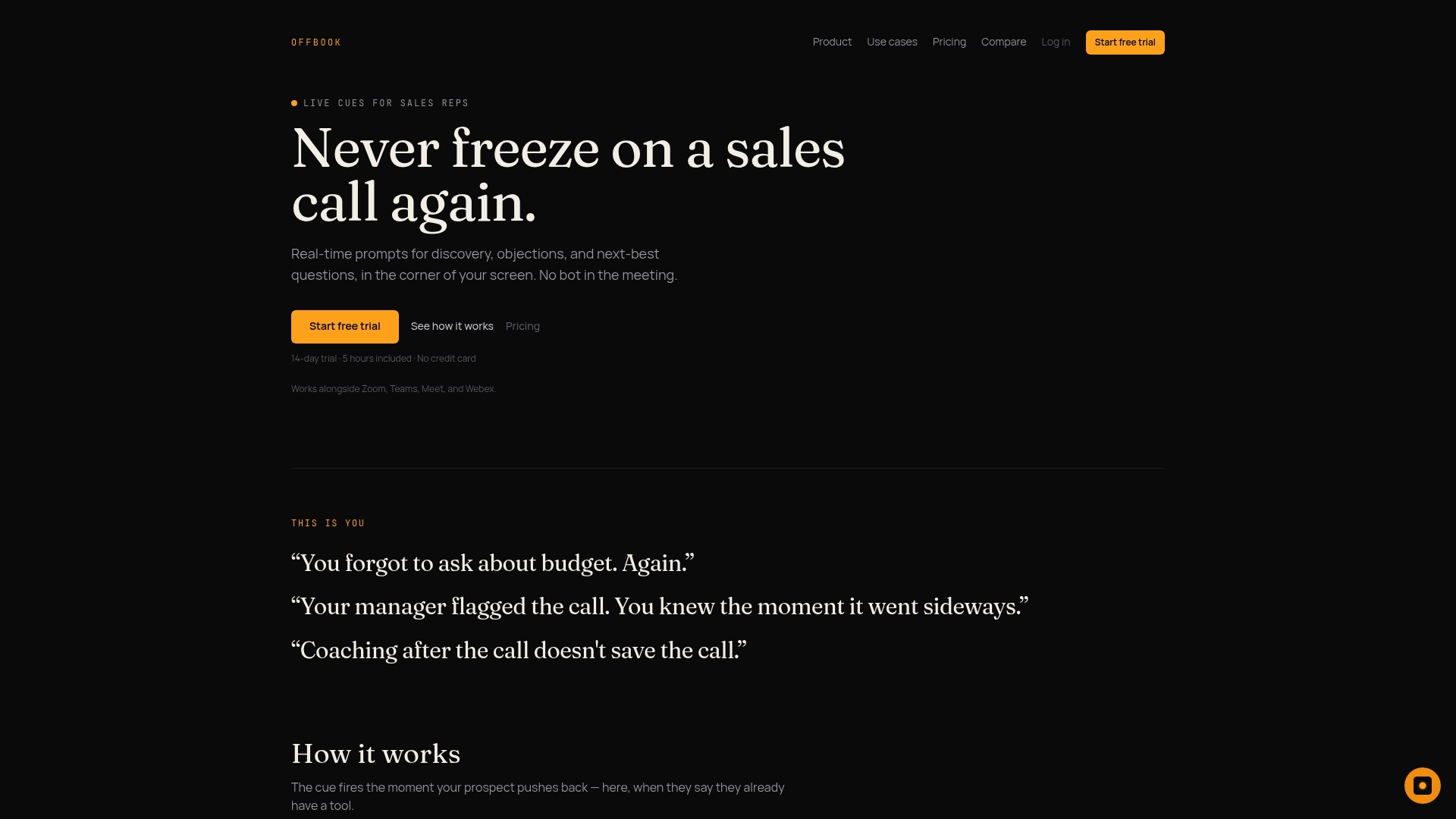
Offbook listens to your reps’ live video calls and surfaces the right coaching cues on-screen in real time, covering qualification gaps, objection handling, and discovery questions, all without a bot joining the meeting. Pre-call briefs mean reps walk in prepared. In-call prompts mean they execute the methodology in the moment. Built for B2B SaaS teams at seed and Series A, Offbook increases coaching frequency without increasing manager bandwidth. See what real-time coaching looks like for your team at Offbook.
FAQ
What are the four types of sales coaching moments?
The four types are Deal Coaching, Skills Coaching, Performance Coaching, and Career Coaching. Most sales leaders focus on only one or two, which limits overall team development.
How quickly should coaching feedback be delivered?
Recognition should be delivered within 2 hours of a win, and tactical corrections within 24 hours of the observed behavior. Feedback delivered later loses its connection to the specific event and produces little behavior change.
What is the SBI feedback model in sales coaching?
SBI stands for Situation, Behavior, Impact. It is a structured feedback model that anchors coaching to a specific observable event, names the exact behavior, and explains its consequence. Adding a direct ask and a written follow-up within 24 hours makes the model produce durable behavior change.
Which reps should managers prioritize for coaching?
Middle performers, who comprise 60% of most sales teams, represent the highest-ROI coaching investment. New reps need Skills and in-the-moment coaching in their first 90 days, while tenured top performers benefit most from Career Coaching conversations.
How does real-time AI coaching support sales managers?
Real-time AI coaching tools like Offbook surface in-call prompts to reps during live calls, reducing the manager’s burden of catching every missed question. This shifts the manager’s role toward higher-value Skills and Career coaching conversations that require human judgment.