What Is AI Sales Coaching? A 2026 B2B Guide
Discover what AI sales coaching is and how it transforms B2B teams by enhancing skills and driving performance. Master sales for 2026!
Published: July 4, 2026
Author: OffBook Editorial Team

AI sales coaching is defined as the use of artificial intelligence to continuously analyze, simulate, and improve sales rep skills through real-time feedback, personalized practice, and data-driven performance insights. The industry term for this practice is “AI-driven sales enablement coaching,” though “AI sales coaching” has become the working shorthand across B2B teams. AI programs accelerate new rep readiness by 40% and improve seller skills up to 38% after just four practice attempts. For sales leaders managing fast-growing B2B SaaS teams, that kind of measurable lift is no longer a nice-to-have. It is the baseline expectation for 2026.
What is AI sales coaching and how does it work?
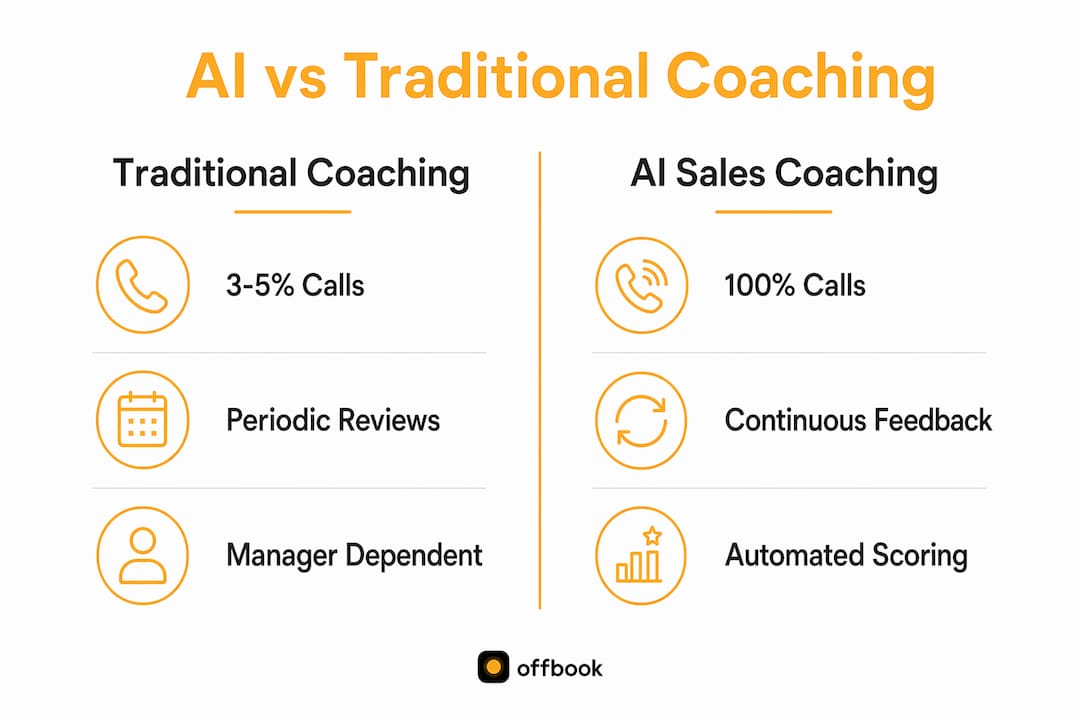
AI sales coaching is a technology-driven method that replaces periodic, manager-led review sessions with continuous, automated skill development. It analyzes every sales conversation, scores rep behavior against proven frameworks, and delivers feedback without waiting for the next one-on-one.

The system rests on three core pillars. First, post-call analysis uses speech-to-text and natural language processing to transcribe and evaluate recorded conversations. Second, pre-call simulation puts reps against large language model-powered virtual prospects to rehearse objections and discovery questions before a real meeting. Third, in-call real-time assistance surfaces contextual prompts on screen while the conversation is happening.
The technologies working underneath these pillars include:
- Speech-to-text engines that convert spoken conversation into structured data for analysis
- Natural language processing (NLP) that identifies talk patterns, filler words, and missed qualification questions
- Large language models (LLMs) that power adaptive role-play personas capable of realistic objection handling
- Behavioral intelligence layers that track performance trends across dozens of calls over time
- Methodology scoring engines that grade calls against frameworks like MEDDIC, MEDDPICC, or SPIN Selling
Each of these components feeds a feedback loop. The AI scores a call, identifies gaps, and assigns targeted practice. The rep improves. The system recalibrates.
Pro Tip: When evaluating AI coaching tools, check whether the system scores against your specific sales methodology. Generic scoring against a proprietary rubric you cannot inspect is a black box, not a coaching tool.
How does AI sales coaching improve performance and team efficiency?
The performance gains from AI sales coaching are not theoretical. Reps who receive immediate AI-driven feedback improve performance scores by 10–70%, depending on baseline skill level and practice frequency. That range is wide because the lift is proportional to how far below the ceiling a rep starts.
Faster onboarding and skill development
New reps traditionally take months to reach full productivity. AI coaching compresses that timeline. Teams using AI simulators see win-rate improvements of 15–25% as of Q2 2026. The mechanism is repetition without risk. A new rep can run 20 discovery call simulations before ever speaking to a real prospect.
Manager time reclaimed
The efficiency gain for managers is equally significant. Managers reclaim 60–70% of weekly coaching time previously spent on routine call reviews. That translates to roughly two hours per week returned to strategic work. Those hours shift toward deal strategy, pipeline reviews, and relationship coaching rather than replaying call recordings.
Full call coverage
Manual review covers 3–5% of sales calls at best. AI coaching enables 100% call coverage, meaning every conversation gets scored and every gap gets flagged. No rep flies blind for weeks before a manager notices a pattern.
| Metric | Traditional coaching | AI sales coaching |
|---|---|---|
| Call coverage | 3–5% | 100% |
| New rep readiness | Baseline | 40% faster |
| Manager coaching time | 2–3 hours/week on reviews | ~1 hour on strategic work |
| Skill improvement rate | Varies by manager | Up to 38% after 4 practice attempts |
| Program launch speed | Standard timeline | 3x faster with AI-augmented tools |
Pro Tip: Track your baseline call coverage percentage before deploying AI coaching. Most teams discover they were reviewing fewer than 4% of calls. That number becomes your before-and-after benchmark.
How is AI sales coaching integrated into daily sales workflows?
The most effective AI coaching does not live in a separate training portal that reps visit once a quarter. Embedding AI coaching into daily workflow allows data-driven feedback after every interaction, compounding learning over time rather than concentrating it in sporadic events.
The shift from event-based to continuous coaching changes the entire rhythm of a sales team. Reps no longer wait for a scheduled one-on-one to learn they missed a key qualification question. The feedback arrives within minutes of hanging up.
Here is how integration typically works across a rep’s day:
- Pre-call brief generation. The AI pulls firmographic data, contact history, and deal context to generate a call prep brief. The rep walks in knowing the prospect’s likely objections and the qualification gaps still open.
- In-call real-time prompts. During the live conversation, the AI surfaces on-screen suggestions for questions to ask, objections to address, and MEDDIC fields to fill. No bot joins the call. The prompts are visible only to the rep.
- Post-call scoring. Within minutes of the call ending, the AI scores the conversation against the team’s methodology, flags missed steps, and assigns a targeted practice module.
- Role-play simulation. The rep completes a short simulation focused on the specific skill gap identified. The LLM-powered persona adapts to the rep’s responses, making the practice realistic.
- Trend reporting for managers. The manager sees aggregated performance data across the team, identifying which reps need strategic coaching and which are self-correcting through AI feedback alone.
Just-in-time coaching built into this daily rhythm means skill development happens in the flow of work, not outside it. That distinction is what separates AI coaching from traditional sales training programs.
What are best practices for adopting AI sales coaching?
Adoption is where most AI coaching initiatives fail. The technology works. The culture often does not. Framing AI coaching as a self-improvement tool rather than performance surveillance directly increases rep engagement and adoption rates.
The following practices separate successful rollouts from stalled ones:
- Position it as judgment-free practice. AI provides a safe space for reps to rehearse high-stakes scenarios like objection handling and executive discovery without fear of judgment. Emphasize this framing in every launch communication.
- Avoid punitive use of AI scores. If reps believe their AI call scores feed directly into performance reviews, they will game the system or avoid using it. Scores should inform coaching conversations, not replace them.
- Train managers on their new role. AI offloads routine feedback. Managers must fill the freed time with deeper strategic coaching on deal complexity, relationship dynamics, and territory planning. Without this shift, the time savings evaporate into administrative work.
- Set a practice cadence. Frequent practice transforms skill-building from a rare event into a habit, leading to genuine mastery. Teams that require two to three short simulations per week see faster improvement than those that leave practice optional.
- Integrate with existing tools. AI coaching effectiveness increases when it lives inside the tools reps already use, whether that is a CRM, a video call platform, or a communication stack. Friction kills adoption faster than any cultural barrier.
For teams following AI integration best practices, the common thread is treating AI coaching as infrastructure rather than a training event. It runs continuously in the background, not as a quarterly initiative.
Pro Tip: Run a 30-day pilot with your top three reps before a full rollout. Their visible improvement creates internal proof that converts skeptical reps faster than any vendor case study.
Key Takeaways
AI sales coaching delivers measurable performance gains when it is embedded in daily workflows, scored against a defined methodology, and framed as a development tool rather than a monitoring system.
| Point | Details |
|---|---|
| Core definition | AI sales coaching uses NLP, LLMs, and behavioral data to deliver continuous, personalized feedback to reps. |
| Performance impact | Reps improve performance scores by 10–70% with immediate AI feedback and 40% faster onboarding. |
| Manager efficiency | AI reclaims 60–70% of manager time spent on routine reviews, freeing it for strategic coaching. |
| Full call coverage | AI reviews 100% of calls versus the 3–5% a manager can manually review. |
| Adoption success | Framing AI as judgment-free practice, not surveillance, is the single biggest driver of rep engagement. |
Why AI coaching is the infrastructure, not the initiative
I have watched B2B sales teams treat AI coaching like a training program. They launch it, run it for a quarter, measure the lift, and then let it drift. That is the wrong mental model entirely.
The teams that get lasting results treat AI coaching the way they treat their CRM. It runs every day. It captures every call. It flags every gap. Nobody asks whether to “use it this week.” It is just how the team operates.
The thing that surprised me most is how much AI coaching improves the quality of human coaching rather than replacing it. AI surfaces deal strategy and relationship nuances that managers would never catch from reviewing three calls a month. When a manager sits down with a rep now, the conversation is about why a specific deal stalled, not whether the rep remembered to ask about budget. That is a fundamentally better use of a manager’s time.
The real-time in-call layer is the hardest to implement well. Real-time AI suggestions yield direct in-call performance boosts, but only when the prompts are relevant and non-distracting. A rep who is reading a screen prompt instead of listening to a prospect has worse outcomes, not better. The best implementations surface only the most critical cues at the right moment.
My advice to any sales leader starting this process: pick one methodology, score everything against it, and give reps 90 days of uninterrupted practice before drawing conclusions. The data will tell you everything you need to know.
— Neil
How Offbook coaches your reps in the moment
Offbook is built for exactly the scenario described in this article. It listens to live video calls and surfaces on-screen prompts for the rep, covering qualification gaps, objection responses, and discovery questions, all structured around MEDDIC and MEDDPICC. No bot joins the meeting. The prospect never knows it is there.
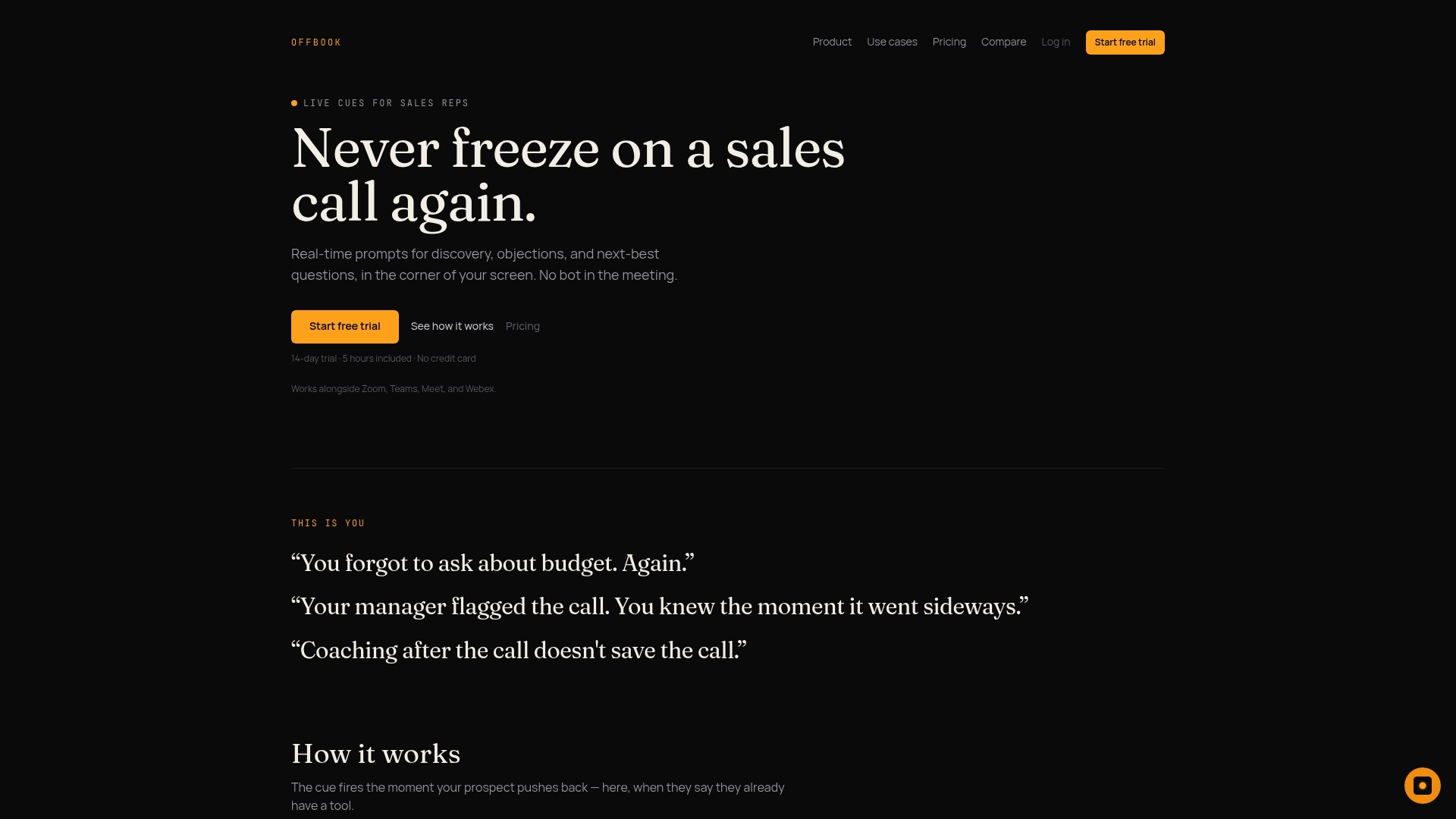
Beyond the live call, Offbook generates pre-call briefs so reps walk into every conversation prepared. For founder-led B2B SaaS teams at seed and Series A, that combination of preparation and real-time call coaching closes the gap between your best rep and your average one. If your team is running discovery calls without a methodology-driven coaching layer, explore what Offbook does for B2B sales teams and see where the gaps are.
FAQ
What is AI sales coaching in simple terms?
AI sales coaching uses artificial intelligence to analyze sales conversations, score rep performance against a defined methodology, and deliver personalized feedback and practice automatically. It replaces periodic manager review with continuous, data-driven skill development.
How does AI sales coaching differ from traditional sales training?
Traditional sales training happens in scheduled events, covers 3–5% of actual calls, and depends entirely on manager bandwidth. AI sales coaching runs continuously, covers 100% of calls, and delivers feedback within minutes of every conversation.
What sales methodologies can AI coaching support?
AI coaching systems can score calls against frameworks including MEDDIC, MEDDPICC, SPIN Selling, and Challenger. The methodology must be configured in the system for scoring to be meaningful.
How long does it take to see results from AI sales coaching?
Teams using AI simulators see measurable win-rate improvements within a quarter. New rep readiness accelerates by 40%, and individual skill scores improve up to 38% after four structured practice attempts.
Does AI sales coaching replace sales managers?
AI coaching does not replace managers. It offloads routine call review so managers reclaim 60–70% of their weekly coaching time and redirect it toward strategic conversations on deal complexity and team development.