Why B2B Deals Have Multiple Stakeholders: 2026 Guide
Discover why B2B deals have multiple stakeholders. Learn how understanding these dynamics can enhance your B2B sales strategy in 2026.
Published: July 2, 2026
Author: OffBook Editorial Team

B2B deals involve multiple stakeholders because no single person carries the authority, budget, and technical knowledge needed to make a high-risk purchase alone. As of 2026, the typical B2B purchase involves 6 to 10 decision-makers, up from 5.4 in 2015. That growth reflects how deeply cross-functional modern organizations have become. Finance needs to approve the budget. IT needs to validate the architecture. Operations needs to confirm the workflow fit. Each function brings a perspective the others cannot replicate, and skipping any one of them creates risk the organization is not willing to accept. Understanding this dynamic is the foundation of every effective B2B sales motion.
Why B2B deals have multiple stakeholders: the structural reason
B2B purchases are organizational decisions, not personal ones. When a company commits to a new software platform, a logistics contract, or a data infrastructure investment, the consequences ripple across departments, budgets, and headcounts. That scope demands input from every function that will feel the impact.
The B2B decision-making process distributes accountability deliberately. No single executive wants to own the full downside of a failed purchase. Spreading the decision across a committee reduces individual exposure and increases the chance that critical risks get surfaced before signing. This is not bureaucracy for its own sake. It is risk management built into the buying structure.

Organizational size amplifies this effect. A 10-person startup might run a purchase decision through two or three people. A 500-person enterprise routes the same category of purchase through legal, procurement, IT security, finance, and the executive sponsor, often simultaneously. The B2B sales cycle lengthens accordingly.
Who are the key stakeholders in B2B deals?
Every buying committee contains distinct roles, and each role evaluates your solution through a different lens. Recognizing those lenses early is what separates reps who close from reps who stall.
The core stakeholder roles you will encounter in most enterprise deals include:
- Economic buyer. Controls the budget and signs the contract. Cares about ROI, total cost of ownership, and strategic fit. This person rarely attends early calls but holds final veto power.
- Champion. Your internal advocate. Wants the solution to succeed because their credibility is tied to the outcome. They open doors, but they cannot close the deal alone.
- Technical evaluator. Assesses integration complexity, security posture, and implementation risk. A single unresolved technical concern can block a deal indefinitely.
- End users. The people who will use the product daily. Their adoption determines whether the purchase delivers value. Resistance from this group kills post-sale renewals.
- Procurement. Manages vendor risk, contract terms, and compliance. Procurement in B2B sales is often underestimated by reps who treat it as a formality rather than a gate.
- Legal and compliance. Reviews data handling, liability, and regulatory exposure. Increasingly active in SaaS deals where data privacy is a concern.
- Executive sponsor. Provides organizational air cover. Does not evaluate features but does evaluate whether the vendor relationship aligns with company direction.
Each role contributes unique veto power. A deal can clear finance and IT only to stall in legal. Understanding who holds which kind of authority, and at what stage, is the core skill in managing B2B partnership dynamics.
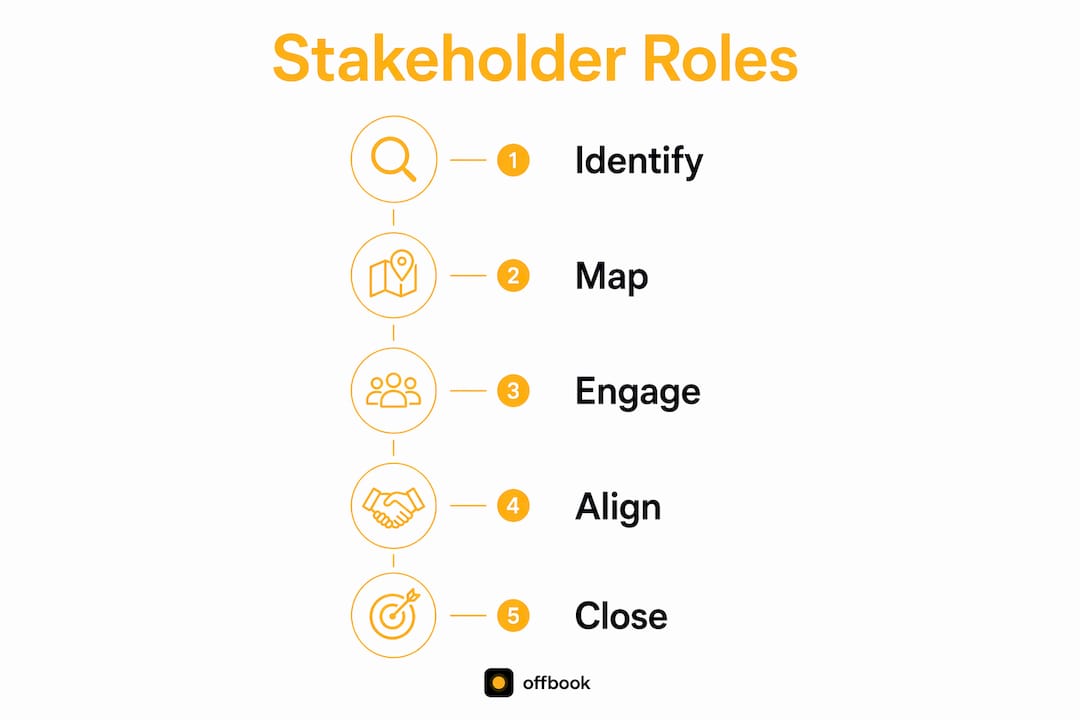
Pro Tip: Map every stakeholder by role, influence level, and motivation before your second call. Use MEDDIC or MEDDPICC as your framework. If you cannot name the economic buyer by the end of discovery, you are not yet in a real deal.
How do multiple stakeholders impact the B2B decision-making process?
Multiple stakeholders do not just slow deals down. They change the nature of the decision itself. Enterprise B2B deals take an average of 102 days to close, and 40% stall during the evaluation phase due to internal misalignment. That statistic tells you where most deals die: not in your pitch, but in the committee room after you leave.
Each additional stakeholder adds complexity to the consensus-building process. Committees spend 67% of their buying time on independent research rather than engaging vendors directly. That means by the time you get a second meeting, multiple people have already formed opinions based on sources you did not control.
This creates what researchers call “confident misunderstandings.” Each stakeholder has done their homework, reached their own conclusions, and now holds those conclusions with conviction. When the committee meets, they are not starting from a blank slate. They are defending positions built on incomplete or conflicting information. Your job as a rep is not just to sell. It is to unify those fragmented mental models into a shared, accurate picture of the problem and the solution.
| Stakeholder count | Estimated impact on deal timeline |
|---|---|
| 1–3 stakeholders | Shorter cycles, faster consensus, lower deal value |
| 4–6 stakeholders | Moderate complexity, cross-functional alignment required |
| 7–10 stakeholders | Extended cycles, formal evaluation stages, procurement involvement |
| 10+ stakeholders | Enterprise-grade complexity, legal and executive review standard |
The biggest competitor in B2B sales is not a rival vendor. It is indecision caused by fragmented stakeholder views pulling the committee in different directions. Reps who understand this stop trying to out-feature the competition and start working to build consensus instead.
Pro Tip: After each stakeholder conversation, send a brief written summary of what you discussed and what was agreed. This creates a shared reference document that reduces the chance of confident misunderstandings compounding across the committee.
Why multi-threaded engagement is non-negotiable
Single-threading is the most common and most costly mistake in complex B2B sales. It means relying on one champion to carry your message through the organization. When that champion loses influence, changes roles, or leaves the company, your deal collapses with them. Staff turnover and relational barriers significantly disrupt deal progress by breaking the connections you built inside the buying committee.
Multi-threading means building direct relationships with several stakeholders simultaneously. Here is how to do it without overwhelming your champion or the committee:
- Identify your stakeholder map early. In the first two calls, ask your champion directly: “Who else will be involved in this decision, and what matters most to each of them?” This question is not intrusive. It signals that you understand how their organization works.
- Request introductions, not just names. A name without a warm introduction is nearly useless. Ask your champion to facilitate a specific meeting with the technical evaluator or the economic buyer. Give them a clear reason to offer: “I want to make sure we address their specific concerns directly so this does not slow down later.”
- Tailor your message to each role. The economic buyer cares about payback period. The technical evaluator cares about integration complexity. The end user cares about whether the product makes their day easier. One pitch does not serve all three. Build separate message tracks for each function.
- Maintain regular contact across the committee. Do not go dark between meetings. Send relevant content, answer questions proactively, and check in with each stakeholder on their specific concerns. Building a proxy network of multiple internal advocates is what keeps deals alive when your primary champion hits a wall.
- Detect blockers before they become deal killers. When you have relationships across the committee, you hear about objections early. A technical concern raised in week three is fixable. The same concern raised in week ten, after the committee has already aligned against you, is not.
The impact of stakeholder involvement on deal outcomes is direct. Reps who engage multiple stakeholders with tailored communication close more deals than reps who rely on a single internal advocate.
What challenges come with multi-stakeholder deals and how do you overcome them?
Managing a buying committee is not a linear process. Experienced reps treat it like a pinball machine: iterative, non-linear, and full of unexpected bounces. Anticipating the common failure points is what keeps you from being surprised by them.
The most frequent challenges include:
- Analysis paralysis. Too many options, too many opinions, and no clear decision framework leads committees to stall rather than choose. Counter this by helping the committee define their evaluation criteria early. When you set the criteria, you shape the outcome.
- Conflicting priorities. Finance wants cost reduction. IT wants minimal disruption. Operations wants speed. These goals are not always compatible, and the tension between them stalls consensus. Surface the conflicts early in your conversations rather than hoping they resolve themselves.
- Relationship erosion. Long sales cycles create drift. A stakeholder who was enthusiastic in month one may be disengaged or skeptical by month three if you have not maintained contact. Re-engagement is not a one-time event. It is a continuous practice.
- Shifting requirements. Committees change their minds. New priorities emerge. A reorganization can reset the entire evaluation. Reps who treat the buying process as fixed get blindsided. Reps who check in regularly on organizational changes stay ahead of the shift.
- Champion loss. Your primary advocate leaves, gets promoted, or loses internal credibility. If they were your only thread into the organization, the deal is in serious danger. Multi-threading is the only reliable defense against this risk.
Tailored communication based on each stakeholder’s priorities is the single most effective tactic for preventing deal stalls. Generic outreach treats the committee as a monolith. Specific, role-aware communication treats each member as an individual with distinct concerns worth addressing. The deal advancement techniques that work in multi-stakeholder environments are almost always built on that distinction.
Key Takeaways
Multi-stakeholder B2B deals require reps to build relationships across every function in the buying committee, map influence early, and maintain tailored communication throughout the entire sales cycle.
| Point | Details |
|---|---|
| Stakeholder count is rising | The average B2B deal now involves 6 to 10 decision-makers, up from 5.4 in 2015. |
| Independent research creates misalignment | Committees spend 67% of buying time on their own research, forming conflicting views before you engage. |
| Single-threading kills deals | Relying on one champion leaves you exposed to turnover, lost influence, and blocked access. |
| Tailor messages by role | Economic buyers, technical evaluators, and end users each need a different conversation. |
| Treat the process as non-linear | Buying committees loop back, stall, and restart. Reps who anticipate this stay in control. |
The uncomfortable truth about multi-stakeholder deals
Most reps lose multi-stakeholder deals not because their product is wrong but because they misread the room. They find one enthusiastic champion, build the entire relationship around that person, and then act surprised when the deal stalls or collapses after a reorg. I have watched this pattern repeat across hundreds of sales cycles, and it almost never comes down to the product.
The mindset shift that actually changes outcomes is moving from “selling to a buyer” to “facilitating a committee decision.” Your job is not to convince one person. It is to help a group of people with different priorities reach a shared conclusion that your solution is the right answer. That requires patience, preparation, and a genuine willingness to understand what each stakeholder actually cares about, not what you assume they care about.
The reps who consistently close complex deals are the ones who ask better questions. They surface the conflicts between stakeholders before those conflicts surface themselves. They build relationships with the technical evaluator before the technical review starts. They know the economic buyer’s fiscal calendar before they submit a proposal. None of this is luck. It is preparation applied consistently across every contact in the committee.
The common B2B objections that kill deals in committee are almost always predictable. The reps who handle them well are the ones who saw them coming because they had enough relationships inside the organization to hear the concern before it became a formal objection. Build the network first. The close follows.
— Neil
How Offbook helps you run multi-stakeholder deals with discipline
Managing a six-person buying committee across a 102-day sales cycle requires more than good instincts. It requires a system that keeps you disciplined on every call, with every stakeholder, at every stage of the process.
Offbook’s AI call coaching for sales surfaces live prompts during your video calls, without a bot joining the meeting. When you are talking to a technical evaluator, Offbook cues you on the right qualification questions to ask and the objections most likely to surface in that role. When you are in a call with the economic buyer, it keeps you anchored to MEDDIC and MEDDPICC so you never leave a gap in your qualification. Pre-call briefs give you context on every stakeholder before you dial in, so you walk into each conversation already knowing what matters to that person. For founder-led B2B SaaS teams navigating complex committees, Offbook is the coaching layer that turns preparation into consistent execution.
FAQ
Why do B2B deals involve so many decision-makers?
B2B purchases affect multiple departments, budgets, and workflows, so organizations require input from every function that carries risk. As of 2026, the average deal involves 6 to 10 stakeholders to distribute accountability and surface critical concerns before signing.
How long does a typical multi-stakeholder B2B deal take?
Enterprise B2B deals average 102 days to close. Each additional stakeholder adds complexity to the consensus process, extending the timeline further when alignment breaks down.
What is single-threading and why is it dangerous?
Single-threading means relying on one internal champion to carry your deal through the organization. If that champion loses influence or leaves the company, the deal collapses. Building relationships across multiple stakeholders is the only reliable defense.
How do you identify all the stakeholders in a B2B deal?
Ask your champion directly in the first two calls who else will be involved and what matters most to each person. Use frameworks like MEDDIC or MEDDPICC to map economic buyers, technical evaluators, end users, and procurement contacts systematically.
What causes B2B deals to stall in committee?
Deals most often stall due to conflicting priorities between stakeholders, analysis paralysis from too many options, and confident misunderstandings formed during independent research. Surfacing these conflicts early and maintaining tailored communication with each role prevents most stalls.