Types of Economic Buyers in SaaS: A Playbook for Sellers
Discover essential strategies for identifying types of economic buyers in SaaS. Engage the right roles to secure your deals effectively.
Published: August 19, 2026
Author: OffBook Editorial Team

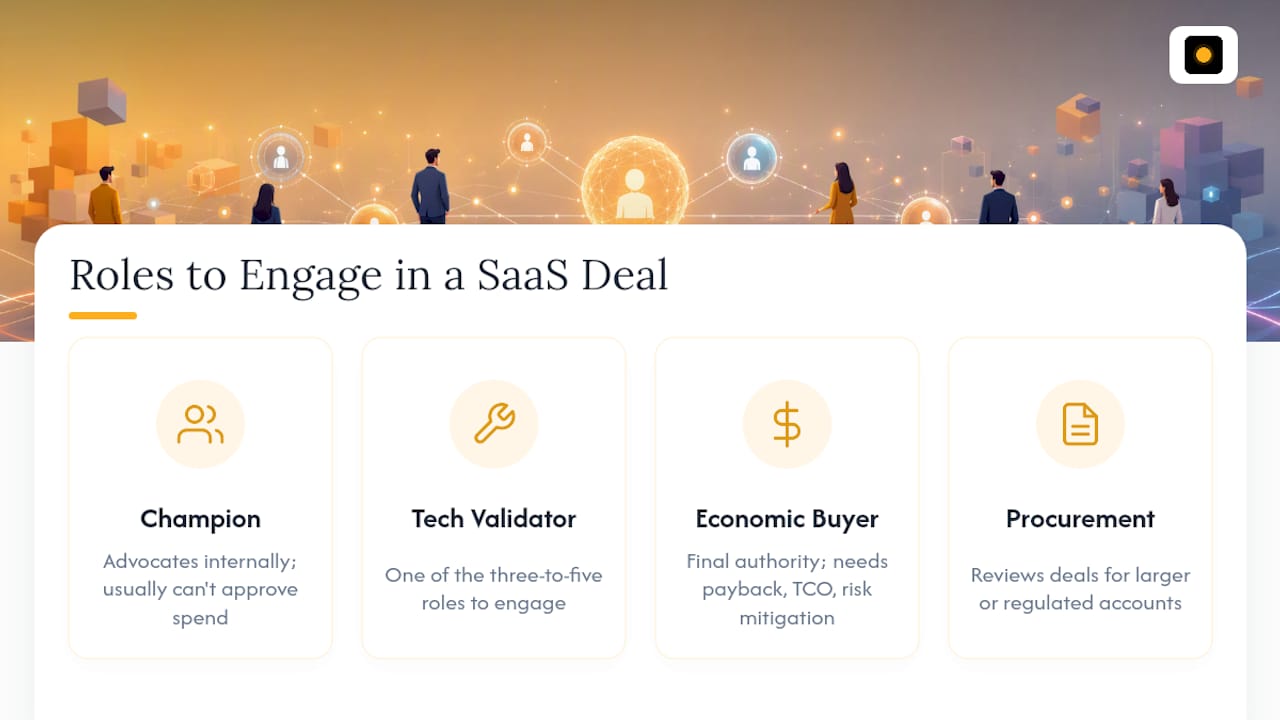
SaaS deals live or die on four roles: the economic buyer, the champion, the technical validator, and a procurement or data reviewer. Get all four engaged and you’re negotiating; get only two and you’re guessing. The economic buyer is the one with final authority to approve or kill the deal, a role MEDDIC and MEDDPICC both treat as a mandatory qualification checkpoint, not a nice-to-have.
Three things to do before your next call:
- Map who actually owns the P&L tied to the problem you solve, not just who has a senior title.
- Ask your champion, directly, who signed off on the last comparable purchase.
- Build role-specific proof: payback math for finance, total cost of ownership for IT, risk mitigation for anyone with their name on the decision.
Tools like Offbook exist because most reps figure this out in the deal review, after the deal is already stalling. Do it in week one instead.
Key Takeaways
Winning SaaS deals requires engaging the economic buyer, champion, technical validator, and procurement, each with role-specific proof, in a deliberate sequence.
| Point | Details |
|---|---|
| Economic buyer defined | The person with final authority and budget control to approve or kill the deal, not the highest title. |
| Five buyer archetypes | CFO, BU leader, CIO, product leader, and founder each evaluate on different criteria: payback, TCO, or risk. |
| Map before you pitch | Use org charts, LinkedIn, and champion validation to confirm who actually controls budget. |
| Multithread early | Engage champion, technical validator, and economic buyer in sequence rather than waiting for one contact. |
| Track role coverage | Measure reply rate, stage velocity, and win rate tied to economic-buyer engagement, not just pipeline volume. |
| Coach the moment it matters | Offbook surfaces payback and risk proof live during buyer calls through live cues and pre-call briefs. |
Table of Contents
- What Is An Economic Buyer In A Saas Deal?
- Five Types Of Economic Buyers You’ll Actually Encounter
- How To Identify And Map The Economic Buyer
- Who To Engage First, And How MEDDIC Maps To Each Role
- Metrics That Show You’re Reaching The Right People
- Discovery Questions And Talk Tracks By Buyer Type
- How Real-Time Coaching Surfaces Buyer-Ready Proof
- What Actually Works With Economic Buyers
- Get Your Reps In Front Of Economic Buyers Faster
- Frequently Asked Questions
- Sources
What Is An Economic Buyer In A Saas Deal?
The economic buyer is the person who can approve the purchase or kill it outright, and who controls the budget for the specific problem you’re solving. That’s the practical economic buyer definition that matters more than title. A VP of Engineering with no discretionary budget is not your economic buyer. A director who can quietly move $40,000 from another line item might be.
The buying group around them typically breaks into five roles:
- Champion: internally sells your solution when you’re not in the room, but usually can’t approve spend alone.
- Technical validator: security, IT, or engineering staff who check whether the product actually works within existing systems.
- User or admin: the person who lives in the tool daily and flags usability problems early.
- Procurement: negotiates terms, checks vendor risk, and enforces process, especially at companies above 200 employees.
- Data or AI governance reviewer: increasingly common where AI features touch customer data, checking compliance before signature.
A champion pushes internally; the economic buyer signs. A technical validator checks the box on security; procurement checks the box on contract terms. Confusing any of these roles with the economic buyer is the single most common reason deals stall in “final approval.”
Five Types Of Economic Buyers You’ll Actually Encounter
Economic buyers cluster into recognizable archetypes, and each one evaluates you differently. Real-world SaaS purchases are commonly decided by five buyer types: economic, champion, technical, operational, and end user, and the economic buyer among them is defined by budget authority, not seniority. Here’s how to recognize and pitch each one.
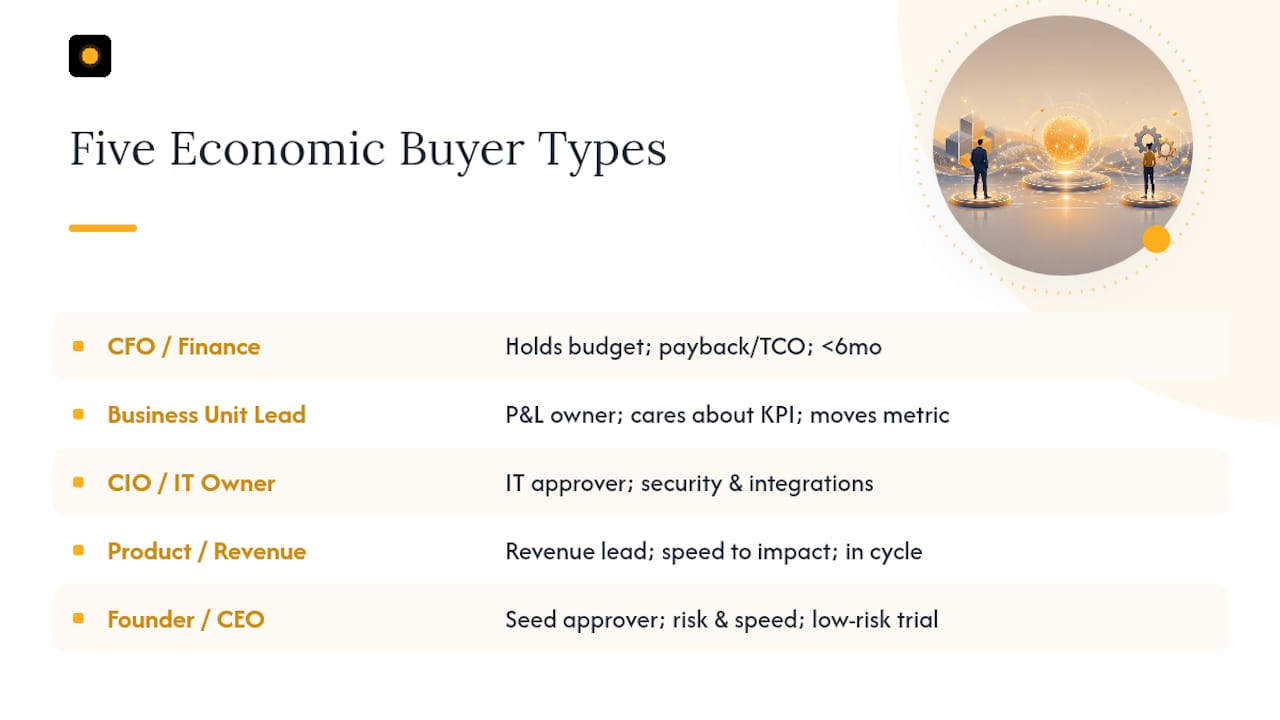
1. The CFO or Finance Leader
Common at companies past 50 employees where finance has formalized approval thresholds. They evaluate almost everything through payback period and total cost of ownership. Pitch line: “This pays for itself in under six months, and here’s the model.” High-value question: “What return threshold does a tool like this need to clear to get funded next quarter?” Signal you’ve found them: they ask about contract terms before they ask about features.
2. The Business Unit Leader or General Manager
Owns a P&L segment, usually sales, marketing, or a product line, and cares about outcomes tied to their number, not company-wide ROI. Pitch line: “This moves the metric your team is judged on.” High-value question: “Which line item would this come out of if we moved forward?” Signal: they talk in terms of quota, pipeline, or revenue targets rather than budget categories.
3. The CIO or IT Owner
Shows up in larger organizations, especially where the buying decision touches security, data residency, or integration with existing infrastructure. They weigh enterprise tradeoffs: vendor risk, uptime, support SLAs. Pitch line: “This fits your stack without adding operational risk.” High-value question: “What’s disqualified a vendor here before, and why?” Signal: they’ve been the approver on similar tool purchases before, which you can often confirm through past vendor announcements or LinkedIn history.
4. The Product or Revenue Leader
Common in growth-stage SaaS companies evaluating tools tied directly to pipeline or activation metrics. They care about speed to impact more than long-term TCO. Pitch line: “You’ll see the effect in your funnel within a sales cycle.” High-value question: “What’s the cost of not solving this by next quarter?” Signal: they can reallocate budget without a formal request process.
5. The Founder or CEO
The default economic buyer at seed and early Series A companies, where there’s often no formal finance function yet. They evaluate on risk and speed simultaneously. Pitch line: “This is low-risk to try and fast to see results from.” High-value question: “What would make this an easy yes versus a maybe?” Signal: every purchase decision routes through them regardless of department.
How To Identify And Map The Economic Buyer
Finding the real economic buyer takes deliberate research, not a guess based on job title. Work through this before your second call:
- Pull the org chart and cross-reference it against LinkedIn to see who owns budget for the function you’re selling into.
- Scan for P&L language in their bio or recent posts, phrases like “owns budget for,” “manages P&L,” or “responsible for spend.”
- Ask your champion directly: “Who approved the last tool like this, and did they need anyone else to sign off?”
- Check closed-won patterns from similar deals. If three past customers all had a VP of Sales as final approver, that’s a strong prior for your current account.
- Confirm with a discovery question rather than an assumption: “If we moved forward, whose budget would this come from?”
That last question alone resolves more ambiguity than any amount of org-chart guessing.
Who To Engage First, And How MEDDIC Maps To Each Role
Sequence matters more than most reps assume. Start with the champion or project owner, who opens the door and gives you political context. Bring in the technical validator early enough to clear objections before they become blockers. Only then push for a direct conversation with the economic buyer, ideally with your champion’s introduction rather than a cold ask.
Multithreading isn’t optional. SaaS deals in 2026 are decided by three to five roles, and reps who only talk to one contact see far lower win rates than those who cover the buying group early.
MEDDIC maps cleanly onto these roles:
- Metrics and Decision criteria: owned by the economic buyer, who defines what success and approval look like.
- Technical decision criteria: owned by the technical validator, who checks feasibility and risk.
- Identify pain and Champion: owned by your internal advocate, who translates your pitch into political capital.
- Paper process (MEDDPICC): owned by procurement, who governs contract terms and timing.
Metrics That Show You’re Reaching The Right People
Track these to know if your economic-buyer strategy is actually working, not just busy:
- Role coverage per account: percentage of target accounts where you’ve confirmed contact with all four buying-team roles.
- Reply and meeting rate by role: economic buyers typically reply slower but convert meetings at a higher rate once engaged.
- Stage velocity after economic-buyer introduction: deals should move faster once this contact is confirmed and looped in.
- Win rate with economic buyer engaged vs. not: this single comparison usually exposes your biggest pipeline leak.
- Payback and TCO clarity by close: whether your team can state, in one sentence, why the economic buyer said yes.
Benchmark these against your own closed-won deals rather than industry averages. Report role-coverage gaps in every pipeline review, not just at the forecast call.
Discovery Questions And Talk Tracks By Buyer Type
Use these to identify, validate, and quantify without sounding like you’re reading from a script.
To identify the buyer: “Who else needs to sign off on something at this price point?” “If we moved forward, whose budget covers this?” “Who approved the last tool your team adopted?”
To validate budget authority: “Is this an existing line item or new spend?” “What’s the approval process for a purchase this size?” “Has anything like this been vetoed before, and by whom?”
To quantify payback: “What would a six-month payback need to look like to get funded?” “What’s this problem costing you today, in dollars or hours?”
To surface procurement or risk concerns: “What typically slows down a deal like this internally?” “Does legal or security need to weigh in before we can move forward?”
Three talk tracks worth memorizing: for the payback-focused buyer, “You’ll see this pay for itself before the end of the quarter.” For the TCO-focused buyer, “This replaces two tools, not adds a third.” For the risk-focused buyer, “Here’s exactly how we handle the failure case.”
Pro Tip: Spread these questions across three calls instead of firing them all in discovery. A rep who asks all 20 in one sitting sounds like an audit, not a conversation.
How Real-Time Coaching Surfaces Buyer-Ready Proof
Picture a rep on a call with a BU leader who keeps circling back to what does this cost us if we don’t act. Offbook listens in the background and surfaces a live prompt: pivot to payback math now, not later. The rep pulls up the ROI figure they prepped, states it in one sentence, and moves the conversation to next steps instead of stalling on vague interest.
That’s the mechanism behind three specific benefits:
- Live cues flag the moment a buyer signals budget authority or risk concern, so the rep responds with the right proof instead of a generic pitch.
- Pre-call briefs prepare reps with company and role context before the call starts, so they don’t waste the first ten minutes figuring out who they’re talking to.
- Post-call debriefs capture what the economic buyer actually cared about, so the next rep on the account, or the next call, doesn’t start from zero.
What Actually Works With Economic Buyers
Rushing the economic buyer backfires more often than it helps. I’ve seen more deals stall from a premature “let’s get your CFO on a call” push than from any objection a champion couldn’t handle. Bring evidence, not urgency: a clear payback number and an honest tradeoff beats a polished deck every time.
The mistake I see most: reps treat the champion as a formality on the way to the “real” buyer. Wrong move. A champion is your political map. Skip them and you walk into the economic-buyer conversation blind, without knowing what already got vetoed or who else needs convincing.
Get Your Reps In Front Of Economic Buyers Faster
Offbook doesn’t replace the groundwork in this playbook, it makes the moment you’re finally in front of an economic buyer count. Live cues surface the payback line or risk-mitigation point the second the conversation calls for it, instead of leaving reps to remember it under pressure. Pre-call briefs mean reps walk into that meeting already knowing the buyer’s role, past approvals, and likely objections.
Three specific outcomes teams report chasing with this approach: faster payback clarity because the numbers surface exactly when the buyer asks, fewer procurement delays because objections get handled in real time instead of in a follow-up email, and clearer accountability because post-call debriefs capture exactly what each buyer committed to. If you’re a founder-led SaaS team trying to shorten the path from first call to signature, start a free trial built for founders and see what your next economic-buyer call looks like with live coaching running in the background.
Frequently Asked Questions
What are the main types of economic buyers in SaaS deals? The most common archetypes are the CFO or finance leader, the business unit leader, the CIO or IT owner, the product or revenue leader, and the founder or CEO at smaller companies. Each evaluates deals through a different lens, whether that’s payback period, total cost of ownership, or risk mitigation.
How do you know if someone is the real economic buyer? Look for discretionary budget authority rather than seniority. Someone who has reallocated funds before, approved a similar purchase, or speaks in P&L terms is a stronger signal than title alone.
How is an economic buyer different from a champion? A champion advocates internally and helps you navigate the account but usually can’t approve spend. The economic buyer holds final authority to approve or kill the purchase.
How many people should you engage in a SaaS buying process? Plan for three to five roles: champion, technical validator, economic buyer, and often a procurement or data governance reviewer for larger or regulated accounts.
What proof does an economic buyer need to say yes? Most economic buyers need a clear payback timeline, a total cost of ownership comparison, and an honest statement of the risks and how they’re mitigated.