The B2B Sales Cycle Explained for Founders and Reps
Discover the B2B sales cycle explained for founders and reps. Master the stages to drive predictable revenue and streamline your sales strategy!
Published: June 6, 2026
Author: OffBook Editorial Team

The B2B sales cycle is defined as the repeatable, multi-stage process through which a business converts a prospect into a paying customer, typically involving multiple stakeholders, extended timelines, and structured evaluation phases. Unlike B2C transactions, B2B deals require navigating buying committees, procurement reviews, and internal alignment processes that can stretch from 30 days to well over six months. Understanding the B2B sales cycle is not optional for founders and sales professionals who want predictable revenue. It is the foundation of every effective B2B sales strategy, and tools like Offbook, MEDDPICC, and CRM platforms exist specifically to help teams run it with discipline.
What are the main stages of the B2B sales cycle?
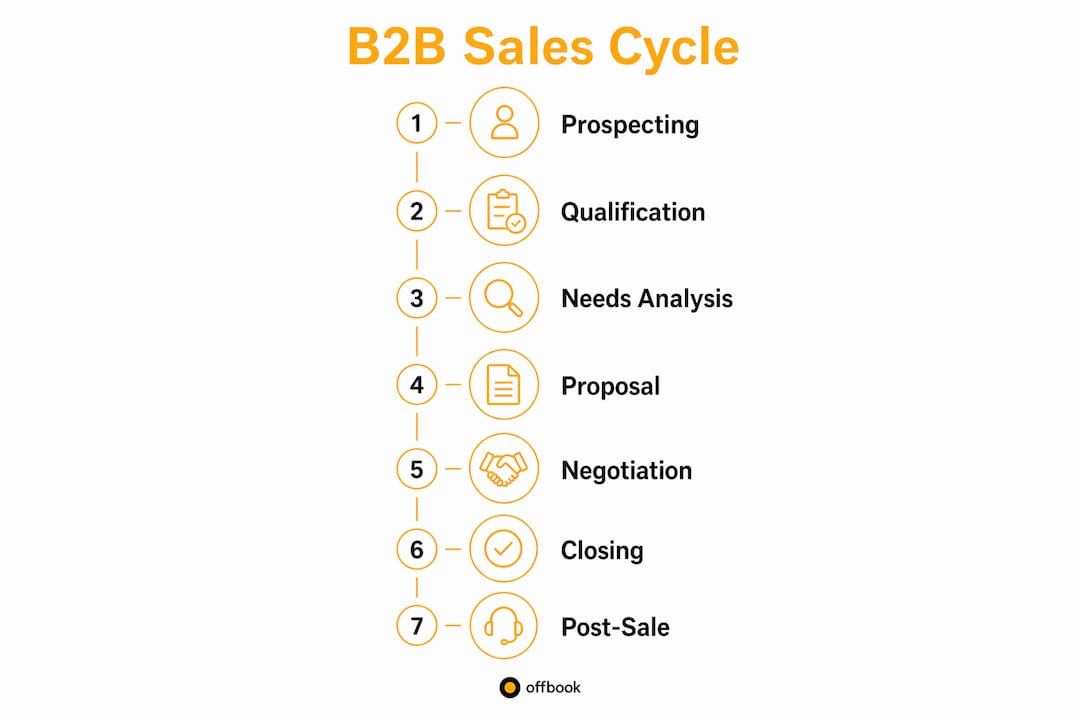
The B2B sales process overview starts with eight core stages, each with a distinct objective and a distinct way to fail.
- Prospecting: Identifying accounts that match your ideal customer profile. The most effective prospecting targets accounts showing buying signals like recent funding or hiring surges, which create a window of heightened problem awareness. Generic list-blasting wastes time and poisons your sender reputation.
- Qualification: Determining whether a prospect has the budget, authority, need, and timeline to buy. Frameworks like BANT, MEDDIC, and MEDDPICC exist for this stage. Qualification is the most commonly rushed step in the entire cycle, and that mistake compounds at every stage that follows.
- Discovery: A deep, buyer-centric conversation to understand the prospect’s real problem, not just their stated need. Shallow discovery is the single biggest reason deals stall before a proposal is ever sent.
- Solution presentation: Connecting your product directly to the pain uncovered in discovery. Generic demos that showcase features rather than outcomes lose deals here.
- Objection handling: Addressing concerns around price, timing, fit, or internal politics. Objections at this stage are almost always a signal of interest, not rejection.
- Negotiation: Agreeing on terms, pricing, and scope. This stage is rarely just about price. It is about risk allocation and internal justification on the buyer’s side.
- Closing: Securing a signed agreement. Deals that stall here usually stalled much earlier. The close is a symptom, not the cause.
- Post-sale onboarding: Handing off to customer success and setting the conditions for renewal and expansion. Skipping this stage destroys the lifetime value of every deal you close.
Multi-threading across the buying committee matters from discovery onward. Relying on a single champion to carry your deal through internal reviews is one of the most common and most preventable reasons deals die. AI tools that automate follow-ups and track buying committee engagement help teams maintain contact across multiple stakeholders without dropping threads.
Pro Tip: Map every deal to a named champion, a named economic buyer, and a named technical evaluator before you send a proposal. If you cannot name all three, you are not ready to propose.

How long does the B2B sales cycle typically last?
Cycle length is one of the most misunderstood variables in B2B sales planning. Most founders underestimate it, which breaks their cash flow forecasts and hiring plans.
B2B SaaS sales cycles vary significantly by deal size: SMB deals close in 30 to 60 days, mid-market deals take 60 to 120 days, and enterprise deals routinely run six months or longer. These are not soft estimates. They reflect the number of stakeholders, the size of the budget approval chain, and the complexity of the security and legal review.
| Deal Segment | Typical Cycle Length | Primary Delay Factor |
|---|---|---|
| SMB | 30 to 60 days | Slow follow-up, weak qualification |
| Mid-market | 60 to 120 days | Multi-stakeholder alignment |
| Enterprise | 6+ months | Legal, security, and procurement review |
The average B2B sales cycle is 32% longer in 2026 than it was in 2021. Buying committees now typically include 6 to 10 stakeholders, each with their own evaluation criteria and approval threshold. That number means a single “yes” from your champion is rarely enough to close a deal.
Buyer behavior compounds this further. Buyers complete roughly 70% of their research before they ever speak to a salesperson. By the time a prospect books a discovery call, they have already formed opinions about your category, your competitors, and often your pricing. This means the sales cycle for the buyer started long before it started for you.
Pro Tip: Ask every new prospect for their contract renewal date with their current vendor. That single data point tells you whether you are in a real buying window or a research exercise, and it shapes your entire follow-up cadence.
What strategies actually shorten the B2B sales cycle?
Speed in a B2B sales cycle does not come from skipping stages. It comes from reducing the dead time between them. Momentum collapses when clear next steps are lacking, and most deals are lost in the gap between discovery and proposal, or between proposal and negotiation, not at the close.
Here are the strategies that consistently compress cycle length without sacrificing deal quality:
-
Target buying signals, not just firmographics. Accounts showing signals like a new VP of Sales hire, a recent Series B, or a tech stack change are far more likely to be in an active buying window. Trigger-based outreach converts at a higher rate than cold volume because it arrives when the problem is already visible to the buyer.
-
Use a qualification framework from the first call. MEDDPICC forces you to identify the Metrics, Economic Buyer, Decision Criteria, Decision Process, Paper Process, Identified Pain, Champion, and Competition before you invest significant time in a deal. Reps who skip this step fill their pipeline with deals that will never close.
-
Align your sales motion to buyer readiness, not your quota. Most sales methodologies fail because they are built around the seller’s quarterly targets rather than the buyer’s authentic timeline. Revenue Alignment Architecture, a framework built around cataloguing accounts by timing and readiness, produces more predictable pipelines than pressure-based tactics.
-
Automate interstitial follow-up. The time between a discovery call and a proposal, or between a proposal and a signed contract, is where deals go cold. AI-powered automation that sends follow-ups, updates CRM records, and surfaces next-step reminders keeps deals moving without requiring a rep to manually track every thread. Offbook’s real-time coaching surfaces these gaps during the call itself, so reps leave every conversation with a confirmed next step rather than a vague “I’ll follow up.”
-
Build pipeline math into your planning. Connecting ICP, motion, and pipeline math into a single strategic framework gives you the ability to predict how many deals you need at each stage to hit your number. Without this, you are reacting to your pipeline instead of managing it.
For founders running deal advancement techniques alongside product development, the discipline of stage-by-stage momentum management is what separates a predictable revenue engine from a series of lucky closes.
Pro Tip: Catalog your accounts into timing buckets: active now, 90 days out, and 6 months out. Work each bucket with a different cadence and message. This prevents you from burning your best prospects with premature urgency.
How do internal buyer dynamics stall deals?
The part of the B2B sales cycle that most reps never see is the buyer’s internal evaluation process. You finish a great discovery call, send a sharp proposal, and then nothing happens for three weeks. The deal did not stall because of you. It stalled because of them.
Internal alignment issues cause 86% of stalled purchases. The buyer’s security team needs to review your data practices. Legal wants to redline your contract. A VP who was not in your original meetings has concerns about the budget. None of these conversations involve you, but all of them determine whether your deal closes.
The risks of single-threaded selling are severe:
- Your champion leaves the company, and your deal leaves with them.
- A stakeholder you never met becomes the deciding vote against you.
- Internal politics between departments delay approval for months.
- Budget gets reallocated before your deal reaches the approval stage.
The solution is not to push harder for a signature. It is to equip your champion to sell internally on your behalf. Successful B2B sales treat the internal buyer evaluation as a shared process. Give your champion a business case document, a one-page ROI summary, and answers to the objections they will face from legal, security, and finance. Understanding how enterprise B2B buying works at the committee level is what separates reps who close enterprise deals from those who lose them in procurement.
The negotiation stage, when it finally arrives, is rarely about price alone. It is about risk. The buyer’s legal and procurement teams are trying to reduce their exposure. Reps who treat negotiation as a price conversation miss the real objection entirely.
Key takeaways
A disciplined B2B sales cycle requires stage-by-stage momentum management, multi-threaded stakeholder engagement, and buyer-aligned timing to close deals predictably.
| Point | Details |
|---|---|
| Cycle length varies by deal size | SMB closes in 30 to 60 days; enterprise deals routinely exceed six months. |
| Qualification drives everything downstream | Rushing qualification fills your pipeline with deals that will never close. |
| Internal alignment stalls 86% of deals | Equip your champion with materials to sell internally rather than pushing for a signature. |
| Dead time between stages kills momentum | Automate follow-ups and confirm next steps on every call to keep deals moving. |
| Buyer research starts before you do | Seventy percent of buyer research is complete before the first sales conversation. |
Why most sales teams are solving the wrong problem
Here is what I have seen consistently across founder-led sales teams and early-stage SaaS companies: the problem is almost never the close. It is the 30 days of silence between the proposal and the negotiation that kills the deal. Reps spend enormous energy perfecting their pitch decks and almost none building the habit of confirmed next steps.
The other mistake I see regularly is treating qualification as a checkbox rather than a diagnostic. MEDDPICC is not a form you fill out. It is a conversation you have to understand whether a deal is real. When reps rush through it to get to the demo faster, they are optimizing for activity over outcomes.
What actually works is building a repeatable architecture around the buyer’s timeline, not your quota. When I see teams adopt tools like Offbook for real-time call coaching, the shift is not just in their close rates. It is in the quality of their discovery. Reps stop guessing what to ask next and start running structured conversations that surface the information they need to advance the deal. That discipline compounds over every call, every quarter, and every rep on the team.
The sales teams that win in 2026 are not the ones with the best pitch. They are the ones with the most disciplined process.
— Neil
How Offbook accelerates your sales cycle in real time
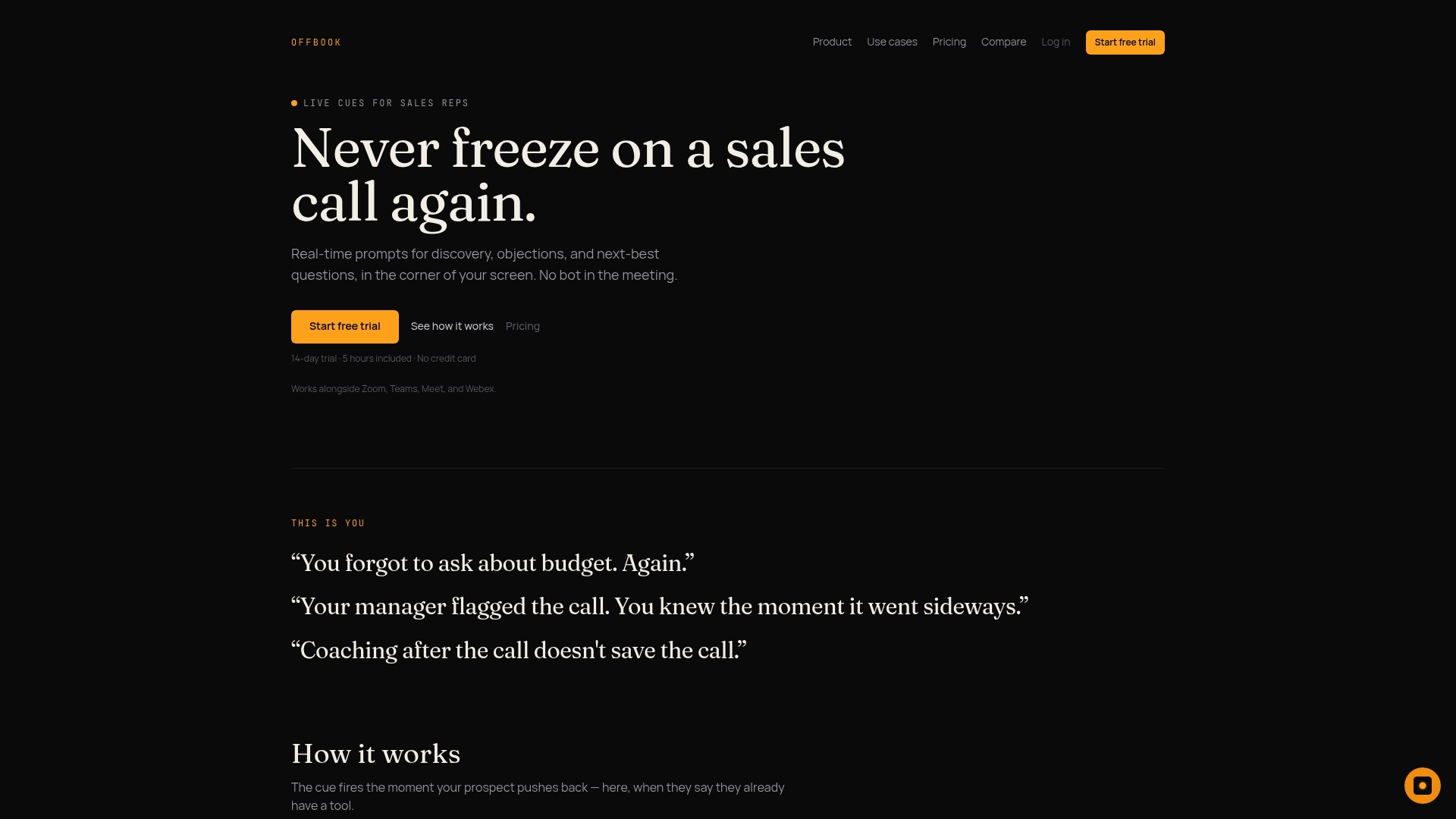
Offbook is built for exactly the problem this article describes: deals that stall because reps miss qualification gaps, skip discovery depth, or leave calls without a confirmed next step. As AI call coaching for sales teams, Offbook listens to your video calls and surfaces live prompts on-screen, structured around MEDDIC and MEDDPICC, so reps ask the right questions at the right moment. No bot joins the meeting. No post-call summary that nobody reads. Offbook coaches in the moment, when it changes the outcome. For founders and seed-stage SaaS teams running use cases across sales and discovery, it is the fastest way to build a disciplined, repeatable sales motion without hiring a full-time sales manager.
FAQ
What is the B2B sales cycle?
The B2B sales cycle is the structured, repeatable process a business uses to move a prospect from initial contact to a signed contract, typically spanning stages from prospecting through post-sale onboarding. It differs from B2C in its length, stakeholder complexity, and the degree of internal evaluation required on the buyer’s side.
How long does a typical B2B sales cycle last?
Cycle length depends on deal size: SMB deals average 30 to 60 days, mid-market deals run 60 to 120 days, and enterprise deals regularly exceed six months. The average cycle is 32% longer in 2026 than it was in 2021, driven by larger buying committees and more complex procurement processes.
What causes B2B deals to stall?
Internal alignment issues cause 86% of stalled purchases, meaning the deal is stuck inside the buyer’s organization, not with the sales rep. The most common fix is multi-threading across the buying committee and equipping your champion with materials to advocate internally.
Which qualification framework works best for B2B sales?
MEDDPICC is the most thorough qualification framework for complex B2B deals because it maps the full decision process, including the paper process and competition, not just budget and authority. BANT works for simpler SMB deals where the decision-making structure is less layered.
How can AI tools shorten the B2B sales cycle?
AI call coaching platforms like Offbook shorten cycles by surfacing qualification gaps and next-step prompts during live calls, while CRM automation reduces the dead time between stages. The combination of in-call discipline and automated follow-up keeps deals moving without relying on rep memory or manual tracking.