Founder Led SaaS: Cut Rep Talk Time to 43% and Close More
Founder led B2B SaaS teams: measure and cut rep talk time to the 43% benchmark, keep questions under 14, and use in call coaching cues to close more.
Published: September 27, 2026
Author: OffBook Editorial Team

That single shift, backed by Gong’s talk-to-listen research, improves discovery quality and close rates more reliably than any script rewrite. The rest of this guide covers how to measure your current ratio, which live behaviors to change first, and how in-call coaching tools like Offbook make the change stick faster than post-call reviews ever will.
TL;DR:
- Sales teams should aim for a talk-to-listen ratio close to 43% to 57%, with top performers maintaining this consistency across calls.
- Limiting questions to 11 to 14 per call is optimal, as asking more leads to lower conversion rates rather than better insights.
- Reducing rep talk time enhances discovery quality when paired with active listening and well-placed, relevant questions.
- Real-time coaching tools like Offbook can effectively help reps cut unnecessary speech by providing prompts during live conversations.
- Tracking time on three calls with a stopwatch and reviewing weekly is the simplest way to measure and improve talk time without complex software.
Table of Contents
- How Do You Measure Rep Talk Time on a Sales Call?
- What Live Techniques Actually Reduce Rep Talk Time?
- How Do You Map Questions to Stay Under the 14-Question Ceiling?
- What Pre-Call Prep Cuts Filler Talk the Most?
- How Does Real-Time In-Call Coaching Reduce Talk Time?
- What Drills Help Reps Practice Talking Less?
- What Distracts Reps During Calls and How Do You Fix It?
- How Do You Handle Small Talk Without Wasting Call Time?
- How Do You Use Transitions to Shorten Calls?
- What Opening and Closing Habits Save the Most Time?
- How Do You Track Call Analytics to Find Reduction Opportunities?
- A Founder’s Case for Prioritizing Talk-Time Coaching
- Get Live Coaching Cues Without Waiting for Call Reviews
- Sources
- FAQ
How Do You Measure Rep Talk Time on a Sales Call?
You cannot fix what you have not measured. Before changing anything, spend one week just watching the numbers.
The fastest method needs no software: run a stopwatch during a call recording and log two totals, rep speaking time and buyer speaking time, then divide rep time by the whole. Most call analytics platforms and CRMs with call intelligence will calculate this automatically once connected, but a manual pass on three calls tells you plenty to start.
While you are timing, track three more things:
- Question count and placement. Count total questions asked and note whether they clustered in the first ten minutes or spread across the call.
- Longest monologue. Flag the single longest unbroken stretch of rep speech, in seconds. Anything over 60 to 90 seconds is worth reviewing.
- Filler phrases. Note repeated throat clearing lines like “so basically” or “just to give you some context” that eat time without adding information.
Pick one to three metrics to track weekly, talk percentage is the easiest starting point, and revisit them every Friday. Gong’s 2025 analysis found that top performers hold their talk-to-listen ratio steady across calls, while lower performers swing wildly depending on how the call is going. Consistency, not just the raw number, is what separates the two groups.
What Live Techniques Actually Reduce Rep Talk Time?
Cutting talk time on a live call is a discipline, not a script change. These five behaviors work because they replace explaining with listening, without making the rep seem passive or unprepared.
- Paraphrase, then confirm. Instead of re-explaining a point the buyer just made, restate it in one sentence and ask “Did I get that right?” It takes ten seconds and proves you were listening, which buys more trust than a two-minute recap.
- Swap follow-up questions for open prompts. “Tell me more about that” or “What else is driving that?” often surfaces more than a scripted follow-up question, and it costs you zero prep time.
- Pair one insight with one question. Share a single relevant observation, then immediately hand the floor back with a question. This is the inquiry-and-advocacy balance RAIN Group’s sales methodology points to: reps who only ask questions can feel robotic, but reps who only advocate lose the discovery entirely.
- Break up back-to-back questions. Three questions in a row starts to feel like an interrogation. Insert a paraphrase or a short comment between questions so the exchange still feels like a conversation.
Pro Tip: Record yourself on one call this week and mark every spot you talked for more than 20 seconds without a question mark. That’s your monologue map, and it usually reveals the same one or two habits repeating.
How Do You Map Questions to Stay Under the 14-Question Ceiling?
Gong’s study of over 500,000 B2B conversations, summarized by Harvard Business Review, found the optimal range sits at 11 to 14 questions per call. Conversion dropped once reps went past that number, which means the fix isn’t to ask more; it’s to ask better and skip the questions that don’t earn their place.
Build a branching map instead of a checklist. Start with two or three diagnostic questions that depend on the buyer’s role and stated priority, then let each answer decide the next question rather than working down a fixed list. A discovery question framework organized by call stage helps here, since it groups questions by intent instead of by topic.
- Open with one or two diagnostic questions on current process or pain.
- Move to impact questions once pain is confirmed (“What does that cost you monthly?”).
- Close discovery with a prioritization question (“Where does this rank against your other Q1 initiatives?”).
- Replace low-value checklist items (“What’s your team size?”) with a quick paraphrase and confirmation instead of a separate question.
A simple micro-flow: ask about current tooling, paraphrase the gap you heard, confirm it, then ask the impact question that naturally follows. That’s three exchanges instead of five separate questions, and it stays inside the ceiling without skipping anything important.
What Pre-Call Prep Cuts Filler Talk the Most?
Most rep filler comes from uncertainty, not habit. A rep who doesn’t know the buyer’s context fills airtime with generic framing because they’re stalling while they figure out where to go next.
The fix is a three-point brief before every call: one line on company context, one hypothesis about their likely pain, and two priority questions to confirm or kill that hypothesis. This kind of pre-call preparation narrows the rep’s focus so there’s less need to think out loud once the call starts.
- Write a one-line context note: what the company does, what triggered the call.
- Draft a single hypothesis about their probable pain point.
- Pick two priority questions that would confirm or disprove that hypothesis fastest.
- Set the agenda out loud in the first 90 seconds so you skip a long framing monologue later.
- Use any available signal, funding stage, tech stack, job title, to skip a generic full-product demo and jump straight to the relevant slice.
A sales call preparation checklist built around these four items takes under five minutes to complete and removes most of the “let me back up and explain” moments that eat call time.
How Does Real-Time In-Call Coaching Reduce Talk Time?
Post-call feedback arrives too late to change the behavior that just happened. A manager reviewing a recording on Thursday can tell a rep they talked too much on Tuesday, but the rep already lost that deal’s discovery window. In-call, unobtrusive coaching nudges act at the moment the rep is deciding what to say next, which is the only moment that actually changes the outcome.
The cues that move the needle most are simple: a prompt to ask a follow-up instead of explaining further, an alert when a monologue crosses a time threshold, and a suggested paraphrase line when the buyer just said something important. Offbook is built around exactly this model. It listens during the call and surfaces on-screen prompts, questions to ask, objections to address, qualification gaps to close, without a bot joining the meeting, structured around MEDDIC and MEDDPICC. It also generates pre-call briefs on the company and people a rep is about to meet, which cuts the uncertainty that drives filler talk in the first place.
- Real-time prompts that flag when a rep has been talking too long.
- Suggested follow-up questions tied to what the buyer just said.
- Pre-call briefs so reps walk in with context instead of guessing.
- Role-specific profiles so cues match how an AE, founder, or CS rep actually sells.
- Consent and privacy defaults built into every session before recording starts.
Statistic Callout: Gong’s talk-to-listen benchmark puts winning reps near 43% talk time against 57% listening, and the reps who hit that mark consistently, not just occasionally, are the ones who close more.
What Drills Help Reps Practice Talking Less?
Reading about the two-second pause and actually holding it under pressure are two different skills. These drills build the muscle before a real call is on the line.
- Pause drills. Pair up reps and have the listener count two full seconds, out loud if needed, before responding to any statement. Repeat for five minutes until it stops feeling awkward.
- Question-budget role-play. Cap the “rep” at eight questions for a ten-minute mock discovery call. The constraint forces better question selection fast.
- Paraphrase relay. One person makes a statement, the next paraphrases it, a third confirms accuracy. This trains the exact sequence covered in active listening techniques for sales conversations.
- One-metric feedback loop. After each practice call, the manager gives feedback on exactly one talk-time metric, never five at once. Multiple corrections at once rarely stick.
Pro Tip: Run the question-budget drill in your next team meeting instead of a status update. Fifteen minutes of forced constraint teaches more than an hour of theory.
What Distracts Reps During Calls and How Do You Fix It?
Talk time creep often traces back to distraction, not habit. A rep who’s half-watching Slack or scrolling notes will default to filling silence with words because they lost the thread of what the buyer just said.
The most common culprits are predictable: a second monitor with notifications on, a CRM tab open mid-call that pulls attention away from the conversation, and multitasking during discovery because the rep assumes the “real” part of the call hasn’t started yet. Every one of these produces the same symptom, longer rep monologues, because a distracted rep re-explains instead of building on what was just said.
The fix is mostly environmental. Close every tab except the call window and whatever notes tool is in use. Turn off desktop notifications for the call’s duration, not just Slack but email and calendar pop-ups too. If note-taking is required, use a single running doc rather than switching between the CRM, a scratchpad, and a shared deck.
The subtler distraction is internal: reps mentally rehearsing their next talking point while the buyer is still speaking. That habit is what breaks the two-second pause discipline covered earlier, because a rep who’s already composing a response isn’t actually listening to the last three seconds of what was said. Training reps to write down one keyword instead of a full thought while listening solves most of this, since it frees up the mental bandwidth that would otherwise go toward rehearsing a reply.
Calendar hygiene matters too. Back-to-back calls with zero buffer mean reps arrive at call three still mentally processing call two, and that residue shows up as longer, less focused monologues. A five-minute buffer between calls is a small change with an outsized effect on how present a rep sounds.

How Do You Handle Small Talk Without Wasting Call Time?
Small talk isn’t the enemy, rushing past it usually backfires more than indulging it briefly. The problem is small talk that runs three or four minutes deep into a 30-minute call and eats into discovery time that never gets recovered.
Cap it deliberately. A brief, genuine rapport-building moment—a comment on something specific from LinkedIn, a shared connection, or a recent company announcement—does more for trust than a longer generic weather talk, and it costs much less time. The key word is specific: generic small talk (“How’s your week going?”) invites a generic, rambling answer, while specific small talk (“Saw you just closed your Series A, congrats”) invites a short, pointed one.
Set a soft transition cue in advance. A line like “I want to make sure we get to the good stuff, so let’s dig in” moves the call forward without feeling abrupt, and it signals to the buyer that you value their time as much as your own. Reps who skip this transition and just barrel into discovery questions often come across as cold, which paradoxically leads to more rapport-building later in the call when the buyer feels the need to warm things up themselves.
If a buyer keeps steering back to small talk, that’s often a signal worth noting rather than fighting. Sometimes it means the buyer isn’t fully bought into the meeting’s purpose yet, and setting the agenda clearly, covered in the pre-call prep section, prevents that drift before it starts. The goal isn’t zero small talk. It’s small talk with a clear exit ramp.
How Do You Use Transitions to Shorten Calls?
The words between your points cost more time than most reps realize. Long-winded transitions, “So, just to kind of build on what you said there, and I think this is a really important point,” add ten seconds of nothing before the actual sentence starts.
Shorter transitions do the same job. Try these swaps in your next call:
- Replace “So just to kind of expand on that” with “Building on that,”
- Replace “I think what’s really important here is” with “Here’s the key part:”
- Replace “Just to give you a little bit of background” with a direct statement, skip the preamble entirely.
Filler words like “basically,” “actually,” and “just” rarely change meaning but add up over a 30-minute call into minutes of dead air. Reps who record themselves once and count filler words are usually shocked at the total, often 20 or more instances per call.
The fix isn’t memorizing new phrases, it’s cutting the throat-clearing habit at the source. Before speaking, ask internally: does this sentence need a lead-in, or can it start with the actual point? Most of the time it can. This single habit change, dropping the wind-up and starting with the point, can shave two to three minutes off a 30-minute call without cutting a single piece of substance.
What Opening and Closing Habits Save the Most Time?
The first two minutes and the last two minutes of a call are where the most time gets wasted, and where the fix is easiest to apply.
Openings run long when reps recap the entire email thread or over-explain who they are before getting to the point. A tight open states the agenda in one sentence, confirms the buyer’s available time, and asks one question to start discovery immediately: “I know we’ve got 30 minutes, I’d like to spend the first ten understanding where things stand today, then walk through what might fit. Sound good?” That’s fifteen seconds, not ninety.
Closings run long for the opposite reason: reps ramble through a recap instead of stating next steps plainly. A clean close names one clear action, one owner, and one date. “I’ll send the proposal by Thursday, and let’s plan for a follow-up call next Tuesday to review it together” replaces a two-minute summary with one sentence that actually moves the deal forward.
Both habits connect directly to talk time. A tight open leaves more of the call for discovery questions, and a tight close means the last five minutes aren’t burned re-explaining what was already covered. Reps who master both routinely finish 30-minute calls with two or three minutes to spare, time better spent on one more good question than on a longer goodbye.
How Do You Track Call Analytics to Find Reduction Opportunities?
You can’t improve a talk-to-listen ratio you’re not watching, and the data usually reveals patterns a rep would never notice on their own.
Start by pulling talk percentage and question count from whatever call recording or analytics tool you already use, most modern CRMs with call intelligence report this automatically. Look specifically for the calls where talk percentage jumps well above your target average. Those outlier calls almost always share a trigger, an objection the rep wasn’t ready for, a demo that turned into a feature dump, or a buyer question that sent the rep into an unplanned monologue.

Compare talk time against outcome, not in isolation. A call with 50% rep talk that closed isn’t proof that 50% is fine, it’s worth checking whether that particular deal had unusually high intent walking in. The more useful comparison is talk time trends across a rep’s full pipeline: is their ratio creeping up specifically on calls where they’re less prepared, or trending down as their demo delivery improves over time?
Simple sales data automation can pull these metrics into a weekly dashboard without manual review of every call, which matters most for founder-led teams where nobody has time to sit through hours of recordings. Track team averages alongside individual ones. A rep sitting well outside the team’s typical talk percentage, in either direction, is usually the fastest coaching win available that week.
A Founder’s Case for Prioritizing Talk-Time Coaching
Early-stage teams live or die by discovery quality, since there’s no brand recognition or big pipeline to absorb a bad call. Talk-time discipline is one of the few sales behaviors that’s both measurable and coachable in a single week. The action for this week: run the timer method on three calls, then use one ten-minute team drill from this guide before your next round of demos.
— Neil
Get Live Coaching Cues Without Waiting for Call Reviews
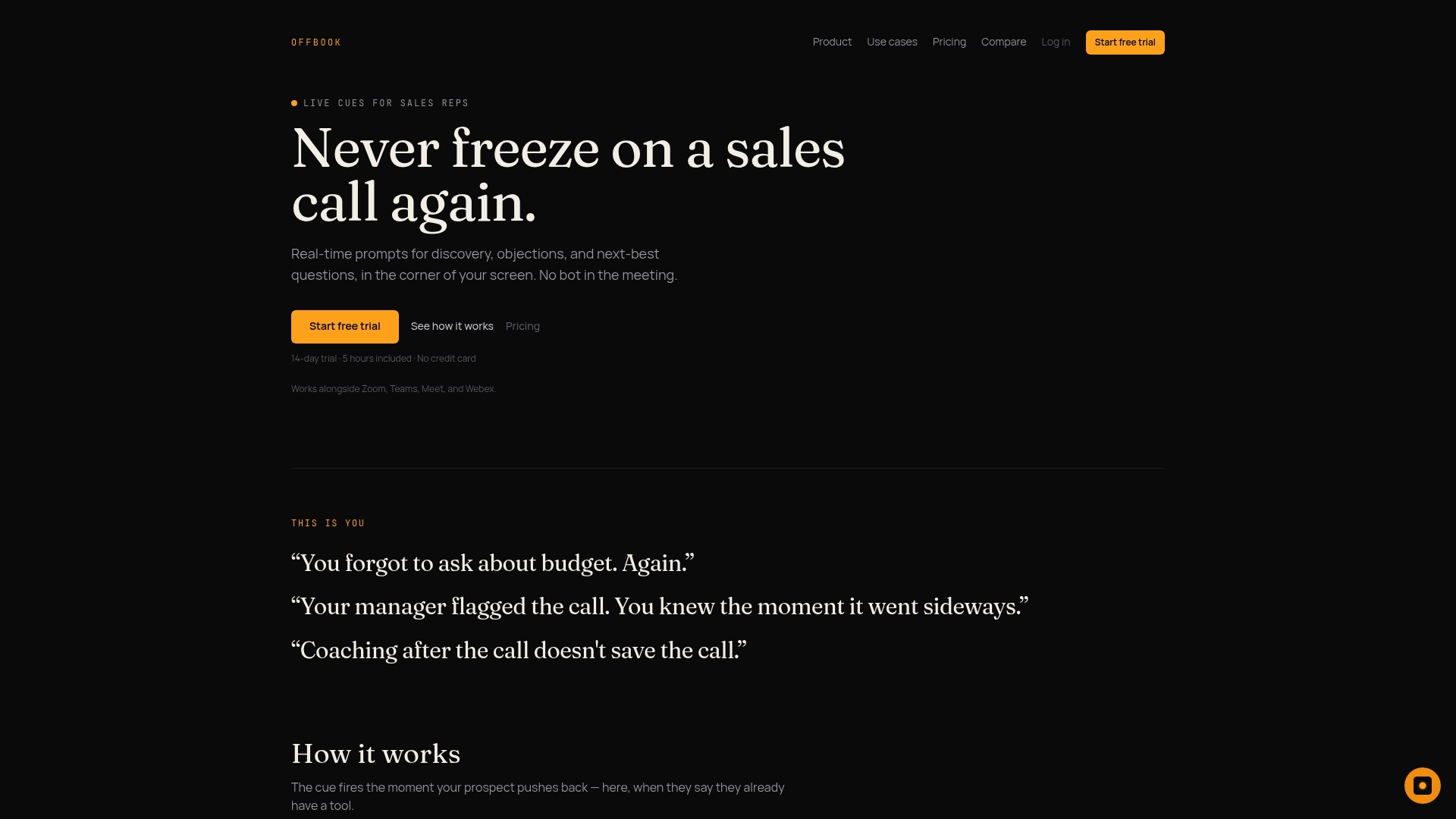
Offbook is built for exactly the problem this guide covers: reps who know the talk-to-listen target intellectually but need something in the room to catch them in the moment. It listens during the call and surfaces real-time prompts, follow-up questions, objection responses, and qualification gaps tied to MEDDIC and MEDDPICC, without a bot ever joining the meeting. Before the call even starts, it builds a brief on the company and people you’re about to meet, so the uncertainty that drives filler talk is already handled.
Teams can start on the Power plan at $59 per month or $590 per year, and startups scaling coaching across a full sales team can move to the Team plan at $1,000 per year per seat. If you want to see how the prompts work on a real objection before committing to anything, the free objection handler tool gives a quick preview. Otherwise, head to the pricing page and start a trial before your next round of discovery calls.
Sources
The talk-to-listen and question-count figures throughout this guide come from Gong’s talk-to-listen research and Gong’s 500,000-conversation study summarized by Harvard Business Review. For technique depth, Harvard Business Review’s piece on why leading questions backfire and HubSpot’s active listening guide cover paraphrase and pause tactics in more detail. For practical templates, Offbook’s discovery question list and call preparation checklist are built for immediate use.
- The Surprising Power of Questions (HBR summary of Gong research)
- Active listening guide (HubSpot blog)
FAQ
What Is the Ideal Talk-to-Listen Ratio for Sales Calls?
The benchmark most reps should aim for is close to 43% rep talk and 57% buyer listen. Top performers hold that ratio consistently across calls rather than letting it swing based on how the deal is going.
How Many Questions Should a Sales Rep Ask on a Call?
Somewhere between 11 and 14 questions per call is the range tied to the strongest conversion outcomes, according to Gong’s study of over 500,000 B2B conversations. Beyond that number, conversion actually started declining, so more questions isn’t the goal, better-placed ones are.
Does Reducing Rep Talk Time Actually Improve Close Rates?
Reducing talk time works when it’s paired with sharper questions and active listening, not silence for its own sake. Reps who talk less while still asking well-placed, scattered questions and confirming what they heard tend to uncover more real information, which directly improves qualification and close rates.
Can Real-Time Coaching Tools Reduce Rep Talk Time During a Live Call?
Yes. In-call prompts that flag a long monologue or suggest a follow-up question act at the moment the rep is deciding what to say, which changes behavior faster than a review after the call ends. Offbook works this way, surfacing cues on-screen during the conversation without a bot joining the meeting.
What’s the Fastest Way to Start Measuring My Own Talk Time?
Time yourself on your next three calls with a simple stopwatch, logging total rep speaking time against total call time. That single number, tracked weekly, is usually enough to spot whether talk time is trending in the right direction before investing in anything more elaborate.