Founder-Led Sales Discovery Calls: 2026 Guide
Unlock the secrets of founder-led sales discovery calls with our 2026 guide. Learn to diagnose problems, qualify deals, and drive success.
Published: June 17, 2026
Author: OffBook Editorial Team

Founder-led sales discovery calls are structured conversations where startup founders uncover a prospect’s challenges, decision criteria, and financial impact to qualify deals fast. Unlike demos, these calls focus entirely on listening and diagnosing before any solution is mentioned. Frameworks like SPIN Selling, MEDDIC, and MEDDPICC give founders a repeatable structure for these conversations. Tools like Offbook now layer real-time AI coaching on top of those frameworks, prompting founders with the right questions mid-call without a bot ever joining the meeting.
How to prepare for founder-led sales discovery calls
Preparation separates a productive discovery call from a wasted 30 minutes. Before you dial in, you need a clear hypothesis about the prospect’s core problem. Not a list of questions. A hypothesis. Something like: “I believe your sales team is losing deals late because reps can’t map the buying committee early enough.” That framing positions you as a peer consultant, not a vendor fishing for pain.
Here is what effective pre-call preparation looks like:
- Research the company. Review the prospect’s LinkedIn, recent press releases, job postings, and G2 reviews. Job postings reveal operational gaps better than any pitch deck.
- Pull CRM history. Check every prior touchpoint. Know what was said, what was promised, and what objections surfaced before.
- Set a call objective. Define the one qualification question you must answer by the end of the call. For MEDDIC users, that might be: “Who is the economic buyer?”
- Prepare your hypothesis. Write one sentence summarizing the business problem you expect to find. You will test it in the first five minutes.
- Fix your CTA. Changing your website CTA from “Book a Demo” to “Book a Call” sets the right expectation before the prospect even joins. Demo-labeled calls attract feature-dumping, not discovery.
Use a structured pre-call preparation checklist to make this repeatable across every rep on your team.
Pro Tip: Generate a one-page brief on the prospect’s company and the individual you are meeting before every call. Offbook does this automatically, so you walk in knowing the context without spending 20 minutes on Google.

What does a successful discovery call look like step by step?
The structure of a high-performing discovery call follows a clear arc: open with your hypothesis, ask open questions to test it, go deeper on consequences, map the buying committee, and close with a defined next step. Here is how to execute each phase.
1. open with your hypothesis
Start by sharing your hypothesis directly. Say something like: “Based on what I’ve seen with similar teams, I suspect your biggest challenge is X. Is that close?” This signals preparation, invites correction, and repositions founders as peer consultants rather than salespeople running a script.
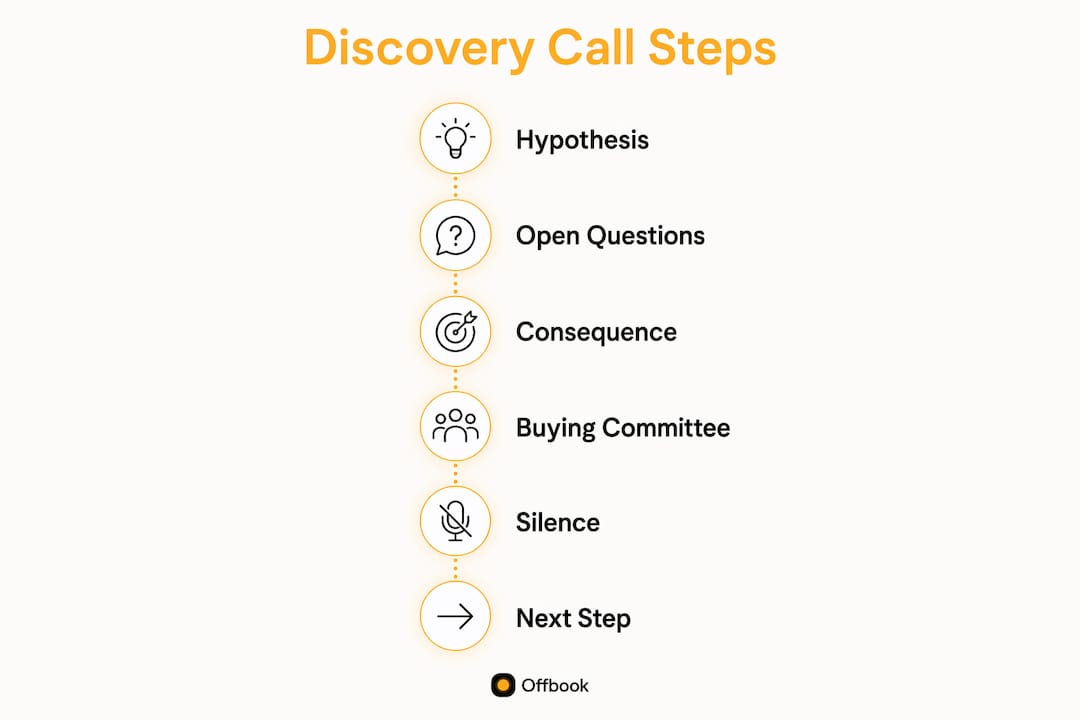
2. ask open-ended questions in sequence
Top performers ask 10–15 open-ended questions during discovery calls and achieve prospects speaking 65–70% of the time. That ratio is not accidental. It reflects a disciplined 80/20 rule: 80% open-ended questions, 20% closed. Asking fewer than 6 questions correlates directly with lower win rates. Use the SPIN sequence: Situation, Problem, Implication, and Need-Payoff. Each layer builds on the last.
3. ask consequence questions to create urgency
Generic problem questions get generic answers. Consequence questions get budget approved. Ask: “What happens to your team if this problem isn’t fixed by Q3?” or “What does this cost you per quarter in lost revenue?” Consequence-driven questions link the problem to financial impact, which is exactly what CFOs and economic buyers need to justify a purchase.
4. map the buying committee live
The average B2B deal involves 6–10 stakeholders. Founders who ignore this in the first call often find deals stalling three months later when a hidden decision-maker surfaces. Ask directly: “Who else will be involved in evaluating this?” and “Who owns the budget for this kind of decision?” Map every name and role in your CRM before the call ends.
5. use silence as a tool
Silence is not awkward. It is productive. After a strong consequence question, resist the urge to fill the gap. Let the prospect sit with the weight of the problem. The best answers come after a pause.
6. close with a defined next step
Never end a discovery call without a committed next step. Not “I’ll send you some info.” A specific meeting, a stakeholder introduction, or a defined evaluation criteria review.
Here is a quick reference for the call structure:
| Phase | Goal | Example Question |
|---|---|---|
| Hypothesis Open | Set peer-level tone | “I suspect your challenge is X. Is that right?” |
| Situation Questions | Understand current state | “Walk me through how your team handles this today.” |
| Problem Questions | Surface pain | “Where does that process break down most often?” |
| Consequence Questions | Quantify impact | “What does this cost you per quarter?” |
| Committee Mapping | Identify stakeholders | “Who else needs to sign off on this?” |
| Next Step Close | Advance the deal | “Can we schedule a working session with your VP next week?” |
Pro Tip: Your discovery call structure should feel like a conversation, not an interrogation. If you are reading questions off a list, the prospect feels it. Internalize the framework so you can follow the prospect’s thread naturally.
What are the most common mistakes in founder discovery calls?
Most founders make the same mistakes on discovery calls. Recognizing them is the first step to fixing them.
- Turning discovery into a demo. The moment you start explaining features, you have lost the call. Discovery calls and demos serve different purposes. Discovery uncovers needs. Demos demonstrate fit after qualification. Mixing them produces neither outcome well.
- Asking too few questions. Asking fewer than 6 questions during a discovery call is a documented predictor of lower win rates. Six questions is the floor, not the target.
- Ignoring the buying committee. Founders often talk to one champion and assume that person controls the deal. In complex B2B sales, early committee mapping reduces the risk of late-stage deal failure significantly.
- Skipping financial consequences. Describing a problem without quantifying its cost gives the prospect no urgency to act. Always connect pain to dollars.
- Talking too much. Top reps maintain a 30% talk, 70% listen ratio. Founders who pitch prematurely cut off the discovery process before it delivers value.
“The best discovery calls feel like a conversation between two people solving a shared problem. The worst feel like a sales interrogation where the rep already knows the answer.”
Overcoming these mistakes requires repetition. Roleplay with other founders, record your calls, and review them against a qualification framework like MEDDIC. AI coaching tools can accelerate this process by giving you feedback on question quality and talk ratios without putting a real deal at risk.
Which tools actually improve discovery call performance?
The right tools do not replace good judgment. They reinforce it at the moment it matters most.
| Tool Type | Example | Primary Benefit |
|---|---|---|
| Real-time AI coaching | Offbook | Live question prompts during video calls |
| Pre-call research briefs | Offbook | Auto-generated company and contact summaries |
| Discovery question libraries | Pitchbase | Structured question banks by sales stage |
| CRM tracking | Salesforce, HubSpot | Stakeholder mapping and deal stage tracking |
| AI roleplay simulators | AI coaching platforms | Low-stakes practice with performance feedback |
Offbook sits in a category of its own here. It coaches in the moment, not after the fact. While post-call note-takers analyze what happened, Offbook surfaces the right MEDDIC or MEDDPICC prompt on-screen while the conversation is still live. That is when coaching actually changes outcomes.
AI sales simulators allow reps to practice discovery calls extensively with feedback, accelerating skill development without pipeline risk. This matters especially for founders who are running their first 50 discovery calls and cannot afford to learn slowly.
Discovery is also not a one-time event. Information about stakeholders and timelines emerges across multiple calls, especially in enterprise deals requiring 2–4 discovery conversations. Your CRM needs to capture this incrementally, not just after the first call.
Pro Tip: Use Offbook’s AI call coaching to practice consequence questions before your next real call. Getting comfortable with silence and financial impact questions takes repetition. Do it in a simulator, not on a live deal.
Community practice also works. Find peer founder groups or sales communities where you can run live roleplay sessions. The feedback from another founder who has run 200 discovery calls is often more direct and practical than any training course.
Key takeaways
Founder-led discovery calls succeed when founders prepare a strong hypothesis, ask 10–15 consequence-driven questions, and map the buying committee before the call ends.
| Point | Details |
|---|---|
| Lead with a hypothesis | Start every call by testing a specific problem assumption, not a generic question list. |
| Ask 10–15 open questions | Fewer than 6 questions correlates with lower win rates; aim for 80% open-ended questions. |
| Use consequence questions | Link every problem to financial impact to create urgency with economic buyers and CFOs. |
| Map the buying committee early | B2B deals involve 6–10 stakeholders; identify them in the first call to prevent late-stage stalls. |
| Treat discovery as ongoing | Complex deals require 2–4 discovery conversations; update your CRM after every stakeholder interaction. |
The insight most founders miss about discovery calls
Most founders treat discovery calls as a qualification checkbox. Run the call, score the lead, move on. That framing is wrong, and it costs deals.
The best discovery calls I have seen do something different. They make the prospect feel understood before a single feature is mentioned. That shift happens when you lead with a hypothesis instead of a question list. When you say “I think your problem is X,” you are showing that you did the work. The prospect’s guard drops. They start talking honestly instead of defensively.
Consequence questions are where I see the biggest gap between average and top-performing founders. Most founders ask “What’s your biggest challenge?” and accept a surface-level answer. The real question is “What happens to your business if this isn’t fixed in the next six months?” That question changes the energy of the entire call. Suddenly the prospect is doing the financial justification work for you, out loud, before you have said a word about pricing.
The other thing I have learned: discovery does not end after the first call. Founders who treat it as a single event miss critical information that surfaces later, often too late to save the deal. Build discovery questions into every subsequent touchpoint. Ask about new stakeholders. Revisit timelines. The hypothesis-led approach works precisely because it keeps the conversation open across the entire sales cycle, not just the first 30 minutes.
For busy founders running 10 calls a week, the practical answer is a repeatable system. A pre-call brief, a question framework, and a real-time coaching layer that catches you when you drift toward pitching. That combination is what separates founders who close from founders who just have a lot of meetings.
— Neil
Practice discovery calls without risking real deals
Offbook is built for exactly this moment in a founder’s sales journey. You know the frameworks. You understand MEDDIC. But knowing and executing under pressure are two different things.
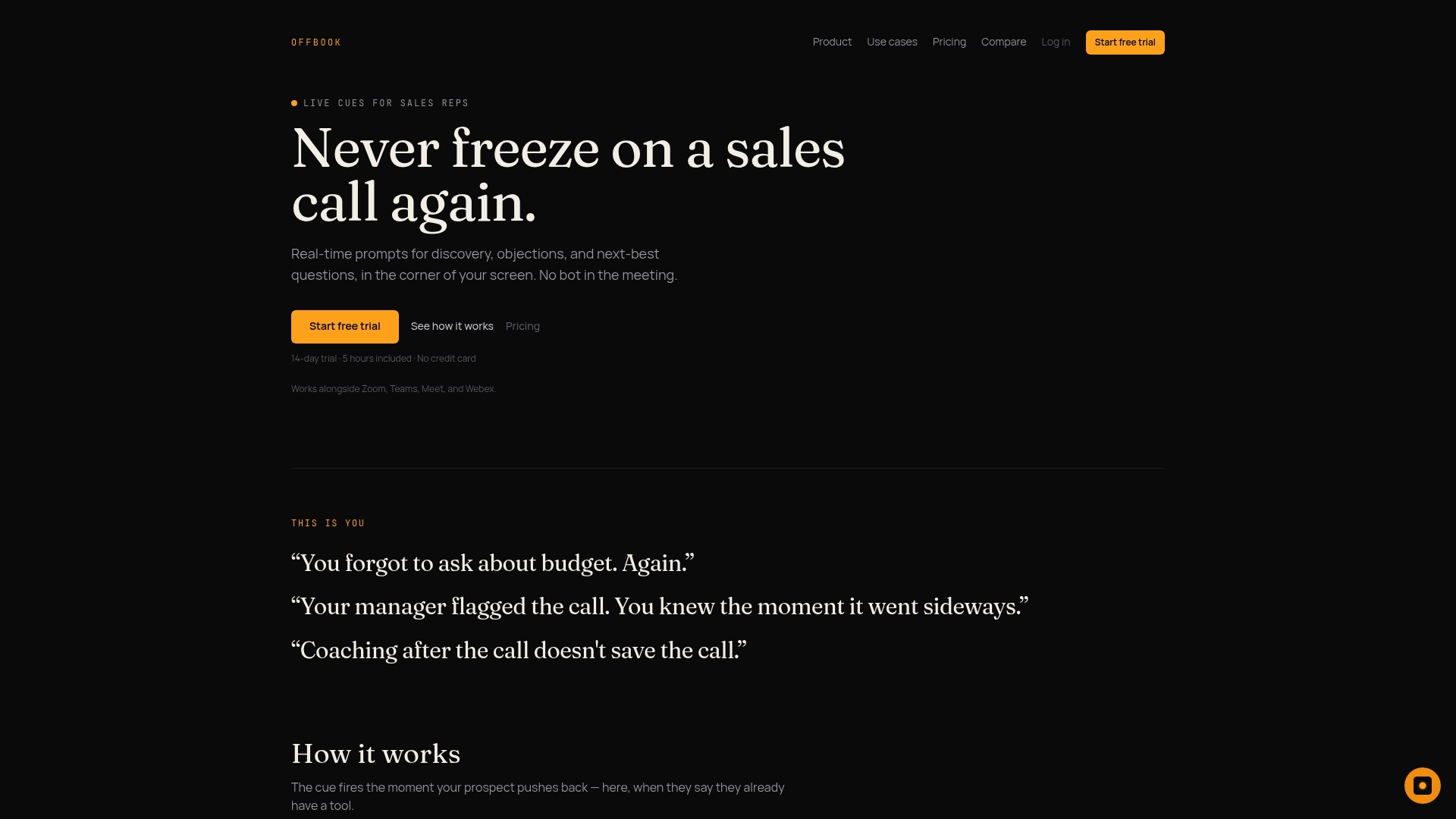
Offbook surfaces live AI cues on-screen during your video calls, prompting you with the right discovery questions, flagging qualification gaps, and guiding you through MEDDIC and MEDDPICC in real time. No bot joins the meeting. No one on the other side knows it is there. Before the call, Offbook generates a research brief on the company and contact so you walk in with context, not guesswork. If you want to sharpen your discovery call skills before your next real conversation, Offbook is where that practice happens.
FAQ
What is the difference between a discovery call and a demo?
A discovery call uncovers a prospect’s needs, challenges, and decision criteria before any product is shown. A demo demonstrates product fit after qualification is complete. Running them in the wrong order leads to feature-dumping and low conversion rates.
How many questions should you ask on a discovery call?
Top performers ask 10–15 open-ended questions and aim for prospects speaking 65–70% of the time. Asking fewer than 6 questions is a documented predictor of lower win rates.
What are consequence questions in sales discovery?
Consequence questions connect a prospect’s problem to its financial or operational impact. An example is: “What does this cost your team per quarter if it stays unresolved?” These questions create urgency and help economic buyers justify budget approval.
How do you map the buying committee during discovery?
Ask directly who else evaluates this type of decision and who owns the budget. Record every name and role in your CRM immediately. The average B2B deal involves 6–10 stakeholders, and missing one early is a common cause of late-stage deal failure.
Can AI tools help founders improve discovery call skills?
Yes. AI roleplay platforms let founders practice discovery calls with performance feedback on question quality and talk ratios without risking live deals. Offbook goes further by coaching in real time during actual calls, surfacing prompts on-screen as the conversation unfolds.