Cut SaaS Sales Cycles 20–40% in 4–8 Weeks for Founder Led SaaS Teams
A 4–8 week, stage-by-stage roadmap for founder led SaaS teams to cut sales cycles 20–40% by enforcing MEDDPICC, compressing POCs, building a Trust Center,...
Published: September 8, 2026
Author: OffBook Editorial Team

The fastest way to shorten a SaaS sales cycle is to qualify harder, multi-thread earlier, and strip out back-end friction like contracting and security review. Teams that combine tighter MEDDPICC discipline with compressed evaluations and pre-built trust packets see the largest velocity gains, often in the 20 to 40 percent range. The rest of this playbook breaks that down stage by stage, with a 4 to 8 week roadmap you can run starting Monday.
TL;DR:
- Shortening the sales cycle by 20 to 40 percent can significantly boost revenue velocity without needing more pipeline or higher win rates.
- Prioritize immediate actions like enforcing mandatory qualification gates and multi-threading early, followed by foundational process improvements such as Trust Centers and compressed proof-of-concept windows.
- Track specific metrics including time-in-stage, proposal turnaround, and stakeholder engagement to identify bottlenecks and measure progress effectively.
- Deal stalls are often caused by single-threaded contacts, lack of a clear economic buyer, or unclear decision criteria, not by market conditions.
- Implementing live coaching tools that provide real-time prompts during calls can improve qualification accuracy and reduce cycle time more than post-call training.
Table of Contents
- What’s a Normal SaaS Sales Cycle Length, and Why Does It Matter?
- What Are the Highest-Impact Ways to Shorten a SaaS Sales Cycle?
- How Long Should Each Sales Stage Actually Take?
- Where Should You Start? A 4 to 8 Week Rollout Plan
- Which Metrics Actually Tell You If Your Cycle Is Getting Shorter?
- What Red Flags Signal a Deal Is About to Stall?
- How AI Coaching and Pre-Call Prep Speed Up the Same Levers
- What Should You Actually Prioritize First?
- Close More Deals With Live Coaching That Works While You’re on the Call
- Sources
What’s a Normal SaaS Sales Cycle Length, and Why Does It Matter?
The median B2B SaaS sales cycle now runs about 84 days, and that number has been drifting longer, not shorter, as buying committees grow and procurement gets stricter. But “median” hides the real story. A self-serve tool with a $3,000 annual contract might close in two to three weeks. An enterprise platform at $80,000 ACV can easily take four to six months, because it routes through legal, security, finance, and sometimes a formal RFP.
That spread matters because it tells you where to focus. If you’re selling into SMB accounts and your cycle is still stretching past 60 days, something in your process is broken, not your market. If you’re enterprise and closing in 90 days, you’re probably already outperforming peers.
Here’s the financial case for compression, and it’s more concrete than most sales leaders realize. Revenue velocity is calculated as (Opportunities × Average Deal Value × Win Rate) ÷ Cycle Length. That’s the argument to bring to your CEO when you ask for budget to fix contracting delays or build a proper trust packet.
Statistic to remember: a 20 to 40 percent cycle reduction increases revenue velocity proportionally, because cycle length sits in the denominator. You don’t need a bigger pipeline or a higher win rate to grow revenue faster. You need a shorter clock.
What actually stretches the clock? Three things dominate: buying committees have swelled from two or three stakeholders to five or more on mid-market deals, procurement and security review now touch almost every deal above $15,000 ACV, and buyers arrive further into their own research, which paradoxically slows things down because they’ve built assumptions you now have to unwind.
What Are the Highest-Impact Ways to Shorten a SaaS Sales Cycle?
Not every fix carries equal weight. Some levers save you three days. Others save you three weeks. Here’s the priority order, ranked by impact and how fast you can implement each one.
- Qualify harder, and disqualify faster. MEDDPICC (Metrics, Economic Buyer, Decision Criteria, Decision Process, Paper Process, Identify Pain, Champion, Competition) exists precisely to catch weak deals before they eat six weeks of your calendar. High-velocity teams treat a missing economic buyer or an unclear paper process as a stop sign, not a detail to chase down later. Rework’s research on pipeline management found that MEDDPICC discipline forces early disqualification and directly cuts time-in-stage, because reps stop nurturing deals that were never going to close.
- Multi-thread by the second call, not the fifth. Single-threaded deals, where you talk to one champion and nobody else, are the single biggest hidden cause of stalled pipelines. If you haven’t identified and engaged three to five stakeholders by the end of Stage 2, the deal is at risk regardless of how warm your champion sounds.
- Compress your proof-of-concept window. Traditional 60 to 90 day pilots let deals drift. A 14 to 30 day compressed POC with a named champion, a narrow scope, and pre-agreed success metrics gets you a real yes or no instead of a slow, maybe.
- Send proposals within 24 to 72 hours of the final discovery call. Waiting a week to “polish” a proposal is dead time that costs you momentum and gives competitors room to enter. Templatize 80% of your proposal content so reps are customizing, not building from scratch.
- Pre-build your security and contracting packets before you need them. A public Trust Center, SOC 2 documentation, a signed DPA template, and a standard MSA that legal has already blessed can shave multiple weeks off late-stage enterprise deals. Most teams build these reactively, deal by deal, which is the slowest possible way to do it.
- Automate the admin that eats rep time. CRM data entry, follow-up sequencing, and meeting scheduling don’t require a human. Sales acceleration frameworks lean heavily on automation and better data specifically because it frees reps to spend more time multi-threading and less time on busywork. A well-built tech stack does more for cycle time than another round of rep training.
- Introduce a Mutual Action Plan on any deal above roughly $15,000 ACV. A MAP is a shared document listing every remaining step, owner, and date, agreed jointly by you and the buyer. It exposes stalls immediately instead of letting them hide inside a vague “checking with the team” response.
The common thread across all seven is that shortening cycles is mostly an architectural problem, not a motivational one. Telling reps to “move faster” rarely works. Changing the qualification bar, the multi-threading requirement, and the paperwork that sits between a verbal yes and a signature does.
Pro Tip: Audit your last ten closed-won deals and count how many stalled for more than five days waiting on legal or security review. If it’s more than three, your Trust Center is your highest-leverage project this quarter, not your next hire.
How Long Should Each Sales Stage Actually Take?
Generic advice to “move faster” is useless without a target. Here’s a stage-by-stage benchmark you can hold your team to, along with what actually needs to happen in each window.
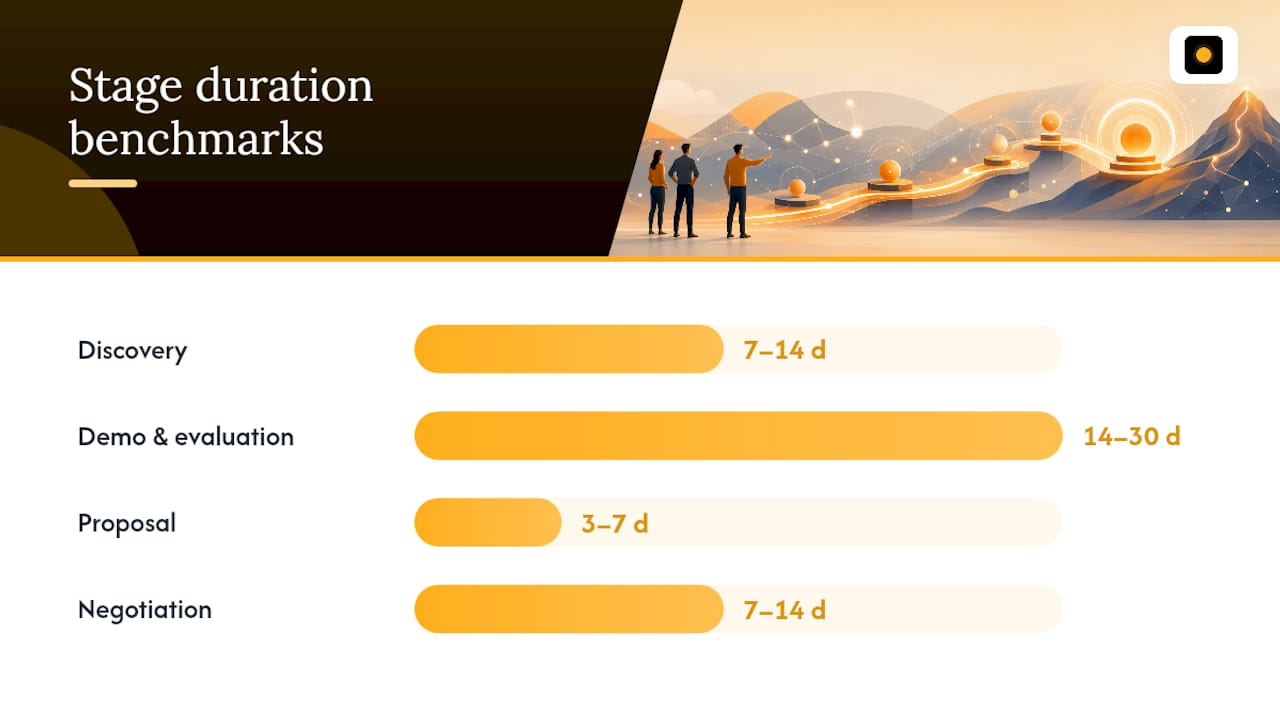
Discovery: 7 to 14 days. Run one structured 90-minute discovery session that includes as many stakeholders as you can get on the call, rather than three separate 30-minute calls spread over two weeks. Come in with pre-call research already done on the company and the people attending, so you’re not spending the first 15 minutes asking questions Google already answered. If the fit isn’t there, say so on the call. Immediate disqualification is a feature, not a failure.
Demo and evaluation: 14 to 30 days. For deals under $20,000 ACV, combine discovery and demo into a single call whenever the buyer’s problem is clear enough to skip the separate step. For anything requiring a proof of concept, run the compressed 14 to 30 day version: one named champion, three or fewer success metrics, and a hard end date agreed upfront. Open-ended pilots with no defined finish line are where deals go to die.
Proposal: 3 to 7 days. Have pricing conversations early, ideally during discovery, so the proposal isn’t the first time the buyer sees a number. A templatized proposal that a rep customizes in an afternoon beats a bespoke deck built from scratch every time. Speed here signals organization; buyers notice.
Negotiation: 7 to 14 days. Build a clear escalation path so reps know exactly when to loop in a manager and what discount thresholds they can approve without one. Vague negotiation guardrails are how a two-week back-and-forth becomes a six-week one.
Contracting: 3 to 10 days for mid-market deals. This is where a public Trust Center, a pre-filled security questionnaire, and an e-signature workflow pay for themselves. Multi-threading and verified contact data materially improve close speed at this stage too, because a legal team that’s been looped in since Stage 2 doesn’t need a rushed introduction in week fourteen.
A few practical guardrails to hold across every stage:
- Every stage transition needs a documented reason to move forward, not just elapsed time.
- No deal advances past discovery without an identified economic buyer or a clear plan to reach one.
- Stalled deals get flagged automatically after seven days of inactivity, not discovered manually in a pipeline review.
For a deeper breakdown of what typically causes deals to stall between these stages, see this explanation of the B2B sales cycle and the related deal advancement techniques for pushing stuck opportunities forward.
Where Should You Start? A 4 to 8 Week Rollout Plan
You don’t need to rebuild your entire sales process at once. Split the work into quick wins you can ship in a month and architectural changes that take longer but pay off more.
- Weeks 1 to 4, quick wins. Install hard qualification gates in your CRM so deals can’t advance without a completed MEDDPICC field. Clean up stale contact data, since dead or outdated contacts are a deceptively high-impact drag that adds weeks to deals without anyone noticing. Build three to five proposal templates covering your most common deal shapes. Turn on automated follow-up sequences so no lead sits untouched for more than 48 hours. This four-week qualification sprint is the highest-ROI stretch in the whole roadmap.
- Weeks 5 to 8, foundational architecture. Launch a public Trust Center with your SOC 2 report, DPA template, and standard MSA. Build the compressed POC template with a fixed 14 to 30 day structure and default success metrics. Wire MEDDPICC scoring directly into pipeline stages so reps can’t skip it.
- Weeks 9 to 12, incentives and scale. Consider a modest bonus for deals closed under your target cycle time, but gate it behind a completed MEDDPICC score and a multi-threading minimum. Without that gate, reps will game the bonus by rushing weak deals instead of qualifying them properly.
Involve your head of sales, one senior AE, and someone from legal or ops in week one. You need legal’s buy-in before the Trust Center goes live, and you need a skeptical AE’s feedback before you roll qualification gates out to the whole team.
Pro Tip: Measure the quick wins against your last full quarter’s average cycle time before you touch anything architectural. If the qualification gate alone doesn’t move the number within four weeks, the bottleneck is somewhere else, likely contracting or procurement, and that’s where week five should focus.
Which Metrics Actually Tell You If Your Cycle Is Getting Shorter?
Tracking the wrong numbers is almost as bad as tracking nothing. Deal velocity, calculated the same way as revenue velocity but isolated to a single team or segment, is the north star metric because it captures speed and quality in one number instead of celebrating fast losses.
Beyond that headline number, a handful of supporting metrics tell you where the friction actually lives:
- Time-in-stage for each of the five stages, tracked weekly, not quarterly.
- Win rate segmented by cycle length cohort, since a shorter average cycle that also drags down win rate isn’t actually a win.
- MEDDPICC completion rate at the point a deal enters proposal stage.
- Percentage of proposals sent within 24 to 72 hours of the final discovery call.
- Number of active stakeholders engaged per deal by the end of Stage 2.
Set a reporting cadence that matches how fast the data actually changes. A weekly pipeline velocity report catches stalls before they become quarter-ending surprises. One-on-ones should zoom in on time-in-stage for that rep’s specific pipeline rather than reviewing the whole funnel. Reserve a full cycle-time review for quarterly planning, since that’s the horizon where architectural changes like a new Trust Center actually show measurable movement. For more on which levers move which metric, this breakdown of deal advancement tactics maps specific actions to specific stage-time reductions.
What Red Flags Signal a Deal Is About to Stall?
Certain patterns predict a stalled deal with uncomfortable accuracy. Catching them early saves weeks you’d otherwise spend chasing a deal that was never going to close on your timeline.
- A deal still single-threaded past the second call, with no plan to bring in additional stakeholders.
- No identified economic buyer, or a champion who can’t name one when asked directly.
- A timeline that keeps sliding without a specific blocking reason attached to it.
- Contact and company data that’s more than a quarter old, especially on job titles and org structure.
- A proof-of-concept with no defined end date or success criteria, sometimes called an open-ended pilot.
Before advancing any deal past discovery, confirm you can answer three questions: who signs the check, what specifically has to be true for them to say yes, and what’s the actual date this needs to close by. If you can’t answer all three, don’t advance the deal. Requeue it for nurture instead.
Disqualifying respectfully matters as much as disqualifying quickly. A simple script works: “Based on what we’ve covered, I don’t think we’re the right fit for this right now, here’s why, and here’s what would need to change for that to be different.” That closes the loop honestly and keeps the door open without burning a week of false hope on either side.
How AI Coaching and Pre-Call Prep Speed Up the Same Levers
Every lever above depends on reps doing something well in real time: asking the right qualification question, catching a missing stakeholder before the call ends, walking in already knowing who they’re talking to. That’s the exact gap live coaching tools were built to close.
Live coaching software listens to sales calls and surfaces on-screen prompts as the conversation happens, structured around MEDDPICC, without a bot ever joining the meeting. Practitioner reporting on conversation coaching backs the underlying premise: live coaching and preparation reduce rep prep time and improve on-call outcomes, which in turn enables faster multi-threading and qualification instead of a rep realizing three days later they forgot to ask about the economic buyer.
The gap between a good qualification framework and a rep actually using it live, mid-call, under pressure, is where most cycle-time gains quietly disappear. Real-time cues close that gap at the moment it matters, not in a post-call debrief nobody rereads.
Neil’s take: teams that treat qualification as a training exercise instead of an in-call discipline lose the compounding effect. A rep who gets prompted about a missing economic buyer while the buyer is still on the call can fix it in the same conversation. A rep who learns about the gap in a Monday pipeline review has already lost a week.
What Should You Actually Prioritize First?
Most advice on shortening sales cycles treats every lever as equally urgent, which is exactly backwards. Qualification is where the conventional wisdom gets it wrong: sales leaders love to talk about disqualifying faster, but almost nobody builds the actual gate that forces it. A MEDDPICC field that’s optional in the CRM is not a qualification process. It’s a suggestion, and reps will skip it under quota pressure every time.

The overrated fix is more training. Reps already know they should multi-thread and qualify harder. What they lack is a system that catches the gap while the deal is still live, not a slide deck reviewed once a quarter.
If you do one thing this month, make qualification mandatory before pipeline advancement, not optional. Everything else on this list works better once that gate is real.
— Neil
Close More Deals With Live Coaching That Works While You’re on the Call
Every lever in this article, tighter qualification, faster multi-threading, sharper proposals, depends on a rep executing well in the moment, not remembering the playbook after the call ends. Live coaching software gives reps live, on-screen cues during the call itself: MEDDPICC-structured prompts for objections to handle and qualification gaps to close, plus a pre-call brief on the company and people they’re about to meet, so they walk in already prepared instead of improvising discovery questions in real time.
After the call, the software generates a debrief and a follow-up draft automatically, cutting the admin time that otherwise delays your proposal past the 24 to 72 hour window that actually matters for close speed. It’s built specifically for B2B SaaS teams where there’s no dedicated sales enablement function to build MEDDPICC training from scratch. If your reps are qualifying inconsistently or forgetting to multi-thread until deal review, the fix isn’t more coaching after the fact. Start a free trial and see what live, in-call prompts do for your sales team’s close rate.
Sources
- Sales cycle reduction: Systematic strategies to shorten time-to-close - Rework resources
- Cut Sales Cycle 40% in 60 Days — Optifai Method + Calculator | Revenue Velocity Lab
- SaaS Sales Cycle: Benchmarks & Stage Timing (2026) — Prospeo
- What is sales acceleration? — ZoomInfo Pipeline