Sales Call Preparation Checklist for B2B SaaS Reps
Maximize your success with our effective sales call preparation checklist for B2B SaaS reps. Elevate your sales game today!
Published: June 4, 2026
Author: OffBook Editorial Team

A sales call preparation checklist is a structured pre-call workflow that ensures every conversation is focused, relevant, and built to move a deal forward. 82% of decision-makers report that sales reps arrive unprepared, yet top performers consistently conduct thorough pre-call research before every meeting. The gap between those two groups is not talent. It is process. This guide gives you a repeatable checklist framework, explains how to adapt it across discovery, demo, and follow-up calls, compares the qualification frameworks that make it sharper, and shows where AI tools like Offbook close the remaining gaps.
What are the critical steps in a sales call preparation checklist?
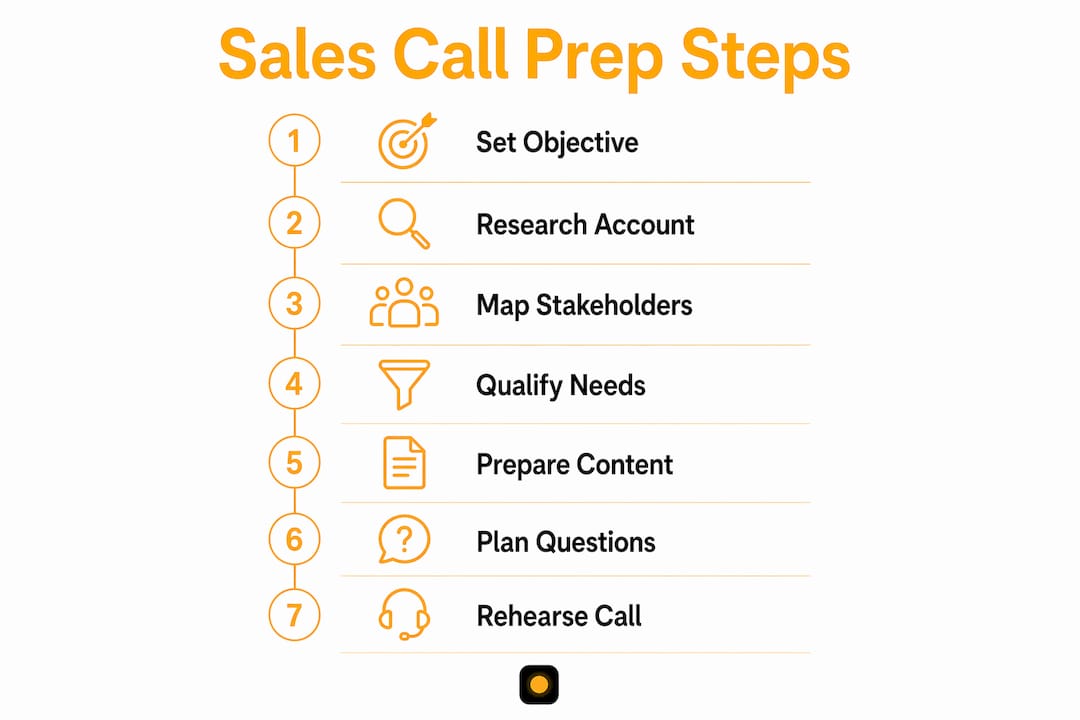
Pre-call planning is the industry term for what most reps call “getting ready.” A strong pre-call planning checklist moves from broad business context down to specific call tactics, so your conversation feels relevant rather than scripted. Follow these seven steps before every B2B SaaS call.
-
Define one clear call objective. Decide the single decision or commitment you need from this call. “Learn about their tech stack” is not an objective. “Confirm budget authority and agree on a technical evaluation scope” is. Defining a single outcome prevents discovery drift and keeps the call from ending with vague next steps.
-
Review CRM history and past interactions. Pull every prior touchpoint: emails, call notes, demo recordings, and support tickets. Look for unresolved objections, promises made, and signals the prospect gave about timing or priorities. Skipping this step means asking questions the buyer already answered, which destroys credibility fast.
-
Map stakeholders, including the ones not on the call. List every attendee and identify who is missing. A VP of Sales joining without the CFO present is a signal worth noting. Stakeholder maps must account for missing roles and their likely objections so you can sequence questions to surface those gaps during the call.
-
Gather account signals and trigger events. Check LinkedIn for recent job changes, press releases for funding rounds, and G2 or Capterra for recent reviews. A company that just hired a new CRO or closed a Series B is in a different buying posture than one that has been quiet for six months. These signals give you a credible reason to be calling right now.
-
Build a tailored point of view with proof points. Generic pitches lose to silence. Prepare one or two proof points specific to the prospect’s industry, company size, or stated pain. A SaaS company scaling from 20 to 60 reps needs different evidence than an enterprise team standardizing across regions.
-
Prepare discovery questions and anticipate objections. Write out five to seven questions that advance your objective, not just fill time. Then list the three most likely objections: pricing, competing priorities, and internal approval are the most common objection categories in B2B sales. Prepare a one-sentence response to each before you dial.
-
Plan mutual next steps and post-call tasks. Know what you will ask for at the end of the call before the call starts. Decide what you will send within 24 hours and what CRM fields you will update. Structured call notes that mirror your checklist fields eliminate rediscovery on the next call and keep deal momentum intact.
Pro Tip: Set a hard 20-minute prep limit per call. If your checklist takes longer than that, you are researching instead of preparing. The goal is a focused brief, not a biography.
How does checklist prep change by call type?
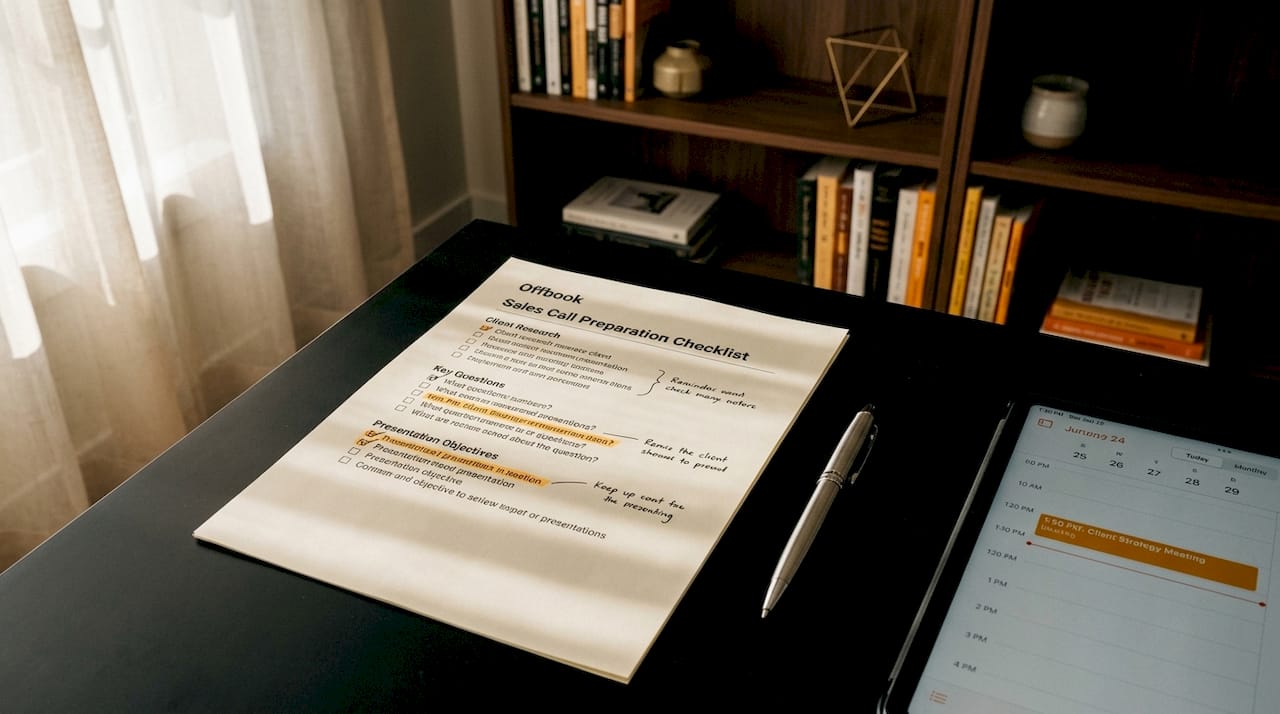
A sales call guide that treats every call the same is not a guide. It is a template. The structure of your preparation shifts depending on where the buyer is in the process.
Discovery calls demand the deepest qualification work. Your checklist should include BANT (Budget, Authority, Need, Timeline) or MEDDIC (Metrics, Economic Buyer, Decision Criteria, Decision Process, Identify Pain, Champion) as a self-assessment before the call. Run through each criterion and mark what you know versus what you need to find out. That gap list becomes your question set. For SaaS specifically, pay attention to current tool usage, contract renewal dates, and team size changes, since those three signals predict buying urgency better than almost anything else.
Demo calls shift the checklist toward content readiness. Confirm which use cases matter most to this specific buyer, not the generic persona. Prepare an ROI framework with their numbers if you have them. Check that your demo environment reflects their industry and that any integrations they care about are visible in the flow. Technical readiness checks belong here too: screen share tested, backup slides ready, and a fallback if the live environment fails.
Follow-up calls are where most deals stall because reps treat them as check-ins rather than structured advances. Your checklist for a follow-up should start with a review of every commitment made on the last call, both yours and theirs. Then define the one new commitment you need from this call to move the deal stage forward.
Pro Tip: For SaaS deals with multiple stakeholders, add a “champion health check” to every follow-up checklist. Ask yourself: has your champion gone quiet, changed roles, or stopped responding to emails? A silent champion is a deal at risk.
AI tools now automate the research layer of this work. AI agents for sales prep generate concise call briefs with objectives, stakeholder maps, top questions, and draft follow-ups, cutting manual prep time without sacrificing quality. That time savings compounds across a full week of calls.
Which qualification frameworks work best with your checklist?
Qualification frameworks serve as readiness checks, not conversation scripts. They tell you what you do not yet know before you walk into a call, which is exactly what a checklist needs to surface.
Here is how the four most common frameworks map to different call types and deal complexities in B2B SaaS:
| Framework | Best for | Core focus | Checklist integration point |
|---|---|---|---|
| BANT | Early-stage discovery | Budget, Authority, Need, Timeline | Use as a gap audit before the first call |
| CHAMP | Mid-market discovery | Challenges, Authority, Money, Prioritization | CHAMP suits early discovery where pain is unclear |
| MEDDIC | Complex or enterprise deals | Metrics, Economic Buyer, Decision Criteria, Process, Pain, Champion | Map each criterion to a CRM field and update after every call |
| GPCTBA | Inbound or product-led deals | Goals, Plans, Challenges, Timeline, Budget, Authority | Use when the buyer has already expressed intent and you need to qualify depth |
MEDDIC and MEDDPICC (which adds Paper Process and Competition) are the standard for SaaS teams selling deals above $50K ACV. The reason is specificity. MEDDIC forces you to identify the Economic Buyer by name before the call, not during it. If you cannot name that person in your checklist, you have a preparation gap and a deal risk at the same time.
Pro Tip: Log your qualification framework fields in your CRM immediately after each call, not the next morning. Memory degrades fast, and vague notes like “seems interested” are useless for forecasting or handoffs.
For a deeper look at how enterprise B2B buying actually works across stakeholder groups, the dynamics behind these frameworks become even clearer.
What mistakes undermine even well-prepared sales calls?
Preparation errors are not always about doing too little. Some of the most common mistakes come from doing the wrong things with confidence.
-
Setting vague objectives. “Have a good conversation” is not a call objective. Without a measurable outcome defined in advance, calls drift and close with “I’ll follow up next week” as the only output.
-
Ignoring stakeholder gaps. Mapping only the people on the invite is a common trap. The person who will kill the deal is often the one not on the call. Missing decision-makers and their objections need to be anticipated in your prep, not discovered after the fact.
-
Skipping objection prep. Reps who have not rehearsed responses to pricing or competitive objections tend to over-explain or discount too quickly. Both behaviors signal low confidence and weaken your position.
-
Taking unstructured notes. Notes that do not mirror your checklist fields create rediscovery problems on the next call. Capturing pain in the buyer’s own words, alongside budget signals and timeline details, is the difference between a useful call record and a paragraph of impressions.
-
Relying on a generic script. Scripts trained on average buyers produce average results. Tailored conversation plans built around this specific company’s signals, pain points, and stakeholder map consistently outperform them.
-
Skipping mock calls. Mock sales calls build the muscle memory that makes real calls feel controlled rather than reactive. Even one 15-minute roleplay before a high-stakes call measurably improves confidence and objection handling.
Pro Tip: Use weak discovery questions as a diagnostic. If your questions could apply to any company in any industry, they are not discovery questions. They are conversation fillers.
AI call coaching tools catch preparation gaps that reps miss on their own. Offbook, for example, surfaces live cues during the call itself when a qualification gap appears in the conversation, which means even an imperfect prep gets corrected in real time.
Key takeaways
A disciplined sales call preparation checklist, built around a clear objective, thorough stakeholder mapping, and a matched qualification framework, is the single most reliable predictor of call quality in B2B SaaS.
| Point | Details |
|---|---|
| Define one objective per call | A single measurable outcome prevents drift and gives the call a clear close. |
| Map missing stakeholders | Identify who is not on the call and prepare for their objections in advance. |
| Match framework to call type | Use CHAMP for early discovery, MEDDIC for complex deals above $50K ACV. |
| Structure your notes to your checklist | Notes that mirror checklist fields eliminate rediscovery and improve forecasting. |
| Use AI to close prep gaps | AI call briefs and real-time coaching catch what manual prep misses. |
Why preparation is the only sales advantage that compounds
Most sales advice focuses on what happens during the call. Tone, pacing, objection handling, closing technique. Those skills matter, but they are hard to scale because they depend on individual talent. Preparation scales. Every rep on your team can follow a checklist. Not every rep can improvise their way through a CFO objection they did not see coming.
What I have seen consistently across B2B SaaS teams is that the reps who struggle are not the ones who lack charisma. They are the ones who walk into calls without a defined objective and without knowing who else influences the decision. They are talented people running on incomplete information, and no amount of in-call skill compensates for that.
The qualification framework piece is where most teams underinvest. MEDDIC is not a call script. It is a pre-call self-assessment that tells you exactly what you do not know yet. Running through it before a discovery call takes five minutes and surfaces gaps that would otherwise cost you two more meetings to uncover. That is the compounding part. Better prep means shorter sales cycles, not just better calls.
The technology angle is real too. AI-generated call briefs are not a shortcut for lazy reps. They are a floor that raises the minimum standard of preparation across the whole team. When every rep walks in with a stakeholder map, a tailored proof point, and three anticipated objections, the average call quality goes up, and so does the win rate.
The teams I respect most treat their checklist as a living document. They review it after every lost deal, add new trigger events to watch for, and update their objection responses when the market shifts. That discipline is what separates a process from a habit.
— Neil
How Offbook makes your pre-call prep faster and your calls sharper
Preparation takes time, and time is the one resource B2B SaaS reps never have enough of. Offbook generates pre-call briefs automatically, pulling together company context, stakeholder details, and qualification gaps before you ever open a browser tab.
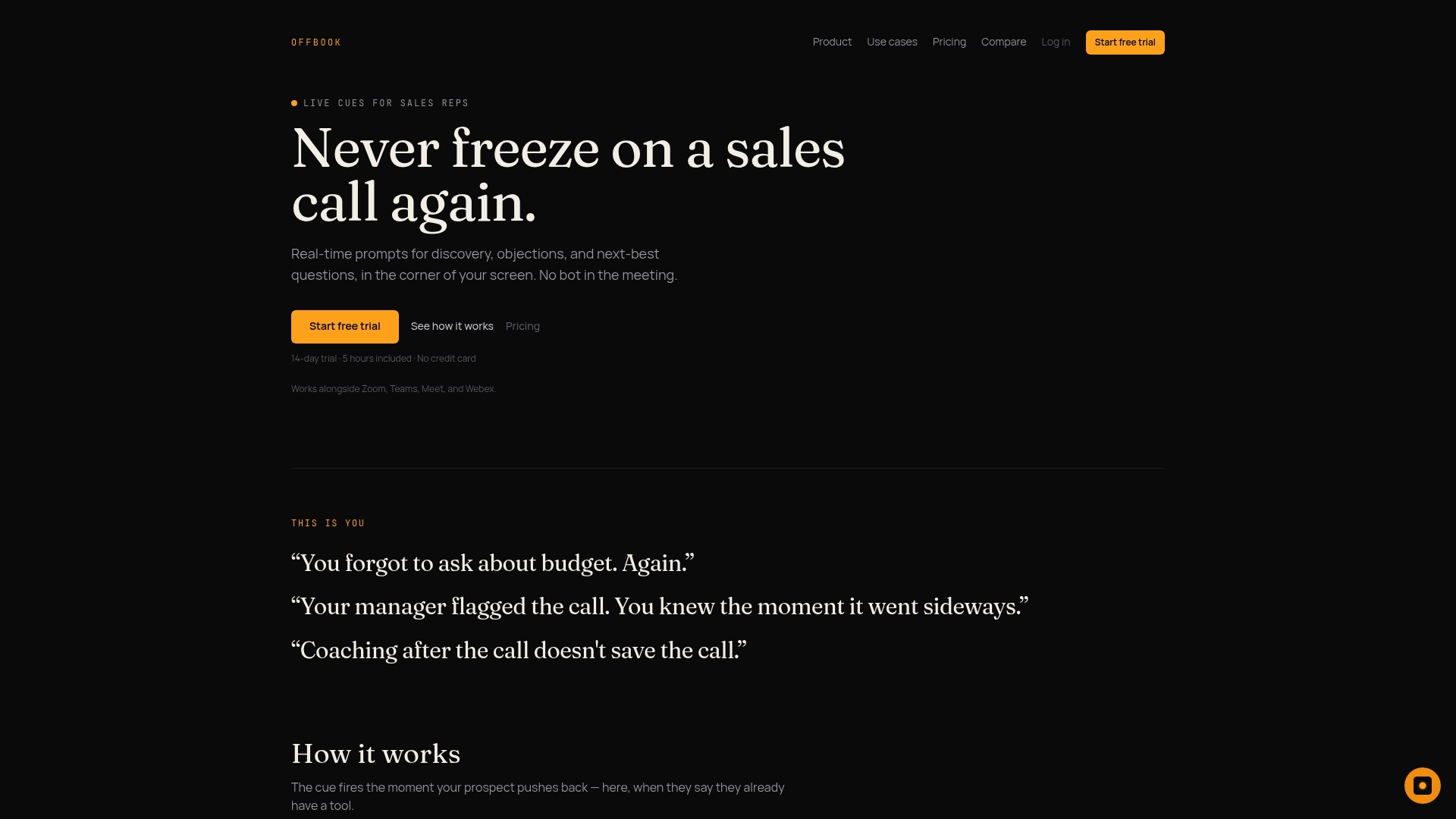
During the call itself, Offbook surfaces live AI cues on-screen, prompting you with the right questions, flagging objections as they surface, and tracking MEDDIC or MEDDPICC gaps in real time. No bot joins the meeting. No one on the other side knows it is there. For sales teams at the seed and Series A stage, it is the difference between coaching that happens after the deal is lost and coaching that changes the outcome while it still can. Founders running their own sales motion can explore the founder-specific coaching track built for exactly that context.
FAQ
What should a sales call preparation checklist include?
A complete checklist covers objective setting, CRM review, stakeholder mapping, account signal research, tailored proof points, discovery questions, objection anticipation, and a planned next step. Each element has a direct output that shapes how the call runs.
How long should pre-call preparation take?
For most B2B SaaS calls, 15 to 20 minutes of focused preparation is enough. AI-generated call briefs can compress the research phase significantly, letting reps spend their prep time on question design and objection planning instead.
Which qualification framework is best for SaaS discovery calls?
CHAMP works well for early-stage discovery where the buyer’s challenges are still unclear. MEDDIC is the standard for complex deals above $50K ACV because it forces identification of the Economic Buyer and decision process before the call begins.
Why do well-prepared reps still lose deals?
Preparation gaps around missing stakeholders and unresolved objections are the most common causes. A rep can follow every checklist step and still lose if they have not accounted for the person who was not on the call but had veto power over the decision.
How does AI improve sales call preparation?
AI tools generate structured call briefs with objectives, stakeholder maps, and draft questions automatically. Real-time coaching tools like Offbook then extend that preparation into the call itself, surfacing qualification gaps and objection cues as the conversation unfolds.