Two Week No Meeting Bot Pilot for Founder Led SaaS Sales Coaching
Pilot playbook for founder led SaaS: run a two week no meeting bot pilot to coach sales calls, with consent steps and an OffBook checklist.
Published: September 23, 2026
Author: OffBook Editorial Team

The reliable alternative to a visible meeting bot is capturing audio straight from your device or using live, in-call coaching that never joins the call as a participant. Both approaches preserve normal meeting dynamics while still producing transcripts, coaching prompts, and follow-ups. OffBook takes the second route: it listens in the background and delivers real-time coaching cues on-screen, without ever showing up as an attendee.
TL;DR:
- Bot-free tools capture audio directly from devices or listen in the background, avoiding participant tiles and meeting platform restrictions.
- Offline and cloud-based processing options offer different benefits, with local recognition better for regulated industries and cloud features providing deeper insights.
- Legal compliance requires clear disclosure, consent logging, and consistent scripts, regardless of whether a bot visibly joins the call.
- A pilot should involve one rep and deal type, with key metrics tracked over two weeks to gauge adoption and impact before wider deployment.
- OffBook offers a cost-effective, easy-to-implement solution that delivers live coaching cues and transcripts without disrupting meeting dynamics.
Table of Contents
- What Does “No Meeting Bot” Actually Mean?
- How Does Bot-Free Capture Actually Work?
- What Legal and Consent Steps Do You Still Need?
- How Do You Build a Bot-Free Sales Workflow?
- Live Coaching or Post-Call Notes: Which Fits Your Team?
- How OffBook Runs Real-Time, Bot-Free Coaching
- A Checklist for Moving Off Visible Meeting Bots
- Pilot OffBook: Pricing, Free Tools, and Next Steps
- Sources
- FAQ
What Does “No Meeting Bot” Actually Mean?
A meeting bot is the little tile that joins your Zoom, Google Meet, or Microsoft Teams call as a named participant, sitting in the attendee list to record and transcribe. Bot-free capture skips that step entirely. Instead of sending a third-party guest into the room, the software pulls audio directly from the device already running the call, whether that’s your laptop’s microphone and system audio or a local capture layer built into the app itself.
Sales teams have started avoiding bots for a few practical reasons. Buyers get visibly uneasy when an unfamiliar name appears in the participant list, especially on discovery or negotiation calls where candor matters. Enterprise IT departments have also gotten faster at detecting and blocking these bots outright. And regardless of how the audio gets captured, the same outputs still need to happen on the back end:
- A clean transcript of what was said
- A summary highlighting key moments and decisions
- Action items assigned to the right person
- CRM fields updated automatically after the call
Bot-free just changes how the data gets collected, not what a sales team ultimately needs from it.
How Does Bot-Free Capture Actually Work?
There are two main architectures behind bot-free tools, and the difference matters more than most buyers realize. The first captures your device’s system audio and microphone feed directly, the same signal your speakers and headset already use, then runs it through either an on-device speech framework or sends it to the cloud for transcription. The second, which is how OffBook operates, listens to the live conversation and surfaces coaching cues in real time, again without a visible participant joining the call.
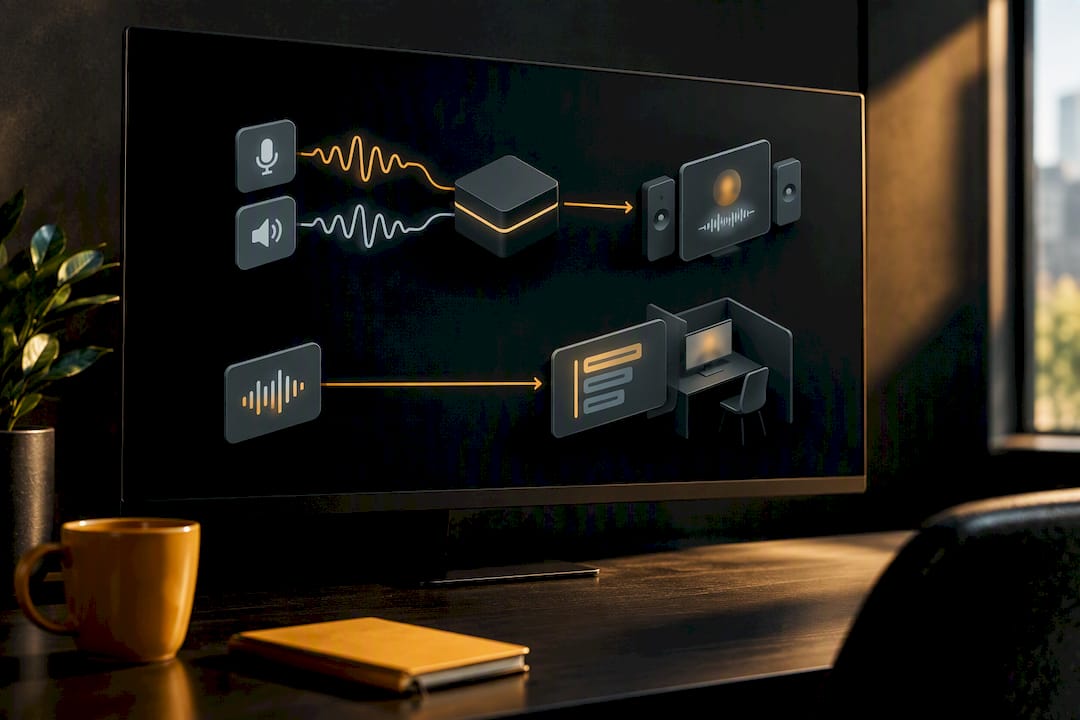
Neither method needs the meeting platform’s permission, which is exactly why it sidesteps the lobby prompts and organizer-approval screens that Microsoft Teams now uses to flag third-party bots. Because there’s no bot requesting entry, there’s nothing for the platform to block.
Trade-offs worth knowing before you pick a tool:
- On-device processing keeps audio local and never touches a server, which matters for data residency and regulated industries
- Cloud-assisted processing tends to offer richer features (deeper summarization, cross-call analytics) at the cost of an upload step
- Offline support varies widely between vendors
- Platform compatibility differs, since some tools only work well with specific browsers or desktop apps
Local speech recognition has advanced enough that full meeting transcripts no longer require constant cloud dependency, which is a meaningful shift from where this technology stood even two years ago.
What Legal and Consent Steps Do You Still Need?
Going bot-free does not erase your recording obligations. Consent and disclosure requirements still apply under state law and professional ethics rules, regardless of whether a bot is visible in the room. Some states require consent from only one party on the call; others require every participant to agree before recording starts.
Here’s a practical sequence to follow on every call:
- Add disclosure language to the calendar invite stating that the call may be recorded or coached with AI tools.
- Read a short verbal script at the start of the call: something as simple as “Just a heads-up, I use an AI assistant to help me take notes and follow up accurately.”
- Log consent somewhere retrievable, even if it’s just a note in your CRM record.
- Set a recordkeeping policy for how long transcripts and notes are retained before deletion.
- Escalate to legal or HR immediately for regulated verticals like healthcare, finance, or legal services, where recording rules can carry real penalties.
OffBook’s own guidance on consent laws breaks down which states require all-party consent and offers language you can drop straight into an invite.
Pro Tip: Keep your disclosure script identical across every call. Reps who improvise the wording tend to sound evasive, and inconsistent language is the first thing a skeptical prospect or a compliance reviewer will notice.
How Do You Build a Bot-Free Sales Workflow?
A bot-free pilot works best when you treat it as three distinct phases rather than one big software swap.
Pre-call (5 minutes or less)
- Pull a short research brief on the company and the people you’re meeting. A 10-minute pre-call research workflow can compress this into a few bullet points on funding stage, recent news, and likely priorities.
- Add the consent disclosure line to the calendar invite before you send it.
In-call
- Start unobtrusive local recording if you only need documentation, or
- Turn on live coaching cues if the call is high-stakes enough that in-the-moment guidance changes the outcome, surfacing suggested questions, objection responses, and qualification gaps as the conversation happens
Post-call
- Generate an auto-summary and update CRM fields without manual re-entry
- Draft the follow-up email while the context is still fresh
- Drop notes into a shared coaching folder for manager visibility
- Run a short 1:1 review checklist focused on what was missed, not just tone
For your first pilot, track key indicators such as the share of meetings captured, the timeliness of follow-ups, any changes in your qualified-opportunity rate, and rep retention beyond the initial two weeks. That last metric tells you more than the other three combined.
Pro Tip: Run the pilot with one rep for two weeks before rolling it out team-wide. You’ll catch consent-script friction and CRM mapping issues while the blast radius is small.
Live Coaching or Post-Call Notes: Which Fits Your Team?
The right choice depends on what you’re actually trying to influence: the outcome of the call itself, or your ability to analyze and scale quality assurance after the fact.
- Choose live, in-call coaching when deal size is large enough that a missed qualification question costs real revenue, or when reps are new enough to need guardrails in the moment rather than a lesson learned two days later.
- Choose post-call note-taking when your priority is building a searchable record across many calls, or when the sensitivity of the conversation makes real-time prompts feel intrusive to the buyer.
- Factor in regulatory exposure. Regulated industries often lean toward structured, reviewable notes because the audit trail matters more than in-call influence.
- Factor in team size. Smaller, founder-led teams often get most of the coaching value from disciplined post-call review, since managers can’t realistically join every call anyway.
Setup time and consent overhead are roughly the same either way. What changes is the manager review cadence: live coaching reduces how much a manager needs to review after the fact, while note-based coaching depends entirely on someone actually reading the notes.
How OffBook Runs Real-Time, Bot-Free Coaching
The software listens to the live call and surfaces on-screen cues, questions to ask, objections to handle, qualification gaps to close, without ever joining as a visible participant. The prompts are structured around MEDDIC and MEDDPICC methodologies, providing concrete next moves instead of generic nudges. It also generates a pre-call brief on the company and people to meet and produces a debrief and a follow-up draft automatically after the call.
This setup fits founder-led early-stage teams particularly well, since there’s rarely a dedicated sales-ops person to manage a complicated rollout. Setup friction stays low, coaching stays targeted to the actual conversation, and privacy defaults are built in rather than bolted on.
A simple two-week pilot checklist:
- Pick one rep and one deal type to start with
- Add the consent line to that rep’s calendar invites
- Turn on live cues for the next 10 calls and track qualified-opportunity movement
- Review the shared coaching folder together after week one
- Decide on team-wide rollout based on adoption, not just the numbers
Pro Tip: Have your pilot rep flag any moment where a coaching cue felt off. That feedback loop matters more in week one than any dashboard metric.
A Checklist for Moving Off Visible Meeting Bots
Consent comes first, always. Technical capture method is a distant second, no matter how good the transcription is. Start with one rep, define two or three metrics before day one, and keep everyone’s notes in a shared folder so review actually happens. For deals big enough that the moment matters, pair pre-call briefs with live in-call cues rather than betting everything on a summary you’ll read two days too late.
— Neil
Pilot OffBook: Pricing, Free Tools, and Next Steps
OffBook replaces the awkward tile in your participant list with coaching that shows up on your own screen, while you’re still talking, not in a recap you read after the deal has already slipped. A two-week pilot is straightforward: pick one rep, one deal type, add the consent line to the calendar invite, and turn on live cues for the next handful of calls.
Before committing to anything, test the mechanics for free. The Objection Handler shows you the kind of in-call prompt OffBook surfaces during a real objection, and the Meeting Notes Generator shows the structured output on the other end. When you’re ready to run the full pilot, OffBook’s Power plan starts at $59 per month or $590 per year, and teams scaling past a single rep can move to the Team plan at $1,000 per year per seat. Track qualified-opportunity movement over two weeks, then decide whether to expand it to the rest of the floor.
Sources
- Microsoft Teams will tag third-party bots in meeting lobbies | BleepingComputer
- How to Take AI Meeting Notes Without a Bot Joining the Call (2026) | Basil AI
- The legality of AI‑powered recording and transcription | Reed
- AI sales coaching software with no meeting bots: How to coach reps without joining every call | Granola
FAQ
What Is a No Meeting Bot Tool?
A no meeting bot tool captures or coaches a sales call without adding a visible participant to the meeting. It works by pulling audio directly from your device or listening in the background, and OffBook uses this approach to deliver live coaching cues instead of a post-call recap.
Is Bot-Free Recording Legal?
Bot-free recording follows the same consent laws as any other recording method. Some states require consent from just one party; others require everyone on the call to agree, so check your state’s rule and disclose recording in the invite either way.
Does Skipping the Bot Affect Call Quality or Transcript Accuracy?
No, bot-free tools capture the same audio stream your device already receives, so transcript quality depends on the underlying speech engine, not on whether a bot joined. Some tools even run transcription fully on-device, which can improve reliability on platforms that block or flag third-party bots.
How Much Does OffBook Cost?
OffBook’s Power plan runs $59 per month or $590 per year, and the Team plan is priced at $1,000 per year per seat for growing sales teams. Both include live in-call coaching and pre-call briefs.
Can Small Sales Teams Get Real Coaching Value Without Joining Every Call?
Yes, structured notes and a disciplined coaching cadence deliver most of the improvement for early-stage teams, especially when paired with live in-call cues for higher-stakes deals. A manager doesn’t need to sit in on every call to catch what a rep is missing.