Founder Led SaaS: 30–60 Day MEDDIC In Call Sales Prompts Pilot
Run a 30–60 day pilot of MEDDIC aligned in call sales prompts for founder led B2B SaaS. Includes prompt examples, manager sequencing, and what to measure.
Published: September 1, 2026
Author: OffBook Editorial Team

In-call sales prompts are real-time, on-screen AI coaching cues that appear to a rep while a sales call is happening, not scripts you write ahead of time or ask ChatGPT to draft. They flag the question to ask next, the objection response to try, or the qualification gap you just left open. Teams using this kind of live coaching report meaningful gains: win rates have climbed by around 22% with conversion improvements of 25 to 40% within 30 to 60 days of rolling it out. Offbook builds exactly this kind of coaching for founder-led B2B SaaS teams.
TL;DR:
- In-call prompts are most effective when they are unobtrusive, silent, and clearly tied to frameworks like MEDDIC, with consent protocols strictly followed.
- Relying on AI for pattern detection is valuable, but human coaching remains essential for interpreting tone, managing internal politics, and reinforcing habits.
- Piloting in stages, starting with discovery prompts and gradually adding objection handling, helps ensure adoption and measurable improvement within 60 days.
- Focusing on conversation metrics such as meeting-to-next-step rate and prompt acceptance rate provides early indicators of a successful coaching pilot.
- Founders and sales leaders should target small wins like qualifying a gap during calls to build trust before scaling AI coaching interventions.
Table of Contents
- How Do In-Call Sales Prompts Actually Work?
- What Do Good In-Call Prompts Actually Look Like?
- How Should Early-Stage Teams Roll This Out?
- What Should You Measure in the First 90 Days?
- Where Human Coaching Still Beats the Algorithm
- Why This Matters More for Founder-Led Teams
- Run Your Own In-Call Coaching Pilot
- Sources
How Do In-Call Sales Prompts Actually Work?
The mechanics are less mysterious than they sound. A live coaching system runs speech-to-text transcription on the call in real time, then passes that transcript through a layer that detects intent and specific trigger phrases. That detection layer gets merged with context: your pre-call brief on the prospect, whatever sits in your CRM, and the deal stage you’re in. The result lands on the rep’s screen as a short, timely cue, not a wall of text.
Advanced coaching systems are built to catch a specific set of moments:
- A competitor name gets mentioned, and the rep needs a fast, factual counter.
- A pricing objection surfaces before the value case has been made.
- A discovery question goes unanswered, leaving a qualification gap open.
- The prospect’s tone shifts, often a sign of hesitation or disengagement.
- The rep’s talk ratio creeps too high, crowding out the buyer’s voice.
None of this works if the delivery is disruptive. The best systems surface cues silently on the rep’s own screen, since a bot joining the call or a voice interrupting the conversation defeats the purpose. Before you trust any vendor’s claims here, ask about consent: does the tool disclose recording to every participant, and can prospects opt out? Effective in-call coaching also has to stay unobtrusive and feed what it learns into the next call, not just the one in progress.
What Do Good In-Call Prompts Actually Look Like?
Generic advice like “ask better questions” doesn’t help anyone mid-call. What helps is a prompt tied to a framework, timed to the right moment. Here’s how that plays out using MEDDIC and MEDDPICC as the backbone, the same structure Offbook uses to align its cues:
- Discovery prompts. When a prospect describes a workflow problem but skips the cost, a good prompt nudges: “Ask what this problem costs them monthly, in hours or dollars.” That’s straight out of the Metrics and Economic Buyer fields in MEDDIC.
- Objection responses. The framework here is acknowledge, clarify, bridge. If a prospect says pricing is too high, the cue might read: “Acknowledge the concern, ask what budget they compared this against, then bridge to the ROI conversation from their stated pain.”
- Competitor mentions. A two-line battlecard beats a paragraph every time. Something like: “They likely lack live in-call coaching. Ask if their current tool surfaces guidance during the call or only after.”
- Next-step nudges. Near the end of a call, a prompt like “Confirm a calendar date, not just ‘we’ll follow up’” keeps momentum from evaporating.
Each of these examples also works as a starting template you can hand to your team, or configure directly inside a coaching tool, during a pilot.
Pro Tip: Don’t try to prompt for every framework field at once. Pick the two or three MEDDIC categories your reps miss most often, usually Metrics and Decision Process, and start there.
How Should Early-Stage Teams Roll This Out?
Rushing a company-wide rollout is the fastest way to kill adoption. A tighter approach works better for founder-led teams:
- Set a 30 to 60 day pilot with one hypothesis, something like “live discovery prompts increase qualified next-steps by X,” and pick just two or three prompt categories to test, not the full menu.
- Give managers a weekly coaching cadence built around what the AI actually surfaced that week, not a raw feed of every flagged moment.
- Confirm the technical basics before launch: a clean audio path on every call, CRM sync so context flows both directions, documented consent language, and pre-call briefs already loaded.
- Sequence features deliberately. Start with discovery, add objection handling once that’s stable, then layer in competitive signals last.
Pre-call prep and in-call coaching aren’t separate projects. A solid pre-call brief on the company and the people in the room feeds directly into sharper live cues, since the system already knows who it’s coaching you to talk to.
Pro Tip: Run roleplay sessions using the same prompt categories you’re piloting live. Reps who rehearse a cue before hearing it in a real call adopt it faster.
What Should You Measure in the First 90 Days?
Skip vanity metrics early on. Watch conversation-level signals first: meeting-to-next-step conversion, talk-to-listen ratio by call stage, and how often objections actually get resolved rather than deflected.
- Meeting-to-next-step conversion rate, tracked weekly during the pilot.
- Prompt acceptance rate, how often reps actually act on a surfaced cue.
- Rep ramp time, since new hires coached live tend to hit competence faster.
- Deal velocity and win-rate against competitive mentions, once you have 60 to 90 days of data.
The 30 to 60 day window is when the payoff usually shows up. Reports of 25 to 40% conversion improvements tend to appear within that timeframe, not in week one, so resist judging a pilot too early. Pair the conversation metrics with rep behavior data like prompt acceptance to know whether a lift is actually coming from the coaching itself.
Where Human Coaching Still Beats the Algorithm
AI is genuinely good at pattern detection: catching a talk-ratio spike, flagging a missed pricing objection, noticing a competitor name the second it’s said. It’s much weaker at reading silent tension in the room, untangling internal stakeholder politics, or judging tone under real pressure. Those require a human ear.
- Give reps one coaching focus per week; stacking five priorities from an AI dashboard guarantees none of them stick.
- Pair live prompts with roleplay, since practice is what turns a flagged moment into a habit.
- Let managers prioritize which signals matter this week, rather than dumping every flagged event on the rep.
- Confirm your consent language covers every call participant before you record a single conversation.
AI coaching surfaces plenty of issues fast, but converting that feedback into lasting behavior change still depends on prioritized human coaching, not the tool alone.
Why This Matters More for Founder-Led Teams
Founders selling their own product get outsized value from live coaching, mostly because they’re improvising discovery on every call without a script to fall back on. The mistake I see most often is rolling out every prompt category at once and drowning reps in signal before they’ve built the habit of acting on any of it.
A convincing early win looks small: a handful of deals where a rep caught a qualification gap live and closed it before the objection stage. Capture that moment, not just the win-rate number, since it’s what gets the rest of the team to trust the tool.
— Neil
Run Your Own In-Call Coaching Pilot
Everything covered above, discovery prompts, objection frameworks, competitor battlecards, is exactly what Offbook surfaces on a rep’s screen while the call is happening, without a bot ever joining the meeting. It’s built around MEDDIC and MEDDPICC, so the cues map directly to the frameworks discussed here, and it pairs with pre-call briefs so the coaching starts before the call even connects.
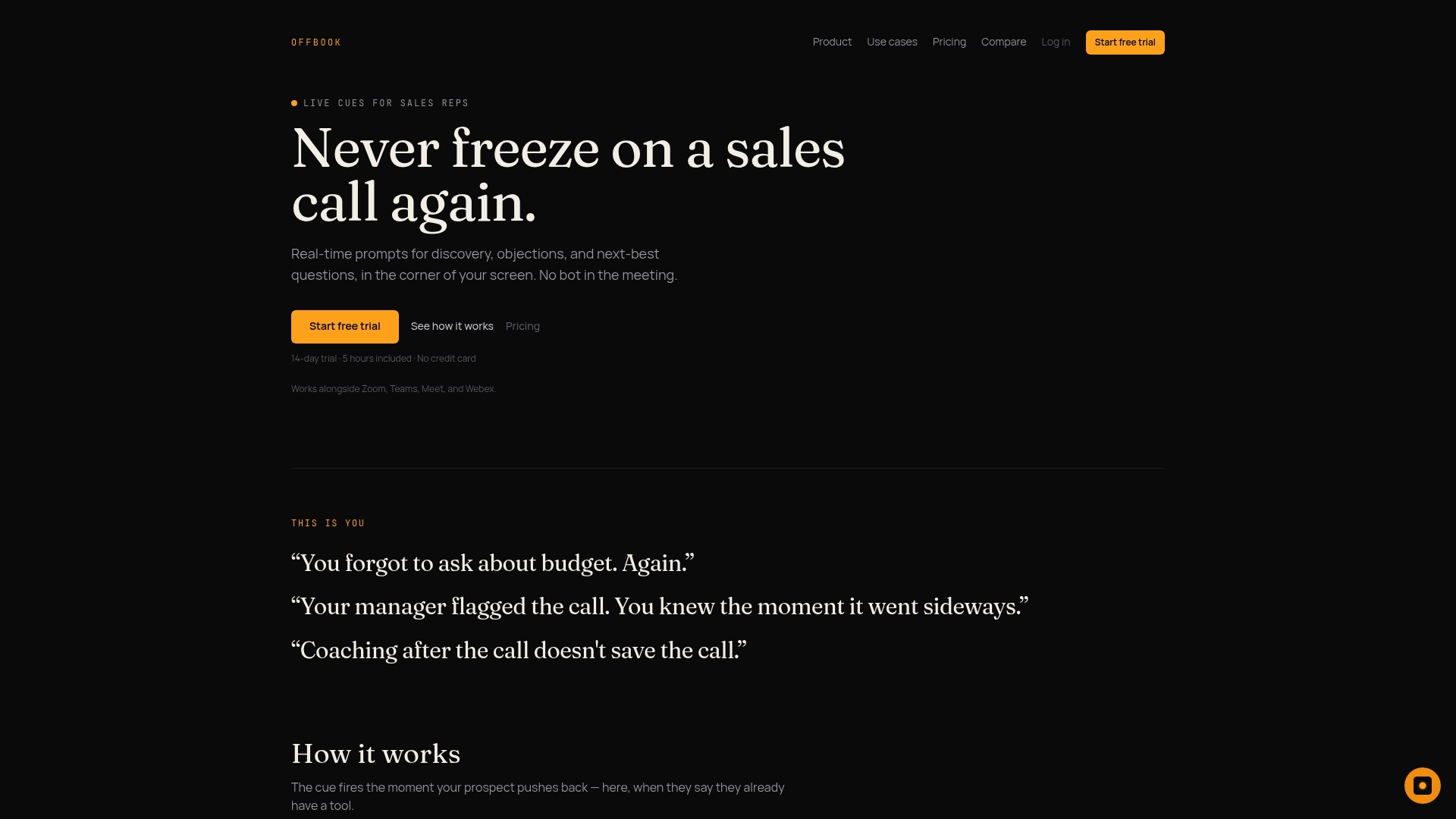
If you’re a founder or VP of Sales running high-stakes calls without a script to lean on, that’s exactly who this was built for. Founder-led teams can see how it fits their specific motion on the AI call coaching for founders page, and sales teams evaluating a pilot can start directly on the AI call coaching for sales page to book a demo.
Sources
For deeper implementation detail, see how AI assists sales conversations for B2B teams, Offbook’s guide on discovery questions that close deals, and LeadPilot’s AI SDR tooling for teams building out lead workflows alongside live coaching.
- AI Sales Coaching in 2026: How Conversation Intelligence Lifts B2B Win Rates by 22% and Turns Every Call Into a Coaching Moment
- AI Sales Coaching That Works When the Call Goes Live
- Limitations of AI Sales Coaching and Where Practice Fits - Agogee - Sales training