Seed Stage SaaS: Three Steps to Zoom Consent for AI Coaching
Get three consent checkpoints, scripts, vendor controls, and state law risks for seed and Series A sales teams using Zoom AI coaching.
Published: August 30, 2026
Author: OffBook Editorial Team

Adopt all-party consent as your default for any Zoom call where an AI tool listens in real time, even if your headquarters state only requires one party to agree. Give notice in the calendar invite, say out loud at the start of the call that an AI coach is listening and get a clear “yes,” and confirm your vendor lets you disable monitoring instantly and prove consent with a timestamp. Anything short of that leaves you exposed the moment a prospect is calling in from a stricter state.
TL;DR:
- In all-party consent states like California and Florida, you must get explicit verbal consent from all participants before AI monitoring begins, even for real-time transcription.
- A clear process includes notifying participants in the calendar invite, verbally confirming consent at the start of the call, and providing an easy opt-out option during the conversation.
- Recording logs should store timestamped consent confirmations separately from call transcripts to ensure legal defensibility and privacy.
- Vendors must provide controls such as per-session toggles, admin overrides, and data processing restrictions to reduce compliance risks.
- Avoid using AI coaching during sensitive discussions like legal, HR, or health-related calls, which should be automatically disabled for such meetings.
Table of Contents
- What Are the Zoom Recording Consent Rules for AI Listening Tools?
- How Do You Get Recording Consent for a Zoom Sales Call?
- What Scripts and Training Should Reps Use for AI Coaching Consent?
- What Technical Controls Should Your AI Coaching Vendor Provide?
- When Should You Turn Off AI Listening Entirely?
- Why a Pilot Rollout Beats a Company-Wide AI Coaching Launch
- Get Compliant AI Coaching Without Building It Yourself
- Where to Check Your State’s Exact Consent Rules
- Sources
What Are the Zoom Recording Consent Rules for AI Listening Tools?
Federal law sets a low bar. Under the Electronic Communications Privacy Act, only one party to a conversation needs to consent to monitoring, which technically means the person running the AI tool could legally proceed alone in many jurisdictions. That baseline is not the whole story, and treating it as the finish line is how sales teams get exposed.
At least a dozen states, including California, Florida, Illinois, Maryland, and Washington, require all-party consent for contemporaneous monitoring, not just recording. That distinction trips up most SaaS teams: they assume consent rules apply only to saved recordings, when in fact many statutes cover real-time access by any third party, human or machine, whether or not audio is ever stored. An AI coach reading a live transcript and surfacing prompts on a rep’s screen counts as monitoring under that definition, even with zero storage happening.
The practical problem is geography. Zoom calls with prospects rarely respect state lines. Your rep in Austin might be pitching a VP in Sacramento while a technical buyer in Chicago sits in on the same call. If any single participant is in an all-party state, the safe move is to get consent from everyone on the line, regardless of where your company is based, as explained in this Video Regulation for U.S. Organizations: Compliance Guide.
That is not a theoretical risk. Several states classify unauthorized contemporaneous monitoring as a felony, and violations can carry civil damages on top of criminal exposure. A missed disclosure on one call with the wrong participant mix is enough to trigger both.
- Federal ECPA: one-party consent is the legal floor, not the ceiling.
- All-party states (California, Florida, Illinois, Maryland, Washington, and others) require every participant to agree before monitoring starts.
- Mixed-state calls should default to the stricter all-party standard, since you rarely know every attendee’s location in advance.
- Consent covers real-time access, not just stored recordings, under most state monitoring statutes.
The safest operating rule for a distributed B2B sales team: assume all-party consent applies to every call, every time, and build your process around that assumption rather than trying to track which state each prospect happens to be calling from.
How Do You Get Recording Consent for a Zoom Sales Call?
A defensible consent process for real-time AI coaching comes down to three checkpoints, and skipping any one of them is where teams get caught. Legal guidance across the industry converges on the same sequence: notify before the call, confirm during the call, and give participants a way to opt out at any point, with active consent prompts rather than passive notice alone.
- Calendar notice. Every meeting invite should disclose that an AI coaching tool will be listening, state the purpose (rep coaching and call quality, not surveillance), and link to a short privacy summary. This is the paper trail that shows intent to disclose, even though calendar copy alone rarely satisfies all-party requirements once the call starts.
- In-call verbal disclosure and affirmative response. At the top of the call, the rep says something like: “Just so you know, we use an AI assistant that listens live to help me ask better questions. Are you okay with that?” Wait for an actual “yes.” Silence or a topic change is not consent. This single step is where most compliance gaps show up. Calendar language alone almost never covers this; you need someone to hear a spoken confirmation.
- Opt-out path. If anyone objects, the rep needs a one-click way to kill the AI listening feature without ending the call or fumbling through settings. Build a fallback: manual note-taking, or pausing coaching until the objecting party leaves.
Recordkeeping ties it together. Log a timestamped consent entry, tied to the call record, noting when disclosure happened and that the answer was affirmative. That log is your evidence if a dispute ever surfaces months later.
Pro Tip: Store the consent timestamp and a short transcript snippet of the disclosure sentence itself, separate from the rest of the call transcript. That combination is compact enough to keep privacy intact while giving you concrete proof the disclosure actually happened.
What Scripts and Training Should Reps Use for AI Coaching Consent?
Consistency across your sales team matters more than clever wording. A rep improvising consent language on the fly is how disclosures get skipped or garbled under call pressure, so give them fixed scripts and rehearse them like any other part of the pitch.

Calendar and invite copy, short version: “This meeting may include real-time AI coaching support for our team. [Privacy summary].” Expanded version, for higher-stakes deals: “We use an AI tool during calls that listens live and gives our rep coaching prompts. It does not record without separate notice, and you can ask us to turn it off anytime. Details here: [link].”
In-call phrasing differs slightly by direction. For outbound calls the rep is initiating, direct disclosure works: “Before we start, I want to flag that I use an AI coaching tool that listens during calls.” For inbound calls, where the prospect booked the meeting, folding disclosure into the standard opening (“As noted in the invite, I’ve got an AI assistant listening live, cool if we proceed?”) keeps it natural.
In known all-party states like Florida or Maryland, skip implied consent entirely and require an explicit spoken confirmation, since courts in those states expect clear affirmative agreement rather than assumed continuation after disclosure.
- Role-play the disclosure line in every rep’s onboarding, the same way you drill objection handling.
- Managers should spot-check a sample of calls monthly for the disclosure and affirmative response.
- Keep a one-page script reference readers can glance at before joining a call, drawn from your sales call preparation checklist.
- Flag any rep who skips disclosure twice for a coaching conversation, not just a warning.
What Technical Controls Should Your AI Coaching Vendor Provide?
Legal defensibility depends on product controls just as much as scripts. If your AI tool can’t be switched off mid-call or can’t prove when consent was captured, no script protects you. Vendor contracts should close that gap explicitly, following the same logic every credible AI-monitoring legal analysis lands on: consent first, then monitor.
- Per-session enable and disable, so a rep can turn listening off for one call without changing account-wide settings.
- An admin-level kill switch that overrides individual rep settings for restricted meeting types or clients.
- Consent flags logged with a timestamp, stored separately from the call transcript itself.
- A data processing agreement that bars the vendor from using your customer meeting content to train its base models.
| DPA element | What to require |
|---|---|
| Training restriction | No use of customer audio or transcripts for model training |
| Retention window | Defined deletion timeline for transcripts and consent logs |
| Subprocessors | Flow-down clauses binding any subprocessor to the same terms |
| Kill switch | Documented admin control to disable monitoring account-wide |
Firms advising on AI meeting tools consistently point to the same fix: documented retention limits, no training on customer content, and an administrative override that doesn’t depend on the rep remembering to flip a toggle.
When Should You Turn Off AI Listening Entirely?
Some conversations should never have an AI coach listening, regardless of consent status. M&A discussions, HR complaints, legal negotiations, and any call touching health information carry risks that outweigh the coaching benefit, and policy should disable the tool automatically rather than trust a rep’s judgment in the moment.
- Set admin-level restrictions by meeting type or client account, not just individual rep discretion.
- Blocklist specific client accounts (legal counsel, HR vendors) where AI listening is never appropriate.
- Document every objection: who raised it, when, and how the team responded, so there’s a record beyond a verbal agreement.
- Escalate repeated objections from the same account to a manager rather than letting reps handle it inconsistently.
Why a Pilot Rollout Beats a Company-Wide AI Coaching Launch
Every team I’ve watched succeed with real-time AI coaching started small. Roll it out to two or three reps first, document every consent decision they make, and stress-test the opt-out path before anyone else touches the tool. That pilot period is where you catch the gaps: a script that sounds stiff, a state you forgot was all-party, a rep who skips disclosure when the prospect seems rushed.
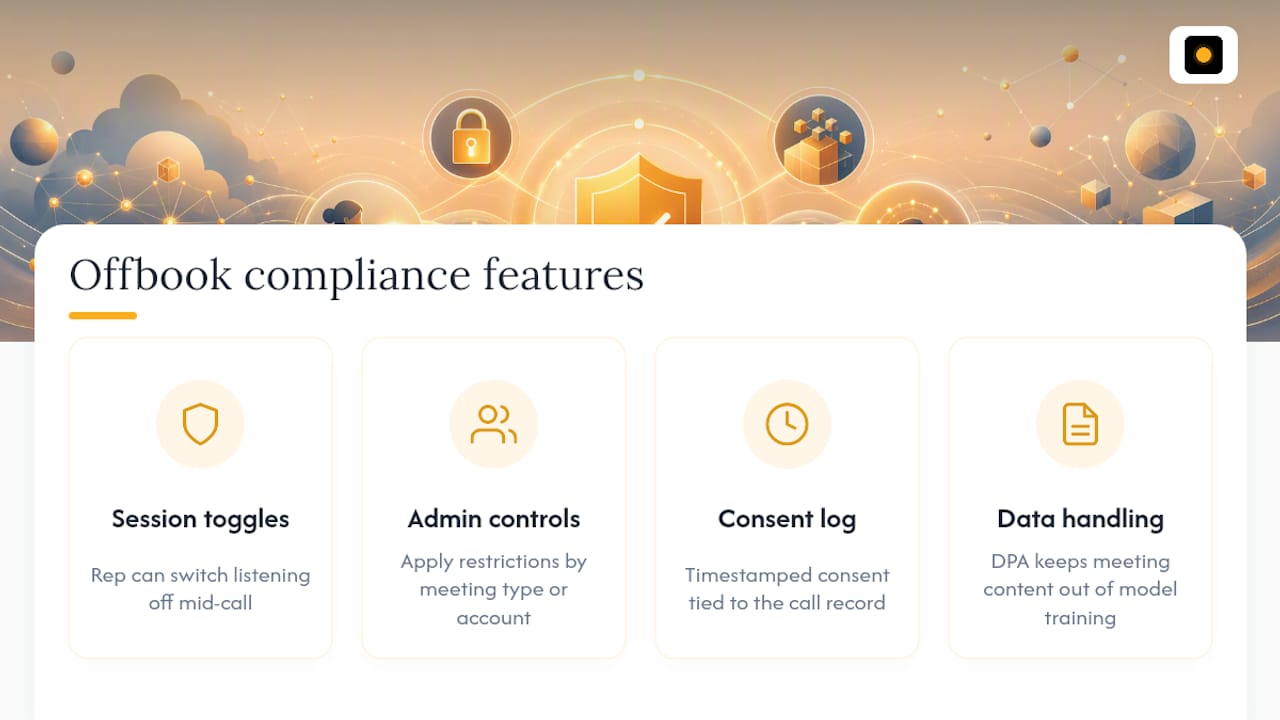
Offbook was built around this exact constraint. Session toggles let a rep disable listening for one call without touching account settings, consent flags log separately from transcripts, and the data processing agreement rules out using customer audio to train models. None of that replaces good training, but it gives a founder-led sales team the infrastructure to prove compliance instead of just claiming it.
The teams that get burned aren’t the ones moving slowly. They’re the ones that skip the pilot, assume calendar copy is enough, and find out otherwise after a prospect in the wrong state objects.
— Neil
Get Compliant AI Coaching Without Building It Yourself
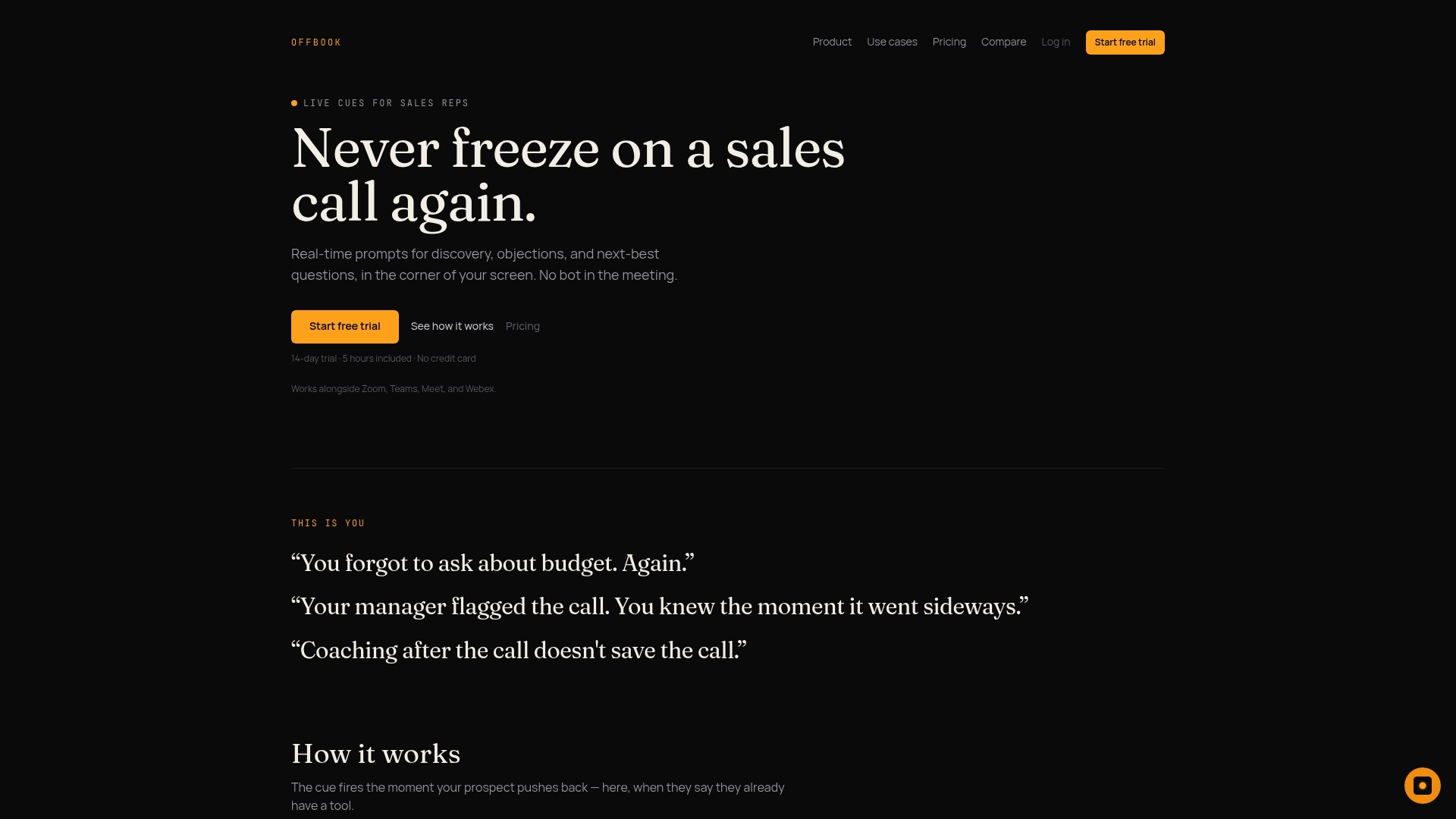
Offbook is built for exactly the compliance problem this article just walked through: it gives founder-led sales teams real-time coaching prompts during Zoom calls, with the consent infrastructure already in place instead of bolted on after a legal review flags a gap. Session-level toggles let a rep switch listening off mid-call, admin controls apply restrictions across meeting types or accounts, and every disclosure gets a timestamped consent log tied to the call record.
That matters most for seed and Series A teams who don’t have a dedicated legal or compliance hire yet. You get MEDDIC and MEDDPICC-based coaching prompts, pre-call briefs on who you’re about to meet, and a data processing agreement that keeps customer meeting content out of model training, without needing to stitch together three separate vendors to hit the same standard.
If you’re ready to see it running on your own calls, start a trial with Offbook’s sales coaching tool and test the consent workflow on a handful of calls before rolling it out to the full team.
Where to Check Your State’s Exact Consent Rules
State consent laws change, and the details matter more than the general principle. RecordingLaw’s state-by-state guide breaks down which states require all-party consent. The Lexology analysis and JDSupra’s briefing on AI call monitoring cover vendor contract language and deidentification practices worth reviewing before you finalize a DPA.
Sources
- AI Meeting Recording Laws by State: Complete Guide (2026) | Recording Law
- The legality of AI-powered recording and transcription - Lexology
- AI on the Line: Consent, Vendors, and Deidentification for Real Time Call Monitoring | JDSupra
- AI meeting assistants: privacy, security and data ownership issues | Holland & Knight