AI Assisted 5–10 Minute Pre Call Brief Template for Founder Led SaaS Reps
Ready to copy AI Assisted pre call brief template plus a 5–10 minute workflow for founder led B2B SaaS reps, with MEDDIC aligned discovery questions.
Published: September 24, 2026
Author: OffBook Editorial Team

A pre-call brief is a one-page decision tool that names the call’s single success criterion, verifies who will be in the room, lists three to five discovery questions tied to that criterion, anticipates objections, and sets one owner and a date for the next step. Building one from scratch takes 20 to 30 minutes; refreshing an existing account takes 5 to 10. The point is not research for its own sake. It’s a document that makes the call sharper and gives you a defined next move the moment it ends.
TL;DR:
- A pre-call brief should be prepared in 5 to 30 minutes, focusing on the account, trigger event, stakeholders, evidence, objectives, and call script elements.
- Tailor each template to the call type, such as discovery, technical review, pricing, or follow-up, and clearly link questions to gaps identified in MEDDIC.
- Verify contact details, tech stack, and recent news before the call, and log facts with confidence levels to prevent disqualification triggers.
- Reps should treat the brief as a working document, using hypotheses to guide questioning and fit the brief to the deal’s complexity automatically.
- Real-time coaching software like Offbook enhances prep and live call guidance by surfacing questions, objections, and gaps, supporting smarter, faster sales conversations.
Table of Contents
- What Goes in a Strong Pre-Call Brief Template?
- Copy/Paste Pre-Call Brief Templates for Different Call Types
- What’s a Fast Workflow for Building a Pre-Call Brief?
- How Do MEDDIC and Committee Mapping Shape Your Questions?
- How Do You Verify Contact Details Before a Call?
- What Do Experienced Reps Get Right About Pre-Call Prep?
- One-Page Brief or Full Account Plan? When to Use Each
- How Offbook Turns Prep Into Live Coaching
- Where to Go Deeper on Call Preparation
- Sources
- FAQ
What Goes in a Strong Pre-Call Brief Template?
A brief that actually gets used has seven working parts. Skip any one of them and you’re either walking in blind or drowning the call in irrelevant research. Apollo’s breakdown of pre-call briefs lands on the same seven sections, and notes each one should take 2 to 5 minutes to fill when you’re working from decent data.
Account snapshot and thesis. Two or three lines: company size, industry, tech stack, and a single sentence on why this account fits what you sell. If you can’t write that sentence, you’re not ready for the call.
Trigger timeline. What changed recently that makes this conversation timely? A funding round, a new VP of Sales, a job posting for a role your product supports. Pull this from LinkedIn activity, a company’s press page, or a Google News search filtered to the last 30 days.
Stakeholder map. Names, titles, and a guess at role (economic buyer, champion, blocker) for everyone likely to show up or influence the decision. Verify titles against LinkedIn before you write them down. Titles change, and reps embarrass themselves referencing a role someone left six months ago.
Evidence table and hypotheses. A short list of facts you believe are true about this account, each with a source and a confidence level. Then one or two explicit hypotheses the call needs to test, like “they’re evaluating three vendors and price will decide it.”
Objective and fallback. One primary objective for the call, an ideal next step with an owner and a date attached, a fallback if the ideal outcome doesn’t happen, and a condition under which you’d walk away. HubSpot’s pre-call planning guidance frames this as defining success before you dial, not after the call ends and you’re guessing what happened.
Opener, questions, objections, assets. A one-line opener referencing the trigger, three to five discovery questions, the two objections you expect to hear, and any case study or one-pager worth having open in another tab.
- Account snapshot: company, industry, stack, one-sentence fit thesis
- Trigger timeline: what changed and when, with source
- Stakeholder map: names, titles, likely role, verification status
- Evidence table: fact, source, date, confidence
- Objective: primary goal, next step with owner/date, fallback, disqualifier
- Call script elements: opener line, 3–5 questions, expected objections, assets to reference
Pro Tip: Keep the whole thing to one page. If your brief runs longer, you’re building an account dossier instead of a call preparation checklist built for one specific conversation.
Copy/Paste Pre-Call Brief Templates for Different Call Types
Not every call needs the same depth. A first discovery conversation and a procurement negotiation pull from different playbooks, even though they share a skeleton. Here are four sales call brief formats you can copy directly.
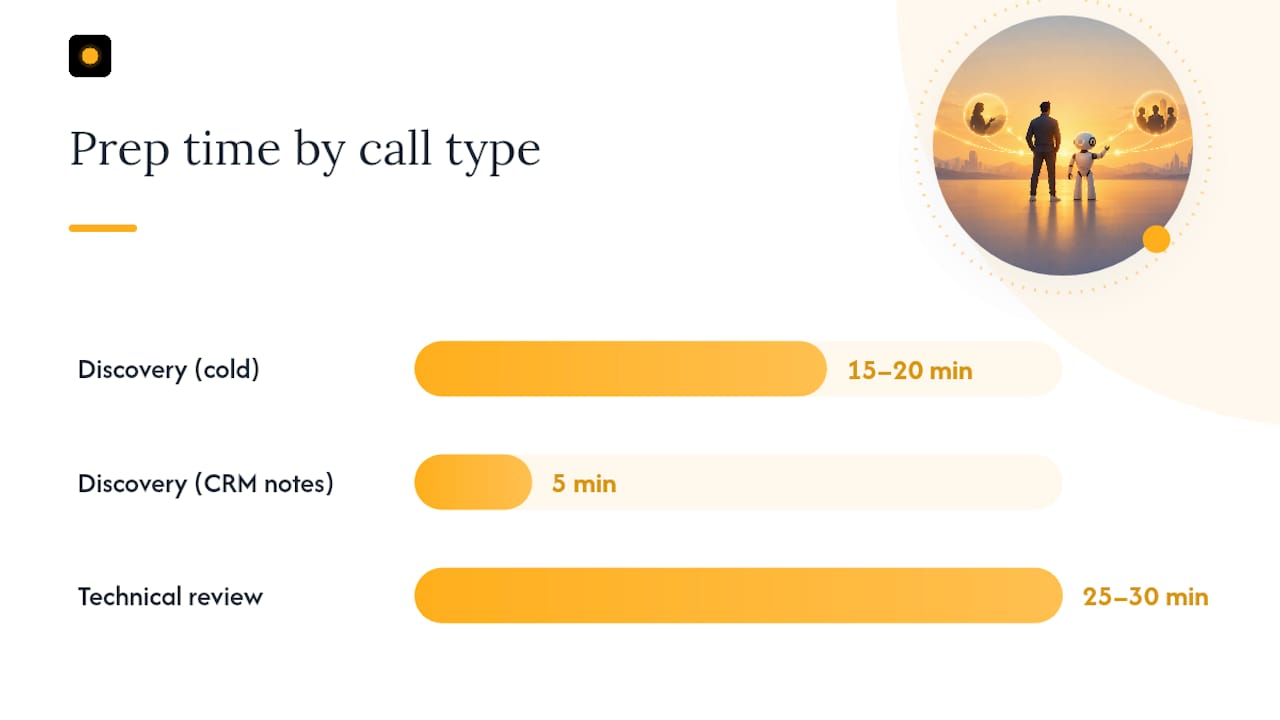
- First discovery call. Account snapshot (2 lines) plus trigger. Stakeholder: one name confirmed, others guessed. Hypothesis: “Pain is X based on job postings/trigger.” Opener: “Saw you just posted for a [role] — figured that means [pain] is becoming a priority.” Three discovery questions max. Time to build: 15 to 20 minutes for a cold account, 5 minutes if your CRM already has notes.
- Technical or security review. Everything from the discovery template, plus a systems list (current stack, integration points, compliance requirements like SOC 2 or GDPR) and the names of technical stakeholders who’ll be on the call. Add a question bank on data residency, API limits, and uptime SLAs, since these calls stall when reps can’t answer infrastructure questions on the spot. Time to build: 25 to 30 minutes, mostly spent confirming the tech stack with a lookup tool.
- Pricing or procurement call. Snapshot stays short. The evidence table matters more here: budget signals, procurement process notes, competing vendors if known, and the economic buyer’s likely decision criteria (cost, risk, speed of implementation). Objective shifts from “advance the deal” to “get a specific number or timeline.” Time to build: 20 minutes, most of it verifying who actually signs.
- Follow-up or expansion call. A refresh brief, not a rebuild. Pull the last call’s next step, check whether it happened, note anything new (a reply email, a Slack message, a changed contact), and write one updated question. Time to build: 5 to 10 minutes.
Adapt each template by swapping the discovery questions to match the call type. A technical review needs implementation questions; a pricing call needs budget and timeline questions. The discovery call question bank is a useful starting point if you want a wider set to pull from without writing new questions every time.
One thing worth flagging: templates fail when reps treat them as forms to complete rather than thinking tools. The hypothesis field is the one people skip most often, and it’s the one that actually changes how you run the call.
What’s a Fast Workflow for Building a Pre-Call Brief?
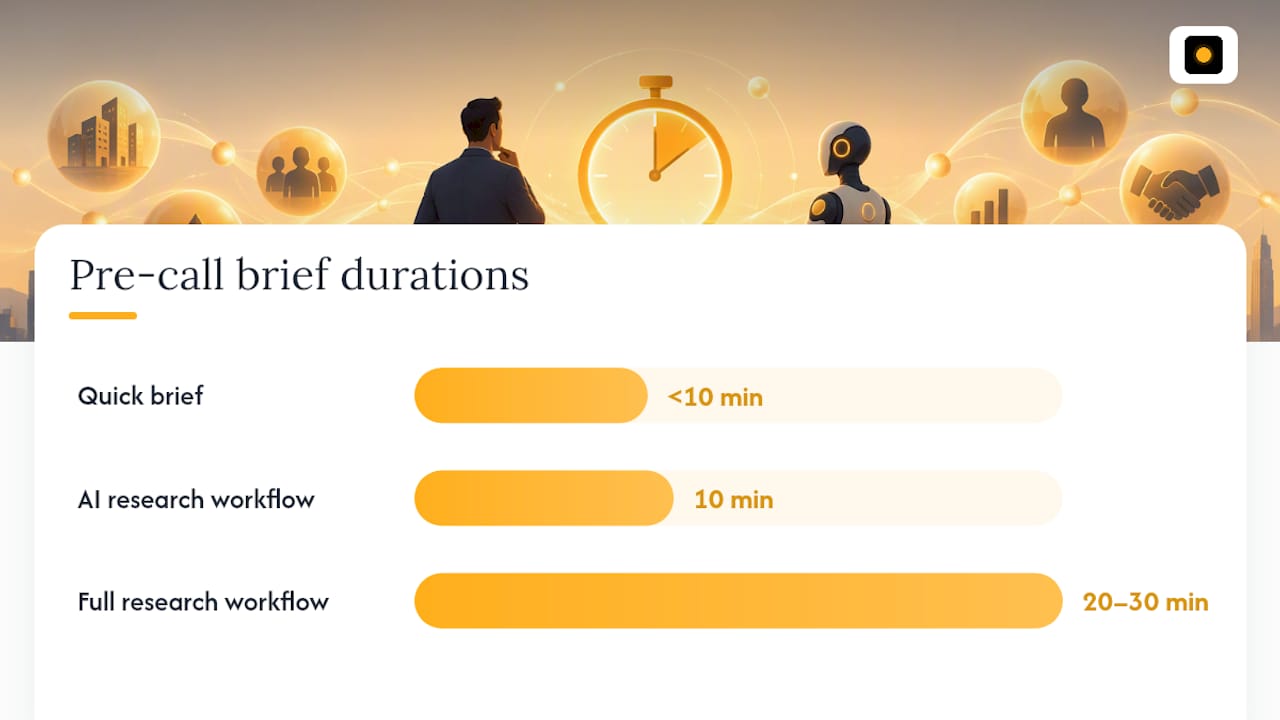
A tight workflow beats a thorough one when you’ve got six calls tomorrow. Here’s the sequence that gets you a usable brief in under 10 minutes for a warm or returning account.
- Verify the contact. Confirm title and company on LinkedIn, check email deliverability if it’s a new address.
- Capture the trigger. One search: company name plus “news” or “funding,” filtered to the last month.
- Map the stakeholder. Note who’s confirmed on the call and guess their role from title alone.
- Write the opener. One sentence tying the trigger to a likely pain point.
- Set the objective. One sentence: what does a win on this call look like?
- Pick three discovery questions. Pull from a saved bank rather than writing new ones each time.
- Assign the next step. Name an owner and a date, even if it’s tentative.
For tool checklists, keep it simple: LinkedIn Sales Navigator or a free LinkedIn account for stakeholder checks, a news aggregator or Google Alerts for triggers, and your CRM for history. If you’re using AI to draft any part of this, treat the output as a starting draft, not a finished brief. NIST’s AI risk management guidance is blunt about this: AI-generated content needs human verification before it’s trusted, especially when it touches names, titles, or claims about a company’s situation. An AI tool can hallucinate a funding round that never happened or misstate someone’s job title. Check both before the call, not during it.
Expand to the full 20 to 30 minute workflow when the account is new, the deal size justifies deeper research, or more than two stakeholders will be on the call. A 10 minute AI research workflow works well as a middle ground when you need more than the quick version but don’t have a half hour to spare.
Pro Tip: Batch your briefs. Building five in one sitting, right after you check your calendar for tomorrow, takes less total time than building one right before each call because you stay in research mode instead of switching contexts five times.
How Do MEDDIC and Committee Mapping Shape Your Questions?
MEDDIC isn’t a script to read from. It’s an evidence map that tells you what you still don’t know about a deal. Use it to decide which discovery questions to ask now versus later, not as a checklist to force into one conversation.
Map your questions to gaps directly. A Metrics gap needs a question like “what would a 20% improvement in [metric] be worth to your team this year?” An Economic Buyer gap needs “who signs off once the team agrees this is worth solving?” Decision Criteria gaps need “what does the evaluation process look like, and who’s involved besides you?” MEDDIC’s structure works because it forces you to notice which of the six elements you’re missing, rather than assuming you’ve covered qualification just because the call went well.
Spread this across conversations. Asking all six MEDDIC categories in one 30-minute discovery call feels like an interrogation and stalls trust. Good discovery questions test the brief’s hypothesis and move the deal forward rather than checking boxes, covering current state, business impact, and decision process across two or three calls instead of one.
For committee mapping, build the role skeleton before you have names: economic buyer, technical evaluator, end user, champion, blocker. Populate names from LinkedIn, your CRM’s contact history, and site engagement data if you have it, a method Fluum’s committee mapping guide lays out well. Score each role’s coverage as confirmed, guessed, or missing, and assign someone to close the biggest gap before the next call.
- Map questions to MEDDIC gaps, not to a fixed script
- Spread the six MEDDIC elements across multiple calls
- Build the committee role skeleton before you have names attached
- Score coverage per role: confirmed, guessed, or missing
- Assign an owner and a refresh date for every unconfirmed role
How Do You Verify Contact Details Before a Call?
Bad data wastes calls faster than bad questions do. A quick verification pass catches most of the errors that make reps look unprepared.
Check email deliverability before sending a calendar invite, and confirm current title and company on LinkedIn since job changes happen constantly and CRM records lag behind reality. Run a technographic lookup through a tool like BuiltWith to confirm the tech stack you’re planning to reference actually exists. Search company news from the past 30 days to catch layoffs, leadership changes, or funding events your trigger timeline might have missed.
- Email: verify deliverability, not just format
- LinkedIn: confirm title, tenure, and recent activity
- Tech stack: cross-check with a technographic lookup tool
- News: search the last 30 days for material changes
Log every fact in the evidence table as fact, source, date, and confidence level. A complete pre-call brief template runs seven sections and treats this table as the backbone connecting hypotheses to something checkable. If verification turns up a title that no longer exists, a company that’s been acquired, or a stakeholder who’s left, that’s a disqualification trigger. Reschedule or redirect before the call, not during it.
What Do Experienced Reps Get Right About Pre-Call Prep?
The reps who run consistently sharp calls treat the brief as a working document, not paperwork. They write the hypothesis first, because that’s the sentence that tells you whether the call is worth having at all. A brief with no hypothesis is just a stack of facts with no direction.
The gap between a brief that gets read and one that gets ignored comes down to one thing: does it tell the rep what to do on the call, or does it just tell them what’s true about the account? Facts without a next action are trivia. The brief’s job is to turn research into a decision.
Real-time call coaching software builds on this same idea. It generates pre-call briefs on the companies and people a rep is about to meet, then layers live, on-screen coaching cues during the call itself, structured around MEDDIC and MEDDPICC, without a bot ever joining the meeting. A rep walking into a technical review with a generated brief covering stakeholder roles and open MEDDIC gaps spends less time guessing and more time asking the three questions that actually move the deal forward. Discovery-call preparation with a documented checklist tends to produce sharper questions and clearer next steps than winging it from memory.
One-Page Brief or Full Account Plan? When to Use Each
A one-page brief covers most calls. It’s built for a single conversation with a defined objective, and refreshing it takes minutes.
Reserve a full account plan for enterprise deals with five or more stakeholders, multi-quarter sales cycles, or accounts already past a certain deal size threshold for your business. In those cases, one page can’t hold the committee complexity or the multi-thread strategy the deal actually needs.
The behavior that matters more than the document format: someone owns the next step, with a date attached, every single time. A brief without an owner is a wish list.
— Neil
How Offbook Turns Prep Into Live Coaching
Real-time sales coaching software listens to video calls and surfaces on-screen cues while you’re talking, without a bot joining the meeting. It generates pre-call briefs on the companies and people you’re about to meet, then during the call itself, prompts you with the right questions to ask, objections to handle, and qualification gaps to close, all built around MEDDIC and MEDDPICC.
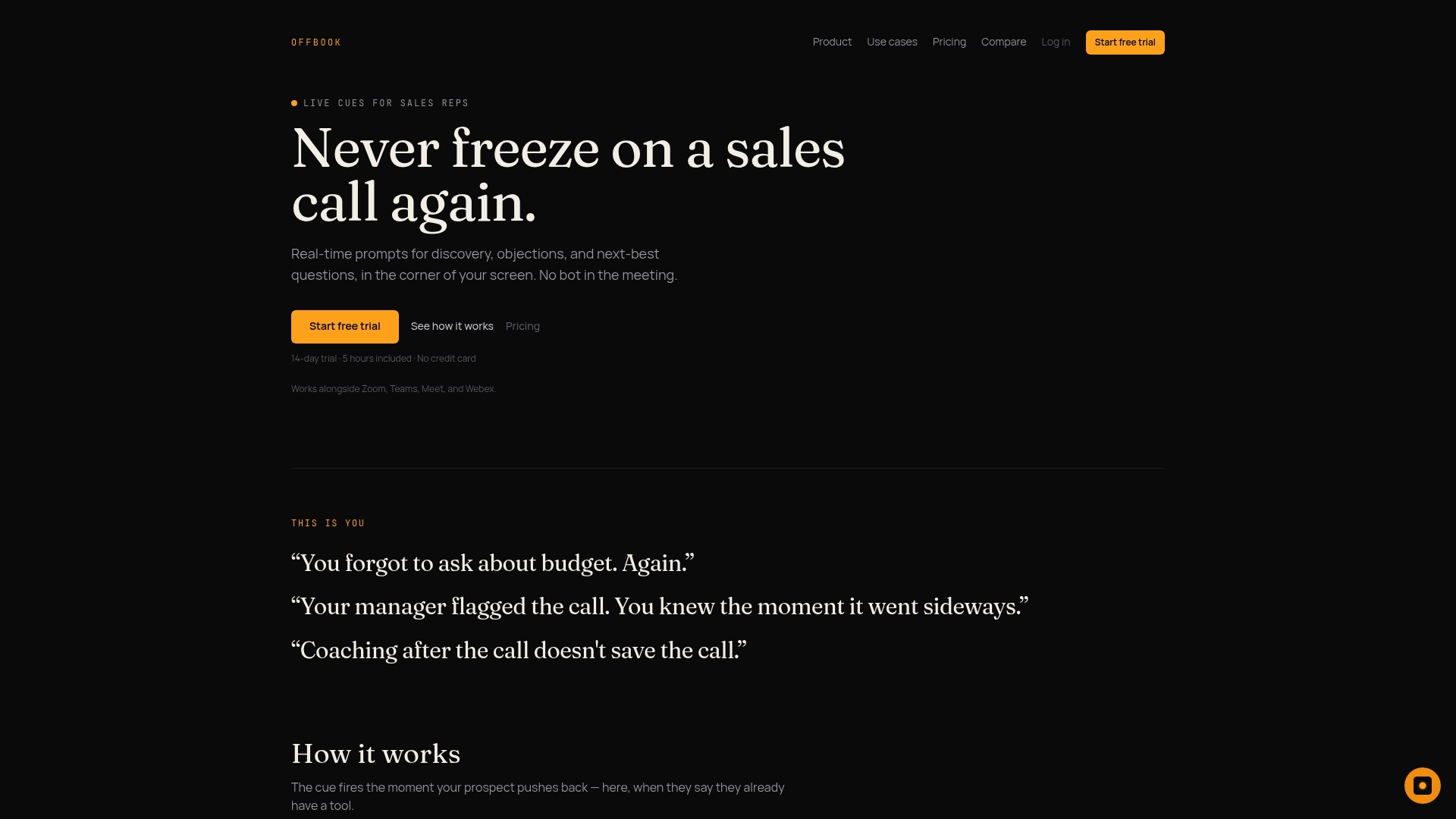
That means the templates and workflows above don’t stop being useful once the call starts. The stakeholder map, the hypothesis, the three discovery questions you picked in your five-minute workflow, Offbook keeps them live on your screen and flags gaps in real time, then generates a post-call debrief and follow-up draft automatically. If you want to test the discovery-question piece first, the free discovery call question generator is a fast way to see how the qualification mapping works before committing to anything. When you’re ready for the full workflow, the Power plan runs $59 per month or $590 per year, and team pricing is available at $1,000 per year per seat for founder-led sales teams scaling past a solo rep.
Where to Go Deeper on Call Preparation
A few sources back the frameworks covered here, worth bookmarking if you want to build out your own version of this system.
- HubSpot’s pre-call planning guidance on defining success before the call
- HubSpot’s MEDDIC qualification guide for evidence-based discovery
- MIT HR’s meeting agenda best practices for structuring the call itself
- LiveAgent’s pre-call planning templates for additional format examples
Sources
- How a Salesforce Solutions Architect Conducts Discovery Calls – IConnect | Isenberg School of Management
- Pre-Call Planning — HubSpot Sales Blog
- How Do You Build A Pre-Call Brief for a Buying Committee? | Apollo
- NIST AI Risk Management Framework guidance
FAQ
What Is Pre-Call Planning and How Is It Done?
Pre-call planning means researching an account, mapping stakeholders, and setting a specific objective before a sales call happens. It’s done by filling a structured brief covering the account snapshot, trigger event, stakeholder roles, evidence, hypotheses, and a defined next step, a process that typically takes 20 to 30 minutes for a new account and far less for a follow-up.
What Are the Seven Steps of a Sales Call?
Most frameworks cover opening with a trigger-based line, confirming the agenda, running discovery questions tied to a hypothesis, presenting relevant proof points, handling objections, confirming next steps with an owner and date, and following up promptly. The exact count varies by source, but the sequence from opener to committed next step stays consistent across most sales methodologies.
How Do You Structure a Cold Call?
Open with a specific, researched reason for calling rather than a generic pitch, state why you’re reaching out in one sentence, then move quickly into a discovery question rather than a feature list. A pre-call brief with a trigger timeline and one hypothesis makes this structure far easier to execute, since you’re not improvising the opener on the spot.
What Should You Say on a Sales Call?
Lead with an opener tied to something real about the account, like a recent trigger event, then ask discovery questions that test your hypothesis about their pain point. Avoid pitching before you’ve confirmed the problem exists and who else needs to weigh in on solving it.
Does Offbook Generate Pre-Call Briefs Automatically?
Yes. Offbook generates pre-call preparation briefs on the companies and people you’re meeting, then provides live, on-screen coaching cues during the call itself. Pricing starts with the Power plan at $59 per month or $590 per year, with team pricing at $1,000 per year per seat.