How to Build a Sales Coaching Program for Startups
Learn how to build a sales coaching program for startups that drives measurable results. Transform chaotic sales into repeatable success within 90 days.
Published: July 29, 2026
Author: OffBook Editorial Team

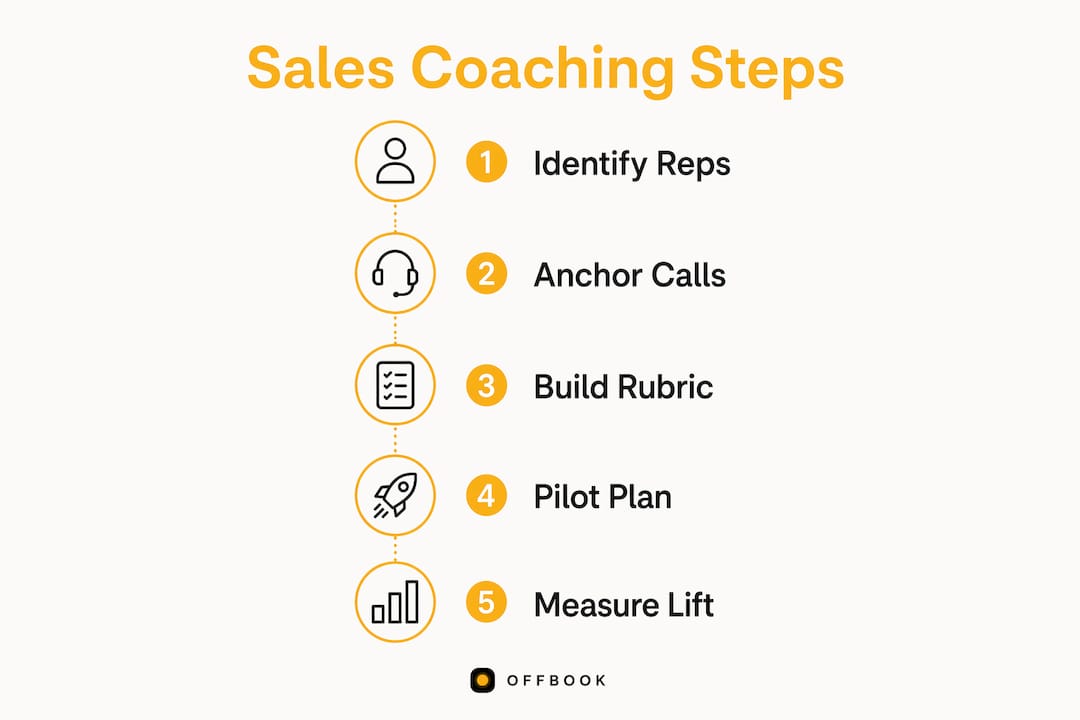
Run a 30–90 day pilot that anchors every coaching session to a recorded call artifact, certifies managers on a 4-point MEDDPICC rubric, and uses real-time AI cues to coach reps in the moment. That is the fastest path from founder-led chaos to a repeatable sales motion.
Your first move in the next 48 hours:
- Pull three recorded discovery calls from your CRM and timestamp the moments where the rep lost control of the conversation.
- Pick four to six middle-tier reps as your pilot cohort.
- Turn on Offbook for live in-call cueing so reps get coached during the call, not after it.
Table of Contents
- How do you build a sales coaching program for startups?
- Who should you coach first, and how many reps?
- Why anchor coaching to a call artifact?
- How do you build a call rubric and playbook?
- What does a 30–90 day pilot plan look like?
- Which tools do you actually need?
- How do you prepare managers to coach?
- How do you measure lift and iterate?
- Ready-to-use templates for your pilot
- Your 30–90 day rollout checklist
- Key Takeaways
- What most founders get wrong in the first 90 days
- Offbook makes this pilot executable from day one
- Useful sources
How do you build a sales coaching program for startups?
The goal is not a training library. It is a measurable behavior change in four to six reps over 90 days. Before you design anything, set three to five program objectives and attach a leading metric to each one.
| Program Goal | Leading KPI | Lagging KPI |
|---|---|---|
| Deepen discovery | Discovery questions asked per call | Discovery-to-demo conversion rate |
| Improve qualification | MEDDPICC fields completed per deal | Pipeline accuracy at 90 days |
| Raise next-step rate | % of calls ending with a confirmed next step | Average sales cycle length |
| Reduce ramp time | Practice-to-real-call score gap | Time to first closed deal |
| Increase win rate | Objection-handling score (rubric) | Quarterly win rate |
Baseline each metric from your last 60 days of CRM and call data before the pilot starts. Without a baseline, you cannot prove the program worked. Structured coaching can lift win rates and improve quota attainment significantly when managers coach consistently and use data-fed coaching, but those improvements only mean something if you know where you started.
Stat: Companies with a dynamic coaching program average at least 28% higher win rates than competitors without one.
Who should you coach first, and how many reps?
Focus on the middle 60% of reps. Top performers already have the behaviors; bottom performers often need a different conversation entirely. The middle cohort delivers the largest aggregate lift from coaching.

For a seed or Series A team, a pilot of four to six reps is the right size. Any smaller and you cannot spot patterns; any larger and the founder cannot give each rep enough attention. When a manager is responsible for more than eight to ten reps, shift to coaching the coaches rather than coaching reps directly.
Candidate selection checklist:
- At least 30 days of call recordings in the system
- Actively working live deals (not in ramp week one)
- Assigned to a segment where you have win-call examples to draw from
- Willing to be recorded and reviewed (get explicit consent)
Minimum data needed to include a rep:
- Five or more recorded calls in the last 60 days
- At least two closed-won deals to establish a personal baseline
- A CRM deal record with stage history intact
Why anchor coaching to a call artifact?
Abstract feedback (“be more curious in discovery”) does not change behavior. Specific feedback tied to a timestamped moment does. Artifact-anchored coaching gives both coach and rep the same reference point, so the conversation is about what actually happened, not what the rep remembers happening.
Three artifact types that work:
- Timestamped call clip: “Replay minute 12. You answered your own question before the buyer could respond.”
- Email thread: Flag the follow-up where the rep buried the ask in paragraph three.
- Deal record: Walk through the MEDDPICC fields together and identify which ones are blank.
Three session types and their cadence:
| Session Type | Owner | Duration | Frequency |
|---|---|---|---|
| Pre-call brief | Rep + manager | 10 min | Before every strategic call |
| Live in-call cueing | Offbook (AI) | Ongoing | Every call |
| Post-call scored review | Manager | 30 min | Weekly |
How do you build a call rubric and playbook?
A competency-based rubric with observable behaviors scored 1–4 reduces coaching variance and gives managers something concrete to calibrate against. Keep it to seven to ten items.
| Competency | Score 1 | Score 2 | Score 3 | Score 4 |
|---|---|---|---|---|
| Discovery depth | No open questions | One or two surface questions | Three or more probing questions | Multi-layered, hypothesis-driven discovery |
| Objection handling | Ignores or deflects | Acknowledges, no response | Acknowledges and responds | Reframes and advances the deal |
| Multi-threading | Single contact only | Two contacts identified | Two contacts engaged | Champion and economic buyer both active |
| Closing / next step | No next step set | Vague follow-up | Date confirmed | Date, agenda, and attendees confirmed |
| Talk-to-listen ratio | Rep talks | Rep talks 60–70% | Rep talks 40–60% | Rep talks under 40% |
To build product-specific discovery questions, pull your five best founder win-calls and extract the exact questions that unlocked the buyer’s real pain. Those become the rubric’s discovery section. Do the same for objections: find the three objections that killed the most deals and write a response for each one from the calls where you handled them well.
Pro Tip: Use raw, unpolished founder call clips rather than produced training videos. Founder-sourced clips transmit judgment and product nuance faster than any deck, and new reps learn to think like the founder, not just recite a script.
What does a 30–90 day pilot plan look like?
A structured weekly cadence of 30–60 minutes per rep, focused on one skill at a time, compounds faster than ad-hoc sessions. Here is the timeline:
Days 1–30 (Build):
- Finalize rubric and get manager sign-off.
- Baseline all five KPIs from CRM data.
- Run first calibration session: score the same call independently, then compare.
- Activate Offbook for live cueing on all pilot rep calls.
- Hold weekly 30-minute post-call reviews anchored to one timestamped clip.
Days 31–60 (Measure):
- Check leading metrics against baseline weekly.
- Run one roleplay session per rep on the focus skill.
- Hold a mid-pilot calibration to keep manager scores within 10% of each other.
- Identify the two reps showing the most movement and document what changed.
Days 61–90 (Decide):
- Calculate practice-to-real-call score gap for each rep.
- Compare leading and lagging metrics to baseline.
- Decision gate: if two or more leading metrics moved, scale the program. If not, change one variable (focus skill, cadence, or artifact type) and run another 30-day cycle.
Role matrix:
- Founder: Sets rubric, owns calibration, reviews gate decisions.
- Manager: Runs weekly post-call reviews, certifies on rubric before coaching others.
- Reps: Complete pre-call briefs, accept live cues, participate in roleplay.
Which tools do you actually need?
The minimum viable stack for a founder-led B2B SaaS team has four capabilities: real-time in-call cueing, call recording and transcription, async roleplay practice, and CRM integration for rubric scoring.
Offbook handles the real-time cueing layer without a bot joining the meeting. It listens to the call and surfaces on-screen prompts tied to MEDDIC and MEDDPICC, so reps get coached in the moment when it changes the outcome, not in a debrief 24 hours later. For real-time sales coaching at the seed and Series A stage, that distinction matters because founders cannot sit on every call.
On live call coaching in U.S. workflows: Recording consent requirements vary by state. Single-party consent applies federally, but California, Illinois, and ten other states require all-party consent. Disclose recording at the start of every call and store a consent log. Data retention policies for call recordings should align with your customer contracts and any applicable SOC 2 commitments.
Integration checklist for Offbook:
- Connect to your video conferencing platform (Zoom, Google Meet, or Microsoft Teams).
- Map MEDDPICC fields to your CRM deal record.
- Set cue triggers for your top three objections and your must-ask discovery questions.
- Share the technology role in coaching guide with managers before the pilot starts.
How do you prepare managers to coach?
Managers need certification before they coach reps. A manager who scores calls inconsistently undermines the entire rubric. The certification sequence takes three weeks.
Manager micro-certification plan:
- Score three archived calls independently using the rubric.
- Compare scores with the founder in a calibration session; target less than 10% variance.
- Run a 30-minute coaching session: ten minutes of scored call review, ten minutes of live roleplay, ten minutes to set a focus experiment.
- Repeat until the manager passes two consecutive calibrations within variance.
Feedback script for 1:1 sessions:
- Open with one specific observation tied to a timestamped clip.
- Ask the rep what they noticed before offering your read.
- Name the one focus skill for the next week. Only one.
- Close by confirming the leading metric you will check together next session.
One-focus-skill rule: Pick one behavior per rep per week. Measure the leading metric tied to that behavior. When it moves, pick the next skill. Trying to fix three things at once fixes nothing.
How do you measure lift and iterate?
Three metrics tell you whether the program is working: the practice-to-real-call score gap, leading-metric movement week over week, and ramp time for new hires entering the program.
The practice-to-real-call gap is the most diagnostic. A large gap means reps can perform the skill in roleplay but not on live calls, which points to a coaching or execution problem, not a training gap. Shrink the gap by increasing live call practice frequency, not by adding more training content.
Simple experiment examples:
- A/B the focus skill: half the cohort works on discovery depth, half on next-step rate. Compare leading metric movement after four weeks.
- Change roleplay intensity: increase from one to three async practice sessions per week for two reps and measure gap change.
- Adjust cadence: move from weekly to twice-weekly reviews for reps with the largest gaps.
Weekly reporting template:
Fill in the baseline column before the pilot starts. Present the Week 12 column to your board as proof of program impact.
Ready-to-use templates for your pilot
30-minute weekly coaching session agenda:
- 0–10 min: Play the timestamped clip. Rep narrates what they heard.
- 10–20 min: Score the clip together on the rubric. Discuss one item only.
- 20–28 min: Roleplay the moment with the corrected behavior.
- 28–30 min: Set the focus metric and confirm next session date.
Pre-call brief template:
- Buyer name, title, and LinkedIn summary (two sentences max).
- Company stage, funding, and known pain signals from public sources.
- Last interaction summary and open MEDDPICC gaps.
- The one discovery question you must ask on this call.
Offbook generates this brief automatically before each call, so reps walk in prepared without spending 20 minutes on research.
On annotated clip reviews: When you clip a call moment for review, add a text annotation at the timestamp that names the competency being reviewed and the score you assigned before the session. That way the rep sees the score before the conversation, not as a verdict delivered at the end. It shifts the dynamic from evaluation to analysis.
Pro Tip: For pain-focused discovery questions, pull the exact language buyers used to describe their problem in your best win-calls. Reps who mirror that language in discovery convert at a measurably higher rate than reps using generic open-ended questions.
Your 30–90 day rollout checklist
Week 0 (Setup):
- [ ] Baseline all KPIs from CRM data.
- [ ] Select four to six pilot reps using the candidate checklist.
- [ ] Finalize rubric and run first calibration session.
- [ ] Activate Offbook and configure cue triggers.
Weeks 1–4 (Build):
- [ ] Run weekly 30-minute post-call reviews.
- [ ] Hold one roleplay session per rep per week.
- [ ] Check leading metrics against baseline.
Weeks 5–8 (Measure):
- [ ] Run mid-pilot calibration; adjust if manager variance exceeds 10%.
- [ ] Calculate practice-to-real-call gap for each rep.
- [ ] Run one A/B experiment on focus skill or cadence.
Weeks 9–12 (Decide):
- [ ] Compare all metrics to baseline.
- [ ] Apply decision gate: scale, iterate, or stop.
- [ ] Present results to investors with before/after leading metrics.
Cost estimate:
| Item | Estimated Cost |
|---|---|
| Offbook pilot license (per rep) | Contact Offbook for pricing |
| Manager time (2 hrs/week x 12 weeks) | Internal cost only |
| Call recording storage | Typically included in video platform |
| Rubric and template setup | Zero; use templates in this article |
Key Takeaways
A well-run 90-day pilot anchored to recorded call artifacts, a 4-point rubric, and real-time AI cueing is the fastest way to convert founder-led sales into a repeatable, measurable motion.
| Point | Details |
|---|---|
| Baseline before you start | Pull 60 days of CRM and call data to set KPIs before the pilot begins. |
| Coach the middle 60% first | Middle-tier reps deliver the largest aggregate lift from structured coaching. |
| One focus skill per rep per week | Coaching multiple behaviors at once produces no measurable movement in leading metrics. |
| Use the practice-to-real-call gap | A large gap signals an execution problem, not a training gap; fix the coaching, not the content. |
| Offbook for live in-call coaching | Offbook surfaces real-time MEDDPICC cues during calls without a bot joining the meeting. |
What most founders get wrong in the first 90 days
The playbook above is built around a pattern I see repeatedly: founders who skip the baseline, coach everyone at once, and then cannot tell their board whether the program worked. The rubric is not bureaucracy. It is the only way to have a conversation about behavior that is not just opinion.
The artifact rule is the one most founders resist. Reviewing a call from memory feels faster. It is not. A timestamped clip forces specificity, and specificity is what changes behavior. The startup sales coaching guide on Offbook’s site goes deeper on rubric calibration if you want to pressure-test your scoring before the pilot starts.
Real-time AI cueing is not a replacement for manager judgment. It is the layer that catches the moment a rep forgets to ask the next discovery question while the conversation is still live. That is the gap no post-call debrief can close.
Offbook makes this pilot executable from day one
Most founders spend the first 30 days of a coaching program building infrastructure. Offbook collapses that to a week. It connects to Zoom, Google Meet, or Microsoft Teams, maps to your MEDDIC or MEDDPICC fields, and starts surfacing live cues on the rep’s screen from the first call. No bot joins the meeting. The buyer never knows it is there.
The pre-call brief feature generates a buyer and company summary before each call, so reps walk in with context instead of scrambling through LinkedIn. Combined with the post-call rubric scoring your manager runs weekly, Offbook gives you the full coaching loop: prepare, perform, review, repeat.
Founders using Offbook for AI call coaching can run the entire 90-day pilot described in this article without hiring a dedicated sales enablement function. That is the point. Start your pilot at offbook.pro/for/founders and have live cueing active before your next discovery call.
Useful sources
- Sales Assembly: How to Coach Sales Reps in 2026 — artifact-anchored coaching mechanics; used in the session types and train-the-coach sections.
- GSR Revenue: Sales Training for Early-Stage Startups — founder win-call methodology; cited in the rubric and playbook section.
- Salesforce: Sales Coaching — middle-60% cohort selection rationale; cited in the who-to-coach section.
- Battlecard / Northr: Sales Coaching Framework 2026 — weekly cadence design and practice-to-real-call gap diagnostic; cited in cadence and measurement sections.
- Pulse RevOps: Build a Competency-Based Coaching Program — rubric design, win-rate lift benchmarks, and manager certification structure; cited throughout.
- Pulse RevOps: How Do You Scale Sales Coaching? — span-of-control guidance and coach-the-coaches model; cited in who-to-coach and cadence sections.
- Deelan: Founder Training for Startups — founder-sourced raw clips for onboarding; cited in rubric and templates sections.
- Zendesk: Sales Coaching Guide — win-rate benchmark and quota attainment data; cited in objectives and metrics section.