What Is Sales Rep Self-Assessment? A Real-Time Checklist
Discover what is sales rep self-assessment and how it boosts your performance and accountability. Start enhancing your skills today!
Published: August 1, 2026
Author: OffBook Editorial Team

A sales rep self-assessment is a structured, written evaluation you complete on your own performance, behaviors, and outcomes, typically before a formal review. The one-line action to take right now: after your next call, spend two minutes scoring yourself on discovery, qualification, and next-step clarity before you close your laptop. That’s it. This is not an annual HR form. It’s a repeating, evidence-driven habit that sharpens every call you run.
Table of Contents
- Why self-assessments move the needle for B2B SaaS reps
- What every effective self-assessment must capture
- A copyable template: pre-call, during-call, and post-call prompts
- How real-time AI coaching integrates with your self-assessment
- How managers should run evidence-first coaching conversations
- Turning your self-assessment into a SMART action plan
- Common mistakes reps make with self-assessments
- A daily and weekly checklist to make the habit stick
- Key Takeaways
- The habit most early-stage teams skip
- Offbook turns self-assessment from a chore into a workflow
- Useful sources
Why self-assessments move the needle for B2B SaaS reps
82 % of organizations include self-assessment as part of performance reviews, yet the practice is almost never a daily sales habit. Only 1 in 7 sellers routinely reflects after meetings. That gap is your edge.
The importance of self-assessment in sales comes down to three things: rep development, manager alignment, and accountability. When you score your own calls, you catch drift before your manager does. You walk into 1:1s with evidence instead of opinions. And you build the self-awareness that separates reps who plateau from reps who compound.
Analyst guidance from Gartner recommends combining leading indicators (behaviors you control, like talk ratio and discovery depth) with lagging indicators (outcomes like win rate and pipeline velocity) to create documented, actionable improvement paths. A self-assessment is the mechanism that connects those two layers.
Immediate benefits for call performance:
- Faster course-correction between calls, not between quarters
- Clearer 1:1 conversations grounded in specific evidence
- Higher rep ownership over skill gaps
- A running record that makes coaching measurable over time
What every effective self-assessment must capture
The difference between a useful self-assessment and a checkbox exercise is evidence. Subjective ratings without supporting data drift toward whatever mood you’re in after the call.
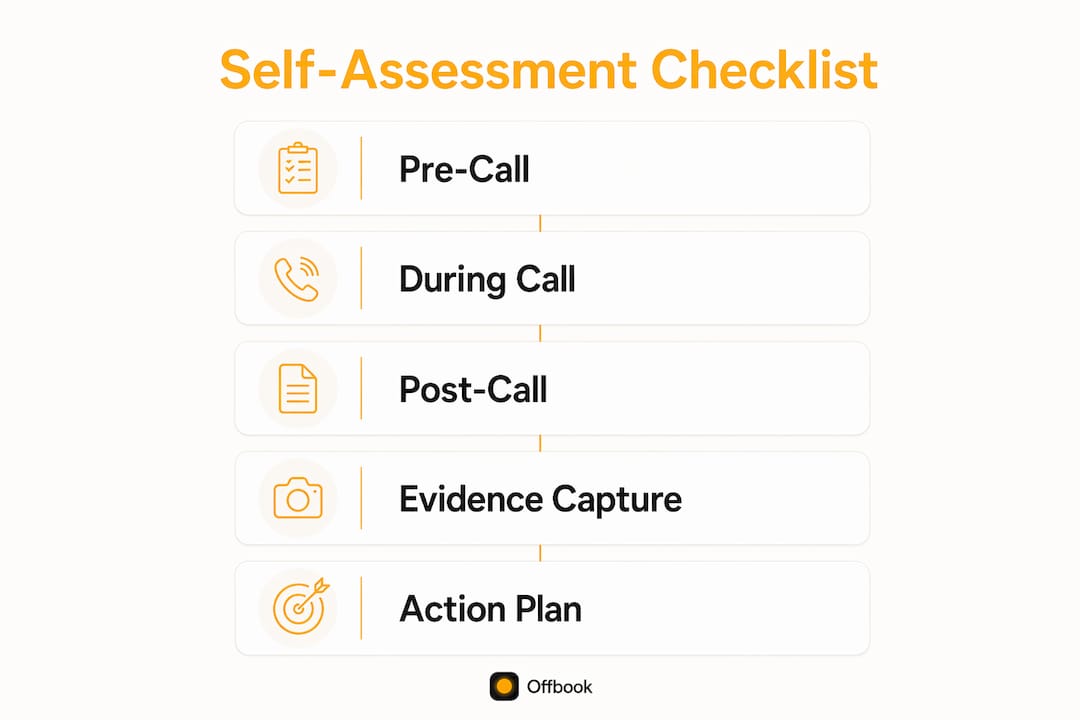
A structured scorecard scoring behavior across key dimensions turns vague impressions into coaching items. Rate yourself 1–5 on each of these:
| Dimension | What to score | Evidence to capture |
|---|---|---|
| Discovery | Quality and depth of questions asked | Verbatim question you asked, timestamp |
| Qualification | MEDDIC/MEDDPICC fields covered | Which fields were confirmed vs. missing |
| Talk ratio | Proportion of time you spoke vs. prospect | Rough estimate or AI-reported % |
| Objection handling | How you addressed pushback | Exact objection raised, your response |
| Next-step clarity | Did you leave with a firm, dated commitment? | Agreed next step, date, owner |
Pair every score with one piece of objective evidence: a call timestamp, a CRM note, or a direct quote from the conversation. Meta-analyses show a consistent gap between self-ratings and supervisor ratings. Anchoring your scores to evidence is what closes that gap and makes your self-assessment defensible in a coaching conversation.
Pro Tip: To avoid Dunning-Kruger distortion, write down one specific moment from the call that justifies each score before you submit the rating. If you can’t name the moment, the score is a guess.
A copyable template: pre-call, during-call, and post-call prompts
This template takes under five minutes total. Paste it into Notion, your CRM, or wherever you log calls.
Pre-call (2 minutes before the call starts):
- What is the single objective for this call?
- Which MEDDIC/MEDDPICC fields am I trying to confirm or advance?
- What is the one objection most likely to come up, and what’s my plan?
During-call reflection cues (annotate in real time or immediately after):
- Did I open with a clear agenda and get buy-in?
- Did I ask at least two open discovery questions before pitching?
- Did I confirm economic buyer, decision process, or timeline?
- Did I handle the main objection with a question before a rebuttal?
- Did I close with a specific next step, date, and owner?
Post-call micro self-assessment (under 3 minutes):
- Score each dimension 1–5 (use the table above)
- Write one sentence: what went well and why
- Write one sentence: what to do differently next call
- Log the agreed next step in CRM with a date
That’s the whole ritual. Five minutes, every call, compounding daily.
How real-time AI coaching integrates with your self-assessment
The self-assessment habit gets dramatically easier when you have live data to pull from. This is where real-time AI coaching changes the workflow.

Three integration points matter most:
Pre-call brief. Offbook generates a brief on the company and contact before the call starts. That brief seeds your pre-call checklist automatically. You walk in knowing the deal stage, open qualification gaps, and the most likely objection.
Live in-call cues. During the call, Offbook surfaces on-screen prompts tied to MEDDIC and MEDDPICC without joining the meeting as a bot. Those cues become your during-call annotation layer. When a cue fires, note whether you acted on it. That’s an objective data point for your post-call score.
Auto debrief. Immediately after the call, Offbook generates a debrief with key moments and follow-up drafts. That debrief pre-populates your evidence fields. Instead of reconstructing the call from memory, you’re reviewing a structured record.
Pro Tip: Before using any live AI coaching tool, confirm that your call recording and AI-assist practices comply with applicable consent laws in your state. Many states require two-party consent for recorded conversations. Offbook includes privacy and consent infrastructure, but you should verify your disclosure workflow with your legal team.
Modern coaching frameworks recommend tying micro-reflection to daily workflows and using real-time tooling to bridge the gap between what happened and what you intended. The AI debrief is that bridge.
How managers should run evidence-first coaching conversations
A self-assessment only reaches its full value when the manager engages with it. Best-practice templates recommend that both parties score the same calls independently, then compare. The gaps between scores are the highest-signal coaching surface in any 1:1.
A short meeting script that works:
- “Walk me through your score on discovery. What evidence did you use?”
- “Here’s what I observed at the 14-minute mark. How does that compare to your rating?”
- “Given the gap, what’s the one behavior you want to adjust on your next three calls?”
- “How will we know it worked? What’s the measurable signal?”
Practical bullets for managers:
- Tie every coaching point to a specific call moment, not a general pattern
- End every 1:1 with one agreed behavior change and a follow-up date
- Use MEDDIC or MEDDPICC as the shared rubric so both parties speak the same language
- Combine CRM activity, call snippets, and self-scores to reduce subjectivity
Frequent, evidence-based 1:1s turn manager feedback into a living record. That record is what makes coaching measurable rather than motivational.
Turning your self-assessment into a SMART action plan
Reflection without a time-bound action is just journaling. Here’s how to convert a self-assessment finding into something trackable.
Example SMART objective: “I will ask at least two open discovery questions before introducing the product on every call this week. I’ll verify by reviewing my Offbook debrief each day. My manager and I will review talk-ratio data in our Friday 1:1.”
That’s specific, owned, time-bound, and measurable. One behavior, one week, one proof point.
| Metric | Type | Evidence to capture |
|---|---|---|
| Talk ratio | Leading | AI-reported % per call |
| Discovery questions asked | Leading | Count from call debrief |
| MEDDIC fields confirmed | Leading | CRM qualification fields |
| Win rate | Lagging | CRM closed-won data |
| Average deal cycle | Lagging | CRM opportunity close dates |
Track leading metrics weekly. Review lagging metrics quarterly. Combining both is what makes your coaching points predictive rather than retrospective.
Common mistakes reps make with self-assessments
Vague evidence. “I think discovery went okay” is not a score. Tie every rating to one timestamp or one verbatim moment from the call.
Skipping post-call reflection. The longer you wait, the more the call blurs. Complete the post-call section within 15 minutes while the details are sharp.
Over-rating to avoid discomfort. A 4 on objection handling when you fumbled the main objection doesn’t help you. The score is for you, not your manager.
Pro Tip: When a gap shows up in three consecutive self-assessments, stop treating it as a one-call fix. Bring it to your manager as a coaching priority with the evidence trail attached. That’s when it becomes a formal improvement focus, not a private note.
A daily and weekly checklist to make the habit stick
Daily (under 5 minutes total):
- Pre-call: set objective, review open MEDDIC gaps, anticipate top objection
- Post-call: score five dimensions, write two sentences, log next step in CRM
- Review AI debrief and flag one timestamp as evidence for your self-assessment
Weekly (15 minutes):
- Review all self-assessments from the week; identify the one dimension with the lowest average score
- Pick two practice priorities for next week
- Prep your 1:1 by pulling your scorecard and one call snippet per coaching point
- Check whether last week’s SMART action produced a measurable change
Integrating self-assessment into daily workflows is what separates reps who improve steadily from reps who rely on quarterly reviews to catch problems. The sales call performance guide from Offbook covers specific call behaviors worth tracking in this cadence.
Key Takeaways
A sales rep self-assessment is a daily, evidence-backed scoring ritual that turns call reflection into measurable behavior change and sharper manager-aligned coaching.
| Point | Details |
|---|---|
| Define it precisely | A self-assessment scores specific call behaviors (1–5) with objective evidence, not general impressions. |
| Use leading and lagging metrics | Track talk ratio and discovery depth weekly; review win rate and deal cycle quarterly. |
| Integrate real-time AI cues | Offbook’s pre-call briefs, live prompts, and auto debriefs pre-populate your evidence fields after every call. |
| Align with your manager | Both parties score the same call independently; gaps between scores are the highest-value coaching surface. |
| Convert to a SMART action | Every self-assessment should produce one specific behavior change with a measurable signal and a follow-up date. |
The habit most early-stage teams skip
The conventional wisdom on sales coaching focuses on manager-led feedback. Review the call recording, share the notes, agree on a fix. That model puts the rep in a passive seat, and passive reps don’t compound.
What actually moves performance at seed and Series A is rep-owned reflection happening at call frequency, not review frequency. When a rep scores their own discovery before the manager ever listens to the recording, two things happen: the rep catches the gap first, and the 1:1 becomes a conversation between two people who’ve already done the analysis. That’s a fundamentally different dynamic.
The objection I hear most often is that reps don’t have time. A two-minute post-call score is not a time problem. It’s a habit problem. The teams that solve it, usually by anchoring the ritual to an AI debrief that’s already sitting in their inbox, build a compounding advantage that shows up in win rates within a quarter.
Offbook turns self-assessment from a chore into a workflow
Most reps skip post-call reflection because it requires reconstructing the call from memory. Offbook removes that friction entirely. The moment a call ends, you get a structured debrief with key moments, qualification gaps, and a follow-up draft already written. Your self-assessment evidence fields are pre-populated before you’ve even opened your CRM.
During the call, Offbook surfaces live MEDDIC and MEDDPICC cues on your screen without a bot joining the meeting. Every prompt you act on or miss becomes a data point in your post-call score. Pre-call, the brief tells you exactly which qualification gaps to close and which objections to prepare for.
Built for B2B SaaS teams at the seed and Series A stage, Offbook gives reps the evidence they need to self-assess accurately and gives managers the shared record they need to coach without guesswork. Try it on your next call at Offbook for sales.
Useful sources
- Gartner: Sales performance metrics — authoritative guidance on linking leading and lagging indicators in sales evaluations
- What Is Self-Assessment in HR? Guide and Examples — prevalence data and the self-rating vs. supervisor-rating gap
- Only 1 in 7 Sellers Do This Crucial Skill — Jill Konrath’s practitioner data on post-call reflection frequency
- Sales Rep Scorecard Template — free 9-dimension rubric with 1–5 scoring across key call behaviors
- How to Conduct Sales Performance Evaluations — Highspot’s evidence-based 1:1 framework and follow-up structure
- Sales performance review template — HubSpot’s dual-scoring approach and shared evidence best practices
- How to Use Rep Self-Assessments in Coaching Plans — modern coaching frameworks for integrating self-evaluation into daily workflows
- Offbook for sales teams — real-time AI coaching with pre-call briefs, live cues, and instant debriefs that feed directly into self-assessment workflows