Sales Call Rep Performance Improvement Guide
Unlock rep performance improvement in sales calls with our guide! Discover tools and techniques to boost win rates and enhance coaching.
Published: June 12, 2026
Author: OffBook Editorial Team

Rep performance improvement in sales calls is defined as measurable, behavior-specific change in how a rep conducts discovery, handles objections, and advances deals, tracked through call data and tied to win rate outcomes. B2B companies with formal weekly sales call coaching achieve 27% higher win rates over those using informal methods. Tools like Offbook, Gong, and AI call coaching platforms now make it possible to analyze every call, not just the ones a manager happens to observe. This guide gives sales leaders and reps a structured path to lift sales call effectiveness through disciplined coaching cadence, precise metrics, and behavior-focused feedback.
What tools and metrics drive rep performance improvement on sales calls?
Call recording and transcription are the foundation of any serious rep performance improvement program. Without 100% call visibility, coaching relies on memory and anecdote, both of which introduce bias and miss patterns. AI call intelligence analyzes every call automatically, flagging objection moments, competitor mentions, long silences, and short calls that signal disengagement. This removes the guesswork from coaching and gives managers a shared, objective language to use with reps.
The metrics that matter most are leading indicators tied directly to deal outcomes. Here are the five you should track on every call:
- Talk-to-listen ratio: Top B2B reps average a 43:57 ratio, meaning they listen more than they talk. Reps on lost deals talk 64% of the time. Reducing talk share by 10 points is often the single highest-impact behavioral change a rep can make.
- Discovery question count: Reps who ask 7 or more open-ended questions in a 30-minute discovery call are 4x more likely to advance the prospect. This metric is easy to pull from transcription tools and easy to coach against.
- Objection handling rate: Track how often a rep acknowledges, reframes, and resolves objections versus deflecting or ignoring them.
- Next-step specificity: Does the rep close every call with a named date, named attendee, and named action? Vague next steps are the leading cause of stalled pipelines.
- Multi-threading mentions: In B2B deals, reps who reference multiple stakeholders during calls close at higher rates. Track how often reps proactively surface this.
| Metric | What it measures | Why it matters |
|---|---|---|
| Talk-to-listen ratio | Rep’s share of call airtime | Predicts engagement and discovery depth |
| Discovery question count | Number of open-ended questions asked | Directly tied to pipeline advancement rate |
| Objection handling rate | Frequency of resolved objections | Signals rep confidence and deal control |
| Next-step specificity | Quality of call close | Reduces pipeline stall and ghosting |
| Multi-threading mentions | Stakeholder coverage on calls | Correlates with enterprise deal close rates |
Platforms like Offbook go further by surfacing these metrics in real time during the call itself, prompting reps with the right questions and qualification gaps as the conversation unfolds. This is a different category from post-call recorders. It changes behavior in the moment, not after the deal is already lost.

How do you structure weekly coaching sessions to maximize rep skill improvement?
High-performing sales teams are 2.4x more likely to coach reps weekly than underperforming teams. The cadence is not optional. It is the mechanism through which behavior change actually sticks.
Here is a proven structure for a 30 to 45 minute weekly coaching session:
- Pre-session preparation (15 minutes before the meeting). The manager reviews two or three recorded calls from the week, scores them against a rubric tied to the five metrics above, and selects one or two specific moments to discuss. Do not walk into a coaching session without a specific call clip ready.
- Open with a rep self-assessment. Ask the rep to rate their own performance on the target skill before you share your view. This activates ownership and surfaces blind spots. The GROW framework (Goal, Reality, Options, Will) works well here because it keeps the rep in the driver’s seat rather than putting them on the defensive.
- Play the call clip and ask a question. Show the specific moment. Then ask: “What would you do differently?” before offering your own interpretation. Reps who diagnose their own behavior change faster than reps who are told what to fix.
- Agree on one behavior to change. Focusing on one specific skill per month leads to measurable improvement. Addressing multiple skills at once dilutes impact and overwhelms the rep. Name the behavior precisely: “In your next three discovery calls, ask at least five open-ended questions before presenting anything.”
- Schedule the next review before the session ends. Confirm the date and time of next week’s session in the room. This removes friction and signals that coaching is non-negotiable.
- Mid-week reinforcement. Send a short video clip or voice note referencing the agreed behavior. This keeps the skill top of mind without requiring another full session.
Pro Tip: Use the GROW, CAR, SBI, and OSKAR frameworks for different rep scenarios. GROW suits reps who are self-aware and motivated. SBI (Situation, Behavior, Impact) works better for reps who need direct, concrete feedback. Match the framework to the rep, not the other way around.
A structured sales call preparation checklist before each session also helps managers arrive with context on the rep’s pipeline, recent wins, and open coaching threads, so the session stays focused on skill development rather than deal review.
What is the difference between coaching and training in rep performance improvement?
Sales coaching and sales training are not interchangeable. Mixing them in the same session is one of the most common mistakes B2B sales leaders make, and it undermines both.
Training transfers knowledge. It covers product features, competitive positioning, use cases, and objection scripts. It is delivered to groups, follows a curriculum, and has a defined endpoint. A new rep needs training before they can coach effectively against real calls.
Coaching changes real-time selling behaviors. It is one-on-one, call-specific, and ongoing. It does not teach a rep what the product does. It changes how the rep shows up in a live conversation with a prospect.
Here is how to keep the two tracks separate and effective:
- Diagnose before you prescribe. Use call data to determine whether a rep’s problem is a knowledge gap (training) or a behavior gap (coaching). A rep who cannot explain your pricing model needs training. A rep who explains it too early in the call needs coaching.
- Run separate sessions. Training happens in group settings with structured curriculum. Coaching happens in weekly 1:1s with call recordings. Never combine them in the same meeting.
- Measure differently. Training success is measured by knowledge retention assessments. Coaching success is measured by behavior change on calls at 30 and 60 days post-intervention.
- Avoid the “feedback dump.” Managers who use coaching sessions to deliver product updates or process changes are training, not coaching. The rep leaves confused about what to actually do differently on their next call.
Separate training tracks by skill type improve both knowledge retention and behavioral application. The reps who improve fastest are those whose managers are disciplined enough to keep the two activities distinct.
How do you measure rep performance improvement over time?
Tracking improvement requires a two-layer measurement system: leading indicators that change quickly and lagging indicators that confirm deal impact.
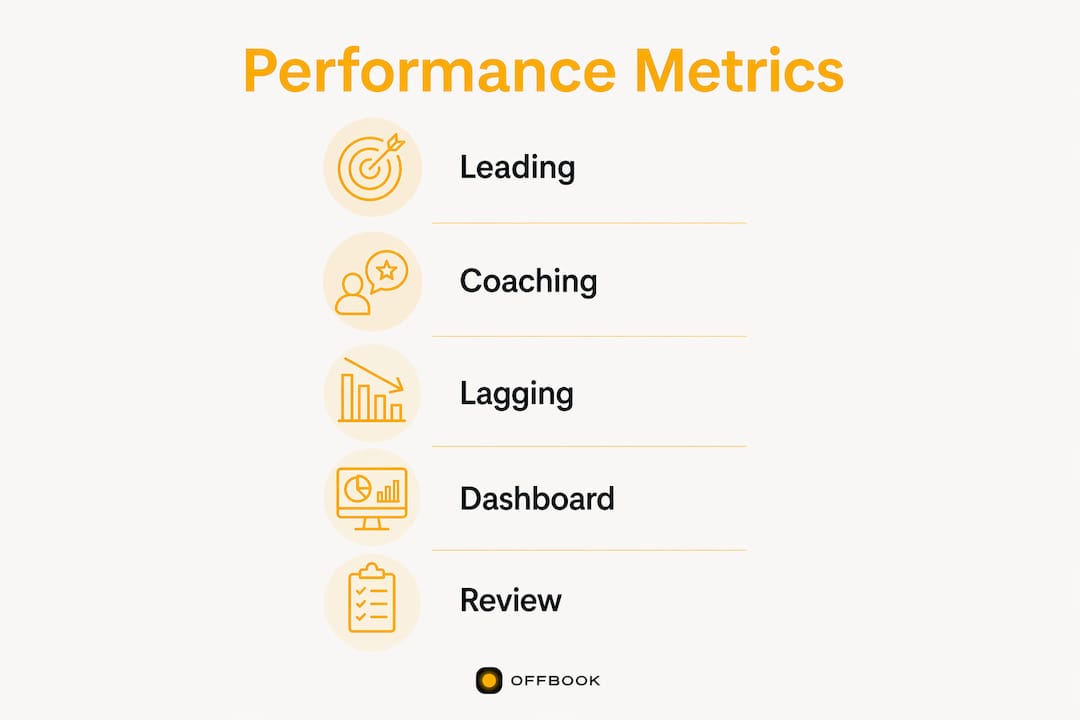
Leading indicators are the metrics you track at the call level. Talk-to-listen ratio, discovery question count, and next-step specificity all move within two to four weeks of focused coaching. These are your early signal that behavior is changing. Track them weekly in a simple dashboard and compare week-over-week for each rep.
Lagging indicators like win rate and quota attainment take 60 to 90 days to reflect coaching impact, because deals in flight were opened before the coaching intervention. Tracking win-rate delta on coached skills at 30 and 60 days post-intervention is the most reliable way to prove coaching ROI and decide where to focus next.
| Indicator type | Examples | When to review |
|---|---|---|
| Leading | Talk ratio, question count, next-step rate | Weekly, per rep |
| Lagging | Win rate, quota attainment, average deal size | Monthly, at 30 and 60 days post-coaching |
Pro Tip: Focus your coaching energy on the middle 60% of your team. Top performers often self-correct. Bottom performers may need structural changes beyond coaching. The middle tier has the most headroom and delivers the largest aggregate lift when coached consistently.
Visual dashboards that display both indicator types side by side help managers have faster, more specific conversations with reps. When a rep sees their talk-to-listen ratio drop from 65% to 48% over four weeks, the behavior change becomes real and motivating, not abstract.
What mistakes undermine rep performance improvement on sales calls?
The most common reason coaching programs fail is not a lack of intent. It is a lack of discipline in execution. These are the mistakes that kill progress:
- Coaching too many skills at once. Telling a rep to improve their talk ratio, ask better questions, and close more specifically in the same session guarantees none of it changes. One skill per month is the rule.
- Canceling or skipping sessions. Sales leaders who protect weekly coaching time see 2.4x higher quota attainment, even during year-end pipeline crunches. Skipping a session sends the message that coaching is optional. It is not.
- Giving vague feedback. “You need to be more consultative” is not coaching. “In your last three calls, you presented the demo before asking about the prospect’s current process. In your next call, ask at least two process questions before opening your screen” is coaching.
- Mixing pipeline reviews with coaching sessions. When a manager uses the coaching slot to review deals, the rep learns to treat coaching as a pipeline check-in. Keep them separate on the calendar and in purpose.
- Skipping reinforcement between sessions. A single weekly session is not enough to embed a new behavior. Short video clips, Loom messages, or a two-minute voice note mid-week referencing the agreed skill dramatically increases retention.
Reviewing types of sales coaching moments before each session helps managers identify which call moments are worth replaying and which skills are most worth targeting for each rep’s current stage of development.
Key takeaways
Rep performance improvement in sales calls requires a fixed weekly coaching cadence, behavior-specific feedback grounded in call data, and a clear separation between skills coaching and product training.
| Point | Details |
|---|---|
| Weekly cadence is non-negotiable | Teams that coach weekly achieve 2.4x higher quota attainment than those with irregular cadence. |
| One skill per month rule | Focusing on a single behavior per rep per month produces measurable, durable improvement. |
| Separate coaching from training | Training fills knowledge gaps; coaching changes live call behaviors. Never combine them. |
| Lead with leading indicators | Track talk ratio and question count weekly before relying on win rate to confirm progress. |
| Real-time coaching beats post-call review | Prompting reps during a call changes the outcome of that deal, not the next one. |
Why discipline beats strategy in sales call coaching
Most sales leaders I talk to have a coaching strategy. Very few have a coaching discipline. They know what good looks like. They have the tools. They have the frameworks. What breaks down is the Tuesday afternoon session that gets pushed for a pipeline call, then pushed again for a customer escalation, and then quietly disappears from the calendar.
Here is what I have observed consistently: the managers who protect that 30-minute weekly slot, even when the quarter is on fire, are the ones whose reps improve. Not because the session is magic, but because the rep learns that their development is a priority. That signal alone changes how a rep approaches their own calls.
The other thing I would push back on is the instinct to coach your top performers hardest. Your top reps are already self-correcting. They listen to their own calls. They ask for feedback. Your middle 60% are where the real leverage is. A rep moving from 70% quota attainment to 90% is a bigger team win than a top rep going from 120% to 130%.
One more thing: let reps own the behavior change. When you tell a rep what to fix, they comply. When you ask them what they would do differently and they arrive at the same answer themselves, they commit. The GROW framework exists for exactly this reason. Ask more than you tell, and your coaching sessions will produce faster, stickier results.
— Neil
How Offbook helps you scale rep coaching without adding hours
Offbook is built for exactly the challenge this article describes: running disciplined, behavior-focused coaching at scale without spending hours reviewing calls manually.
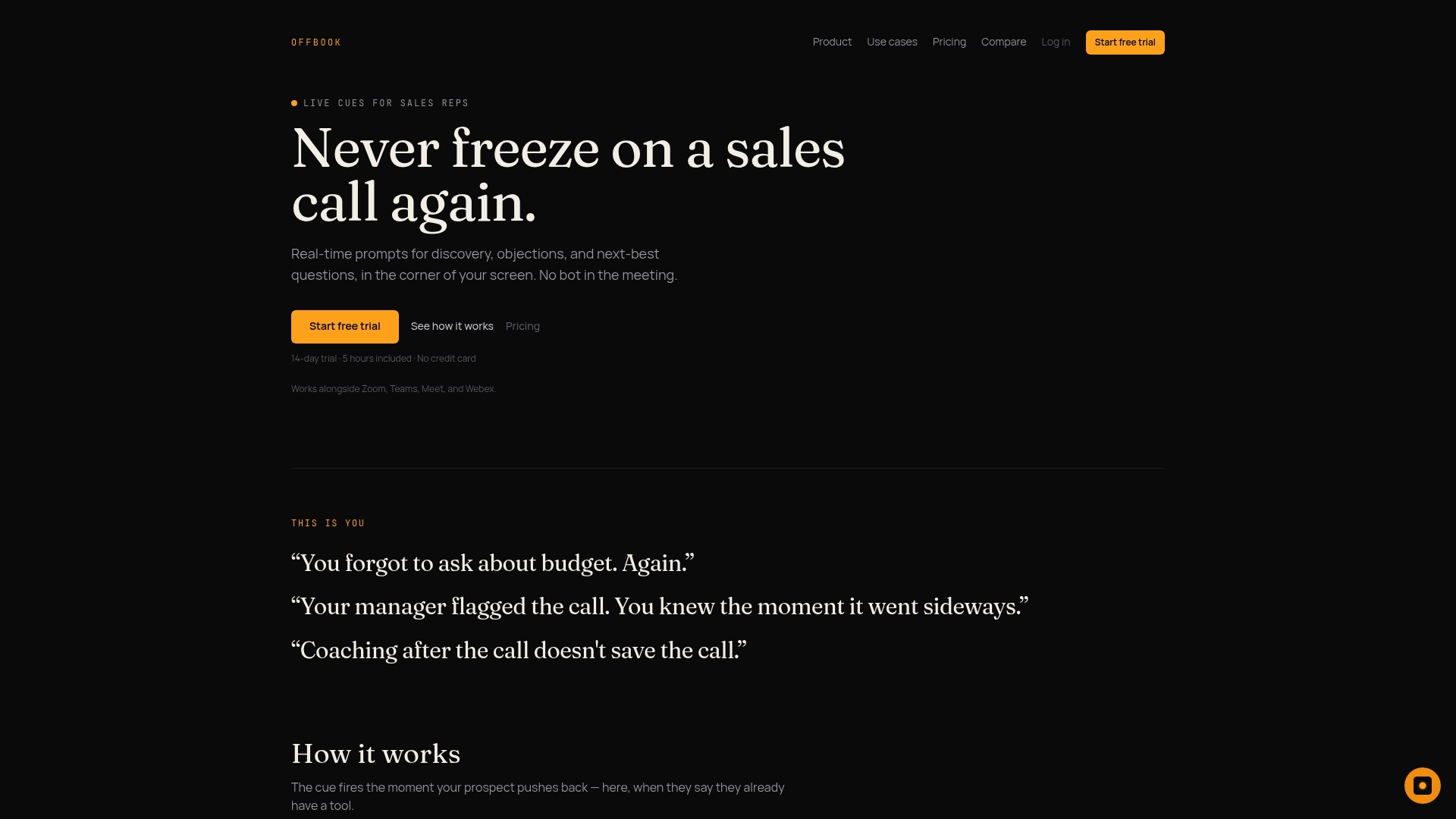
Offbook surfaces live AI cues to reps during video calls, prompting them with the right discovery questions, objection responses, and qualification gaps in real time, structured around MEDDIC and MEDDPICC. It also generates pre-call briefs so reps walk into every conversation prepared. For managers, Offbook flags the highest-impact calls and coaching moments automatically, so your weekly 1:1s start with the right clip already queued up. If you are building a repeatable coaching system for a B2B SaaS team, explore Offbook’s AI call coaching to see how it fits your current process.
FAQ
What is rep performance improvement in sales calls?
Rep performance improvement in sales calls refers to measurable, behavior-specific changes in how a rep conducts discovery, handles objections, and advances deals, tracked through call metrics and tied to win rate outcomes. It is distinct from general sales training and requires ongoing, call-based coaching.
How often should sales managers coach their reps?
Weekly 30 to 45 minute individual sessions are the standard. High-performing teams are 2.4x more likely to coach weekly than underperforming teams, and consistent cadence is the single highest-ROI management activity for rep development.
What metrics should I track to measure sales call effectiveness?
Track talk-to-listen ratio, discovery question count, objection handling rate, and next-step specificity as leading indicators. Win rate and quota attainment are lagging indicators that confirm improvement at 30 and 60 days post-coaching.
What is the difference between sales training and sales coaching?
Training transfers product and competitive knowledge to groups on a curriculum. Coaching changes live call behaviors through one-on-one, call-specific sessions. Mixing the two in the same session dilutes the effectiveness of both.
How many skills should a rep focus on improving at once?
One skill per month. Focusing on a single behavior, such as talk ratio or discovery questioning, produces measurable improvement. Addressing multiple skills simultaneously overwhelms the rep and produces no lasting change in any of them.