What Is Sales Rep Accountability? A B2B SaaS Guide
Learn what is sales rep accountability and how it drives performance in B2B SaaS. Discover strategies for improved revenue and goal achievement.
Published: July 20, 2026
Author: OffBook Editorial Team

Sales rep accountability is defined as the ownership sales representatives take for their activities, behaviors, and results, ensuring consistent performance aligned with organizational goals. This is distinct from compliance, which is simply following rules when someone is watching. True accountability lives in what a rep does when no one is looking. Teams with strong accountability systems achieve goals 31% more often and gain up to 7% annual revenue growth. Those numbers make accountability one of the highest-leverage investments a sales leader can make.
What is sales rep accountability in daily sales operations?
Sales rep accountability means owning the process, not just the outcome. A rep who hits quota by luck but ignores pipeline hygiene is not accountable. A rep who misses a month but can explain exactly what broke and how they are fixing it is. The difference is process ownership.
Accountable reps consistently own their pipeline hygiene, follow-up cadence, and call preparation, not just their revenue targets. That ownership shows up in specific daily behaviors:
- Prospecting discipline: Blocking time for outreach and protecting it from internal meetings.
- Pipeline hygiene: Updating deal stages in the CRM after every call, not at the end of the week.
- Follow-up cadence: Sending next-step emails within 24 hours of a discovery call.
- Call preparedness: Reviewing company research and contact history before every meeting.
- Qualification rigor: Applying frameworks like MEDDIC or MEDDPICC to every active deal, not just the big ones.
Clarity in expectations drives all of this. A rep cannot own a standard they do not know exists. When expectations are documented and agreed upon, accountability shifts from a management conversation to a personal standard.
Pro Tip: Write down the five behaviors you expect from every rep each week. Share the list with the team. Reps who help define the standard are far more likely to hold themselves to it.

How does leadership build a culture of accountability?
Leadership behavior is the foundation of any accountability culture. A manager who cancels one-on-ones, skips pipeline reviews, or ignores their own deadlines cannot expect reps to behave differently. Flaws in the leadership system cause most accountability failures, not rep problems. That distinction changes where a sales leader should look first when performance slips.
Effective accountability rests on three conditions: clarity about standards, continuous visibility of performance, and recognition of positive behaviors. Each condition requires deliberate design, not just good intentions.
“Accountability is not a tool you use on people. It is a standard you model for them. When leaders show up prepared, follow through on commitments, and inspect behaviors rather than just outcomes, reps learn what ownership actually looks like.”
Building this culture requires specific leadership choices:
- Set standards collaboratively. Reps who help define expectations take more ownership of meeting them.
- Inspect behaviors, not just numbers. Review call preparation quality and follow-up speed, not only closed revenue.
- Coach continuously. Weekly one-on-ones focused on behavior patterns create more growth than quarterly performance reviews.
- Recognize publicly. Call out reps who demonstrate strong process discipline, not just those who close the biggest deals.
- Model follow-through. If you commit to sending a resource or making an introduction, do it before the next meeting.
The shift from control to congruence is the hardest part. Micromanagement signals distrust. Accountability culture signals shared ownership. The goal is a team where reps hold themselves to the standard because they believe in it, not because someone is watching.
How to measure sales rep accountability with the right metrics
Sales reps spend only 30% of their day actively selling due to inefficiencies and poor system alignment. That means 70% of a rep’s time is consumed by tasks that do not directly move deals forward. Accountability metrics help identify where that time goes and whether the right behaviors are happening.
The most useful metrics split into two categories.
Lead indicators (activity-based)
Lead indicators measure behaviors a rep controls directly. They predict future outcomes and allow self-correction before a quarter ends. Examples include calls made per day, discovery calls booked per week, qualification scores on active deals, and follow-up emails sent within 24 hours of a meeting.
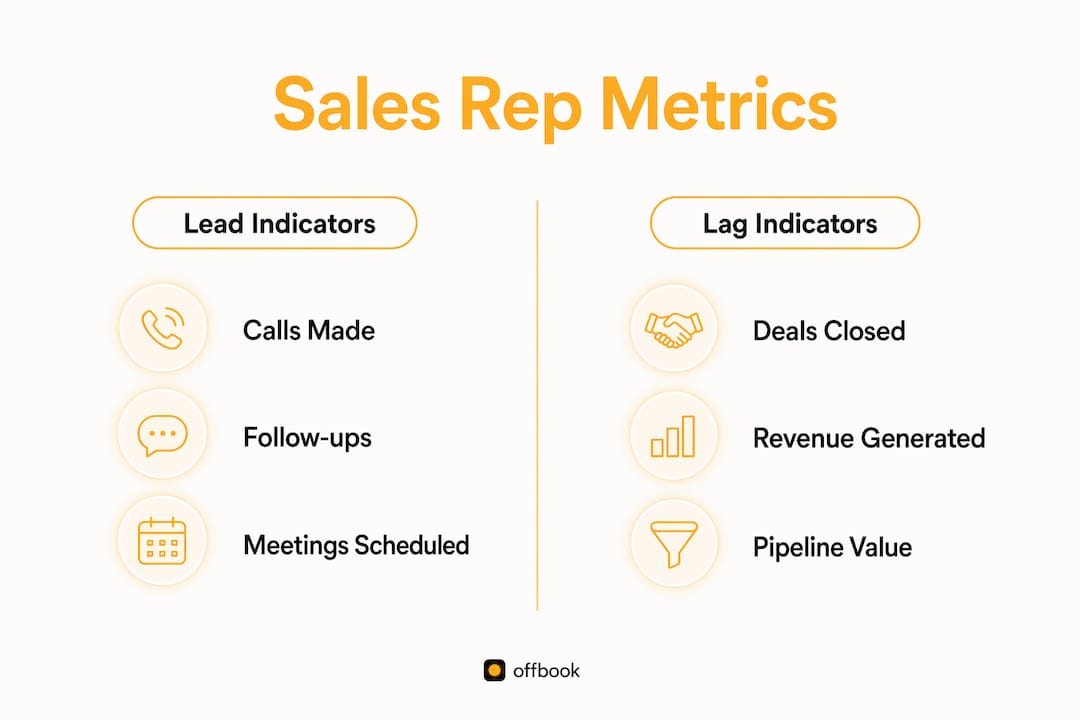
Lag indicators (outcome-based)
Lag indicators measure results. They confirm whether the behaviors worked. Examples include pipeline value by stage, win rate, average deal size, and revenue closed per month. Lag indicators tell you what happened. Lead indicators tell you why.
The most effective accountability systems track both. A rep with strong lag numbers but weak lead indicators is likely to have an inconsistent next quarter. A rep with strong lead indicators but weak lag numbers probably has a coaching or skills gap worth addressing.
Real-time access to performance data shifts the manager’s role from oversight to coaching. When reps can see their own numbers against team benchmarks, they self-correct without being told. Dashboards and leaderboards inside a CRM make this possible at scale.
AI tools take this further. Offbook, for example, surfaces live cues during video calls, prompting reps on qualification gaps and objection handling in real time. That kind of in-call visibility creates a feedback loop that post-call reviews cannot replicate. For a deeper look at how this works in practice, the role of technology in sales coaching covers the mechanics in detail.
Pro Tip: Build a simple weekly scorecard with three lead indicators and two lag indicators for each rep. Review it together every Monday. The conversation that follows is worth more than any dashboard.
Common pitfalls in sales rep accountability programs
Most accountability initiatives fail before they produce results. The failure is almost always a leadership problem, not a rep problem.
The most common mistakes are:
- Confusing surveillance with accountability. Tracking every click and call log creates anxiety, not ownership. Reps optimize for the metric being watched, not the outcome that matters.
- Skipping the agreement step. Top-down mandates without rep buy-in lead to minimal compliance and quiet disengagement. Reps do the minimum required to avoid a conversation.
- Measuring outcomes without coaching behaviors. Holding a rep accountable for missing quota without reviewing their call quality or pipeline discipline is punishing a symptom, not fixing a cause.
- Ignoring recognition. Teams that only hear about problems develop a defensive relationship with accountability. Recognition of strong process behavior reinforces the standard.
- Inconsistent leadership follow-through. A manager who does not review the scorecard consistently signals that it does not actually matter.
The term “malicious compliance” describes what happens when reps follow the letter of an accountability system while ignoring its intent. A rep who logs 50 calls per week but spends 30 seconds on each one is gaming the metric. The fix is not more metrics. The fix is a conversation about the standard and why it exists.
Pro Tip: Before adding a new accountability metric, ask: “Would a rep who genuinely wanted to improve use this number to guide their own behavior?” If the answer is no, the metric serves management, not growth.
Strategies for embedding accountability in B2B SaaS startup sales teams
Early-stage SaaS sales teams face a specific challenge. Processes are still forming, roles are fluid, and founders often carry sales responsibility alongside product and fundraising. Accountability in this context requires a lighter structure that still creates real ownership.
These steps build accountability without adding bureaucracy:
- Document expectations before you hire. Write down the five behaviors you expect from every rep before their first day. Share the document in the first week. Reps who start with clarity perform better from the beginning.
- Build a visible dashboard from day one. Use your CRM to surface lead and lag indicators in a shared view. Sales pipeline visibility creates natural self-accountability when reps can see where they stand against the team.
- Run weekly behavior reviews, not just pipeline reviews. Ask reps what they did differently this week, not just what moved in the pipeline. Behavior-focused conversations build the habit of self-reflection.
- Recognize process wins publicly. When a rep sends a thorough pre-call brief or follows up within an hour of a meeting, name it in the team channel. Public recognition of process behavior sets the standard for everyone.
- Build peer accountability into the rhythm. Pair reps for weekly call reviews. Peers often catch patterns that managers miss, and the conversation feels less evaluative and more collaborative.
- Align accountability to growth stage. A seed-stage team of two reps needs a different system than a Series A team of ten. Start with three core behaviors and add complexity as the team scales.
For B2B SaaS teams specifically, startup sales rep best practices offer a useful framework for building these habits at the early stage.
Key Takeaways
Sales rep accountability is the ownership reps take for their behaviors and results, and it requires clarity, visibility, and consistent leadership modeling to produce lasting performance gains.
| Point | Details |
|---|---|
| Define accountability clearly | Accountability means owning behaviors and process, not just hitting revenue targets. |
| Leadership sets the standard | Accountability failures trace back to leadership systems, not rep character. |
| Track lead and lag indicators | Activity metrics predict outcomes; outcome metrics confirm whether behaviors worked. |
| Agree on standards with reps | Top-down mandates without rep buy-in produce compliance, not ownership. |
| Use real-time visibility | Reps with access to live performance data self-correct without manager intervention. |
The accountability paradox most sales leaders miss
The most common mistake I see sales leaders make is treating accountability as something you impose rather than something you build. They add more tracking, more check-ins, more dashboards, and then wonder why reps feel watched instead of supported.
Here is what I have found to be true: the leaders who build the most accountable teams are the ones who audit themselves first. They ask whether their own follow-through is consistent. They check whether their expectations are actually written down somewhere or just assumed. They notice whether they recognize good process behavior or only respond when something goes wrong.
Micromanagement destroys the autonomy that accountability requires. A rep who is told exactly what to do every hour never develops the judgment to own their own process. The goal is a team that holds itself to a standard because the standard makes sense, not because someone is watching.
The other thing I would push back on is the idea that accountability is primarily a rep problem. In my experience, when a whole team underperforms, the system is broken. When one rep underperforms, it might be a skills or fit issue. Leaders who skip that distinction waste time coaching individuals when the real fix is redesigning the process.
Start by looking at your own consistency. If you want reps to show up prepared, show up prepared yourself. If you want reps to follow up fast, respond to their questions fast. Accountability is contagious, but it has to start somewhere. That somewhere is you.
— Neil
How Offbook supports sales rep accountability in real time
Offbook is built for exactly the accountability gap that early-stage B2B SaaS teams face. Most sales leaders know what good looks like on a call. The hard part is getting reps to execute it consistently, especially when they are still building their skills and confidence.
Offbook listens to live video calls and surfaces real-time cues on screen, prompting reps on qualification gaps, objection handling, and next steps structured around MEDDIC and MEDDPICC. No bot joins the meeting. The rep gets the coaching in the moment it matters, not in a debrief two days later. Pre-call briefs give reps the context they need to walk in prepared. That combination of preparation and live coaching creates the behavioral consistency that accountability requires. Sales leaders can see AI-driven call coaching in action and understand how it fits into a broader accountability system for their team.
FAQ
What is sales rep accountability?
Sales rep accountability is the ownership a sales representative takes for their activities, behaviors, and results. It goes beyond hitting quota to include pipeline hygiene, call preparation, and consistent follow-up.
How do you measure sales rep accountability?
Measure accountability with a combination of lead indicators, such as calls made and follow-up speed, and lag indicators, such as win rate and pipeline value. Lead indicators show whether the right behaviors are happening before outcomes are determined.
What is the difference between accountability and micromanagement?
Accountability gives reps ownership of a standard they helped define. Micromanagement removes autonomy by dictating every action. True accountability focuses on behaviors and processes, not surveillance.
Why do sales accountability programs fail?
Most programs fail because standards are imposed without rep agreement, leading to minimal compliance. Accountability requires bidirectional agreement on standards, consistent leadership modeling, and recognition of positive behaviors.
What makes a good sales rep in terms of accountability?
A good sales rep owns their process regardless of whether a manager is watching. They update their CRM consistently, prepare for every call, follow up fast, and apply qualification frameworks like MEDDIC to every active deal.