Script the First 20 Seconds, Use AI Prompts the Rest for B2B SaaS
Script the first 20 seconds, then use live prompts for discovery and objections. Includes a five part script blueprint and prompt templates.
Published: September 20, 2026
Author: OffBook Editorial Team

A script is fixed language written in advance; a prompt is a flexible cue, either a written instruction to an AI tool or a live nudge that adapts to what the buyer just said. Script your first 20 seconds so the opener lands every time. Use prompts for everything after that, especially discovery and objections, where rigid wording backfires the moment a prospect goes off-book.
TL;DR:
- Scripts ensure consistency but can struggle to handle unexpected prospect responses, especially during discovery and objection handling.
- Prompts offer real-time flexibility by guiding reps based on conversation flow but require good guardrails to prevent hallucinated or off-brand outputs.
- Optimal strategies involve scripting the first 20 seconds of a call and then using prompts during the rest, tailored to each call stage.
- Larger teams benefit from tighter scripts for high-volume outreach, while smaller or complex deals succeed with prompts that adapt to individual contexts.
- Using structured prompts with clear roles, contexts, and goals helps generate effective questions, objections, and follow-up content during live calls.
Table of Contents
- Scripts vs. Prompts in Sales: The Core Difference
- When Should You Use a Script vs. a Prompt?
- How to Write a Sales Script That Doesn’t Sound Like One
- How to Write Sales Prompts That Actually Help Mid-Call
- How Do You Train Reps and Measure What’s Working?
- Live Prompts in Action: What This Looks Like on a Real Call
- What Actually Matters: Structure Where It Counts, Judgment Everywhere Else
- Where OffBook Fits for Teams Choosing Between Scripts and Prompts
- Sources
- FAQ
Scripts vs. Prompts in Sales: The Core Difference
A sales script is pre-written, word-for-word language a rep delivers the same way on every call. A sales prompt is a shorter instruction or cue, sometimes typed into an AI tool, sometimes flashed on-screen during a live call, that guides the rep’s next move without dictating exact phrasing. That distinction is the entire “scripts vs. prompts” debate in one sentence.
Scripts win on consistency. New hires ramp faster because they’re not improvising a cold open from scratch, and managers can audit calls against a known standard. The tradeoff is brittleness: a rep locked into a script tends to freeze the moment a prospect says something unexpected, according to HubSpot’s sales enablement research. Prompts flip that tradeoff. They flex with the conversation but carry a different risk when generated by an AI tool: hallucinated claims or off-brand phrasing if nobody validates the output.
Script example (20 seconds): “Hi, this is [Name] from [Company]. I know I’m interrupting your day, so I’ll be quick. We help B2B SaaS teams cut discovery calls that go nowhere. Do you have 90 seconds, or should I catch you at a better time?”
Prompt example (in-call cue): “Prospect just mentioned budget freeze. Surface the ROI question and ask who else needs to sign off.”
- Scripts: consistent, coachable, weak against curveballs
- Prompts: adaptive, personalized, dependent on good guardrails
When Should You Use a Script vs. a Prompt?
Match the tool to the moment in the call, not to a blanket policy. Here’s how that breaks down in practice:
- Cold outreach: Script the first line and the reason for calling. Gong-cited analysis in HubSpot’s guide found that clearly stating why you’re calling correlates with longer, more successful calls.
- Discovery: Use prompts, not scripts. A list of open questions works as scaffolding, but the follow-up needs to react to the actual answer, not a pre-written next line.
- Demos: Script the structure (problem, solution, proof point) but prompt the transitions based on what the prospect reacted to earlier in the call.
- Objection handling: This is prompt territory almost entirely. A frozen, scripted rebuttal reads as canned; a real-time cue that references the specific objection reads as attentive.
- Qualification: Hybrid works best. Script the MEDDIC categories you need to cover, then prompt the exact question based on what’s still missing.
Team size matters too. A five-person SDR team with high call volume benefits from tighter scripts because consistency scales faster than coaching bandwidth. A five-person AE team closing six-figure deals should lean toward prompts, since each buyer’s context is different enough that a fixed script wastes the rep’s judgment.
How to Write a Sales Script That Doesn’t Sound Like One
Start with a blueprint, not a monologue. Every effective script has five parts: the goal of the call, a 20-second opener, a discovery bridge, a value statement tied to something specific about the prospect, and a clear next step. Skip any of those five and the call either rambles or ends without a commitment.
The opener is the only part worth scripting word-for-word. HubSpot’s guidance is blunt about this: script the first 20 seconds, then improvise. Reps who try to script the whole call end up reciting instead of listening, and prospects notice the difference within a sentence or two.
Build scripts modularly instead of as one long document:
- Write separate, swappable modules for opener, discovery bridge, and close
- Replace any module past the opener with a prompt once reps have 10 to 15 live calls under their belt
- Keep each module under 30 seconds of spoken content
- Version-date every script so outdated lines don’t survive a product change
Test scripts the same way you’d test ad copy. Have two reps run the same opener for two weeks, then compare booked-meeting rates before rolling either version out team-wide.
Pro Tip: Read your script out loud to someone who’s never heard your pitch. If they can’t repeat the value line back to you in their own words, rewrite it.
How to Write Sales Prompts That Actually Help Mid-Call
A good prompt has five parts: role, context, goal, constraints, and an example of the output you want. Skip the constraints and an AI tool will happily generate a confident, wrong answer. Prompt libraries built for sales teams, like the ChatGPT prompt sets for cold calls, discovery, and objections from AI Academy, follow this same structure because it’s what keeps output usable instead of generic.
Three templates worth adapting:
- Discovery question generator: “You are a B2B sales coach. The prospect is a VP of Engineering at a 40-person startup evaluating dev tools. Generate three open-ended discovery questions that surface budget authority and current pain, avoiding yes/no phrasing. Example format: ‘What happens today when…’”
- Objection-response cue: “You are coaching a rep live on a call. The prospect just said pricing is too high. Suggest one question that reframes cost around the problem it solves, under 20 words.”
- Follow-up email draft: “Write a 3-sentence follow-up email referencing [specific pain point discussed] and proposing [specific next step], in a direct, non-salesy tone.”
Live in-call prompts work differently than these. An AI sales teleprompter surfaces private, glanceable cues that only the rep sees, updating in real time instead of requiring a pre-written monologue.
Two guardrails matter regardless of format: keep prompts brief enough to scan in two seconds during a live call, and get explicit consent before any tool listens to or records a conversation. Validate AI-generated phrasing before it reaches a prospect, since hallucination risk is real without a review step.
How Do You Train Reps and Measure What’s Working?
Rolling out scripts or prompts without a training loop wastes both. Here’s the sequence that holds up across teams:
- Onboard with pre-call briefs and shadowing. New reps should sit on five to ten live calls before running their own, watching how veterans deviate from scripts when the conversation calls for it.
- Roleplay against calibrated scorecards. Score practice calls on the same criteria you’ll use for real ones, not a separate training rubric.
- Track four metrics: conversion rate by call stage, talk-to-listen ratio, ramp time to first closed deal, and objection-handling success rate.
- Run A/B tests on phrasing, not just on whether a script exists, since the wording inside a module matters as much as the module itself.
- Version-control every script and prompt, and pull feedback from recorded calls monthly to retire lines that consistently underperform.
Governance is the part teams skip and regret. A script written in Q1 without a review cadence is stale by Q3, especially if your product or pricing has shifted since then.
Live Prompts in Action: What This Looks Like on a Real Call
Picture the workflow: a pre-call brief loads context on the company and the person a rep is about to meet, then live cues surface during the call itself, then a debrief captures what happened right after hang-up. That’s the shape real-time in-call coaching takes when it’s built around a sales methodology instead of generic transcription.
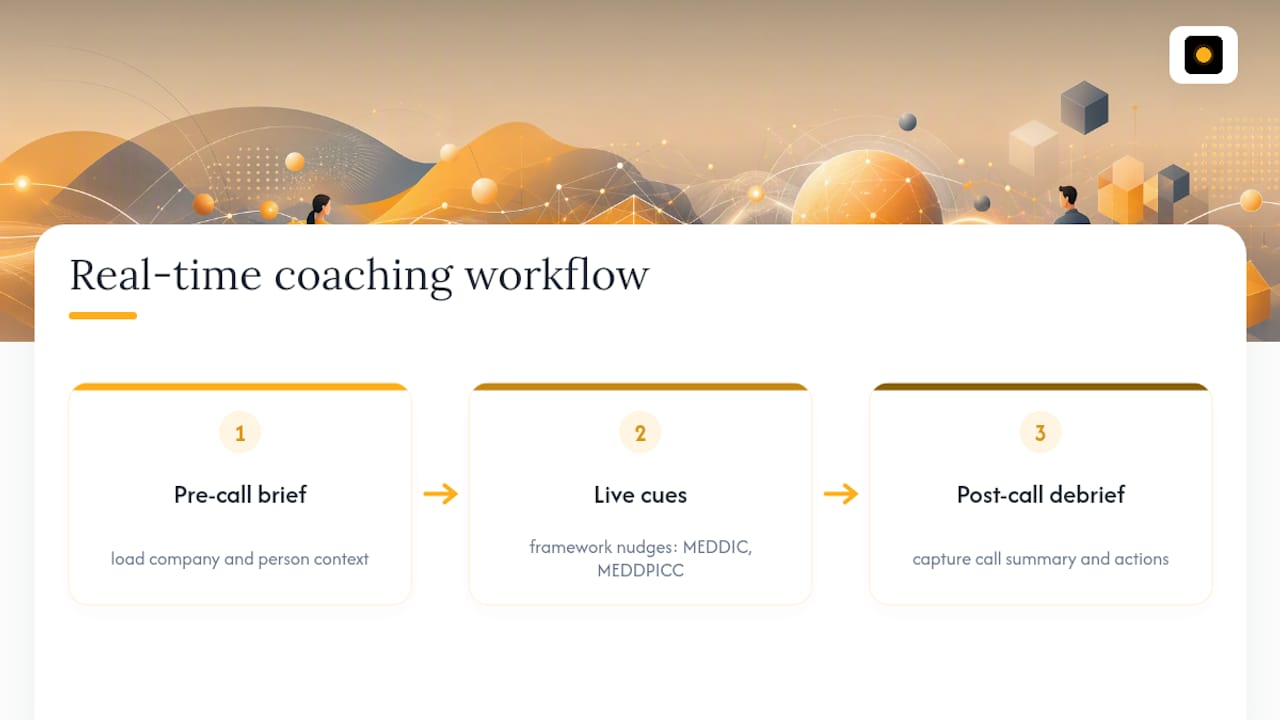
Cues tied to frameworks like MEDDIC or MEDDPICC tend to flag specific gaps: no economic buyer identified yet, no clear pain articulated, decision criteria still fuzzy. For founder-led B2B SaaS teams running lean, that kind of in-the-moment nudge catches what a rep might miss under call pressure, before the deal stalls in a stage it should have never reached.
What Actually Matters: Structure Where It Counts, Judgment Everywhere Else
Script the first 20 seconds. Prompt everything after. Most teams overinvest in one and underinvest in the other. Run small, deliberate A/B tests before committing either way.
— Neil
Where OffBook Fits for Teams Choosing Between Scripts and Prompts
Once you’ve settled on scripting your opener and prompting the rest, the harder problem is delivering that prompt at the exact second it matters, mid-call, without breaking eye contact to check notes. OffBook handles that by listening to the video call and surfacing on-screen cues in real time, without a bot ever joining the meeting. No fixed script to memorize, no assistant visibly present, just the next question or objection response flagged when the conversation calls for it.
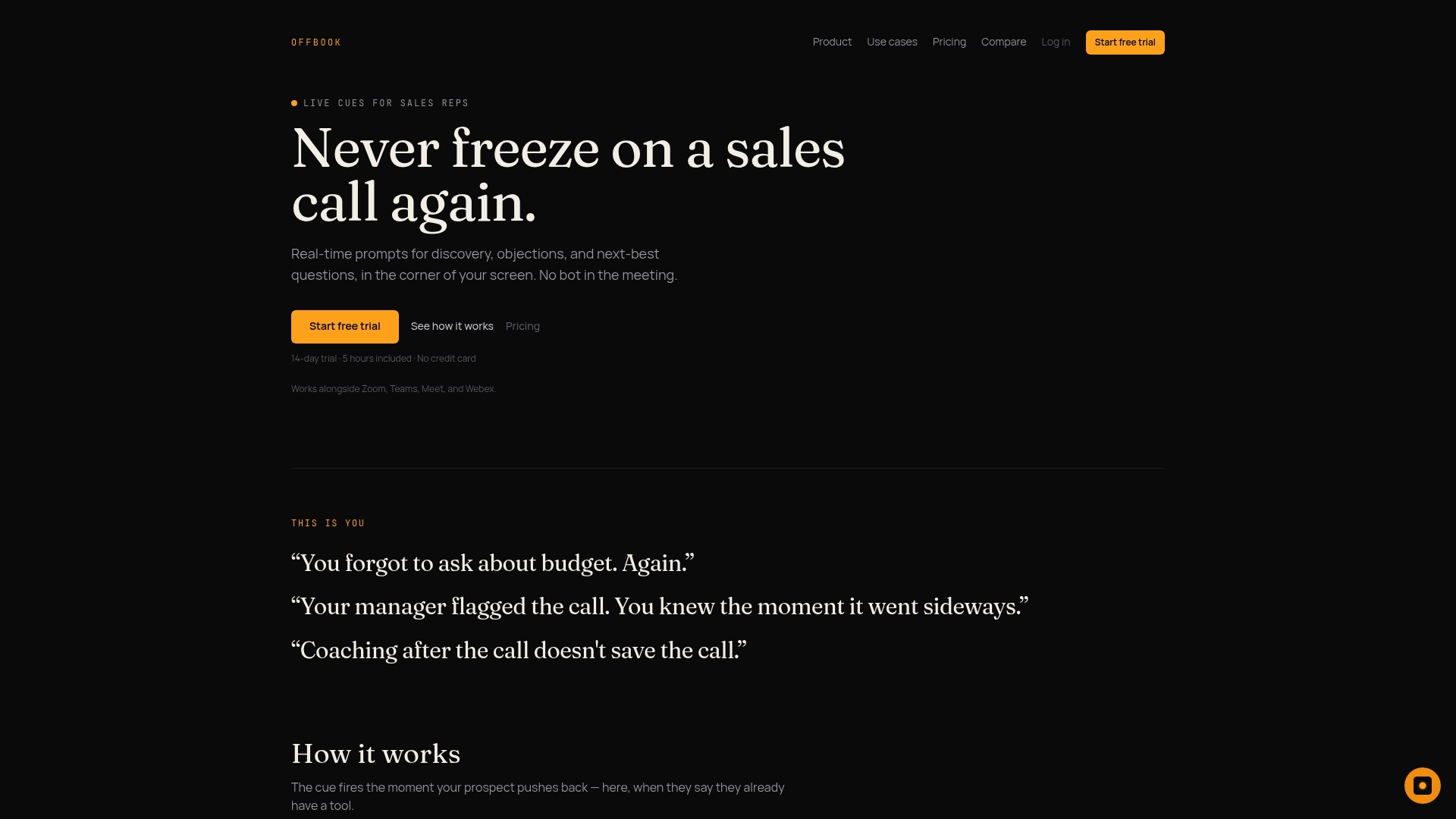
The cues are structured around proven sales methodologies, so a rep sees which qualification gap is still open instead of guessing. It can generate a pre-call brief on the company and person before the meeting starts, and draft a post-call debrief and follow-up right after. It is designed for B2B SaaS teams, including early-stage startups, that may not have a dedicated sales enablement function writing scripts full-time. Plans start at $59 per month on the Power plan, with a team option for growing sales orgs. Check current pricing and trial details to see which tier fits your team.
Sources
- How & why to use sales scripts + 14 examples and templates - HubSpot
- Sales Script Prompts for Cold Calls, Discovery, Demos, and Closes - AI Academy
FAQ
What’s the Difference Between a Prompt and a Script?
A script is fixed, word-for-word language written in advance and delivered the same way every time. A prompt is a shorter, adaptive cue, either an instruction fed to an AI tool or a live suggestion during a call, that responds to what’s actually happening in the conversation rather than dictating exact wording.
What Is a Script in Sales?
A sales script is pre-written dialogue a rep uses to guide a call, typically covering the opener, key talking points, and a close. The most effective ones only script the first 20 seconds and leave the rest to modular prompts and improvisation.
What Is the 2-2-2 Rule in Sales?
Definitions of the 2-2-2 rule vary across sales training resources, and it isn’t tied to a single verified standard covered in this article’s research. If you’ve encountered a specific version from a training program, treat it as that program’s framework rather than an industry-wide rule.
What Is an Example of a Sales Prompt?
A discovery prompt might read: “You are a sales coach. The prospect just mentioned a hiring freeze. Suggest one question that uncovers whether budget is frozen too, under 15 words.” Live in-call prompts work similarly but appear on-screen as a short cue rather than typed into a chat tool, the way OffBook surfaces qualification gaps in real time.