Sales Conversation Frameworks Founders Can Run Today
Master effective sales conversation frameworks founders can use today. Use the four-stage approach to qualify prospects and move them forward.
Published: July 30, 2026
Author: OffBook Editorial Team

The fastest way to qualify fit and move a prospect to a clear next step is a four-stage founder-friendly framework: Understand → Reflect → Offer → Decide. Run it on every discovery call, and you stop winging it. Diagnostic methods like MEDDIC and MEDDPICC slot in as qualification checks during Understand and Decide. Real-time coaching tools like Offbook keep you on track when the conversation pulls you off script.
The four-stage framework in 30 seconds:
- Understand (about fifteen minutes): Diagnose the problem. Ask, listen, and quantify. Talk no more than 30% of this stage.
- Reflect (around five minutes): Paraphrase what you heard. Confirm the pain before you pitch anything.
- Offer (between five and ten minutes): Present only the product paths that map to named pains. No feature tours.
- Decide (around five minutes): Agree on a specific next step. No vague “I’ll follow up.”
Next-step script you can paste into a closing email: “Based on what we discussed, the next step I’d suggest is [specific action] by [specific date]. Does that work for you?”
Table of Contents
- What does each stage of the framework actually look like on a call?
- Why this framework works especially well for founders
- Your live playbook: from pre-call prep to locking next steps
- Ready-to-copy questions and scripts for every stage
- Buying signals, red flags, and the traps founders fall into
- How to document your instincts and hand off to your first sales hire
- How Offbook enforces the framework when you’re live on a call
- Key Takeaways
- Founder-led selling is a learning motion, not a heroic one
- Run the framework on your next call with Offbook
- Useful sources
What does each stage of the framework actually look like on a call?
A standard typical half-hour to forty-minute discovery call maps cleanly to the four stages. The table below shows where your time goes, what you’re trying to accomplish, and the language that moves each stage forward.

| Stage | Time | Objective | Sample language |
|---|---|---|---|
| Understand | about fifteen minutes | Diagnose pain, quantify impact | “Walk me through how your team handles [X] today.” |
| Reflect | around five minutes | Confirm pain in the prospect’s words | “So if I’m hearing you right, the real cost is [Y]?” |
| Offer | between five and ten minutes | Show only relevant product paths | “Given what you described, here’s how we’d approach that.” |
| Decide | around five minutes | Lock a specific, dated next step | “What would need to be true for us to move forward by [date]?” |
The Understand stage is where most founders lose deals before they start. No feature tours, no product screenshots, no “let me show you what we built.” Your only job for those 15 minutes is to understand the problem well enough to repeat it back better than the prospect can.
For a structured discovery call, the Reflect stage is the hinge. Skipping it and jumping straight to Offer is the single most common founder mistake. When you paraphrase the pain accurately, the prospect relaxes. They feel heard. That’s when they start telling you the real problem.
Pro Tip: If a prospect gives you a specific, dated answer to any question in the Understand stage, lengthen it. That specificity signals genuine intent. If answers stay vague, shorten Understand and use Decide to test urgency directly.
Why this framework works especially well for founders
Founders carry three advantages into every sales call that a hired rep simply doesn’t have: deep product knowledge, authority to reshape scope or pricing on the spot, and direct accountability that makes buyers trust the outcome. The framework turns those advantages into a repeatable structure instead of a one-off heroic performance.
The listening-first rule is the core of it. Founders who treat discovery as diagnostic and talk no more than 30% of the call consistently outperform those who demo immediately. That’s not a soft preference. It’s the difference between a call that qualifies fit and one that just entertains a prospect.
MEDDIC and MEDDPICC plug directly into the framework as diagnostic checklists. During Understand, you’re covering Metrics, Economic Buyer, and Pain. During Decide, you’re confirming Decision Criteria, Decision Process, and Champion. You don’t need to run through every letter on every call. Use them as a gap-check: if you can’t answer a MEDDIC field after Understand, you haven’t listened hard enough.
Your live playbook: from pre-call prep to locking next steps
Good calls start before the call. A pre-call preparation checklist takes under ten minutes and changes the entire dynamic. Before every call, confirm your ICP one-liner for this prospect, note one recent signal from their company (a funding announcement, a job posting, a product launch), and identify two outcome metrics you want to quantify during Understand.
Opening script (the first couple of minutes):
This agenda-assertion does two things. It signals you’re not going to pitch for 25 minutes, and it gives the prospect permission to say “no fit” without awkwardness. That permission is what makes the rest of the call honest.
Transition from Understand to Reflect:
Transition from Reflect to Offer:
Micro-behaviors matter here. Nod, pause after they finish a sentence, and resist the urge to fill silence. Silence after a good question is the prospect thinking. Let them think.
Ready-to-copy questions and scripts for every stage
Pain-focused questions for Understand:
- “Walk me through how your team handles [X] today. What does that actually look like?”
- “Where does that process break down most often?”
- “What’s the cost of leaving that unsolved for another quarter?”
- “Who else feels the impact when [X] goes wrong?”
- “Have you tried to fix this before? What happened?”
Qualification probes for Decide:
- “What would need to happen internally for you to move forward?”
- “Who else needs to be involved before a decision gets made?”
- “Is there a deadline driving this, or is the timing flexible?”
For pain-focused discovery questions that force quantification, always follow up with: “Can you put a number on that?” If they can’t, the pain isn’t real enough to buy yet.
Founder story template (based on value-based story frameworks):
The best indicator a story landed is when the prospect starts asking questions instead of nodding politely.
Objection handler for “We’re not ready yet”:
Buying signals, red flags, and the traps founders fall into
Buying signals to double down on:
- Prospect asks about implementation timeline or onboarding
- They reference a specific internal deadline or budget cycle
- They ask “who else needs to be involved” from their side
- They start calculating ROI out loud
Red flags that mean slow down or disqualify:
- Can’t quantify the cost of the status quo
- Timeline is “sometime this year” with no driver
- Every answer is noncommittal or deferred to someone not on the call
- They’ve been “evaluating solutions” for more than six months
The most dangerous trap is chasing curiosity. Deals stall after a verbal yes because the buyer was interested, not committed. The fix is one question: “What changed to make solving this matter now?” A specific, dated answer is intent. A vague one means you’re in an education conversation, not a buying one.
Pro Tip: Never treat a verbal yes as a qualified deal. Ask for a specific dated reason for urgency before moving it to the next pipeline stage. Shallow qualification wearing a closing problem’s clothes is the most common pipeline leak founders miss.
How to document your instincts and hand off to your first sales hire
Before you hire, you need five artifacts. These aren’t nice-to-haves. A hire who inherits an undocumented motion fails, and the failure looks like a hiring problem when it’s actually a documentation problem.
| Artifact | Minimal contents | Owner after hire |
|---|---|---|
| ICP one-liner | Firmographic + behavioral profile of your best customers | Sales hire updates, founder reviews |
| Signal map | Observable triggers that indicate buying intent | Sales hire maintains |
| Message bank | Top pain statements + matching value claims | Founder writes, hire adapts |
| Discovery script | four-stage framework with stage-specific questions | Sales hire runs, founder coaches |
| Objection library | Top objections + tested responses | Both update after every loss |
The founder-led sales playbook recommends building these artifacts through your first several dozen deals. That’s not an arbitrary number. It’s the volume at which patterns become consistent enough to be teachable. Until then, you’re still discovering what works.
How Offbook enforces the framework when you’re live on a call
The hardest part of any framework isn’t knowing it. It’s staying on it when a prospect says something unexpected and your instinct is to pitch.
Offbook addresses that gap directly. It listens to your video call without joining as a bot, and surfaces live on-screen cues: questions to ask, qualification gaps to close, objection handlers to deploy. The pre-call brief gives you the ICP signal note and company context before you join. The post-call debrief populates your playbook artifacts automatically.
Mapped to the framework:
- Pre-call: Offbook generates a brief on the company and person you’re meeting, so you walk in with the ICP one-liner and signal note already confirmed.
- Understand stage: Live cues prompt MEDDIC gaps you haven’t covered yet.
- Reflect/Offer: Objection handlers surface in real time if the prospect pushes back.
- Decide: Qualification probes appear on screen to help you lock a specific next step.
Pro Tip: Configure your Offbook cue sets to mirror your founder story template and your top five qualification probes. That way the AI nudges match your voice, not a generic sales script.
Key Takeaways
The four-stage framework (Understand → Reflect → Offer → Decide) is the fastest way for founders to run disciplined discovery calls, qualify fit, and close to a clear next step every time.
| Point | Details |
|---|---|
| Memorize the time allocation | Understand about fifteen minutes, Reflect around five minutes, Offer between five and ten minutes, Decide around five minutes — protect each stage. |
| Never demo before Reflect | Confirm the pain in the prospect’s words before showing any product path. |
| Talk ≤30% during discovery | Founders who listen first outperform those who pitch early on every call. |
| Build five artifacts before hiring | ICP, signal map, message bank, discovery script, and objection library make the motion transferable. |
| Use Offbook for live discipline | Pre-call briefs, in-call cues, and post-call debriefs enforce the framework and populate your playbook automatically. |
Founder-led selling is a learning motion, not a heroic one
The founders who scale sales fastest aren’t the ones who close every deal personally. They’re the ones who treat every call as evidence. Each win or loss tells you something about the ICP, the message, or the qualification gap. The framework isn’t there to make you sound like a sales rep. It’s there to make your instincts legible so someone else can eventually run them.
Ethical selling matters here too. The goal isn’t to close at all costs. It’s to help the prospect make the right decision for their situation, even when that means telling them you’re not the right fit. That stance builds the kind of trust that generates referrals and long-term customers, not just logos.
The hiring signal is repeatability: several dozen deals closed at standard origin, standard price, and standard scope, with documented artifacts that explain why each one won or lost. Until you hit that, you’re still in the learning phase. That’s not a failure. It’s the work.
Run the framework on your next call with Offbook
Most founders know what a good discovery call looks like in theory. The gap is execution under pressure, when a prospect goes off-script and the instinct to pitch kicks in. Offbook closes that gap with live AI call coaching that surfaces the right cue at the right moment, without a bot joining your meeting or breaking the conversation’s flow.
Pre-call briefs mean you walk in prepared. In-call prompts keep you diagnostic. Post-call debriefs build your playbook automatically. It’s built specifically for founder-led B2B SaaS teams at the seed and Series A stage.
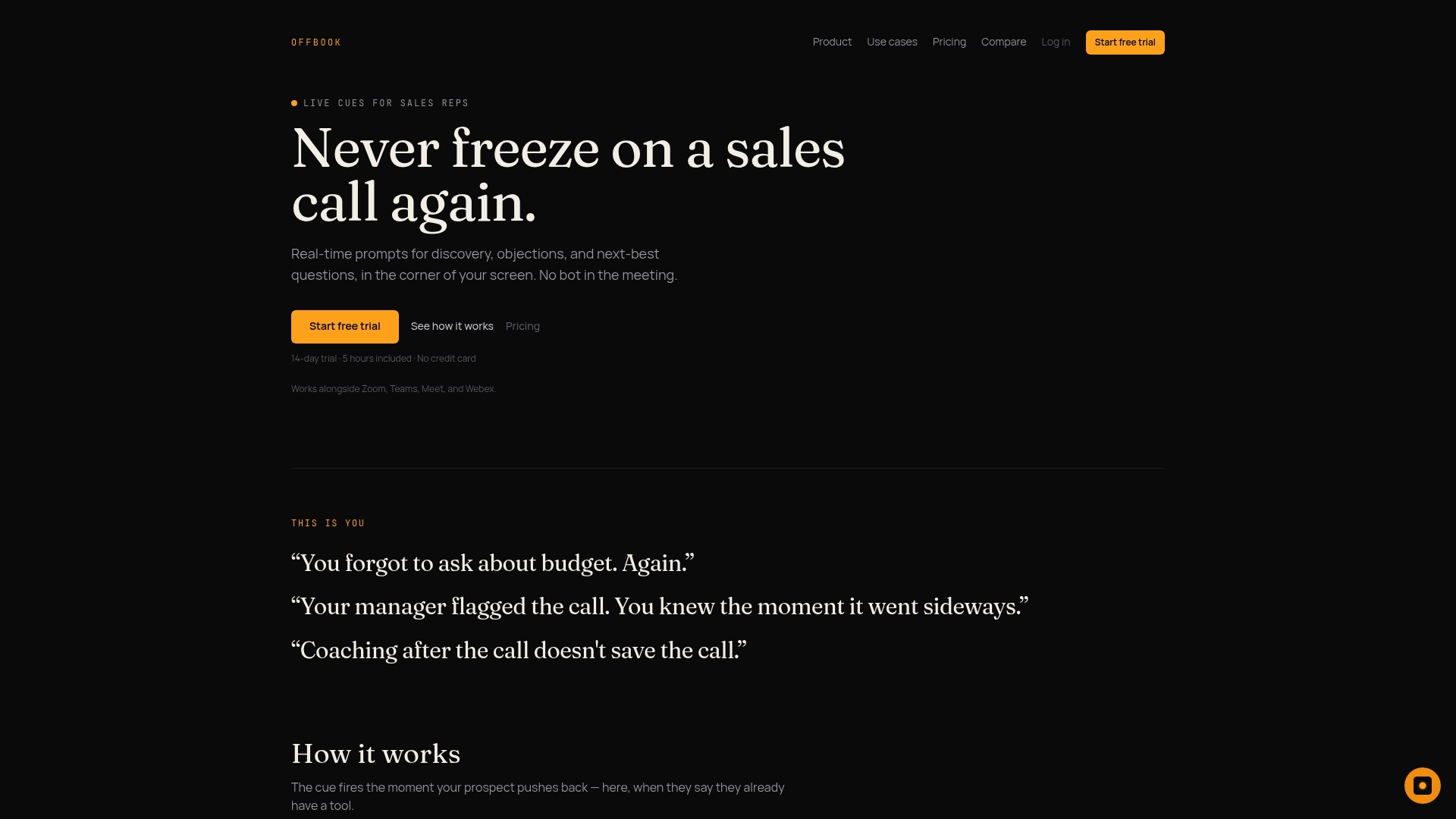
Start a free trial at offbook.pro and run the four-stage framework on your next three calls with live coaching support.
Useful sources
- Sales conversation framework for founders — Founders Best Friend: Primary source for the four-stage Understand/Reflect/Offer/Decide framework and stage timings.
- Founder-led sales — PipelineGrader: Evidence for the listening-first rule, selling-too-early trap, and the learning-motion framing.
- Founder-led sales complete guide — Closing Foundry: Curiosity vs. intent distinction, qualification probes, and the verbal-yes stall pattern.
- The three sales frameworks every early-stage founder needs — Venture Curator: Founder story and value-based customer story templates.
- The three frameworks to kick-start sales — First Round Review: Minute-level call structure and story construction exercises.
- Founder-led sales playbook — Embers: Five-artifact handoff model and ARR-stage playbook guidance.
- Founder-led sales — Justin McKelvey: 50-prospect pipeline model and follow-up sequencing (same-day recap through day-30 check-in).
- Offbook — live AI sales coaching: Pre-call briefs, in-call cues, and post-call debriefs for founder-led B2B SaaS teams.
- Sales call structure for founders — Offbook: Offbook’s own guidance on call rhythm and demo narrative for founders.