Sales Qualification: The B2B Rep's Complete Guide
Discover what is sales qualification and how mastering it can drive revenue for B2B teams. Learn to identify ideal prospects today!
Published: July 26, 2026
Author: OffBook Editorial Team

Sales Qualification: The B2B Rep’s Complete Guide
Sales qualification is the process of evaluating whether a prospect has the fit, intent, budget, and authority to actually buy your product. It is not a single conversation or a checkbox at the top of a CRM stage. Done right, it is an ongoing discipline that runs from the first outreach call through to contract signature, and it is the single biggest lever separating high-performing B2B sales teams from those perpetually chasing dead pipeline.
At its core, sales qualification answers four questions about every prospect:
- Fit: Does this company match your ideal customer profile (ICP)?
- Budget: Do they have realistic capacity to buy?
- Authority: Are you talking to someone who can influence or make the decision?
- Need: Is there an active, urgent problem your product solves?
Beyond those four pillars, qualification also surfaces timing, stakeholder complexity, and competitive dynamics. And it produces three distinct lead types that determine how your team routes and prioritizes its energy:
- MQL (Marketing Qualified Lead): Vetted by marketing based on engagement signals and demographic fit
- SQL (Sales Qualified Lead): Confirmed by sales as having genuine intent, budget, and authority
- PQL (Product Qualified Lead): Has demonstrated intent through direct product usage or trial behavior
The distinction matters because each type demands a different conversation, a different urgency, and a different next step.
Table of Contents
- Why sales qualification is the backbone of a healthy pipeline
- Key stages and lead types you need to recognize
- Core criteria and the frameworks that structure them
- How to run an effective sales qualification process
- How Offbook makes qualification sharper in real time
- Key Takeaways
Why sales qualification is the backbone of a healthy pipeline
Most sales teams do not have a closing problem. They have a qualification problem. They are working deals that were never real to begin with, and the pipeline report looks full until the quarter ends and the numbers do not.
Sales reps spend only 28% of their week actually selling, with the rest consumed by administrative tasks and chasing leads that go nowhere. That figure alone explains why qualification is not a nice administrative step. It is how you protect the time that actually drives revenue.
The downstream effects of strong qualification compound quickly:
- Shorter sales cycles: Reps who qualify hard early spend less time in late-stage limbo with prospects who were never going to sign.
- More accurate forecasting: When every deal in the pipeline has buyer-provided evidence behind it, the forecast becomes a real planning tool rather than a guess.
- Higher close rates: Focusing on prospects who genuinely fit your ICP and have active urgency means fewer deals die in the final stages.
- Stronger rep morale: Nothing burns out a sales team faster than working hard on deals that collapse at the finish line because the buyer was never serious.
71% of sales professionals report their jobs have become harder due to increased pressure to hit targets. Rigorous lead qualification is the most direct way to work smarter inside that pressure, not just harder.
Sales qualification also builds credibility with finance and leadership. When your forecast is grounded in confirmed stakeholder engagement and real budget conversations rather than rep optimism, the business can make better hiring, marketing, and capacity decisions around it. Qualification is, at its root, a risk management function for the entire organization.
Key stages and lead types you need to recognize
Qualification is not a single gate. It is a series of progressive filters, each one designed to confirm that the deal still deserves your attention as it moves deeper into the cycle.

Understanding where a lead sits in that progression determines what questions to ask, how much time to invest, and whether to advance or exit.
| Lead Type | Who Defines It | What It Signals | Typical Next Step |
|---|---|---|---|
| MQL | Marketing team | Demographic fit + engagement (content downloads, webinar attendance, form fills) | Sales development rep (SDR) outreach |
| SQL | Sales team | Confirmed intent, budget awareness, and access to a decision-maker | Account executive discovery call |
| PQL | Product usage data | Active trial behavior or feature adoption indicating purchase intent | Direct sales conversation or upgrade prompt |
The movement between these stages is not automatic. A lead can be moved backward when new information surfaces. A prospect who looked like a strong SQL in week two might reveal in week four that the budget is frozen or the project has been deprioritized. Keeping that deal in the pipeline as an SQL is forecast pollution. Moving it back, or disqualifying it entirely, is the disciplined call.
Each stage also demands different qualifying questions. At the MQL stage, the focus is on fit and intent: does this company look like your ICP, and did they engage with content that signals a real problem? At the SQL stage, the conversation goes deeper: who owns the budget, what is the decision process, and what happens if they do nothing? PQLs are often the warmest leads in the pipeline because they have already experienced the product, so the qualification conversation shifts to expansion potential and organizational readiness to buy.
Pro Tip: Do not let MQL-to-SQL conversion happen automatically based on lead score alone. Require a human touchpoint, even a brief one, before a lead earns SQL status. Lead scoring tells you who engaged; qualification tells you who is actually buying.
Core criteria and the frameworks that structure them
Every qualification conversation, regardless of the framework your team uses, comes back to five core criteria. Miss any one of them and you are flying blind on that deal.
- ICP fit: Does the company match the profile of customers who get real value from your product? Size, industry, tech stack, and growth stage all matter.
- Budget: Not just “do they have money” but “is there a budget allocated or approvable for this problem?”
- Authority: Are you engaged with someone who can sign, or at minimum, someone who has direct access to the person who can?
- Need: Is there a specific, active business problem that your product addresses, with a cost attached to leaving it unsolved?
- Timeline: Is there a real decision window, or is this exploratory with no urgency?
These criteria map directly onto the most widely used qualification frameworks in B2B sales.
BANT, MEDDIC, and CHAMP at a glance
| Framework | Best For | Core Elements | Limitation |
|---|---|---|---|
| BANT | Transactional deals under $50K, short cycles | Budget, Authority, Need, Timeline | Too shallow for complex enterprise deals |
| MEDDIC / MEDDPICC | Enterprise deals, long cycles, multiple stakeholders | Metrics, Economic Buyer, Decision Criteria, Decision Process, Identify Pain, Champion (+ Paper Process, Competition) | Requires disciplined CRM hygiene to execute |
| CHAMP | Mid-market, consultative sales | Challenges, Authority, Money, Prioritization | Less structured for multi-stakeholder environments |
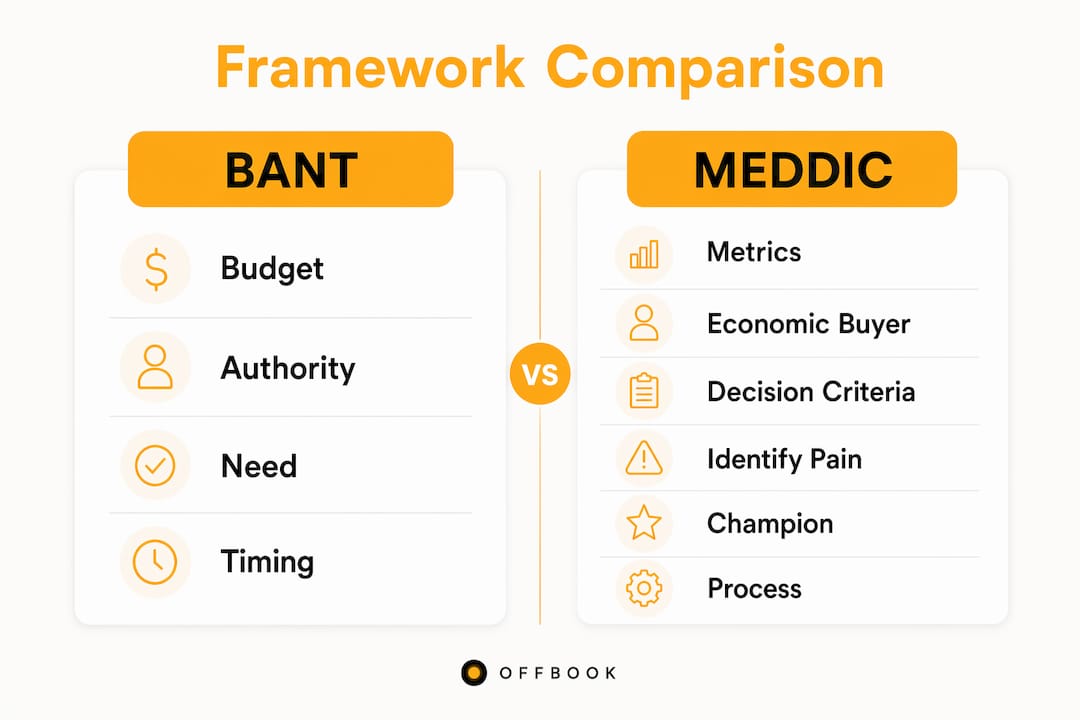
BANT works well for high-velocity transactional sales, typically deals under $50K with short cycles where a single decision-maker controls the budget. It is a fast first-pass filter, not an opportunity management tool.
MEDDIC and its extended variant MEDDPICC are built for the opposite environment: complex enterprise deals with buying committees, long procurement cycles, and multiple stakeholders who can each kill the deal independently. The addition of Paper Process and Competition in MEDDPICC reflects the reality that even a fully qualified deal can stall in legal review or lose to a competitor who got to the economic buyer first.
CHAMP flips the traditional order by leading with Challenges rather than Budget. The logic is sound: if you understand the business pain deeply enough, budget conversations become easier because the prospect has already articulated what the problem is costing them.
The right framework is not a matter of preference. It is a function of your deal size, cycle length, and buyer committee structure. A seed-stage SaaS team selling $8K ACV deals does not need MEDDPICC. A Series B team selling $200K enterprise contracts absolutely does.
Pro Tip: Use BANT for triage in the first call, then layer MEDDIC elements as the deal progresses. You do not need to complete every MEDDIC field on day one. Build the picture across multiple conversations.
How to run an effective sales qualification process
Qualification is a workflow, not a single conversation. Here is how high-performing B2B teams structure it.

1. Research before you reach out. Before the first call, know the company’s size, recent news, tech stack, and any signals that suggest active pain. Effective prospect research is what separates a rep who opens with “tell me about your business” from one who opens with a specific, informed hypothesis about the prospect’s problem.
2. Confirm fit and intent in the first touchpoint. The opening conversation is not a pitch. It is a fast check: does this prospect match your ICP, and is there a real problem in play? If the answer to either is no, exit gracefully and move on.
3. Run a structured discovery call. This is where the real qualification happens. Ask questions that surface pain intensity, urgency, authority, and budget, in that order. The most effective qualifying questions go beyond surface factors to diagnose real business pain: “What happens if you do nothing for six months?” or “What is it costing you to not fix this?” These questions reveal whether the problem is urgent enough to drive a purchase decision.
4. Map the buying committee. In B2B sales, especially enterprise, a single champion is not enough. You need to know who the economic buyer is, who influences the decision, and who can veto it. Relying on one champion without confirmed economic buyer engagement is one of the most common causes of stalled deals.
5. Require buyer-provided evidence before advancing CRM stages. Every stage progression should be backed by something the buyer did, not something the rep believes. A verbal “this looks interesting” is not evidence. A confirmed next meeting with the CFO is.
6. Reassess continuously. New information changes the picture. A budget freeze, a leadership change, or a shift in company priorities can disqualify a deal that looked strong last week. Build a habit of asking “what has changed?” at every subsequent touchpoint.
7. Disqualify without hesitation when the data says to. This is the step most reps skip. Qualification theater, going through the motions without uncovering real buyer evidence, is one of the most damaging behaviors in sales. It fills the pipeline with deals that will never close and makes the forecast meaningless. High-performing teams celebrate disqualification because it protects the time and focus of everyone on the team.
Pro Tip: Build disqualification into your team culture explicitly. When a rep disqualifies a deal cleanly and moves on, recognize it publicly. The message it sends: we win by being honest about our pipeline, not by padding it.
The sales pipeline management discipline that follows from rigorous qualification is what turns a chaotic funnel into a predictable revenue engine. Qualification is the input; pipeline health is the output.
A few mistakes to avoid at every stage:
- Asking budget before you have established pain. It signals you are a vendor, not a partner, and drops response rates sharply.
- Treating qualification as a one-time event rather than an ongoing assessment.
- Advancing deals based on rep optimism rather than buyer behavior.
- Ignoring red flags like repeated reschedules, vague answers about cost of inaction, or “just exploring” with no timeline attached.
How Offbook makes qualification sharper in real time
The gap between knowing a qualification framework and executing it consistently under the pressure of a live sales call is where most reps lose ground. Offbook closes that gap.
Offbook is real-time sales coaching software that listens to your video calls and surfaces live, on-screen cues without a bot ever joining the meeting. When a rep is mid-conversation and the prospect says something that reveals a qualification gap, Offbook prompts the rep with the right follow-up question right then, not in a debrief an hour later when the moment has passed.
Here is what that looks like in practice:
- Live qualification prompts: If a rep has not surfaced the economic buyer or confirmed budget, Offbook flags the gap and suggests the question to ask, structured around MEDDIC or MEDDPICC depending on the deal type.
- Objection handling cues: When a prospect raises a concern, Offbook surfaces the most effective response in the moment, keeping the conversation on track.
- Pre-call briefings: Before each call, Offbook generates a brief on the company and the people in the meeting, so reps walk in with context, not just a name and a calendar invite. That preparation directly improves the quality of qualification questions asked.
- Framework alignment: Offbook structures its coaching cues around proven methodologies, so every call reinforces the same qualification discipline across the entire team, not just the reps who have been around long enough to internalize it.
The difference between Offbook and a post-call note-taker is the difference between a coach on the sideline and a film review the next morning. Film review has value. But the coaching that changes outcomes happens during the game.
For founders running their own sales calls or sales leaders trying to scale qualification consistency across a growing team, Offbook removes the dependency on individual rep experience. The framework is always present. The right question always surfaces. The deal either qualifies or it does not, and the rep knows which one it is before the call ends.
If your team is losing deals in late stages or your forecast keeps missing, the problem is almost always upstream in qualification. Offbook’s AI call coaching gives your reps the structure and the real-time support to fix that, one call at a time.
Key Takeaways
Sales qualification is an ongoing, evidence-based process that protects pipeline integrity and drives close rates by ensuring every deal in your funnel has confirmed fit, budget, authority, and urgency.
| Point | Details |
|---|---|
| Qualification is continuous | Reassess every deal at each stage; new information can disqualify a deal that looked strong last week. |
| Match framework to deal complexity | Use BANT for fast triage on deals under $50K; apply MEDDIC or MEDDPICC for enterprise deals with multiple stakeholders. |
| Disqualification is a discipline | Removing unfit deals from the pipeline protects forecast accuracy and focuses rep time on deals that can actually close. |
| Buyer evidence drives stage progression | Every CRM advancement should be backed by something the buyer did, not something the rep believes or hopes. |
| Real-time coaching closes the execution gap | Tools like Offbook surface qualification prompts during live calls, when the conversation can still be redirected. |