How to Ask Pain-Focused Discovery Questions That Close
Learn how to ask pain-focused discovery questions that close more deals. Uncover real prospect fears and drive action with proven strategies.
Published: July 19, 2026
Author: OffBook Editorial Team

Asking pain-focused discovery questions is the single most effective way to uncover what a prospect actually fears losing, not just what they say they want. Elite closers see a 34% increase in deal closures by using deep pain-discovery frameworks instead of surface-level questioning. That gap exists because most reps stop at symptoms. The best reps dig until they find the business cost, the personal stakes, and the urgency that makes a prospect act. This guide gives you the frameworks, sequences, and habits to do exactly that on every discovery call.
What are pain-focused discovery questions and how do frameworks help?
Pain-focused discovery questions are structured questions designed to move a prospect from vague frustration to a clearly articulated business problem. The industry term for this practice is “pain discovery,” and it sits at the core of methodologies like MEDDIC, MEDDPICC, and the Sandler Selling System. The goal is not to interrogate. The goal is to guide the prospect psychologically from “we have some challenges” to “this problem is costing us real money and we need to fix it now.”
Two frameworks give this process structure.
The P.A.I.N. framework organizes your questions into four stages:
- Problem: “What’s the biggest challenge your team faces with [process]?”
- Amplify: “How often does that happen, and who else feels the impact?”
- Implications: “What happens to revenue or retention if this stays unresolved?”
- Need development: “If you could fix this in the next quarter, what would that mean for your team?”
Each stage builds on the last. You are not jumping to solutions. You are helping the prospect articulate the full weight of their problem.
The Sandler Pain Funnel structures discovery across three levels: what the problem is, what it costs, and what is personally at stake for the buyer. Most reps stop at level one. The financial cost and personal stakes questions are where urgency actually forms. A prospect who has said “this costs us about $200,000 a year in wasted engineering time” is a fundamentally different conversation partner than one who said “yeah, it’s a bit inefficient.”

Two advanced techniques sharpen this further. Assumptive questions state a common pain as a given: “Most ops teams we talk to are losing 10+ hours a week to manual reporting. Is that showing up for you?” This lowers the prospect’s defensiveness because they are not admitting a unique failure. Projection questions ask about peers: “What do you think other companies in your space do when this problem gets bad enough?” Both techniques surface real pain without making the prospect feel exposed.
Pro Tip: Sequenced pain questions that build emotional tension outperform random or checklist-style questioning every time. Design your questions to escalate, not just accumulate.
How to prepare and personalize your discovery questions for B2B SaaS buyers
Generic scripts fail because they treat every prospect the same. Top-performing sales teams prioritize tailored questions over standardized lists, and the difference shows up in engagement within the first five minutes of a call.
Context-aware preparation means doing three things before you dial:
- Research the prospect’s current stack. If they use a tool that competes with yours in one workflow, you already know where friction lives. Ask about that workflow specifically.
- Identify the buyer persona. A champion cares about their team’s daily pain. An economic buyer cares about cost and risk. Your questions need to match their frame of reference.
- Map the deal stage. Early-stage calls need broader pain exploration. Later-stage calls need quantification and urgency. Asking “tell me about your challenges” in a second call with a VP signals you were not listening the first time.
42–43% of startups fail because they build for problems that do not have real market need. That same failure mode shows up in sales: reps assume they know the pain and skip the questions that would confirm or disprove it. Non-leading, behavior-based questions protect you from that trap.
For a champion, ask: “Walk me through the last time this problem caused a real issue for your team. What happened?” For an economic buyer, ask: “What does this problem cost you annually, and how did you arrive at that number?” The same underlying pain requires a completely different question depending on who is sitting across from you.
Pro Tip: Focus on three to five highly relevant questions per call, not a 20-question script. Context-aware preparation means fewer, sharper questions that go deeper, not a longer list that stays shallow.
You can also use product discovery consulting approaches to validate whether a pain is real before you build your pitch around it. The same behavioral questioning principles that work in product development apply directly to sales discovery.
How do you execute pain discovery questioning on a live call?
The biggest shift in execution is moving from surface questions to depth questions within the same conversation. Most reps ask one pain question, get a vague answer, and move on. The follow-up question is where the real discovery happens.
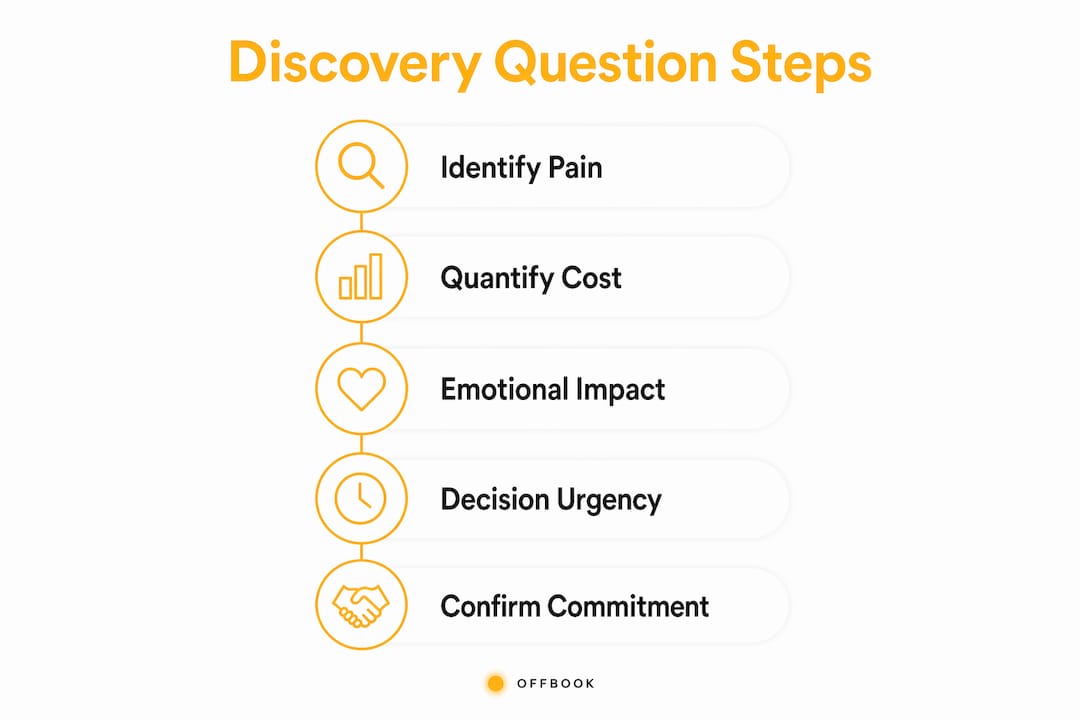
A practical sequence looks like this:
- Open with a broad pain question. “What’s the biggest operational challenge your team is dealing with right now?”
- Reflect and narrow. “You mentioned reporting delays. How often does that happen, and what triggers it?”
- Cascade to impact. “When that happens, what does it cost you in time or revenue?”
- Apply the Ripple Effect. “Who else in the organization feels that impact? Does it reach the customer?”
- Use Time Projection. “If this is still unresolved in 12 months, what does that look like for your team?”
Each question builds on the previous answer. You are not reading from a list. You are following the prospect’s words and pulling the thread.
“The sequence in which pain questions are asked matters more than exact wording. Building business impact understanding and creating personal buying urgency requires a deliberate escalation, not a checklist.” Sandler Training
Discovery calls spend the most time on the impact and decision stages, yet those are the stages most reps rush through. Quantifying pain is not optional. When a prospect says “it’s a big problem,” ask: “Can you put a number on it? Even a rough estimate?” A prospect who says “$300,000 a year” has just given you the foundation of your business case.
Handling pushback or vague answers requires a specific technique. When a prospect deflects with “it varies” or “it depends on the quarter,” respond with: “Totally fair. What does a bad quarter look like for this specifically?” You are not accepting the deflection. You are narrowing the frame so they can answer concretely.
Earning permission before asking deeper questions keeps the conversation collaborative. A simple bridge like “Can I ask you something a bit more direct about the business impact?” signals respect and keeps sophisticated buyers from feeling interrogated.
Common mistakes when asking pain-focused discovery questions
Most discovery calls fail at the same predictable points. Recognizing these patterns before they happen is the fastest way to improve your close rate.
- The premature solution trap. Rushing to offer fixes the moment a prospect mentions pain is the most common mistake in discovery. You cut off the depth of the problem before you understand it, and you lose the urgency that would have built naturally.
- Accepting vague answers. When a prospect says “we have some inefficiencies,” that is not a pain. That is a category. Push for specifics: “What does that look like on a Tuesday morning for your team?”
- Skipping quantification. Most reps skip the uncomfortable questions about consequences and financial cost. Those questions are exactly what separates a stalled deal from a closed one.
- Treating praise as validation. Customer praise alone is a weak buying signal unless supported by concrete evidence like budget allocation or documented workarounds. A prospect who says “this sounds great” but cannot name a budget or a timeline is not a qualified buyer.
- Ignoring procurement-trained buyers. Some buyers are trained to deflect pain questions and keep sellers at a surface level. With these buyers, use peer projection: “What do companies in your space typically do when this problem gets serious enough to escalate?” It removes the personal pressure and still surfaces the real stakes.
If you realize mid-call that you skipped a critical pain question, recover with: “I want to make sure I understand the full picture. Can we go back to [topic] for a moment?” Most prospects respect the honesty. You can also find a list of discovery questions organized by deal stage to use as a preparation reference.
How do you measure and improve your pain discovery approach?
The metrics that matter are close rate by deal stage, average deal velocity, and the rate at which deals stall after the discovery call. If deals regularly die between discovery and proposal, your pain questions are not creating enough urgency. That is a specific, fixable problem.
| Metric | What it tells you |
|---|---|
| Close rate post-discovery | Whether pain was real and urgent enough to drive action |
| Deal velocity | Whether urgency was established early or built too late |
| Stall rate after proposal | Whether quantification was missing from discovery |
| Champion engagement score | Whether you reached the right pain level for the buyer persona |
A/B testing question sequences is the fastest way to improve. Run the same core pain question with two different framings across 10 calls each and compare how often prospects give quantified answers. The version that produces more numbers and more follow-up questions from the prospect is the stronger one.
AI call coaching tools can surface real-time feedback on whether you are asking depth questions or staying at the surface. Offbook, for example, prompts reps on-screen during live calls with the next pain question to ask based on what the prospect just said. That kind of in-the-moment coaching accelerates skill development faster than post-call review alone.
Key Takeaways
Asking pain-focused discovery questions requires a deliberate sequence, behavioral specificity, and the discipline to quantify pain before moving to a solution.
| Point | Details |
|---|---|
| Use structured frameworks | Apply P.A.I.N. or the Sandler Pain Funnel to escalate from symptom to business cost. |
| Personalize by persona | Tailor questions to champion vs. economic buyer frames before every call. |
| Quantify pain explicitly | Always push for a number; a prospect with a dollar figure is a motivated buyer. |
| Avoid premature solutions | Stay in discovery mode until the full cost and personal stakes are on the table. |
| Measure and iterate | Track stall rates and deal velocity to identify where your questioning breaks down. |
What I have learned from watching reps avoid the hard questions
The most common mistake I see from early-stage founders and new reps is not asking bad questions. It is avoiding the questions they know they should ask. The question “what happens if this problem is still here in 12 months?” feels uncomfortable because it forces a real answer. Reps skip it because they do not want to create tension. But that tension is the point.
Discovery is not a comfortable process for either side. A prospect who feels no tension has no urgency. A rep who avoids discomfort will always lose to one who leans into it. The reps who master pain discovery are not the ones with the best scripts. They are the ones who have made peace with sitting in an awkward silence after a hard question and waiting for the prospect to fill it.
The other thing I have seen consistently: reps treat positive feedback as a green light. A prospect says “this is really interesting” and the rep accelerates toward the close. Behavioral evidence is what matters, not enthusiasm. Has the prospect named a budget? Have they described a workaround they are currently paying for? Have they said who else needs to be involved? Those are the signals. Verbal praise is noise.
If you want to improve faster, record your discovery calls and listen specifically for the moment you accepted a vague answer and moved on. That moment is where your deal started to stall. Fix that one habit and your close rate will move. You can also review weak discovery question patterns to identify exactly where your current questions fall short.
— Neil
How Offbook helps you ask better pain questions in real time
Running a disciplined pain discovery sequence is hard when you are also managing rapport, listening for cues, and tracking qualification gaps. Offbook is built for exactly that moment.
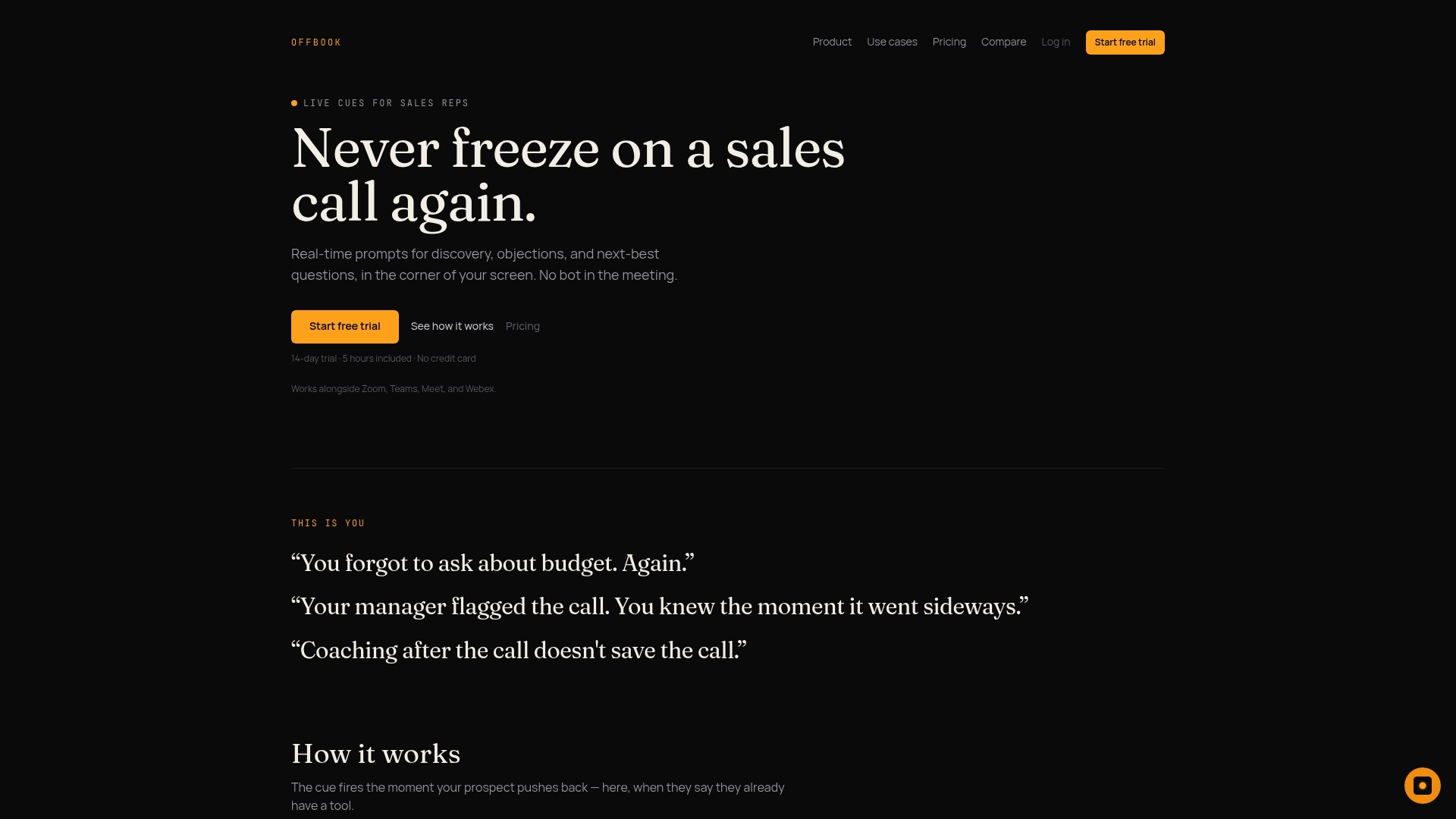
Offbook’s AI call coaching for sales listens to your live video calls and surfaces on-screen prompts when you need them, including the next pain question to ask based on what the prospect just said. No bot joins the meeting. No post-call summary to review later. The coaching happens in the moment, when it actually changes what you say next. For B2B SaaS teams running MEDDIC or MEDDPICC, Offbook structures those prompts around the methodology you already use. Founders and reps at seed and Series A stage use it to run more consistent, more disciplined discovery calls from day one.
FAQ
What are pain-focused discovery questions?
Pain-focused discovery questions are structured questions that guide a prospect from vague frustration to a clearly articulated business problem with a measurable cost. They are the core of frameworks like the Sandler Pain Funnel and MEDDIC.
How many pain questions should I ask per call?
Focus on three to five highly targeted questions rather than a long script. The goal is depth, not volume. A single well-placed follow-up question often reveals more than five scripted ones.
What is the Sandler Pain Funnel?
The Sandler Pain Funnel is a three-level questioning approach that moves from identifying the problem, to its financial cost, to the personal stakes for the buyer. Each level builds urgency the previous one cannot create alone.
Why do deals stall after discovery?
Deals stall after discovery when pain was not quantified and urgency was not established. Skipping deeper pain questions about consequences and cost leaves the prospect without a compelling reason to act.
How do I handle a prospect who deflects pain questions?
Use peer projection: ask what companies in their space typically do when the problem gets serious. This removes personal pressure while still surfacing the real stakes and common consequences of the unresolved pain.