60 Minute Demo Coaching Runbook for Sales Managers with Live AI Cues
Run a 60 minute demo coaching session that pairs manager led role play, recorded demo homework, and live AI cues to lift held next step rates.
Published: October 3, 2026
Author: OffBook Editorial Team

Demo call coaching is the practice of training sales reps to run tighter, more persuasive product demonstrations through structured review, role-play, and feedback. The single highest-impact move for most teams is to start with a rep-heavy, 60-minute coaching session built around live role-play, paired with homework that requires reps to submit recorded demos for review. Tools with live AI cues can now supplement human coaching, and tracking a metric like held next-step rate shows whether a framework such as MEDDIC is actually landing on calls.
TL;DR:
- Reps should focus on clearly identifying the buyer’s problem and stating ROI metrics out loud during each segment of a demo call.
- Coaching sessions that isolate one segment at a time and enforce homework lead to measurable improvements in demo performance.
- AI tools effectively track talk time, pacing, filler words, and buyer sentiment, but require human managers to address root cause issues.
- Successful demo coaching depends on managers protecting practice time and reviewing homework, not just on frameworks or technology.
- Measuring progress through held next-step rates and demo engagement is essential to determine coaching effectiveness over a 6 to 8-week pilot.
Table of Contents
- Core practices that make demo calls better
- How AI-enabled coaching fits into demo call training
- Build a runnable coaching session and weekly program
- Measuring whether demo coaching is actually working
- What coaching actually moves the needle
- Where OffBook fits into this runbook
- Sources
- FAQ
Core practices that make demo calls better
Good demo coaching starts with a shape. The macro arc, Problem, then Solution, then ROI, then Next Step, keeps a rep from wandering into a feature tour that loses the buyer by minute ten. Coaching should check, segment by segment, whether the rep actually named the buyer’s problem before showing anything, and whether ROI got stated out loud rather than implied.
Inside each segment, the micro loop matters just as much. Tell-Show-Tell means a rep states what they are about to show, demonstrates it, then restates what the buyer just saw and why it matters to their specific situation. Reps who skip the bookends turn a demo into a screen share with narration, and buyers tune out.
A practical session runs on a timer, and the single biggest coaching mistake is reviewing everything at once. Pick one segment to fix per review cycle: the opener, the pivot after a tough question, or the close. According to a 60-minute training runbook, sessions that protect role-play time and enforce homework produce measurable behavior change only when a manager actually follows up.
Three mistakes show up constantly and deserve direct coaching scripts:
- Feature parade: the rep demos everything the product does instead of what this buyer asked about; coach by requiring a one-sentence “why this matters to you” after every screen.
- Plowing through silence: the rep keeps talking when a buyer goes quiet instead of pausing and asking a recovery question; coach by drilling a specific pivot line, such as asking what’s on the buyer’s mind right now.
- No stated ROI: the rep assumes the value is obvious and never says a number or outcome out loud; coach by requiring an ROI sentence before the next-step ask.
Pro Tip: Record one of your own demos and watch it with the sound off first. You’ll see dead air, screen fumbling, and pacing problems that text feedback alone would never catch.
How AI-enabled coaching fits into demo call training
AI coaching tools are good at the things humans are slow to track in real time. Live prompts and post-call scorecards typically measure talk time, pacing, filler words, and sentiment, giving a rep an on-screen nudge the moment a buyer goes quiet or the rep starts to monopolize the call.
What AI does not do well is diagnose why a rep keeps making the same mistake. A Georgia Southern study on AI role-plays in sales education found that AI-driven role-plays scale feedback and cut instructor time spent on repetitive practice, but the research is clear that AI complements human coaching rather than replacing it. Scaling practice volume is different from fixing a root cause, and that second job still belongs to a manager.

Demo engagement correlates strongly with deal outcomes; buyers who watch many demos have much higher close rates and even a few demos viewed materially improve win probability, according to the Consensus Buyer Behavior Report. That makes demo engagement itself a coaching signal, not just an outcome metric.
A practical AI-plus-human workflow looks like this:
- Pre-call briefs surface who’s on the call and what they likely care about, so the rep walks in prepared.
- In-call cues flag objections, qualification gaps, and pacing issues while the conversation is still live.
- Post-call action items turn the scorecard into a short, specific homework assignment instead of a vague “do better.”
- Consent and privacy practices require announcing any recording and honoring opt-outs, a standard covered in standards-led guidance on AI coaching.
Build a runnable coaching session and weekly program
A repeatable format beats a one-off training. The classic 60-minute split is 5 minutes framing the goal, 15 minutes reviewing a recorded demo together, 15 minutes of role-play, another 15 minutes of a second role-play round focused on recovery, and 10 minutes assigning homework. Reps-heavy teams can flip that ratio and spend 40 of the 60 minutes in role-play once the framework is familiar.
Run three role-play rounds with distinct objectives:
- Opener and problem statement: the rep has 90 seconds to state the buyer’s problem before touching the screen; judge on clarity, not politeness.
- Recovery from silence: a coach plays a disengaged buyer midway through a feature walkthrough; judge on whether the rep pauses and asks a real question instead of talking faster.
- ROI and next-step close: the rep must state a concrete outcome and ask for a specific next meeting; judge on whether both happened out loud.
Homework keeps the session from evaporating by Friday. Assign each rep to rewrite their opener, submit three recorded demo clips that week, and have the manager review at least one clip per rep before the next session. According to the same 60-minute runbook, tying the whole cycle to one measurable goal, held next-step rate, is what makes the coaching accountable rather than ceremonial.
Pro Tip: Use an AI simulation for the first role-play rep, then have the manager run the second round live. The AI pass catches obvious pacing and filler-word issues before a human spends time on the harder diagnostic work.

Measuring whether demo coaching is actually working
Coaching without measurement is just a meeting. The primary KPI is held next-step rate, the share of demos that end with a scheduled, kept follow-up rather than a vague “I’ll get back to you.” Pair it with demo engagement metrics, like how many times a prospect reopens or rewatches a shared demo, since the Consensus Buyer Behavior Report ties higher view counts to stronger close rates. Round out the picture with demo-to-close conversion over a quarter.
Inside the recordings themselves, watch for a few operational signals:
- Talk-time balance between rep and buyer across the call.
- Whether screen share started before or after the problem was stated out loud.
- How many objections got a direct answer versus a deflection.
Set a baseline, then run a 6 to 8 week pilot comparing held next-step rate before and after the coaching cycle starts. A one-line manager scorecard per rep, noting the single segment they’re drilling that week, keeps the whole program visible without turning into another report nobody reads.
What coaching actually moves the needle
The habit that separates teams that improve from teams that just talk about improving is simple: managers protect the drill time and actually review the homework. Everything else, the frameworks, the AI scorecards, the fancy role-play scripts, fails without that follow-through.
AI should scale the volume of practice and catch the mechanical stuff, filler words, pacing, talk time, so human coaching time goes toward the harder diagnostic work: why a rep avoids asking for the close, or freezes when a buyer pushes back. Used that way, AI and human coaching reinforce each other instead of competing for the same hour.
— Neil
Where OffBook fits into this runbook
Some AI coaching solutions map directly onto the workflow above: pre-call briefs prepare reps for who’s on the call, live cues surface objections and qualification gaps during the conversation itself, built around sales frameworks, and post-call debriefs turn the call into specific follow-up actions.
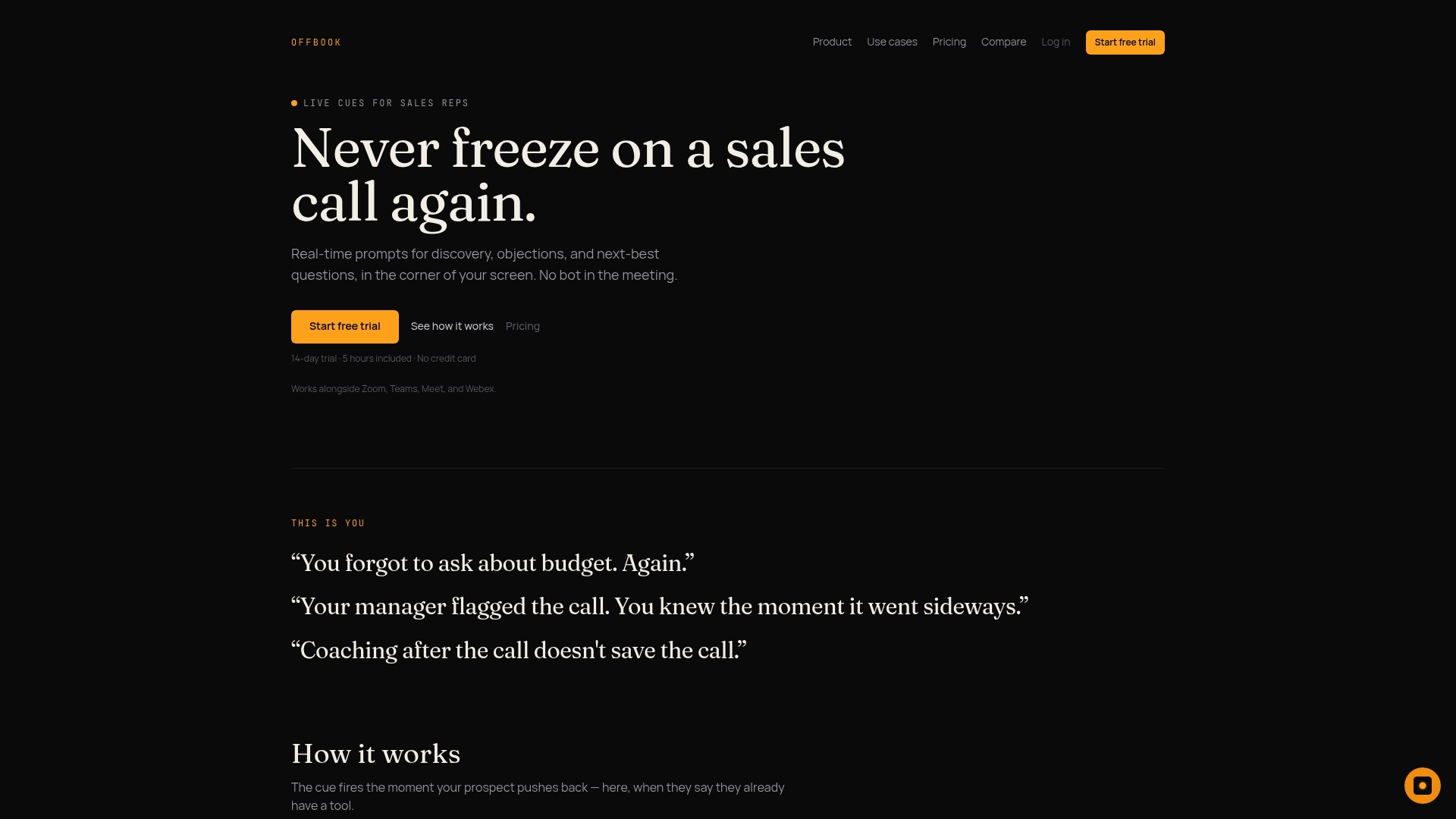
- The system avoids joining the meeting with a bot, and recording follows explicit per-session consent.
- Pre-call briefs can replace scattered research with a single prepared document.
- Multi-profile support can fit teams running different plays across roles.
See plans starting at $59 per month or explore how OffBook supports live sales coaching to see where it fits your next demo cycle.
Sources
- Consensus - Buyer Behavior Report 2025
- When AI Joins Your Teaching Team: Reinventing Sales Education with AI
- 60-Min Sales Training: Running a Killer Demo
FAQ
What is a demo call?
A demo call is a sales conversation where a rep shows a product’s features and value to a prospective buyer, usually after a discovery call has established the buyer’s problem. Its goal is to connect what the product does to a specific outcome the buyer cares about, then secure a clear next step.
What are the four types of coaching?
Sales coaching generally breaks into deal-specific coaching, skill-based coaching, performance review coaching, and developmental or career coaching, though definitions vary by organization. Most demo call coaching programs blend skill-based coaching, through drills and role-play, with deal-specific coaching on live opportunities.
What are the 7 steps of a sales call?
Common models describe prospecting, pre-call preparation, the approach, discovery, presentation or demo, handling objections, and closing with a next step, though exact step counts vary across sales methodologies. Demo call coaching focuses mainly on the presentation and objection-handling stages, since that’s where the macro arc and Tell-Show-Tell loop matter most.
Is there an AI cold calling coach available?
Several AI coaching tools now offer live, in-call cues for sales conversations, including demo and discovery calls, rather than only post-call analysis. OffBook provides real-time prompts during video calls without a bot joining the meeting, built around frameworks like MEDDIC.