Under 200 Words: One Screen Sales Call Recap Template for B2B Reps
Copyable one screen templates and a same day, under 200 words workflow. Use live coaching and automation to turn call notes into next steps.
Published: September 4, 2026
Author: OffBook Editorial Team

Use one structure: subject line, one sentence of shared understanding, next steps with named owners and dates, and a value anchor tied to what the buyer said they need. Send it the same day, ideally within a few hours, and keep it under 200 words. Everything else is decoration. The recap’s only job is to make the next action obvious to everyone who reads it.
TL;DR:
- Sending a sales call recap within a few hours with a clear subject line improves follow-through and future searchability.
- The recap must include a contextual detail proving attentive listening and a shared understanding of the problem, timeline, or decision criteria.
- Action items should always specify one task, assigned owner, and a concrete deadline to ensure accountability.
- Tailoring the recap format to call type—discovery, demo, or negotiation—ensures emphasis on relevant details and next steps.
- Using AI for initial drafting combined with a quick review accelerates sending while maintaining quality and clarity.
Table of Contents
- What Should a Sales Call Recap Template Include?
- Copy-Ready Sales Call Recap Templates
- How Do You Format Action Items So They Actually Get Done?
- When Should You Send a Sales Call Recap?
- Adjusting the Template for Different Call Types
- How Automation Speeds Up Recap Writing Without Hurting Quality
- Why the 20-Minute Post-Call Habit Beats Any Template
- Sources
What Should a Sales Call Recap Template Include?
A sales call recap email that actually moves a deal forward has five parts, no more. Skip one and the email either reads like a transcript or leaves the buyer guessing what happens next.
- Subject line: tells the recipient what this is and when it happened, before they even open it.
- Contextual opening: one line proving you were listening, not just note taking.
- Shared understanding: one or two sentences summarizing what you both agreed the problem or opportunity is.
- Next steps: a short list, each with a named owner and a date.
- Value anchor and CTA: a sentence tying the next step back to the outcome the buyer cares about, plus a clear ask.
The subject line matters more than most reps give it credit for. Something like “Recap: pricing model discussion, March 3” gets found again in a crowded inbox three weeks later when the buyer is trying to loop in their VP. A vague “Great call today!” does not.
The contextual opening is where most recaps fail before they start. Don’t write “Thanks for your time today.” Write the thing that proves you were paying attention: “You mentioned your renewal cycle resets in Q2, so timing matters here.” That single sentence does more for trust than a polished paragraph of pleasantries.
Shared understanding should read like a headline, not a paragraph. If you can’t compress the call’s outcome into two sentences, you probably didn’t reach a clear outcome. That’s worth noticing before you write the recap, not after.
Next steps need an owner and a date on every line, not just yours. “We’ll follow up” is not a next step. “Sarah sends the security questionnaire by Thursday” is. Buyers who see their own name next to a deadline are far more likely to actually hit it.
The value anchor closes the loop between the call and the buyer’s stated goal. If they said they need to cut onboarding time, don’t just recap the demo, tie the recap to that number: “Based on what you saw today, this should shave about two weeks off your current onboarding.”
Pro Tip: Read your draft on your phone before sending. If it requires scrolling past your signature to see the next steps, cut it down. Recaps that fit on one screen get acted on faster than ones that don’t.
Copy-Ready Sales Call Recap Templates
Three call types cover most of what a B2B sales rep sends in a given week: discovery, demo, and post-demo negotiation. Each one uses the same skeleton, with different emphasis.
-
Discovery call template. Subject: “Recap: [Company] discovery call, [Date].” Open with the one detail that proves you listened. State the shared understanding in one sentence: the problem, the timeline, and who else needs to weigh in. List next steps with owners and dates, usually two or three items. Close with a line tying the next step to their stated priority.
-
Demo recap template. Subject: “Recap: [Company] demo, [Date].” Open by naming the one feature or workflow that got the strongest reaction, not a generic “thanks for watching.” Shared understanding covers what the demo confirmed can solve. Next steps typically point toward a proof of concept, a technical review, or a pricing conversation, each with an owner.
-
Post-demo / negotiation template. Subject: “Next steps: [Company] + [Date].” Restate the buyer’s stated decision criteria in one line, so there’s no ambiguity about what’s being evaluated. Next steps here often include internal stakeholder reviews, contract redlines, or security sign-off, each assigned to a specific person.
Here’s a filled-in discovery recap that runs 178 words, well inside the readable range for a busy inbox:
Subject: Recap: Northbridge discovery call, March 4
Hi Dana,
Good talking today. You mentioned your team is losing about a week per new hire on manual onboarding steps, and that leadership wants a fix before the next cohort starts in April.
Here’s what we agreed on: your current process works but doesn’t scale past 15 new hires a month, and the finance sign-off step is the biggest bottleneck.
Next steps:
- Dana pulls last quarter’s onboarding time data by Friday
- I send a tailored workflow breakdown by Wednesday
- We reconvene March 11 with your ops lead, Marcus
Given the April deadline, getting Marcus into the next call matters. This should get you back to a scalable process well before your next cohort starts.
Talk soon, [Name]
That structure, contextual opening plus named owners, works whether the deal closes in two weeks or two quarters. Adjust the middle section; keep the frame identical.
How Do You Format Action Items So They Actually Get Done?
Every action item needs three pieces: the task, the owner, and the due date. Drop any one of the three and the line becomes a suggestion instead of a commitment. “Follow up on pricing” invites nobody to do anything. “Marcus sends updated pricing sheet by Tuesday” gives one person one job with one deadline.
A few rules keep this format from breaking down:
- Assign each task to exactly one person. Shared ownership usually means no ownership.
- Break multi-step work into separate lines. “Review contract and loop in legal” is two tasks pretending to be one.
- Keep external emails to the two or three actions that matter to the buyer; push internal follow-ups (updating the CRM stage, briefing your manager) into your own task list or CRM instead of the recap.
- Reread the list before sending and ask: could someone forward this to their boss and have it make sense in ten seconds?
Action items without a named owner and a date tend to stall, because nobody feels responsible for them. That’s true whether you’re the one writing the recap or the one reading it three weeks later trying to remember what you agreed to.
Pro Tip: If a next step depends on someone who wasn’t on the call, name them anyway. “Marcus (your ops lead) reviews the workflow by Friday” sets the expectation before the introduction even happens.
When Should You Send a Sales Call Recap?
Same day, every time. Aim for a few hours after the call ends; treat 24 hours as the outer limit before urgency and memory both start to fade. A recap sent the next morning reads like an afterthought, even when the content is identical to one sent an hour after the call.
Subject lines that work consistently:
- “Recap: [Topic] — [Date]”
- “Next steps: [Company] + [Date]”
Both signal exactly what’s inside before the recipient opens the email, which matters when they’re searching for it later.
On the send list, keep your main contact on the “to” line and add anyone who joined the call. Bcc your own manager only when the deal needs internal visibility, not as a default habit. Attach a deck or recording link only when it adds something the recap itself doesn’t already cover, an extra attachment on a short email undercuts the “read in 90 seconds” goal you’re aiming for.
Adjusting the Template for Different Call Types
The five-part structure holds for any call, but what you emphasize shifts. A discovery recap leans on shared understanding of the problem; a demo recap leans on what resonated and the technical next step; a renewal recap leans on usage data and the value delivered so far.
- Discovery: emphasize the problem and timeline, keep next steps light (usually one or two items).
- Demo: emphasize what confirmed fit, point toward a technical or pricing next step.
- Renewal: emphasize outcomes delivered, skip re-explaining the product entirely.
- Internal handoff (sales to customer success, for example): this one skips the buyer-facing tone completely and goes into the CRM instead, covering deal history, stakeholder map, and open risks that never belong in an external email.
A trimmed discovery recap might run 90 words when the deal is early and simple. A negotiation recap involving legal and procurement might stretch closer to 200 words because there are genuinely more moving parts, still short enough to read in one sitting.
How Automation Speeds Up Recap Writing Without Hurting Quality
The fastest reps follow a consistent sequence: pre-call brief, live call with notes captured in real time, an AI-generated first draft, a two-minute human check, then send. Automating the draft step cuts the time between hanging up and hitting send, and it keeps the format consistent even on a rep’s fifth call of the day.
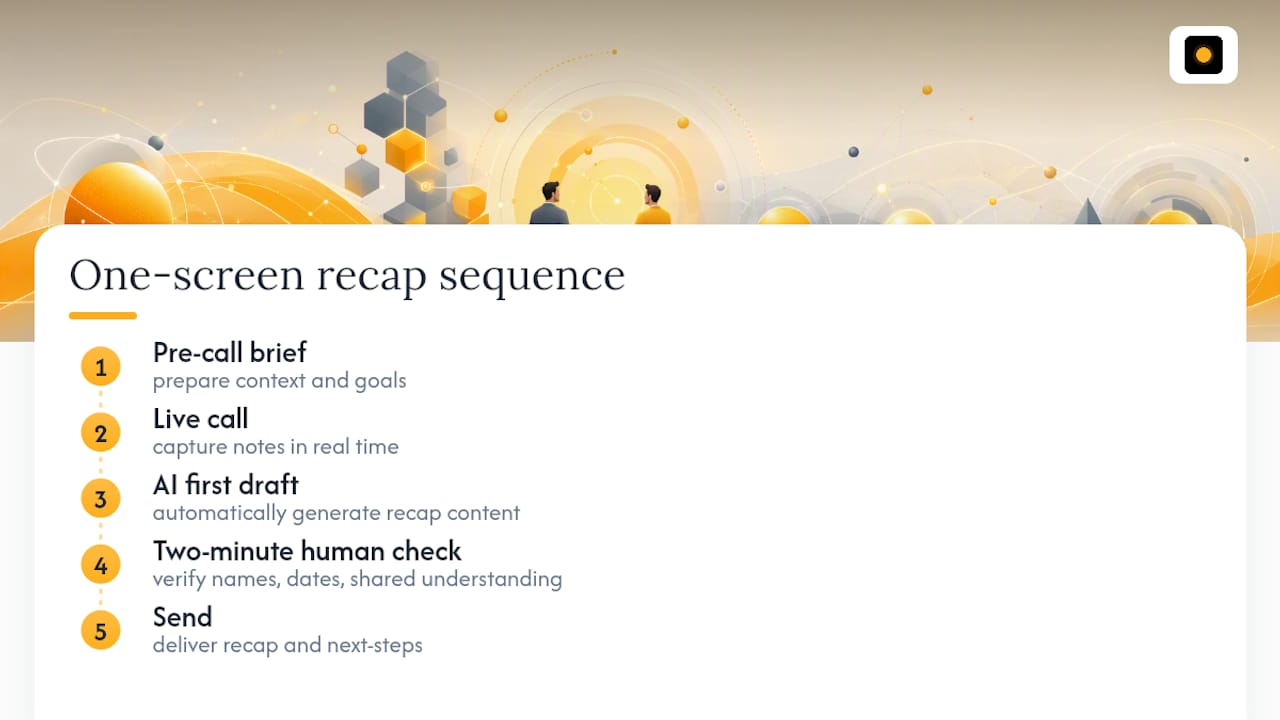
An AI draft is good enough to send once you’ve verified three things: names and titles are spelled correctly, dates match what was actually discussed, and the shared understanding sentence reflects what the buyer said, not a generic summary of the product.
Live coaching during the call itself changes what ends up in that draft. When a rep gets prompted in the moment to ask about budget authority or timeline instead of realizing the gap after hanging up, the recap that follows has cleaner next steps because the call itself surfaced them. That’s the gap OffBook is built to close, coaching during the conversation rather than cleaning up notes afterward.
If a call is recorded or transcribed for any of this, get explicit consent first and say so on the call. That’s not optional in most jurisdictions, and skipping it undermines the trust the recap is trying to build.
Pro Tip: Automation tools built for SaaS outbound and follow-up sequencing can turn a recap’s next steps directly into your outreach cadence, so the commitment you documented doesn’t sit idle in an inbox.
Why the 20-Minute Post-Call Habit Beats Any Template
The template matters less than the discipline of using it every single time, including on the calls that felt unremarkable. Here’s the habit worth building: the first five minutes after a call, jot the shared understanding sentence while it’s still fresh. The next ten, draft the recap using whichever template fits the call type. The last five, reread it on your phone screen and cut anything that doesn’t serve the next step.
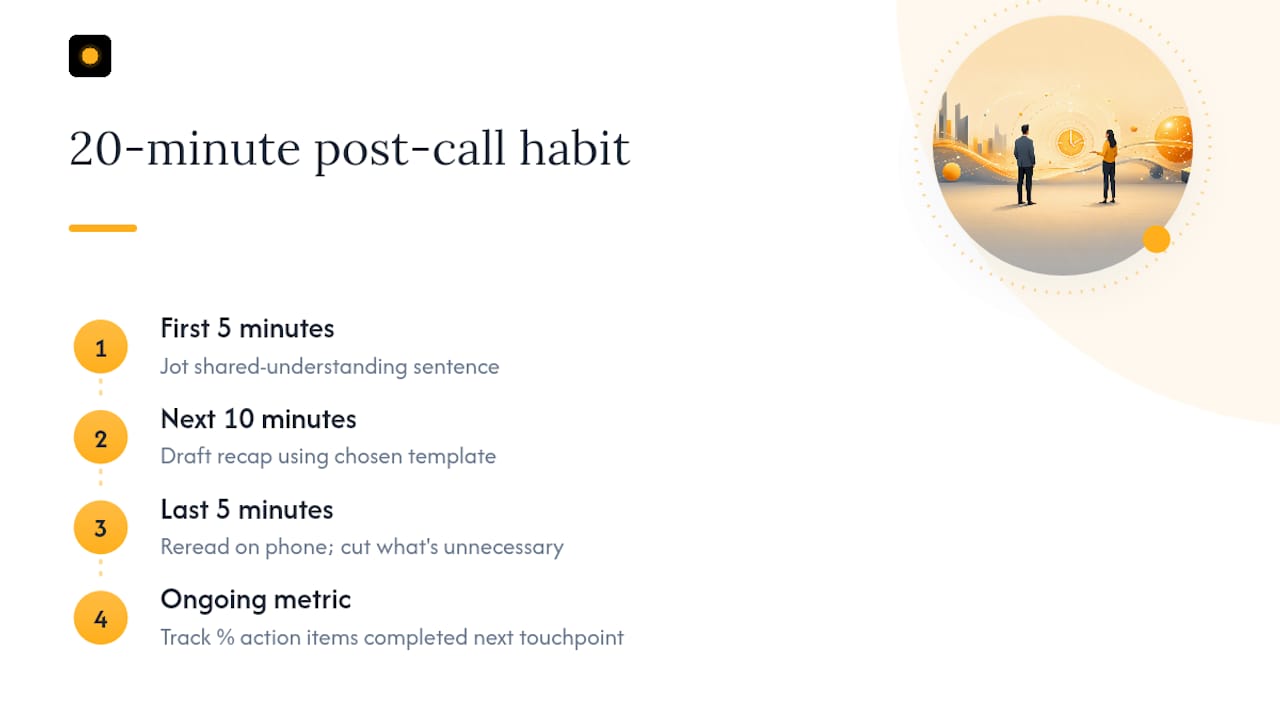
Track one number over the next month: the percentage of action items completed by the next scheduled touchpoint. That single metric tells you more about your recap quality than open rates or reply rates ever will. A recap with vague ownership produces vague follow-through; a recap with named owners and dates produces a measurable jump in completed tasks.
Most reps treat the recap as paperwork. Treat it instead as the only artifact of the call that outlives the call itself, and the habit starts to feel less like admin and more like the actual work of selling. OffBook’s blog covers more of this territory, including pre-call preparation checklists that make the recap easier to write because the call itself was better structured going in.
— Neil
Sources
For deeper templates and examples, see Sybill’s guide to sales recap emails, OfficeAgent’s meeting recap breakdown, RecordMeeting’s follow-up templates, and Owll’s subject-line guidance. For call preparation, see OffBook’s discovery call structure guide.
- How to Write a Sales Call Recap Email That Moves the Deal Forward
- How to Write a Meeting Recap Email (Template + Example)
- Meeting Recap Email Template: Write Better Follow-ups in Minutes