5 Minute CRM Ready Post Call Debrief Template for Sales Reps
Copy ready post call debrief template plus a 5 minute CRM ritual. Log the note, pick one coaching focus, and set an owner and due date.
Published: September 29, 2026
Author: OffBook Editorial Team

A good post-call debrief template captures four things in a short time: what actually happened on the call, the rep’s own read on their performance, the objections that surfaced, and one next step with a named owner and a date. Copy the template below, fill it in right after your next call, and log it straight into your CRM.
TL;DR:
- A structured post-call debrief emphasizes articulating the objective, what worked, where the rep was reactive, and specific objections or signals.
- Logging clear next steps with owner and due date directly into the CRM ensures accountability and prompt follow-up.
- The debrief process is most effective when conducted immediately after the call, focusing on a single coaching point and avoiding overly lengthy reviews.
- Using the Sandler RECON model and observation-before-interpretation guidance helps prevent bias and promotes honest self-evaluation.
- Automating debriefs through tools like OffBook can eliminate friction and ensure consistent, timely logging of call insights and follow-up actions.
Table of Contents
- The complete post-call debrief template
- How to run the debrief without turning it into an interrogation
- A filled-in example you can copy and adapt
- Why structured debriefs actually change behavior
- A short routine you can run after every call
- What five years of watching debrief habits taught me
- How OffBook turns debriefs into something automatic
- Sources
- FAQ
The complete post-call debrief template
Paste this into Slack, a Google Doc, or directly into a CRM note field. Each field takes one line, so the whole thing fits on one screen.
- Call header: account name, contact name, date, call type (discovery, demo, negotiation).
- Attendees and roles: who was on the call and their function (economic buyer, champion, technical evaluator).
- Objective: the one goal you set before dialing in, stated in a single sentence.
- Factual summary: three to five lines of what was actually said, no interpretation.
- What worked: the moment or question that produced real engagement, with the evidence.
- What didn’t: where the conversation stalled or you went reactive instead of leading.
- Objections surfaced: the exact concern raised, in the prospect’s own words if possible.
- Budget and decision signals: any mention of timeline, approval process, or dollar range.
- Next step and owner: the agreed action, who owns it, and the date it’s due.
- Follow-up tasks: anything that needs to happen before the next step, like sending a case study.
- CRM tags and status: the pipeline stage and any tags your team uses for reporting.
A filled example might read: “Objective: confirm technical fit. What worked: cost-per-seat comparison landed well. Objection: ‘we already have a tool for this.’ Next step: send integration doc, owner Maria, due Thursday.”
Most CRMs have a notes field and a next-step or task field built in. Drop the factual summary and objections into notes, and push the next step directly into the task or activity field so it triggers a reminder.

How to run the debrief without turning it into an interrogation
The order matters as much as the content. Run it in this sequence:
- Ask the rep to state the call’s objective and whether it was met.
- Ask what worked, with a specific example, before anything else.
- Ask where they felt reactive instead of in control of the conversation.
- Only then does the manager add observed facts the rep might have missed.
- Together, pick one behavior to change on the next call, not five.
The manager’s job here is closer to a self-assessment facilitator than a grader. Ask curious questions instead of delivering a verdict, since most managers only catch a fraction of a rep’s calls and rely on the rep’s own read to fill the gaps, a point Salesforce’s coaching guidance makes directly. For timing, a quick verbal note logged within minutes of hanging up beats a deeper scheduled 1:1 held two days later, though both have a place.
Pro Tip: Keep a running list of the “one behavior to change” from each debrief. After five calls, you’ll see a pattern worth coaching on directly.
A filled-in example you can copy and adapt
Here’s what a complete note looks like once it’s written up, sized to fit inside a standard CRM note field:
- Account: Northstar Logistics. Date: March 10, 2026. Type: Discovery call.
- Attendees: Dana (VP Ops, economic buyer), Ravi (rep).
- Objective: qualify budget and timeline. Partially met.
- What worked: the ROI framing around driver turnover landed immediately.
- What didn’t: rep talked over Dana’s question about implementation time.
- Objection: “our last vendor promised this and it took six months.”
- Budget signal: mentioned a Q3 budget cycle, no dollar figure yet.
- Next step: send implementation timeline one-pager. Owner: Ravi. Due: March 12.
- CRM tag: Stage 2, Qualification. Flag for manager review next 1:1.
That’s the whole note. It reads fast, and every field maps back to something a manager or rep can act on within a day.
Why structured debriefs actually change behavior
Sandler’s coaching material frames the debrief around five specific questions: what was the objective, where were you in control versus reactive, which question uncovered the most, what commitment did you secure, and what would you do differently next time. These five, paired with Sandler’s RECON model of Review, Evaluate, Coach, Organize, and Next actions, give the conversation a repeatable backbone instead of an open-ended chat.
The reason self-evaluation comes first isn’t just etiquette. Salesforce’s coaching guidance recommends separating observation from interpretation: write down what was said and agreed before anyone decides what it means. That order keeps hindsight bias out of the room and makes the rep’s own reflection more honest.

Debriefs that check process, whether budget was confirmed, whether a decision maker was identified, whether next steps have an owner, tend to catch problems that a simple win or loss outcome hides.
Managers should:
- Ask before telling.
- Pick one coaching action, not several.
- Log the next step before the conversation ends.
A short routine you can run after every call
- Rep gives a spoken summary of the objective and outcome.
- Manager asks one probing question and picks a single coaching focus.
- Both agree on the next step and write down the owner and date.
- Confirm the follow-up task or calendar invite is set.
Log the summary and objections in the CRM notes field, tag the record by pipeline stage, and set the next-step task with a due date so it surfaces on someone’s list, not just in a conversation, following a comprehensive marketing automation checklist to streamline your workflow. The accountability loop closes when that owner and date get checked at the next call or the next scheduled 1:1, not left to memory.
What five years of watching debrief habits taught me
Early-stage B2B teams don’t have time for hour-long call reviews. What works is brutally short: a rep talking for sixty seconds while the details are still fresh, one coaching point, one next step. The habit that makes debriefs stick isn’t a better template, it’s tying the debrief to something that already happens, like the CRM update you’d do anyway.
— Neil
How OffBook turns debriefs into something automatic
Everything above works well as a manual habit, but it still takes discipline to run every single time. OffBook generates pre-call briefs on the people you’re about to meet, surfaces live on-screen cues during the call itself, and produces a CRM-ready recap the moment you hang up, without a bot sitting in your meeting. It’s built for founder-led B2B SaaS teams who need the debrief habit without the friction of writing it by hand every time.
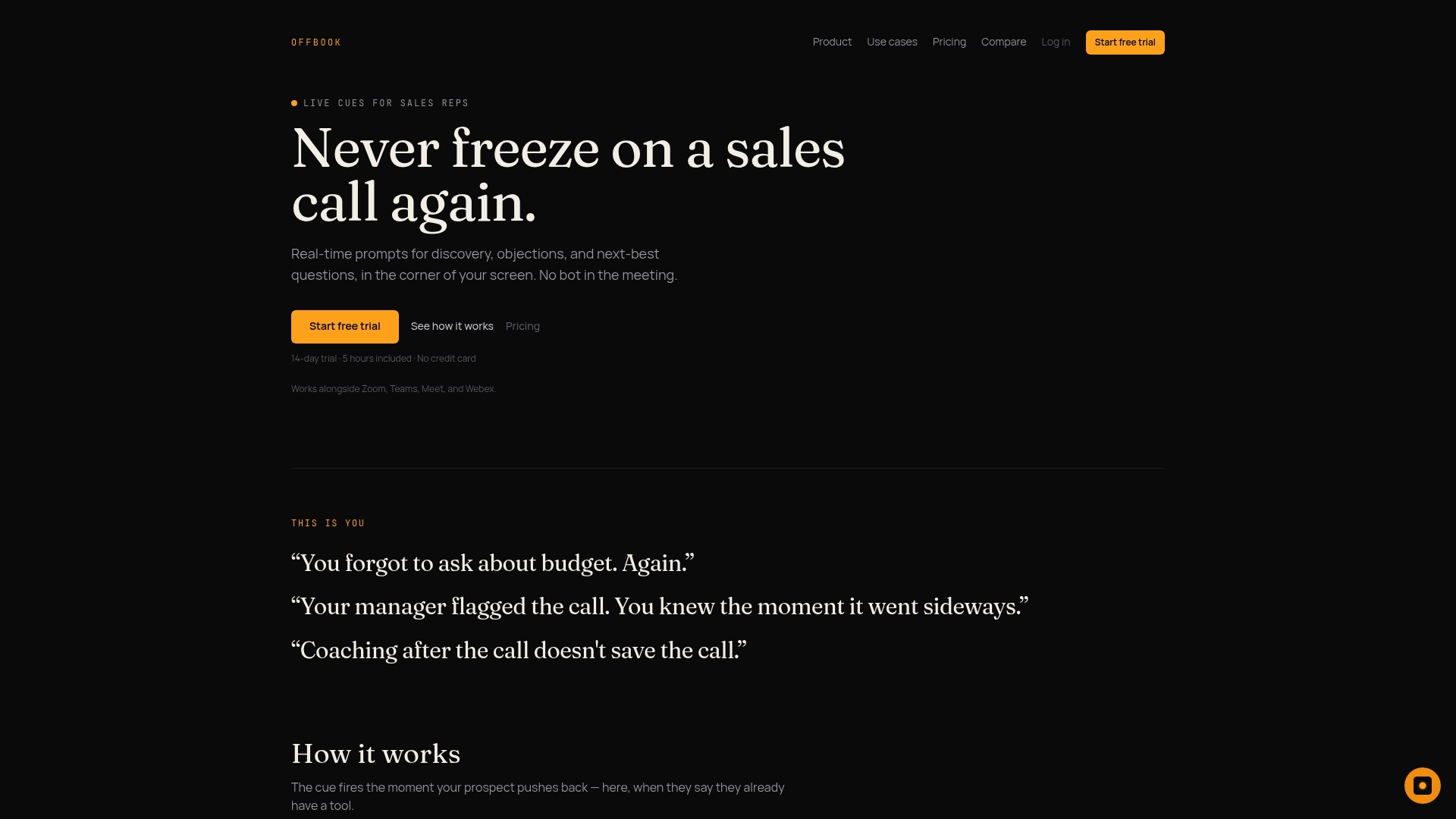
If you’d rather automate the recap than fill in the template yourself, check OffBook’s pricing and see which plan fits your team.
Sources
For the frameworks and examples referenced above: Sandler’s five-question debrief, Sandler’s RECON model, Salesforce’s coaching guidance, and Contextli’s post-call debrief format.
- Sales coaching guidance — Salesforce
FAQ
What are the 5 key points of debriefing?
A strong debrief covers the original objective, whether the rep stayed in control or went reactive, which question uncovered the most useful information, what commitment was secured, and what the rep would change next time, a structure Sandler’s coaching material lays out directly. These five points work as prompts for the rep’s own self-evaluation before a manager adds anything.
What are the 7 steps of debriefing?
Sandler’s RECON model gives five labeled steps: Review, Evaluate, Coach, Organize, and Next actions, as described in Sandler’s post-call framework. Attaching a specific owner and a due date to the final step turns those five stages into a fully operational routine.
What are some good debrief questions?
Ask what the call’s objective was, where the rep felt in control versus reactive, and which single question drew out the most useful response. Follow with what objection or hesitation came up and what the rep would try differently on the next similar call.
How do you structure a debrief?
Start with the rep’s self-evaluation using open prompts, then have the manager add observed facts the rep may have missed, following the observation-before-interpretation order Salesforce recommends. Close by agreeing on one behavior to change and logging a next step with an owner and a date.