Pick 12 Questions: Multi Persona Discovery by Stage for B2B Reps
Create a 12 question shortlist by asking three role specific questions per attendee. Includes a persona stage matrix and MEDDPICC mapping.
Published: September 25, 2026
Author: OffBook Editorial Team

Run one metric question, one impact question, and one decision-process question for every attendee on the call, then pick 12 of those questions total for your shared shortlist. Before you dial in, sketch a quick persona map of who’s attending and what each person is measured on. Open with a 60-second role roll-call so nobody gets asked a CFO question when they’re actually the end user. The rest of this guide gives you the full persona-by-stage matrix, sequencing scripts, and MEDDPICC mapping to make that shortlist repeatable.
TL;DR:
- Asking role-specific, past-behavior questions tied to each attendee’s key metric yields sharper, more actionable insights than generic or hypothetical inquiries.
- Mapping out a maximum of 12 tailored questions across all personas before the call improves qualification and prevents stalls caused by unaddressed buying network gaps.
- Starting calls with role verification and framing your questions around each attendee’s primary KPI helps surface genuine pain points and decision drivers.
- Identifying sequential questions based on attendee hierarchy and persona ensures the conversation stays focused and surfaces the most relevant qualification signals.
- Using live coaching software during calls to prompt follow-up questions and record answers enhances consistency and helps build a structured qualification process.
Table of Contents
- Why Persona-Specific Discovery Beats a One-Size Script
- The Persona × Stage Question Matrix
- How to Sequence Questions When Multiple Personas Are on the Call
- Mapping Discovery Questions to MEDDPICC by Persona
- Disqualification Signals and Common Mistakes
- Templates and Tools That Make This Repeatable
- What Actually Changes When You Watch Enough of These Calls
- Get Live Prompts for Every Persona on the Call, Not Just After
- Sources
- FAQ
Why Persona-Specific Discovery Beats a One-Size Script
Most discovery calls fail before the first question gets asked. The rep prepared one script for “the buyer,” but three or four people just joined the Zoom, and only one of them cares about the thing the script leads with.

B2B purchases are rarely a single-person decision anymore. Forrester’s research on buying networks found that Many purchases involve multiple departments, often more than two, with several people inside and outside the buying organization shaping the outcome. That’s 22 potential influences on one deal, and most reps prepare for exactly one of them.
The gap shows up in how sales teams actually run their calls. Gartner’s peer community poll on discovery questions found that Many sales leaders prioritize uncovering pain points, but significantly fewer treat mapping the full buying group as a mandatory step. Reps chase pain hard. They almost never stop to ask who else is in the room, mentally or literally.
The gap in numbers: 85% prioritize pain. 38% map the buying group. That 47-point gap is where most stalled deals quietly die, according to Gartner’s polling data.
That mapping gap has a real cost. Forrester also found that A large majority of B2B buyers report dissatisfaction with the vendor they eventually chose, often because the deal got closed with only one persona’s priorities addressed while the others quietly disengaged after signing.
Generic questions make this worse because they invite generic, rehearsed answers. Ask “What are your biggest challenges?” and you get whatever the prospect said in their last three vendor calls. The Mom Test approach, adapted for B2B sellers, fixes this by anchoring questions to the past and to specifics instead of opinions and hypotheticals:
- Ask what happened last time, not what might happen next time.
- Ask for a number, a date, or a workaround they built, not a feeling.
- Ask what they tried already instead of what they’d theoretically consider.
- Ask who else weighed in on the last similar decision, not who’s “involved” in the abstract.
The other lever that changes engagement fast: tie the question to the exact metric that person is judged on. A CFO doesn’t get animated talking about “efficiency.” A CFO gets animated talking about days sales outstanding, or the specific line item that’s over budget. HubSpot’s persona interview framework makes the same point: questions anchored to a role’s actual KPI produce sharper, more usable answers than questions built around a generic pain category.
The Persona × Stage Question Matrix
Every persona in a B2B deal answers a different question well and a different question badly. A CTO can talk architecture all day and go silent on budget. A CFO will give you a number in one sentence and glaze over if you ask about implementation timelines. The matrix below breaks out six common personas across four stages: current state, pain and impact, buying process, and urgency.
1. CISO or Security Lead
Current state: “Walk me through how you currently handle [security/compliance process] today, from start to finish.” Pain and impact: “What’s the last incident, audit finding, or near miss that made this a priority?” Buying process: “Who signs off on new tools that touch your security stack, and does legal review vendor contracts separately?” Urgency: “Is there a compliance deadline or audit date driving the timeline here?”
Three-question shortlist: current-state walkthrough, last incident or audit finding, sign-off chain.
A strong CISO answer names a specific control gap, a specific audit finding, or a specific framework (SOC 2, ISO 27001) they’re working toward. A red flag answer is vague (“we just want to be more secure”) with no named incident, no named framework, and no urgency attached to a date.
2. CTO or VP Engineering
Current state: “What does your current stack look like for this, and who built or maintains it?” Pain and impact: “What’s broken enough that your team has built a workaround for it?” Buying process: “Does engineering evaluate this alone, or does it need sign-off from security, finance, or the CEO?” Urgency: “Is this blocking a roadmap item, or is it more of a background priority right now?”
Three-question shortlist: current stack ownership, the workaround they built, roadmap dependency.
A strong answer names the internal tool or script they built to patch the gap, which is verifiable proof of pain. A red flag is a CTO who says everything is “fine” but agreed to take the call anyway. That mismatch usually means someone else scheduled it for them.
3. CFO or Finance Leader
Current state: “How is this cost or process tracked today, and who owns that number?” Pain and impact: “What did this cost the business last quarter, in dollars or hours?” Buying process: “What’s your approval threshold before this needs a board or committee sign-off?” Urgency: “Is this tied to a budget cycle, a renewal date, or a fiscal-year deadline?”
Three-question shortlist: who owns the number, last quarter’s cost, approval threshold.
A strong CFO answer gives you an actual figure without hesitation, because they track it closely. A red flag is a CFO who can’t name a number at all, which usually means the pain hasn’t been quantified internally yet, and the deal will stall in the business case stage.
4. VP Sales or Revenue Leader
Current state: “How does your team currently handle [process], and how much of it is manual?” Pain and impact: “Where are reps losing the most time, or where are deals slipping because of this gap?” Buying process: “Would this roll out to the whole team at once, or does it start with a pilot group?” Urgency: “Is there a quota target or a hiring plan that makes this more urgent this quarter?”
Three-question shortlist: manual process share, where deals slip, pilot versus full rollout.
A strong answer connects the gap directly to a number reps are missing, like quota attainment or ramp time. A red flag is enthusiasm with no connection to a rep-facing metric. That’s usually a VP who likes the idea in theory but hasn’t felt the pain personally.
5. RevOps or Sales Operations
Current state: “What does your current reporting or tooling stack look like for this?” Pain and impact: “Where does data get lost or manually re-entered between systems right now?” Buying process: “Who owns the tech stack decision, RevOps or the department head requesting it?” Urgency: “Is there a system migration or renewal forcing a decision on a timeline?”
Three-question shortlist: current stack, where data breaks, decision ownership.
A strong RevOps answer is specific about integration points and data flow. A red flag is someone who can describe the problem but has no visibility into who actually approves new tools, meaning they’re an influencer, not a decision-maker.
6. CRO or Executive Sponsor
Current state: “At a company level, how is this problem being addressed today?” Pain and impact: “What’s the business impact if this doesn’t get solved this year?” Buying process: “Who else needs to be aligned before you’d move forward?” Urgency: “What happens if you do nothing? Walk me through that scenario.”
Three-question shortlist: business-level impact, alignment needed, cost of inaction.
A strong CRO answer connects the problem to a company-wide number: churn, growth rate, or a board-level priority. A red flag is an exec who took the call as a favor to someone on their team and can’t articulate why it matters to them personally.
How to Sequence Questions When Multiple Personas Are on the Call
Preparation happens before you ever open the call window. Build a quick persona map: list every confirmed attendee, their likely role, the one metric question that fits them, and stitch those into a single shared shortlist of about 12 questions total across the group. That shortlist becomes your call outline, not a script you read top to bottom.
- Confirm roles in the first 90 seconds. Open with something like: “Before we dive in, can everyone say their name and what you’re mainly responsible for on this side?” This single question does more qualification work than anything else on the call, because it tells you instantly who owns which of your prepared questions.
- Set expectations out loud. Say plainly: “I’ve got a few questions for the group, and a couple specific to each of your roles, so I don’t waste anyone’s time.” That framing gives you permission to redirect a question later without it feeling like a snub.
- Start with the highest-authority persona’s current-state question. This orients the room and usually gets the most detailed answer, since senior stakeholders tend to speak first anyway.
- Pivot by name, not by topic. Instead of “What about pain points?”, say “[Name], from your side as the engineering lead, what’s the workaround you’ve built for this?” Naming the person and their role keeps the conversation from collapsing into one loud voice answering everything.
- Redirect a rambling answer with a bridge line. Try: “That’s helpful context. [Name], does that match what you’re seeing from the finance side?” This moves the conversation forward without cutting anyone off.
- Close with a one-line stakeholder surfacing question. Ask: “Who else on your team would weigh in before a decision like this gets made?” This single question, drawn from Forrester’s guidance on mapping buying networks, routinely surfaces a hidden influencer or an external source, like an analyst report or an AI tool the buyer already consulted, that the rep never would have known to ask about.
Pro Tip: Keep a visible running list, on paper or on screen, of who said what. When you follow up next week, referencing that CTO’s exact workaround by name does more for credibility than any generic recap email.
Time management matters more on multi-persona calls than solo ones, because a single dominant talker can eat the whole 30 minutes. If one person is answering every question, that’s your signal to explicitly redirect: “I want to make sure I get [other name]'s view on this too before we run out of time.”
Mapping Discovery Questions to MEDDPICC by Persona
MEDDPICC only works as a qualification framework if each letter gets answered by the person who actually holds that information, not by whoever happens to be talking. Assigning letters to personas up front turns a loose conversation into structured evidence you can drop straight into your CRM.
- Metrics → CFO, RevOps, or CRO. Ask: “What number does this need to move, and by how much, for this to be considered a win internally?” A dollar figure or percentage here becomes your qualification artifact.
- Economic Buyer → Usually CFO or CRO, sometimes VP Sales for smaller deals. Ask: “Who signs the check, and have they seen this conversation yet?”
- Decision Criteria → CTO or VP Engineering alongside RevOps. Ask: “What would disqualify a vendor outright, regardless of price?”
- Decision Process → RevOps or whoever owns procurement. Ask: “Walk me through every step and every sign-off between today and a signed contract.”
- Paper Process → RevOps or Finance. Ask: “Once verbal approval happens, how long does legal or procurement typically take to finalize?”
- Identify Pain → CTO, VP Sales, or the end-user persona. Ask: “What’s the specific workaround or cost that proves this pain is real today?”
- Champion → Whoever asked the most detailed, most invested questions during the call. Test them with: “Would you be comfortable walking your team through this internally if we sent a summary?”
- Competition → CTO or RevOps. Ask: “What else have you evaluated or built in-house, and why didn’t that stick?”
Log each answer directly against its MEDDPICC field in the CRM the same day, with the persona’s name attached. A note like “Metrics, confirmed by CFO: reduce DSO by 8 days” is a usable qualification artifact. A vague note like “seems like a good fit” is not, and it’s the kind of gap that shows up in a stalled pipeline review three weeks later. OffBook’s guide to economic buyers in SaaS breaks down how to identify who actually holds the checkbook when the org chart isn’t obvious from the call alone.
Disqualification Signals and Common Mistakes
Some multi-persona calls are worth walking away from early, and spotting that fast saves everyone’s quarter.
Watch for these disqualification signals:
- No one on the call can name who signs the contract or approves the budget.
- There’s no timeline, deadline, or triggering event tied to the decision.
- Only one person is engaged and everyone else stays silent or drops off future calls.
- Nobody can name a specific, measurable success metric, even when asked directly.
The most common mistakes stack on top of each other: asking hypothetical questions instead of past-behavior ones, using the same question for every persona regardless of their actual metric, and never asking who or what outside the room, a peer, an analyst report, or an AI tool, shaped their thinking before the call even started.
A short corrective script works better than pushing forward blind: “It sounds like there isn’t a clear owner for this decision yet. Would it make sense to loop that person in before we go further, or should we pause until priorities are clearer?” That question either surfaces the real decision-maker or gives you permission to deprioritize the deal without burning the relationship.
Templates and Tools That Make This Repeatable
Building a fresh persona question bank from scratch every week doesn’t scale, which is why a lot of reps now lean on structured generators instead of a blank notes doc. OffBook’s discovery call questions library is a good starting reference for building your own persona bank, and prompt-based tools like the Discovery Question Bank AI Prompt can generate persona-specific banks with red-flag answer notes already built in.
Live call coaching solves a different problem: catching the moment a persona gives a rehearsed answer instead of a real one, in real time, not three days later on the call recording. That’s the gap between a good question bank and a good call.
A five-question mixed-persona shortlist that models this whole approach:
- CFO: “What did this cost you last quarter, in dollars or hours?”
- CTO: “What workaround has your team already built for this?”
- RevOps: “Where does data currently break between your systems?”
- VP Sales: “Where are reps losing the most time because of this gap?”
- Anyone: “Who else would need to weigh in before this moves forward?”
What Actually Changes When You Watch Enough of These Calls
Watch enough multi-persona discovery calls and the same failure pattern repeats: the rep prepared brilliantly for the loudest voice on the invite and improvised everything else. The CFO gets a great question. The RevOps person, who actually controls the tech stack decision, gets nothing tailored, and that silence is exactly where deals quietly stall three weeks later.
The one habit worth adopting tomorrow is boring but effective: before every call, write down each attendee’s name next to the single metric they’re personally measured on. Not their title. Their metric. A VP Sales title tells you nothing useful. “Measured on rep ramp time” tells you exactly what question to ask.
Test this across your next ten calls and track how many produce a usable MEDDPICC artifact for every attendee, not just the loudest one. That number, more than call volume or talk-time ratio, tells you whether your discovery process is actually working.
— Neil
Get Live Prompts for Every Persona on the Call, Not Just After
Building the perfect persona question bank is only half the job. The other half is remembering to ask the CFO’s metric question and not the CTO’s, while the conversation is actually moving and three people are talking over each other. Live call coaching software listens to the call in real time and surfaces the next question, the objection response, or the qualification gap on screen as it happens, without a bot ever joining the meeting.
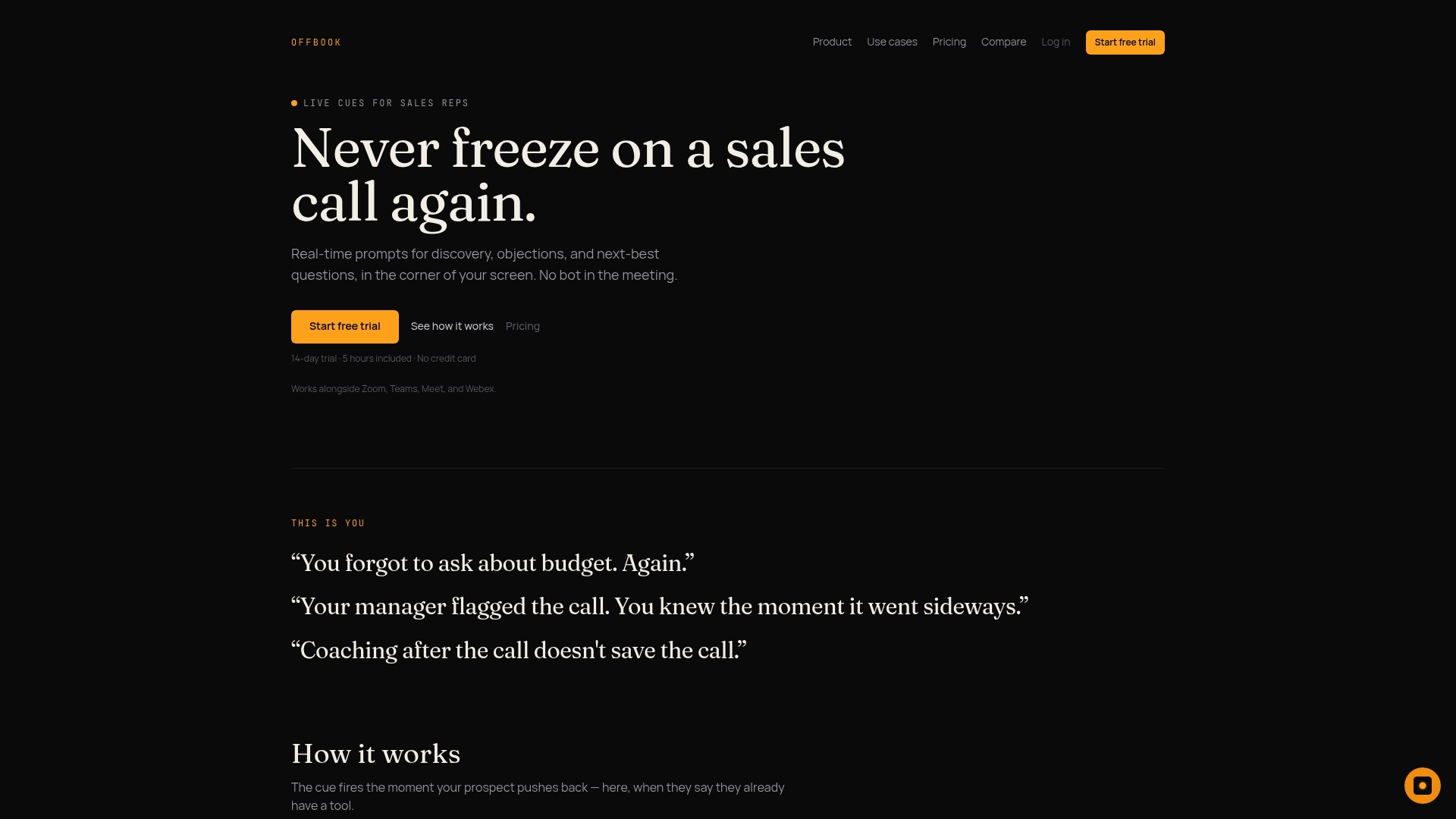
Picture a rep on a call with a CFO and a VP Engineering at once. The software flags that the engineering lead just described a workaround, an unclaimed pain signal, and prompts the rep to press for the cost of that workaround before the conversation moves on. It also builds a pre-call brief on both attendees beforehand, so the rep already knows who’s who before the roll call even happens. For reps who want a lighter starting point, the free discovery call question generator is a no-cost way to test the persona-question approach before committing to anything. When you’re ready to run this live on every call, the Power plan starts at $59 per month, or $590 billed annually, and OffBook’s sales coaching page walks through exactly how the in-call cues work for founder-led B2B teams.
Sources
- Taming B2B Buying Mayhem - Forrester
- Which types of questions should always be asked during discovery calls? — Gartner Peer Community
- Buyer Persona Questions I Ask in Interviews — HubSpot
FAQ
What Are Some Good Discovery Questions to Ask?
The strongest discovery questions ask about specific past behavior, not opinions or hypotheticals, and they tie directly to the metric the person you’re talking to is measured on. Questions like “What did this cost you last quarter?” or “What workaround has your team already built?” outperform generic questions like “What are your challenges?” because they force a verifiable, concrete answer.
What Are the Three C’s in Sales?
Definitions vary across sales training programs, but a common version refers to Contact, Challenge, and Close, or sometimes Clarity, Consistency, and Commitment, depending on the methodology. There’s no single agreed-upon industry standard for this term, so it’s worth confirming which framework a specific source or trainer means before applying it.
What Are the Five W Questions in Sales?
The five W’s, borrowed from journalism, translate to Who (the decision-makers and influencers), What (the specific pain or need), When (timeline and urgency), Where (where the problem shows up operationally), and Why (why it matters now). In a multi-persona call, each W often gets answered by a different attendee, which is exactly why persona-specific discovery questions for personas matter more than a single generic script.
What Should You Say on a Discovery Call?
Open by confirming each attendee’s role in the first minute, then ask a mix of current-state, pain-and-impact, and decision-process questions tailored to each person on the call. Close by asking who else would need to weigh in before a decision gets made, a question Forrester’s buying-network research shows most reps skip and most deals need.
How Many Questions Should a Multi-Persona Discovery Call Include?
A shared shortlist of around 12 questions across all attendees works well for a standard 30 to 45 minute call, based on HubSpot’s persona interview guidance recommending five to ten core questions per persona conversation. That breaks down to roughly three questions per attendee when three or four personas join the same call.