Gong vs Chorus: SaaS Founders Need Coaching During Calls, Not After
Compare Gong’s deal analytics and broad integrations with Chorus’s sentiment and data suite focus. See why SaaS founders may prefer live coaching.
Published: October 12, 2026
Author: OffBook Editorial Team

Gong tends to fit enterprise teams that want deep predictive deal analytics and broad integration coverage, while Chorus tends to fit teams already anchored in a CRM data suite who want conversation sentiment woven into that ecosystem. The real split is analytics depth versus integrated data and sentiment focus. Teams outside both camps, especially founder-led groups that need coaching inside the call rather than after it, often look at a third category entirely, including tools like OffBook.
TL;DR:
- Both vendors use custom negotiated pricing, so compare a yearly total that includes licenses, implementation, CRM setup, administration, and rep training.
- Before signing, verify which Salesforce objects the CRM sync updates, whether HubSpot activity logs in real time, and how much sync delay to expect.
- Small teams, founders who still sell, and reps handling high stakes renewals should weigh live guidance more heavily because both platforms coach after calls.
- Test your team’s sample call, since transcription claims are hard to verify and useful analytics depend on matching conversations to the metrics sales leaders track.
- Bring a live pipeline deal to the demo and request a report exported into your CRM to assess the manager workflow and data quality firsthand.
Table of Contents
- Gong vs Chorus at a glance
- How their features and analytics actually compare
- Post-call coaching versus live in-call support
- What integration depth and breadth really mean
- Pricing structures and what they actually cost over a year
- A decision framework for choosing between them
- Where live coaching changes the calculus
- A practitioner’s take on coaching versus analytics
- Prepare calls with real-time coaching from OffBook
- FAQ
- Sources
Gong vs Chorus at a glance
Both platforms record and transcribe calls, but they built their reputations around different strengths. Here’s how they typically stack up on the factors sales leaders weigh most.
- Core features and analytics: Gong leans on predictive deal scoring and risk signals across the pipeline; Chorus leans on sentiment detection and topic tracking tied closely to CRM records.
- Coaching approach: Both rely on post-call review, clip sharing, and scorecards rather than guidance delivered during the conversation itself.
- Integration posture: Gong is frequently described as broad across many connectors; Chorus is frequently described as deep within the data suite it’s bundled with.
- Pricing shape: Both use custom, quote-based pricing rather than published per-seat rates, which makes upfront cost comparison difficult.
- Ideal team size and use case: Gong suits larger revenue organizations managing complex forecasting; Chorus suits teams standardized on the CRM ecosystem it extends.
The one-line takeaway: shortlist Gong first if forecasting accuracy and integration breadth matter most, and shortlist Chorus first if your team already lives inside a connected data suite.
How their features and analytics actually compare
Recording and transcription are table stakes at this point, covering Zoom, Microsoft Teams, Google Meet, and in some cases dialed phone calls. The real differentiator is what happens after the transcript exists. Vendor claims about transcription accuracy are hard to verify independently, so it’s worth testing a sample call from your own team rather than trusting a headline number.
Deal intelligence and conversation-level insight are two distinct layers, and buyers often conflate them. Deal intelligence covers predictive scoring and risk flags across an entire pipeline, the kind of output a VP of Sales uses to sanity-check a forecast. Conversation-level insight covers what happens inside a single call: keyword and topic detection, objection patterns, talk-time ratios. Aggregated user reviews on Capterra consistently frame one platform profile as stronger on deep predictive deal intelligence and broad integrations, and the other as stronger on conversation sentiment and data-suite integration.
G2 reviews of Gong describe strengths in analytics depth and enterprise reporting, useful for illustrating buyer trade-offs rather than establishing exact accuracy figures. Managers typically act on this analytics layer in a few concrete ways: automated alerts when a deal shows risk language, clips pulled from calls for team coaching sessions, and scorecards customized to match specific KPIs like discovery question coverage or next-step confirmation. The quality of those actions depends less on raw transcription accuracy and more on how cleanly the platform maps conversation data to the metrics a sales leader already tracks.

Post-call coaching versus live in-call support
Both Gong and Chorus operate primarily as post-call coaching tools. A rep finishes a call, a manager reviews the recording later, tags a moment, and shares a clip for feedback. This workflow scales well for skill development across a larger team, since one manager can review dozens of calls asynchronously and build a library of example moments for onboarding.
The limitation shows up in the gap between the call and the feedback. A rep who mishandles an objection on Tuesday doesn’t learn about it until a manager reviews the recording, sometimes days later. G2 reviews of Chorus.ai point to transcription accuracy and sentiment detection as recurring strengths, but those signals still surface after the conversation has ended.
Live, in-call guidance is a different category: cues surfaced to a rep while the call is happening, which matters most on high-stakes calls where there’s no second chance, like a renewal negotiation or a founder’s first call with a target account. Implementation signals worth watching either way include how quickly reps adopt the tool without prompting, how much manager time the review cycle actually consumes, and whether coaching KPIs like ramp time or win rate move measurably after rollout.

What integration depth and breadth really mean
A bidirectional CRM sync should do three things automatically: log call activity to the right record, update opportunity fields based on what was discussed, and trigger downstream workflows like a follow-up task or a Slack alert to a manager. The difference between a platform with many connectors and one with deep native integration into a specific data suite is a real trade-off, not just a marketing distinction. Breadth gets you coverage across tools your team already uses; depth gets you richer, more reliable data flow with the one or two systems that matter most.
Before signing anything, ask vendors specific questions: which Salesforce objects does the sync actually write to, does HubSpot activity logging happen in real time or on a delay, and what’s the typical sync latency under normal call volume. For more on how these mechanics play out with a major CRM, see our Salesforce call coaching notes. An independent breakdown of CRM email integration tools is also worth a look if you’re mapping integration effort across your broader stack.
Pricing structures and what they actually cost over a year
Both Gong and Chorus use custom, sales-negotiated pricing rather than a published rate card, which is common in this category but makes side-by-side comparison harder for buyers. Common pricing shapes in conversation intelligence generally fall into two patterns: a platform fee plus a per-user charge, or a base fee plus per-seat pricing that scales as the team grows. Petĩra’s analysis of per-user pricing makes the case that this model can penalize teams for growing headcount, a dynamic worth factoring into any multi-year projection.
License cost is rarely the full picture. A realistic 12-month total cost of ownership should also include implementation time, integration setup with your CRM, ongoing admin hours to maintain scorecards and permissions, and training time for new reps. For a 25-rep team, a simple TCO template adds: annual license cost, estimated implementation hours times your team’s loaded hourly rate, integration setup cost if outsourced, and an estimate for quarterly enablement refreshers. Running that math before a demo call puts you in a stronger negotiating position than comparing sticker prices alone.
A decision framework for choosing between them
Work through these criteria in order rather than letting any single feature drive the decision:
- Define the primary outcome you need, whether that’s tighter forecasting, faster rep ramp, or better objection handling on live calls.
- Check CRM fit first, since a platform that doesn’t sync cleanly with your system of record creates manual work that erodes any time saved elsewhere.
- Match the coaching model to your rhythm, confirming whether your team needs post-call review at scale or guidance during the conversation itself.
- Confirm analytics depth against what you’ll actually use, since predictive deal scoring matters less for a five-person team than for a 50-person one.
- Verify privacy and consent handling, especially for recording laws tied to the regions your calls touch.
- Model budget against the TCO template, not just the quoted license fee.
When you get to a demo, bring a real deal from your pipeline instead of a canned scenario, ask to see a manager’s actual review workflow rather than a highlight reel, and request a sample report exported directly into your CRM so you can judge the data quality firsthand. Good RFP questions include how sync behavior handles edited fields, who owns the recorded data after a contract ends, what admin controls exist for permissions, and whether the vendor can provide references from a team your size.
Where live coaching changes the calculus
Post-call intelligence changes future behavior: a manager reviews a pattern, coaches a rep, and the next call improves. Live, in-call cues change the outcome of the call that’s happening right now, surfacing the next question to ask or the objection response a rep forgot under pressure. That distinction matters most for founder-led outreach, where the founder is often the best closer on the team but has no manager reviewing their calls, and for high-stakes renewal conversations where there’s no second attempt.
Pro Tip: If your team runs fewer than ten reps and the founder is still closing deals personally, weigh live in-call guidance as heavily as any post-call analytics suite.
For more on how this plays out operationally, see our notes on how AI cues improve sales performance and our broader guide to AI sales coaching.
A practitioner’s take on coaching versus analytics
Early-stage teams overweight analytics dashboards because they feel rigorous, but a seed or Series A team rarely has the call volume to make predictive scoring meaningful. What actually moves the needle at that stage is whether the rep on the call right now asks the right qualification question. Prioritize coaching that changes the next five minutes, not the next quarterly review. Our use cases page walks through how that looks for teams at this stage.
— Neil
Prepare calls with real-time coaching from OffBook
When the real decision criterion is changing what happens during the call itself, not just reviewing it afterward, we built OffBook around that exact job. We listen to the live conversation and surface on-screen prompts: the next question to ask, how to handle the objection that just came up, and where a qualification gap is opening, structured around frameworks like MEDDIC and MEDDPICC. We never join the call as a bot, and every session runs on explicit per-session consent.
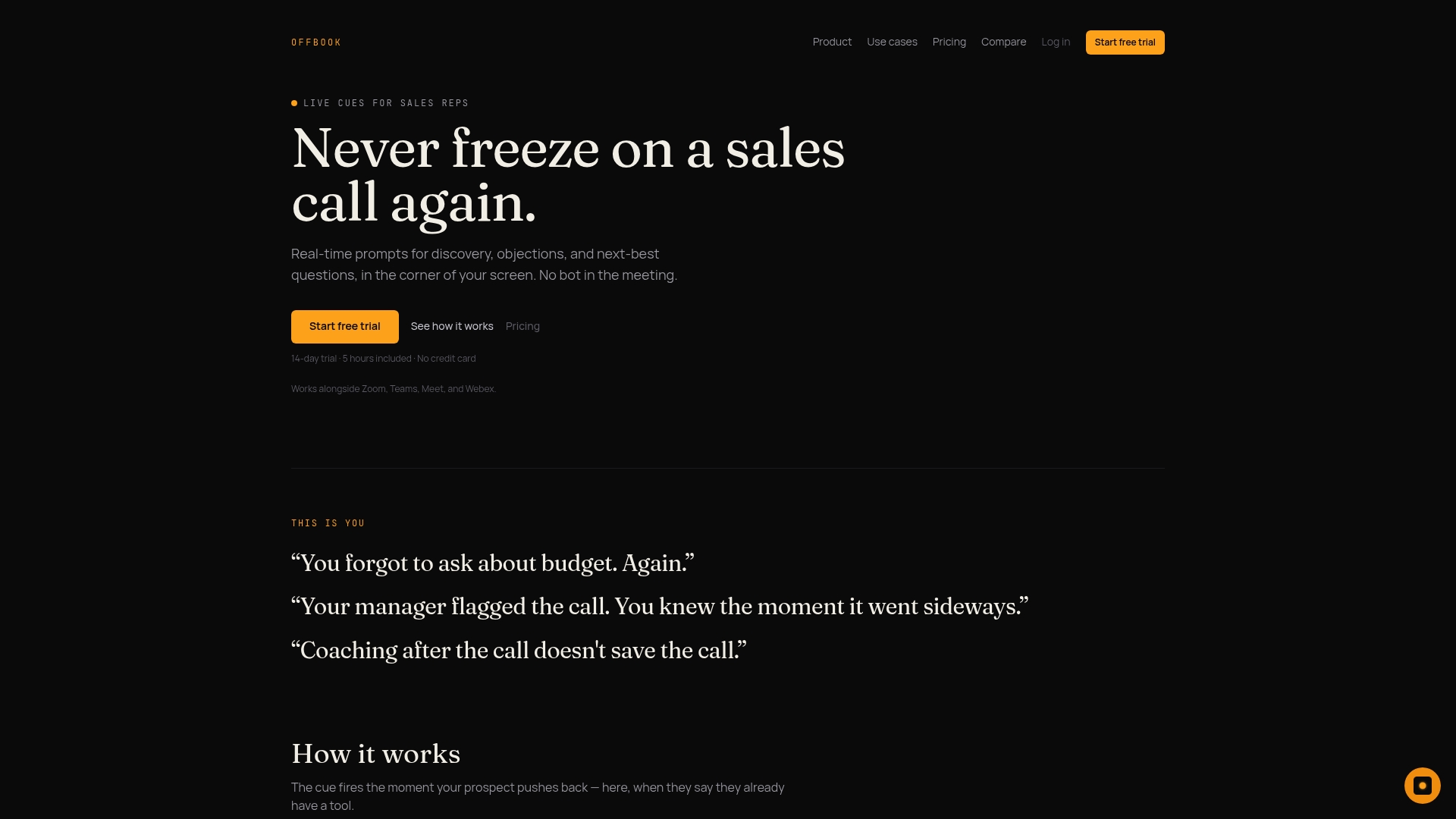
Before the call even starts, we generate a brief on the company and people a rep is about to meet, which matters most for founder-led teams without a research team behind them. Plans start with Power at $59 per month or $590 per year, and Team pricing runs $1,000 per year per seat for groups that need shared visibility. See how it works on our sales coaching page or check the pricing page directly to compare against a trial period.
FAQ
Is Gong an Israeli company?
Gong was founded in Israel before establishing its headquarters in the United States, a common pattern for sales technology companies with founding teams there. This detail matters less for buyers than its current product and support structure, which operates as a global SaaS vendor today.
Who are the top competitors of Gong?
The conversation intelligence category includes several platforms built around recording, transcription, and deal analytics, with positioning that ranges from broad revenue intelligence suites to tools focused on real-time, in-call coaching like OffBook. The right comparison set depends on whether your priority is post-call analytics at scale or live guidance during the conversation itself.
Is Gong worth it?
For larger revenue teams that need predictive deal scoring and broad integration coverage, G2 reviews of Gong suggest the analytics depth earns its reputation among enterprise buyers. Smaller or founder-led teams often find the value proposition weaker relative to cost, since the predictive features need call volume to become meaningful.
How much does Chorus.ai cost?
Chorus.ai uses custom, quote-based pricing rather than a published rate card, so exact costs depend on team size and contract terms negotiated directly with the vendor. Buyers should request a quote tailored to their seat count and ask specifically what’s included versus billed separately.