Salesforce Call Coaching: Live AI Prompts for Early-Stage SaaS
Enhance sales performance with Salesforce call coaching, offering real-time AI prompts to help your team improve live call outcomes.
Published: August 21, 2026
Author: OffBook Editorial Team

Salesforce call coaching, as most founders now use the term, means real-time AI coaching that listens to live sales calls and surfaces on-screen prompts, pre-call briefs, and post-call debriefs while a rep is still talking to the prospect. If you run sales at a seed or Series A B2B SaaS company, the answer is yes: adopt it now, but pilot it before rolling it out to the whole team. Salesforce’s own research shows AI coaching agents can identify objections and speech patterns and hand a rep instant feedback mid-call, not three days later in a deal review.
It fits best for founder-led teams still building their first repeatable playbook and reps who are new enough to need a safety net on live calls.
- Best fit: early-stage teams without a dedicated sales enablement hire.
- Integration note: coaching should write structured updates back to Salesforce automatically, and any tool touching live audio needs clear consent handling built in.
Key Takeaways
Live, in-call AI coaching improves close rates by correcting rep behavior during the call itself, not days later in a review.
| Point | Details |
|---|---|
| Define the term first | Salesforce call coaching here means real-time AI coaching during live calls, not post-call analytics. |
| Pilot before rollout | Run a 60 to 90 day pilot with one mid-performing rep to get a clear read on impact. |
| Map methodology to triggers | Coaching tied to MEDDIC or MEDDPICC outperforms generic prompts tied to no framework. |
| Prioritize CRM writeback | Structured, field-level updates to Salesforce reduce manual work and drive adoption. |
| Start with OffBook | OffBook offers pre-call briefs, live in-call cues, and post-call debriefs built for founder-led SaaS teams. |
Table of Contents
- How Salesforce Call Coaching Works During a Live Call
- What Founders and Reps Actually Gain From Live Coaching
- What to Set Up Before You Turn on Live Coaching
- How Long Until You See Results From a Pilot?
- Rolling Out Live Coaching Without Disrupting Your Pipeline
- Will Reps Trust an AI Listening to Their Calls?
- Why We Built OffBook Around the Live Call, Not the Transcript
- Try OffBook for Your Sales Team
- Sources
How Salesforce Call Coaching Works During a Live Call
The flow is simple to describe and hard to build well: the software listens to the call, analyzes what’s being said in real time, surfaces a coaching cue on the rep’s screen, then writes a summary back to the CRM when the call ends.
Break it into steps and it looks like this:
- Live transcription captures the conversation as it happens, with no bot visibly joining the meeting.
- Intent and topic detection flags moments that matter, a pricing objection, a competitor mention, a vague answer to a qualification question.
- Playbook matching checks that moment against your sales methodology, whether that’s MEDDIC, MEDDPICC, or a homegrown framework.
- On-screen coaching cards appear with a suggested question or response, small enough to glance at without losing eye contact with the prospect.
- Post-call writeback pushes notes, next steps, and qualification gaps into Salesforce automatically.
Here’s a concrete example: a prospect says, “Your pricing feels high compared to what we’ve seen.” A rep without support might discount on the spot. With in-call coaching, a card surfaces asking the rep to isolate the objection, “Is it the price itself, or how it compares on value?”, before any number gets renegotiated.
Pro Tip: Map your methodology’s key qualification criteria (the “I” in MEDDIC, for instance) to specific triggers before launch. Coaching that fires generic prompts feels like noise; coaching tied to your actual sales process feels like a second brain.
What Founders and Reps Actually Gain From Live Coaching
The core benefit is straightforward: live coaching improves call execution in the moment, which shortens the feedback loop between a mistake and the correction. A rep doesn’t wait for a Friday call review to learn they skipped discovery on Tuesday’s demo. They learn it live, on the call, when the fix still matters.
Each role sees a different payoff:
- Founders get a more predictable pipeline because every call, not just the ones a manager happens to sit in on, follows the same qualification standard.
- Reps blow fewer calls because objection handling and next-step questions show up when they’re needed, not in a post-mortem.
- VPs of Sales get coaching that scales past the hours in their calendar. You can’t personally shadow every call once headcount hits ten reps.
Track these metrics to see if it’s working: time-to-first-close, win rate lift, ramp time for new hires, and CRM field completeness. Otter watching quota attainment and ramp time specifically, since those two numbers tend to move first and move fastest in a pilot. OffBook is built for exactly this kind of team, where one or two hires closing more consistently changes the whole company’s trajectory.
What to Set Up Before You Turn on Live Coaching
The single most important prep step is documenting your sales methodology and mapping it to your CRM fields, because coaching without a methodology behind it is just noise with good timing. Before you flip the switch, work through this sequence:
- Confirm data access and permissions so the coaching tool can read calendar invites and join calls without manual setup per rep.
- Set calendar and meeting join patterns, deciding which call types (discovery, demo, negotiation) get coaching enabled by default.
- Configure transcription settings, including language and any industry terminology your reps use that a generic model might miss.
- Map playbooks to triggers, tying specific objections or qualification gaps to the coaching cards that should fire.
- Customize agent behavior for different roles. A founder-led seed team often wants different cues than a Series A team with a dedicated SDR function.
Before launch, a RevOps or IT lead should check a short list: data residency and retention policies, deletion controls for call recordings, and consent prompts for every participant on the call. Deep, structured CRM writeback turns out to be the one integration feature that actually changes rep behavior day to day, more than any dashboard or report.
Structured, field-level writeback to your CRM is what separates a coaching tool reps actually use from one they tolerate. If updates still require manual entry after the call, adoption drops fast.
How Long Until You See Results From a Pilot?
A 60 to 90 day pilot window is the realistic minimum for seeing signal in most B2B SaaS sales cycles, according to Otter.ai’s implementation guidance. Shorter than that and you’re reading noise, not a trend.
During the pilot, track:
- Quota attainment for the pilot rep versus a comparable control rep.
- Win rate on calls where coaching fired versus calls where it didn’t.
- Ramp time to first closed deal, especially for newer hires.
- CRM completeness, since automatic writeback should measurably reduce manual entry gaps.
- Coaching adoption rate, meaning how often the rep actually acts on a surfaced prompt.
Before the pilot starts, test the tool’s scoring quality against 10 to 20 of your own historical calls.
Rolling Out Live Coaching Without Disrupting Your Pipeline
Before launch, ask one question: do you have a documented methodology, at least 20 to 50 recorded calls to calibrate against, and one mid-performing rep willing to pilot it? If yes, you’re ready.
- Pre-launch: finalize consent language, load your playbook and objection library, and pick your pilot rep.
- Weeks 1 to 4: run coaching live, collect call data, and have the manager spot-check a sample of calls weekly against the AI’s suggestions.
- Months 2 to 3: hold calibration sessions comparing manager judgment to AI scoring, and adjust trigger sensitivity based on what’s actually useful versus distracting.
Pilot with a mid-performer rather than your top closer or your newest hire. Otter.ai notes mid-performers show clearer, more measurable improvement in a short window than reps at either extreme.
Pro Tip: Add a light gamification layer, like a leaderboard for coaching cues acted on, during weeks 1 to 4. Adoption stalls fastest when reps forget the tool is there.
Will Reps Trust an AI Listening to Their Calls?
Most adoption concerns are manageable with the right pilot design and clear guardrails, not with more features. The real risks cluster around a few predictable spots:
- Privacy and consent, since call participants need to know they’re being recorded and coached in real time.
- Accuracy and calibration, because a tool that misreads tone or context erodes trust fast.
- Rep acceptance, since some reps read coaching prompts as surveillance rather than support.
- CRM noise, where over-eager writeback clutters records with low-value updates.
Mitigate each with consent banners at call start, manager-led calibration sessions in the first month, and staged rollout to one team before company-wide deployment.
Pro Tip: Set conservative confidence thresholds at launch so only high-certainty triggers fire in-call. A tool that interrupts with weak suggestions loses rep trust faster than one that says less but says it right.
Why We Built OffBook Around the Live Call, Not the Transcript
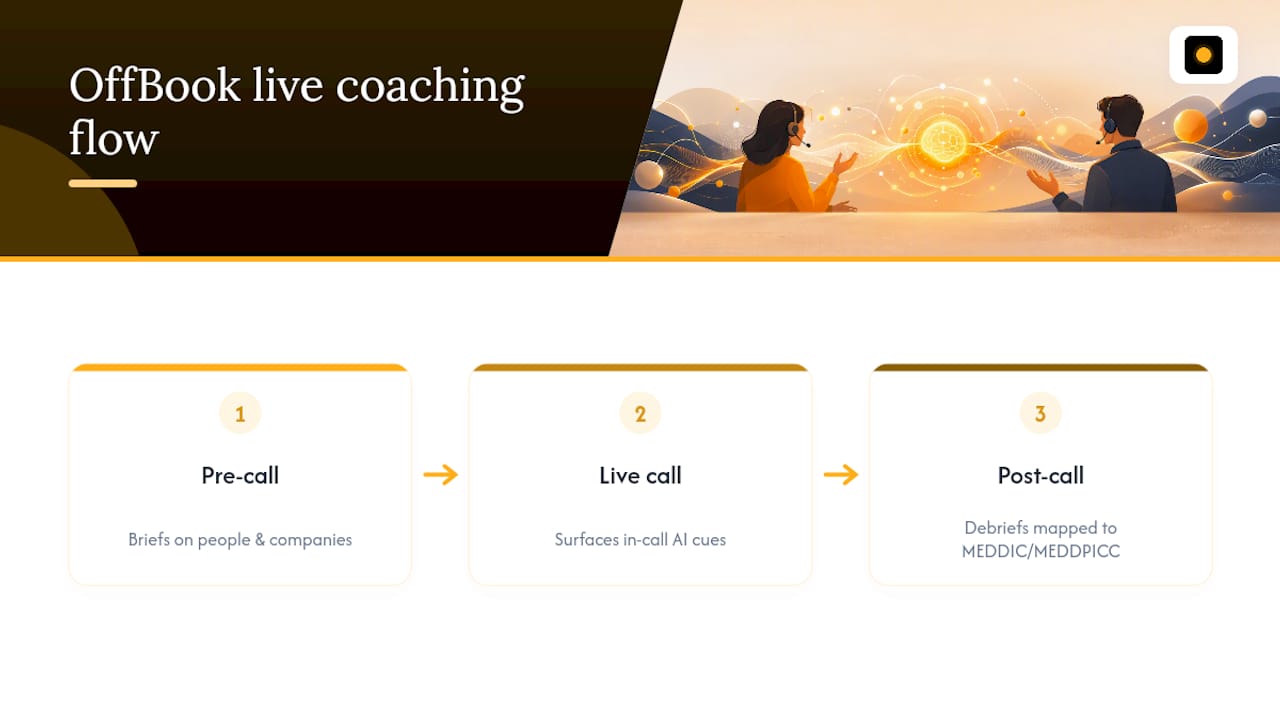
We built OffBook on a simple bet: coaching only changes outcomes when it arrives while the rep can still act on it, not in a summary they read after the deal has moved on. That’s why OffBook surfaces cues during the call itself, generates pre-call briefs on the people and companies a rep is about to meet, and produces post-call debriefs mapped to MEDDIC and MEDDPICC, built specifically for founder-led SaaS teams still building their first real sales process.
Try OffBook for Your Sales Team
OffBook delivers the exact coaching flow this article describes: live cues during the call, pre-call briefs so reps walk in prepared, and structured writeback to your CRM after every conversation, without a bot ever joining the meeting.
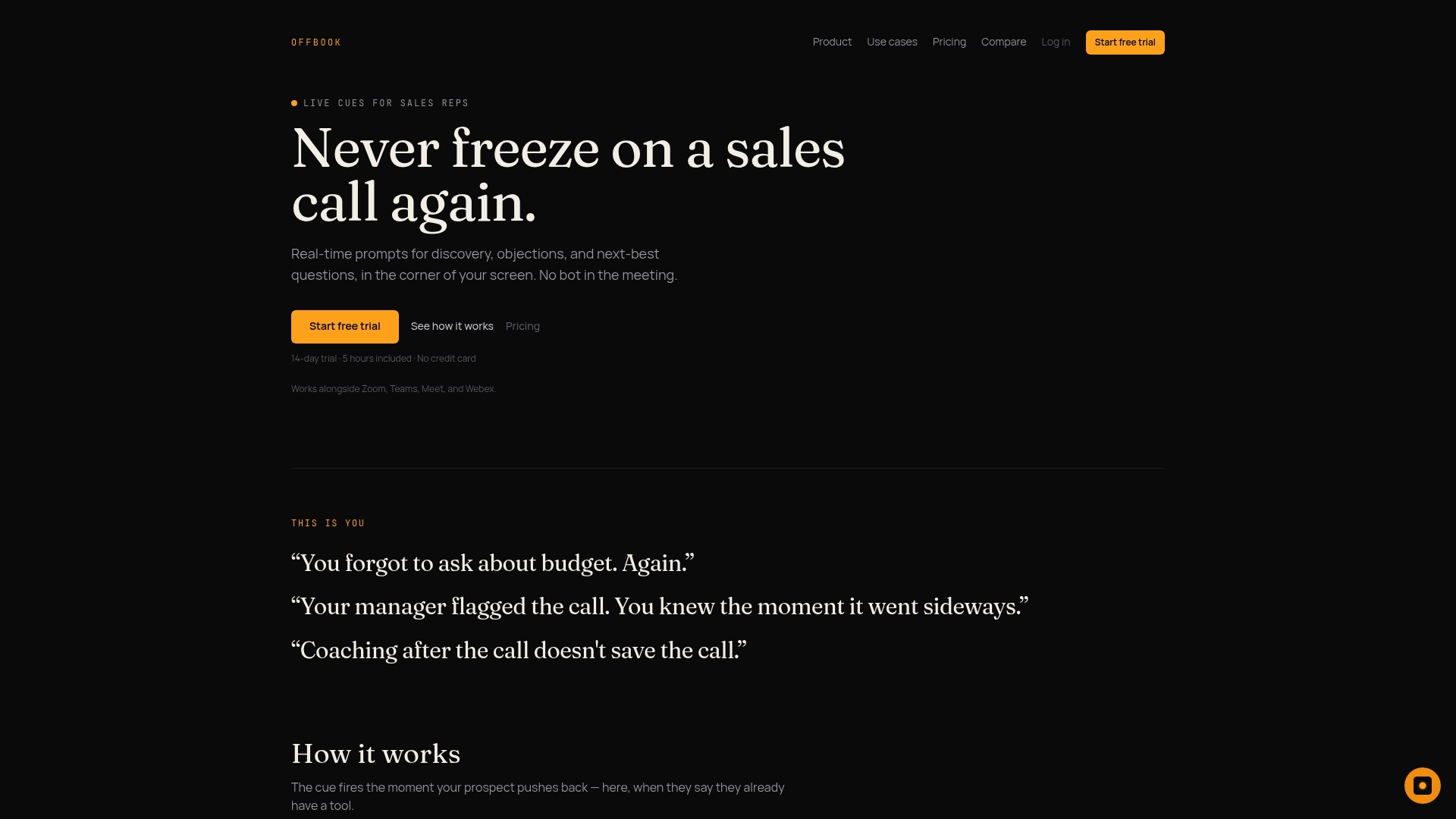
The features map directly to the checklist above. Pre-call briefs cover the setup step of knowing who you’re talking to before the call starts. In-call prompts handle objection detection and qualification gaps in real time. MEDDIC and MEDDPICC alignment means the coaching follows a methodology your whole team can calibrate around, not a generic script. And automatic writeback solves the CRM completeness problem most sales teams never quite fix.
Start small: pilot with one or two reps for 60 to 90 days, the window that gives you real signal instead of noise. Head to the OffBook sales page to see the trial options and get your first rep coached on their next call.