How AI Cues Improve Sales Performance in 2026
Discover how AI cues improve sales performance in 2026. Learn to transform your sales strategies with real-time insights and save valuable time.
Published: July 7, 2026
Author: OffBook Editorial Team

AI cues in sales are real-time, data-driven signals that guide reps toward winning behaviors during live conversations. Understanding how AI cues improve sales performance is now a baseline requirement for B2B SaaS teams, not an experiment. 87% of sales organizations now use AI for prospecting, forecasting, or lead scoring. That number signals a market-wide shift in what “standard practice” looks like. Reps using AI-assisted workflows save an average of 12 hours per week, time that top teams redirect into discovery calls, executive engagement, and deal acceleration. The industry term for what AI surfaces in the moment is “real-time sales coaching signals,” though “AI cues” captures the same idea in plain language. Both terms describe the same thing: on-screen prompts that tell a rep what to do next, right when it matters.
How AI cues improve sales performance through behavioral signals
The four behavioral signals that AI coaching systems score are discovery question density, objection acknowledgment, value framing, and close attempts. These four signals strongly predict quota attainment. That finding reframes what “good selling” means. It is not charisma or tenure. It is measurable, coachable behavior.
- Discovery question density measures how often a rep asks open-ended questions that uncover prospect pain, budget, and decision process. Reps who ask more discovery questions generate deeper engagement and surface the information needed to qualify deals under frameworks like MEDDIC and MEDDPICC.
- Objection acknowledgment tracks whether a rep validates a prospect’s concern before responding. Reps who skip acknowledgment trigger defensiveness. Reps who acknowledge first build trust and keep conversations moving.
- Value framing scores how clearly a rep connects product capabilities to the prospect’s stated business problem. Generic feature pitches score low. Specific, outcome-linked statements score high.
- Close attempts count how often a rep asks for a clear next step or commitment. Many reps avoid this out of fear of rejection. AI cues remove the hesitation by prompting the rep at the right moment.
Personalized AI feedback loops improve all four metrics in as little as 12 weeks, with measurable gains in quota attainment and ramp time. That timeline matters for seed and Series A SaaS teams where every quarter counts.
Pro Tip: Run a baseline audit of your team’s call recordings against these four signals before deploying any AI coaching tool. Knowing your starting point makes the 12-week improvement curve visible and defensible to leadership.

How does AI automate sales workflows to save time?
AI reduces prospect research time by 34% and email drafting time by 36%, according to Salesforce’s 2026 State of Sales data. Those two tasks alone consume a significant portion of a rep’s non-selling hours. Cutting them frees capacity for the work that actually closes deals.
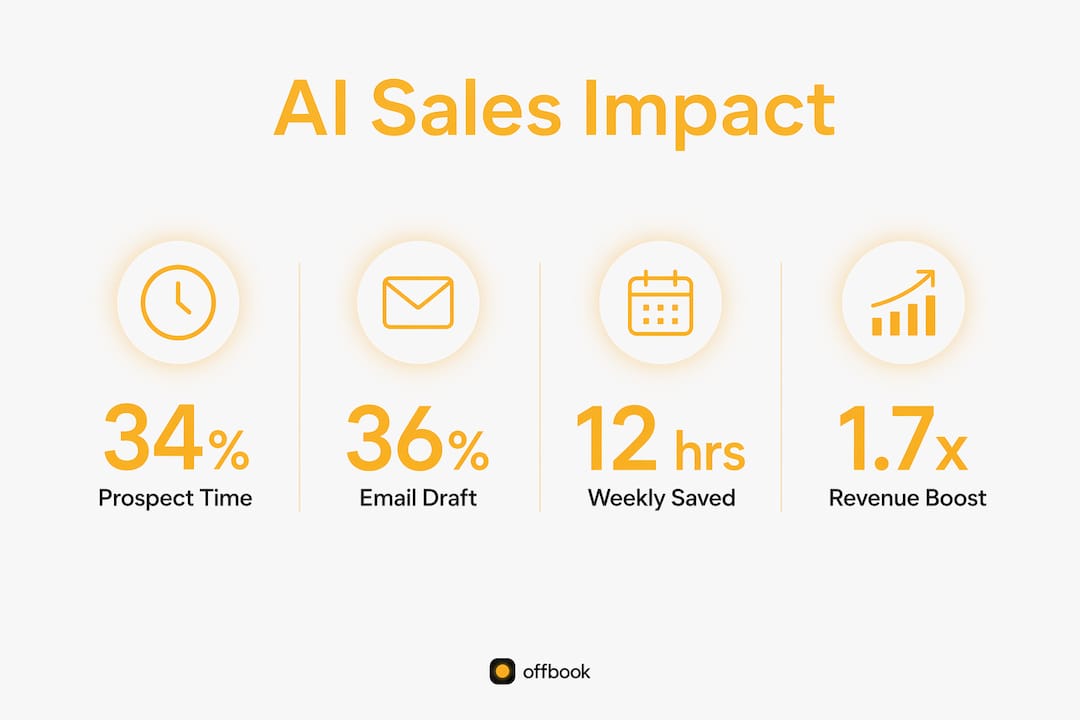
The time savings compound across the week. Reps using AI-assisted workflows save an average of 12 hours weekly. That is roughly 30% of a standard 40-hour work week returned to the rep. The question is what they do with it.
Here is how high-performing B2B SaaS teams structure AI-driven workflow gains:
- Automate pre-call research. AI generates company briefs, stakeholder summaries, and recent news before every call. Reps walk in prepared instead of winging it.
- Use AI agents for outreach sequencing. 54% of sales organizations now deploy autonomous AI agents to manage outreach and pipeline tasks. This removes the manual follow-up burden from reps entirely.
- Automate CRM updates post-call. AI transcribes and logs call notes, action items, and deal stage changes. Reps stop spending 20 minutes after every call on admin.
- Redirect saved hours to pipeline-building. The best teams schedule the recovered time explicitly. Discovery calls, executive outreach, and deal reviews fill the gap.
Top-performing sales teams are 1.7x more likely to use AI agents and achieve higher revenue growth than their peers. The gap between AI-adopting teams and laggards is widening fast. AI is not a productivity tool in the narrow sense. It is an accelerant that changes what a rep can accomplish in a given day.
Why reinvesting AI time savings is the real revenue lever
Most sales organizations miss the point. They deploy AI, celebrate the efficiency gains, and then let reps fill recovered hours with low-value activity. Gartner research found that 72% of sales organizations fail to reinvest AI-saved time into high-value activities. That failure caps the business impact of every AI investment the company makes.
Organizations that do reinvest effectively are 2.2x more likely to exceed growth goals and 3.1x more likely to improve lead conversion rates. The difference is not the technology. It is the system built around the technology.
The “productivity paradox” describes this gap precisely. A team saves five hours per rep per week with AI. Output stays flat. Leadership questions the ROI. The problem is not the tool. The problem is that no one redesigned the workflow to capture the value. Overcoming this paradox requires building AI-forward sales infrastructure that orchestrates winning behaviors, not just reduces task time.
Sales leaders who want to avoid this trap should act on three fronts:
- Shift KPIs from activity counts to revenue impact. Tracking call volume and email sends rewards busyness. Tracking pipeline created per rep and conversion rate rewards outcomes. Salesforce 2026 data shows productivity as a success metric dropped by 5.8 points while financial impact metrics doubled in importance.
- Schedule the recovered time explicitly. Do not leave it to reps to decide how to use freed hours. Build discovery blocks, executive outreach windows, and deal review sessions into the weekly calendar.
- Measure AI adoption alongside revenue outcomes. Track which reps use AI cues consistently and correlate that behavior with win rate and quota attainment. Make the link visible.
Pro Tip: Start with one reinvestment behavior per rep. Ask each person to book two additional discovery calls per week with the time AI saves them. Measure the pipeline impact over 30 days before adding more changes.
The financial case for reinvestment is clear. AI’s value in sales does not come from doing the same things faster. It comes from doing different, higher-value things with the time it creates. This principle applies directly to how AI reduces costs across business functions, freeing resources for work that generates real returns.
How can B2B SaaS teams apply AI cues to coaching and pipeline management?
AI coaching changes the economics of skill development. A sales manager at a 10-person SaaS team cannot review every call, score every conversation, and deliver personalized feedback to every rep. AI can. AI coaching platforms identify coachable moments and surface personalized priorities without requiring a manager to listen to full recordings. Teams adopting AI coaching see win rate improvements of 22–28% within 90 days. Reps are 90% more likely to hit quota when AI coaching is consistently applied.
The practical application for B2B SaaS teams breaks down into four areas:
- Live call coaching. AI surfaces prompts during active calls, telling reps which discovery questions to ask, which objections to address, and when to attempt a close. Offbook does this without a bot joining the meeting, keeping the conversation natural while the rep gets real-time guidance on screen.
- Deal-level AI insights. AI flags at-risk deals based on engagement patterns, missing qualification data, and stalled next steps. Managers can prioritize pipeline reviews around the deals that need attention, not the ones that feel comfortable.
- AI roleplay practice. Three AI-assisted roleplay sessions per week produce noticeable skill improvement within a month. Reps practice objection handling, value framing, and close attempts in a safe environment before applying them in live deals.
- Behavioral feedback loops. AI scores each call against the four behavioral signals and shows reps their trend over time. Reps who see their own data improve faster than those who receive only manager feedback.
The comparison below shows how AI-assisted coaching differs from traditional approaches across key dimensions:
| Dimension | Traditional coaching | AI-assisted coaching |
|---|---|---|
| Feedback speed | Days or weeks after the call | During or immediately after the call |
| Coverage | Selective call reviews | Every call scored automatically |
| Personalization | Manager judgment | Data-driven, rep-specific priorities |
| Scalability | Limited by manager bandwidth | Scales across the full team |
| Skill reinforcement | Periodic sessions | Continuous, session-by-session feedback |
For B2B sales teams at the seed and Series A stage, this shift from periodic coaching to continuous AI-guided development is one of the highest-leverage changes available. The ramp time reduction alone justifies the investment when every new hire represents months of lost pipeline.
Key Takeaways
AI cues improve sales performance by scoring four measurable behaviors, automating routine tasks, and enabling continuous coaching that scales across the full team without adding manager headcount.
| Point | Details |
|---|---|
| Four behavioral signals drive quota | Discovery density, objection acknowledgment, value framing, and close attempts predict attainment. |
| AI saves 12 hours per week | Reps recover time from research and admin, but must reinvest it into high-value selling activities. |
| 72% miss the reinvestment step | Most orgs fail to redirect AI-saved time, capping the revenue impact of their AI investment. |
| Continuous coaching scales results | AI coaching improves win rates by 22–28% within 90 days without requiring full call reviews by managers. |
| Roleplay accelerates skill adoption | Three AI-assisted practice sessions per week produce measurable improvement within a month. |
The uncomfortable truth about AI in B2B SaaS sales
Sales leaders talk about AI adoption as if buying the tool is the hard part. It is not. The hard part is changing how the team operates after the tool is in place. I have watched teams deploy AI coaching, see the efficiency numbers, and then quietly revert to the same habits within 60 days because no one changed the underlying system.
The teams that get real results treat AI cues as a behavioral standard, not a feature. They build it into onboarding. They score calls against it in pipeline reviews. They make the four behavioral signals part of how they talk about performance. That cultural shift is what separates teams that see 22–28% win rate gains from teams that see a modest improvement in call notes quality.
The other mistake I see consistently is underinvesting in practice. Reps need repetitions with AI cues before they trust them in live deals. Roleplay sessions feel awkward at first. Managers skip them because they feel like a distraction from real selling. They are not. They are the mechanism that turns a software subscription into a skill upgrade.
The urgency is real. Just-in-time coaching delivered at the moment of the conversation is categorically different from post-call feedback. The window to act on a cue is measured in seconds. Teams that build that capability now will be significantly harder to compete against in 12 months.
— Neil
Offbook coaches your reps in the moment, not after the fact
Post-call tools tell you what went wrong. Offbook tells your reps what to do while the call is still happening.
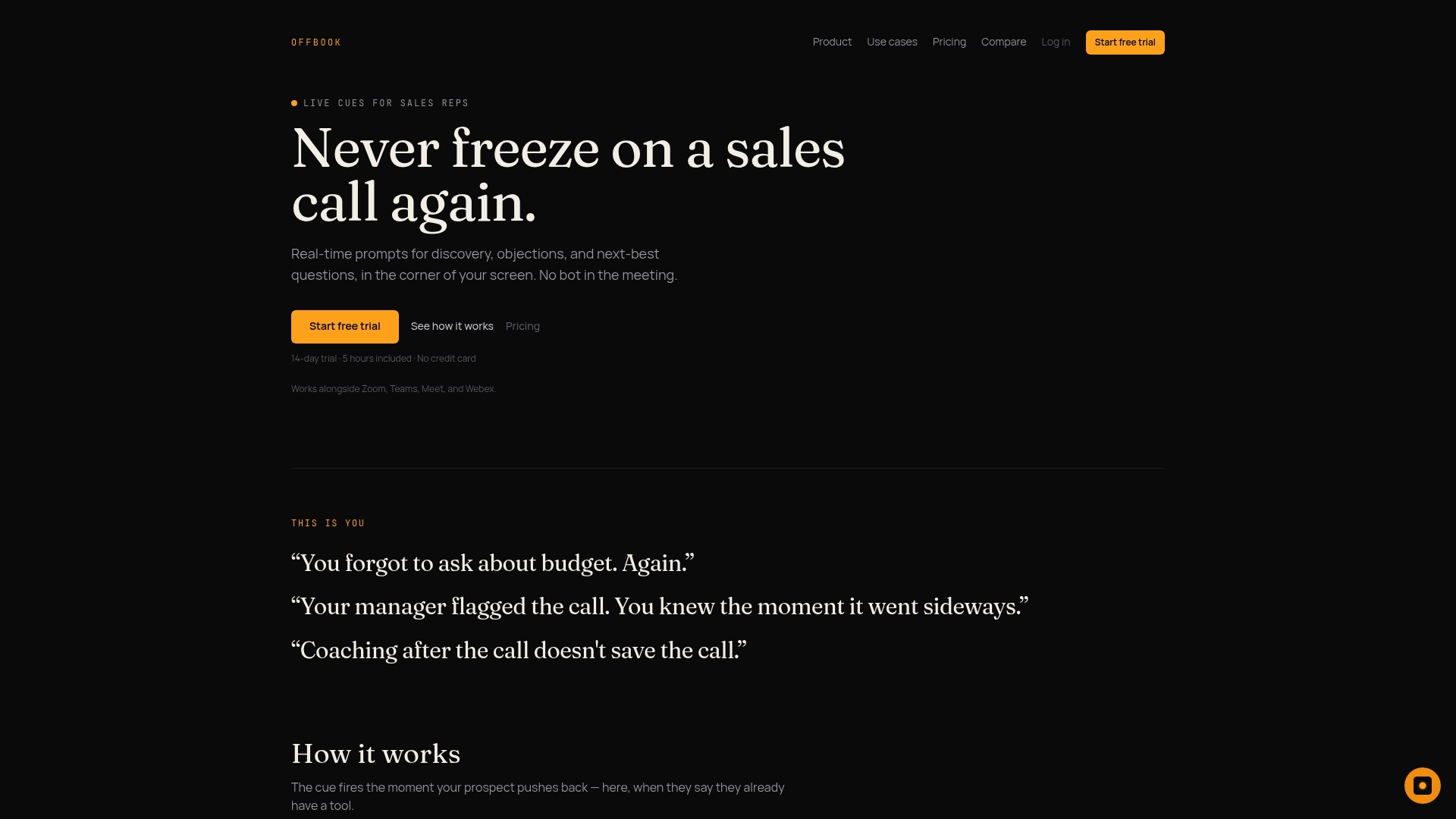
Offbook surfaces live AI cues during video calls without a bot joining the meeting. Reps see on-screen prompts for discovery questions, objection handling, and qualification gaps, all structured around MEDDIC and MEDDPICC. Pre-call briefs prepare reps before they join. Real-time signals guide them through the conversation. The result is more disciplined calls and faster deal progression. If you lead a B2B SaaS sales team and want to see what AI call coaching looks like in practice, Offbook is built for exactly that.
FAQ
What are AI cues in sales?
AI cues are real-time, on-screen prompts that guide sales reps during live calls. They surface the right questions to ask, objections to handle, and qualification gaps to close based on the conversation as it happens.
Which behaviors do AI coaching systems measure?
AI coaching systems score four behaviors: discovery question density, objection acknowledgment, value framing, and close attempts. These four signals predict quota attainment and improve with personalized AI feedback within 12 weeks.
How much time does AI save sales reps each week?
AI reduces prospect research time by 34% and email drafting time by 36%, saving reps an average of 12 hours per week. The impact on revenue depends on how teams reinvest that recovered time.
Why do most AI sales investments underperform?
72% of sales organizations fail to reinvest AI-saved time into high-value activities, according to Gartner. This “productivity paradox” limits revenue impact even when efficiency gains are real.
How quickly does AI sales coaching improve win rates?
Teams that adopt AI coaching consistently see win rate improvements of 22–28% within 90 days. Reps who practice with AI roleplay three times per week show measurable skill gains within a month.