Sales Leaders: 6 Point Pilot to Test CI vs Live Coaching Adoption
An integration first playbook for sales leaders: a 6 point pilot to test conversation intelligence and live coaching adoption, with 60 to 90 day timelines...
Published: October 8, 2026
Author: OffBook Editorial Team

Conversation intelligence and live coaching solve different problems: CI reviews calls after the fact to surface patterns across your whole team, while live coaching changes what a rep says while the buyer is still on the line. Use conversation intelligence to find what good looks like and scale it. Use live coaching when you need to change the outcome of the call happening right now. The two work best together once your playbooks are stable enough to turn into real-time prompts and your team has consented to live capture. A short pilot that tests both the technology and how reps actually adopt it will tell you faster than any vendor demo whether you are ready.
TL;DR:
- Conversation intelligence is best for analyzing call patterns and scaling good behaviors, but it cannot help in real-time objections during a call.
- Live coaching provides immediate guidance within a narrow one-minute window but depends heavily on a mature playbook and accurate timing.
- Successful pilots require reliable call capture, timely prompts, prompts grounded in your methodology, and respect for privacy consent protocols.
- Start with CI if your team’s main issue is inconsistency or forecasting, and introduce live coaching only when the playbook is stable and team readiness exists.
- A typical pilot lasts 60 to 90 days, focusing on cue acceptance, prompt timing, and behavior change, with quick checkpoints to test hypotheses.
Table of Contents
- Conversation intelligence vs live coaching: strengths, limits, and outcomes
- How real-time coaching actually works under the hood
- When to use conversation intelligence, live coaching, or both
- A six-point checklist for piloting either approach
- How an OffBook pilot might be structured in practice
- Why most coaching rollouts fail before the technology does
- Where OffBook fits if you are ready to pilot live coaching
- FAQ
- Sources
Conversation intelligence vs live coaching: strengths, limits, and outcomes
Conversation intelligence and live coaching are often pitched as competing categories, but they answer different questions. CI answers “what happened across hundreds of calls, and what should we teach?” Live coaching answers “what should this rep say in the next 30 seconds?” Gartner’s guidance on conversation intelligence frames this distinction directly: CI captures and analyzes calls across conversations to identify patterns and scale high-performer behaviors, while live coaching helps the rep inside the current call by surfacing the next question or objection response in real time.
That difference shapes what each tool is good at and where it falls short.
- Conversation intelligence excels at scale: it reviews every call, flags talk-time ratios, and builds a library of what top performers do differently, but it cannot help a rep who is fumbling a pricing objection right now.
- Live coaching excels at immediacy: it can hand a rep the right discovery question mid-call, but it depends entirely on the quality of the playbook feeding it, and it adds nothing once the call has ended.
- Coaching coverage improves with CI because managers no longer have to sit in on calls to know what happened; they can review flagged moments instead of full recordings.
- Manager workload shifts rather than disappears: CI reduces time spent listening to calls but adds time spent interpreting dashboards and deciding what to coach next.
A common misconception is that conversation intelligence “coaches” reps. It does not, at least not in the moment. It produces the evidence a manager or an automated system can act on later, or during a future call. Gartner’s research on coaching orchestration recommends treating coaching as an organizational capability rather than a manager-by-manager habit, with CI supplying the evidence layer that makes coaching repeatable across a team instead of dependent on any one manager’s memory or attention. That framing, often described through Gartner’s ORBIT lens, positions CI as the measurement backbone and live coaching as the delivery mechanism, not as two separate purchases competing for the same budget line.
The practical upshot: if your team’s biggest problem is inconsistent behavior that nobody can quantify, start with CI. If your biggest problem is that reps freeze on objections they already know the answer to, live coaching addresses that gap directly, but only if the guidance it delivers is grounded in a playbook worth following.
How real-time coaching actually works under the hood
Both categories rely on overlapping technical building blocks, but live coaching adds constraints that pattern-analysis tools never have to solve. A typical stack includes call capture (audio or video), speech-to-text transcription, speaker identification to separate rep from buyer, natural language processing to classify what is being said, signal detection to flag moments that matter, and CRM writeback so the conversation data lands where a manager will see it.
The hard part is timing. A pattern flagged three days after a call is useful for coaching the next rep. A pattern flagged three minutes too late inside the call is useless, because the moment to act on it has already passed.

Empirical research on this problem identifies an optimal point of about a minute as the best time to intervene during a live conversation, according to multimodal sales coaching research that modeled temporal prediction and rejection across recorded B2B calls. Miss that window and a prompt either arrives too late to change the rep’s next sentence or interrupts a moment that was already going well.
Designing a live-coaching system that respects this window involves a few recurring decisions:
- Keep prompts short. A cue a rep has to read for ten seconds defeats the purpose of a real-time nudge.
- Build escalation rules. Not every signal deserves an on-screen prompt; some should wait for a post-call summary instead.
- Support role-specific profiles. A founder selling enterprise deals needs different cues than an SDR running discovery calls.
- Give reps override authority. A system that cannot be dismissed trains reps to ignore it entirely.
Before piloting any live-coaching tool, verify its privacy and consent model: whether it records audio or video, whether participants are notified, how long data is retained, and whether consent is captured per session or assumed. Our guidance on Zoom recording consent for early-stage teams covers what to check before turning live capture on for the first time.
When to use conversation intelligence, live coaching, or both
The right starting point depends on team maturity, not budget size. Conversation intelligence is the sensible first investment when your main problem is discovery, not delivery: you do not yet know which behaviors separate your best reps from everyone else, you need better forecasting accuracy from call-level signals, or you want a system that surfaces coaching priorities for managers who cannot listen to every call.
Live coaching earns its place when the stakes of a single call are high enough that waiting for a post-call review is too slow. That includes high-stakes product demos where one fumbled technical answer can end a deal, short sales cycles where there is no “next call” to fix a mistake on, and discovery-heavy conversations where missing a qualification question means the deal stalls out later for reasons nobody can trace back to the call.
Most mature teams eventually run both, structured around the call itself:
- Before the call: CI-informed briefs summarize what similar deals needed and flag likely objections.
- During the call: live prompts surface the next question or objection response in real time.
- After the call: automated summaries and CRM updates close the loop without manual note-taking.
Our explainer on real-time sales coaching for startup teams walks through what that combined workflow looks like for a small founder-led sales team specifically.
Pro Tip: Do not introduce live coaching until your playbook is stable enough that a rep would say the same thing twice given the same objection, otherwise the tool has nothing reliable to surface.
Readiness for live coaching shows up as a short list of conditions: documented consent for call capture, a playbook mature enough to encode into prompts, and a measurement plan that defines what success looks like before the pilot starts, not after.
A six-point checklist for piloting either approach
A pilot should be short, specific, and built to fail fast if the tool is not ready. Based on evaluation criteria drawn from field research on human-AI interaction, six things are worth testing in a live workflow before any team-wide rollout:
- Capture reliability: does the tool consistently capture and transcribe calls across different call platforms and network conditions?
- Latency and cue timing: do prompts arrive inside the usable intervention window, or do they lag behind the conversation?
- Relevance and correctness: are the cues actually tied to what the buyer just said, or generic enough to ignore?
- Playbook grounding: do prompts reflect your approved methodology, or a generic sales framework that does not match how your team sells?
- Rep usability: can a rep glance at a cue without it distracting from eye contact or conversational flow?
- Manager visibility and CRM integration: does the data land somewhere a manager can act on it without manually exporting anything?
For a short-cycle pilot, define hypotheses you can test in two to four weeks rather than a quarter: track cue acceptance rate (how often reps act on a prompt), behavior adoption (whether a specific technique shows up more often in later calls), and any shift in call-level win signals like next-step commitment.
- Pair the technical checklist with an adoption plan, not just a feature test.
- Decide in advance who owns the decision to keep or kill the pilot.
Adoption design matters as much as the AI itself. A field experiment published in Management Science found that tailoring human-AI interaction, meaning work procedures, decision authority, training, and incentives, to how individual sellers actually think materially improved performance, while untailored interaction produced negative effects for some sellers. That means the same coaching tool can help one rep and hurt another if the rollout treats every rep identically. Before signing anything, confirm that consent is documented per session, that the vendor can show you where transcripts and audio are stored, and that your CRM integration has been tested with real data, not a demo account.
How an OffBook pilot might be structured in practice

A live-coaching pilot works best when it mirrors the checklist above rather than a generic software rollout. OffBook is built specifically for this use case: it surfaces on-screen cues during video calls without a bot joining the meeting, structured around MEDDIC and MEDDPICC so prompts reflect a qualification framework reps already recognize rather than generic sales advice. It also generates pre-call briefs on the people and companies a rep is about to meet, and produces post-call debriefs so the loop closes without manual notes.
A reasonable 60 to 90 day pilot might look like this:
- Days 1 to 15: Onboard a small cohort of two to four reps, set up role-specific profiles, and confirm consent and recording settings are documented for every participant.
- Days 15 to 45: Track cue acceptance rate, prompt timing against the call, and whether reps report the prompts as distracting or helpful.
- Days 45 to 75: Compare call-level outcomes (next-step commitment, objection resolution) between the pilot cohort and a control group running the same playbook without live prompts.
- Days 75 to 90: Review CRM writeback accuracy and decide whether to expand the rollout or adjust prompt rules.
What matters during that window is less the vendor’s feature list and more whether prompts stay grounded in the approved playbook, arrive inside the usable timing window, and get acted on rather than ignored. Our guide to handling objections on live calls is a useful reference for judging whether a tool’s objection-handling cues reflect sound technique or generic filler.
Why most coaching rollouts fail before the technology does
The failure mode I see most often has nothing to do with whether the AI is accurate. It is that leaders buy a coaching tool the way they buy a CRM: one configuration, rolled out to everyone at once, measured by adoption rate instead of outcome. Field evidence on tailoring human-AI interaction suggests that approach actively backfires for some reps, because a prompt style that helps a methodical closer can distract a reactive one.
The fix is not more features. It is treating the rollout itself as the experiment: small cohorts, clear decision authority over what counts as success, and training that acknowledges reps will use the tool differently. Before signing a contract, require three things: a pilot cohort small enough to monitor weekly, a documented consent and data-retention policy, and a kill criterion you agree on before the data starts coming in.
— Neil
Where OffBook fits if you are ready to pilot live coaching
If your playbook is stable and your team has agreed to consented call capture, OffBook gives founder-led B2B SaaS teams at the seed and Series A stage a way to put MEDDIC and MEDDPICC prompts in front of reps during the call itself, not in a report three days later. Pre-call briefs mean reps walk in knowing who they are talking to, and post-call debriefs close the loop without someone writing notes by hand.
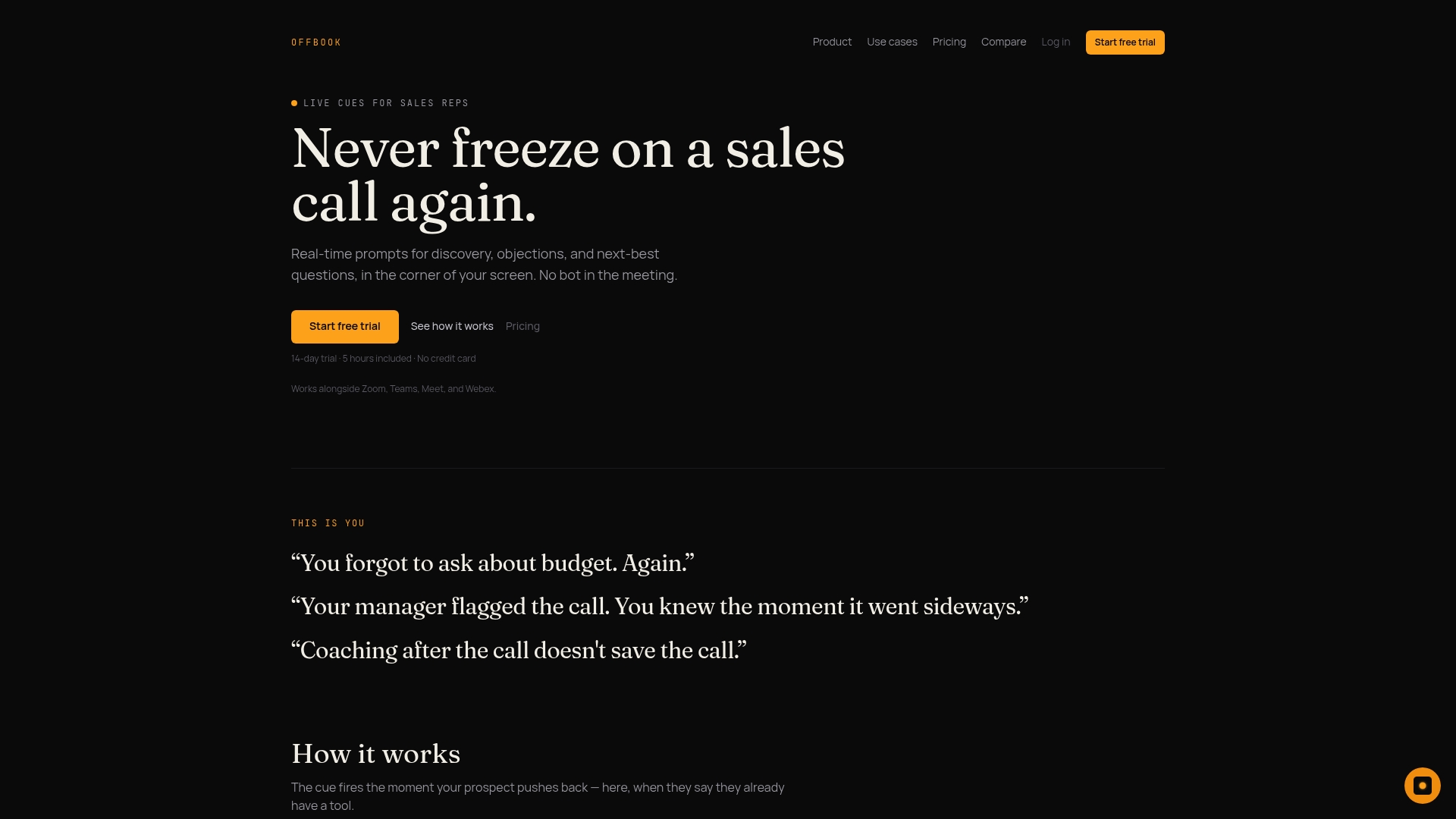
Capabilities relevant to a pilot like the one described above include:
- Real-time, on-screen cues during video calls with no bot joining the meeting.
- Pre-call briefs on the people and companies a rep is about to meet.
- Methodology-aligned prompts built around MEDDIC and MEDDPICC rather than generic scripts.
- Privacy defaults built around explicit per-session consent.
Plans start at $59 per month or $590 per year on the Power plan, with a Team plan at $1,000 per year per seat for larger rollouts. Run the six-point checklist from this article against a small cohort before committing to a full rollout.
FAQ
Will coaching be replaced by AI?
No single source supports a full replacement claim, and the research points the other way: field experiment evidence shows tailoring human–AI interaction to users’ cognitive preferences materially improves sales performance, while untailored interaction produced negative effects. Manager involvement still shapes how reps interpret and act on AI-generated coaching, according to research comparing AI and manager coaching.
What does coaching conversation mean?
A coaching conversation refers to an exchange, live or reviewed afterward, where a rep receives specific feedback or guidance meant to change how they handle a similar situation next time. In sales, that can mean a manager reviewing a recorded call or a live system surfacing a prompt during the call itself.
What is the difference between conversation intelligence and live coaching?
Conversation intelligence analyzes calls after they happen to find patterns across a team, while live coaching surfaces guidance during the call itself so a rep can act on it immediately, according to Gartner’s guidance on conversation intelligence. They address different moments in the sales process rather than competing for the same job.
How long should a live-coaching pilot run?
A focused pilot can run 60 to 90 days with a small cohort, long enough to measure cue acceptance, prompt timing, and behavior change without committing an entire team. Shorter two to four week checkpoints inside that window let you test specific hypotheses, like whether reps act on objection-handling cues, before expanding further.
Does live coaching work on every type of sales call?
Live coaching tends to add the most value on high-stakes or discovery-heavy calls where a missed question or mishandled objection has an outsized effect on the outcome, as opposed to routine check-ins. Empirical research on real-time coaching design identifies a roughly 60-second intervention window as optimal, which matters more in fast-moving, high-stakes conversations than in low-pressure ones.
Sources
- Improve Seller Performance Using Conversation Intelligence
- Human-Centered Artificial Intelligence: A Field Experiment | Management Science
- AI-assisted sales coaching framework: Empirically-derived models for B2B communication analysis