How to Handle Objections on Live Sales Calls
Learn how to handle objections on live sales calls effectively. Master strategies that boost your closing rates and turn hesitations into sales.
Published: July 5, 2026
Author: OffBook Editorial Team

Objection handling on live sales calls is the real-time skill of recognizing, diagnosing, and responding to buyer hesitations to advance a deal toward closure. Most B2B reps treat objections as stop signs. The best reps treat them as diagnostic signals. Sales teams with structured objection handling training see 4.2x higher win rates than those without. That gap is not about personality or charisma. It is about method. This article breaks down the frameworks, pricing tactics, and live call techniques that separate reps who close from reps who cave.
How to handle objections on live sales calls: the core skill
Objection handling, known in sales methodology as “objection resolution,” is a structured discipline, not an improvised reaction. The distinction matters because improvised responses tend to be defensive, rushed, or discount-heavy. Structured responses are calm, diagnostic, and value-focused.
The most common objection types in B2B sales fall into four categories:
- Price: “It’s too expensive” or “We don’t have budget.”
- Authority: “I need to check with my manager” or “This isn’t my decision alone.”
- Timing: “Let’s revisit this next quarter.”
- Product fit: “I’m not sure this solves our specific problem.”
Each category has a different root cause. A rep who hears “too expensive” and immediately discounts has misread the signal. Most pricing objections mask an anchor problem, a value gap, an authority issue, or a timing constraint. Diagnosing which one is happening before responding is the difference between protecting margin and giving it away.
Surface statements rarely tell the full story. A prospect who says “the timing isn’t right” may actually be uncertain about internal buy-in. A prospect who says “it’s not in the budget” may not have the authority to approve spend at all. Active listening techniques that surface the real concern are the foundation of every effective response.

What does a step-by-step objection handling framework look like?
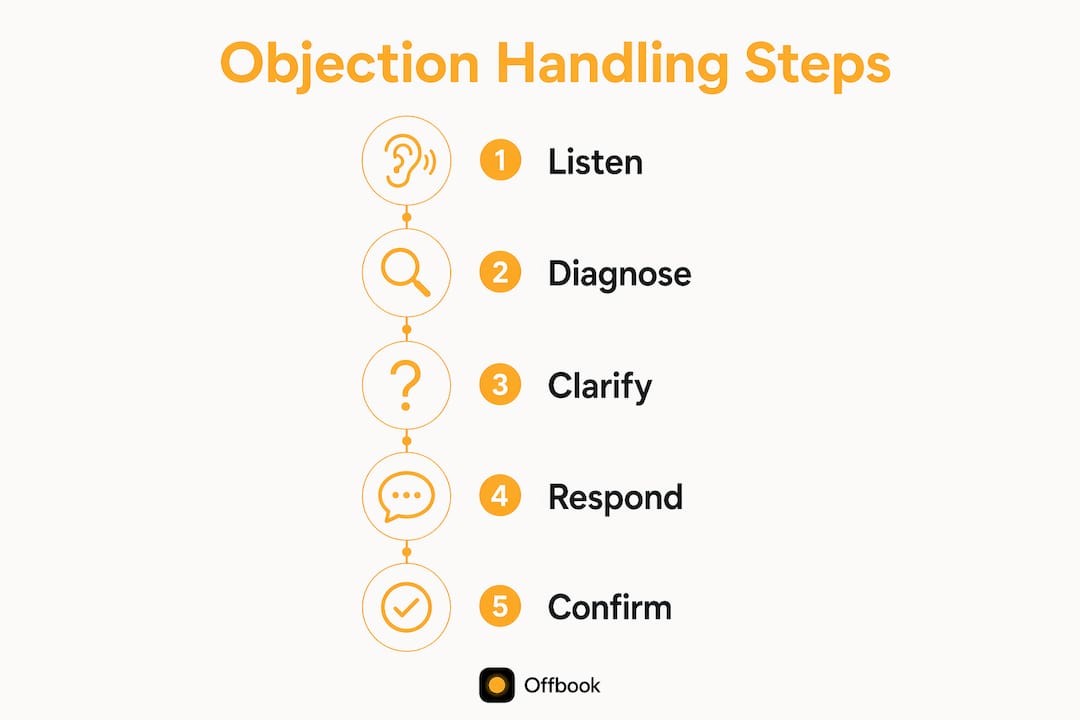
The most effective live call objection framework runs in five steps. Each step builds on the last, and skipping any one of them typically collapses the conversation.
-
Use a pattern interrupt early. Early knee-jerk objections on cold or discovery calls are not real barriers. They are reflexes. A brief acknowledgment followed by a request for 30 seconds to explain resets the frame and advances nearly all prospects past the initial pushback.
-
Ask calm, diagnostic questions. Once the prospect is engaged, ask open questions that reveal the real concern. “What specifically is making you hesitant?” or “Help me understand what’s driving that concern” are far more productive than defending your product.
-
Isolate the objection type. Before responding, confirm you have identified the right barrier. The question “Setting price aside for a moment, if cost were not an issue, is this the right solution?” resets price objections and reveals whether the real issue is fit, authority, or timing.
-
Reframe around outcomes and ROI. Once you know the true concern, link your response to business outcomes the prospect cares about. Translate price into per-outcome or per-day terms. “That’s $X per day to eliminate a problem that costs you $Y per week” anchors value concretely.
-
Confirm agreement and close the loop. After reframing, confirm the prospect’s concern has been addressed. “Does that answer what you were worried about?” followed by a clear next step keeps the deal moving.
Pro Tip: Slow down deliberately after an objection lands. Calm, measured responses outperform rushed rebuttals by a wide margin. Delivery style carries as much weight as the words themselves.
How to handle pricing objections without discounting
Price objections are the most common and the most mishandled objections in B2B sales. The instinct to discount is understandable. It feels like it removes the barrier. It does not. Reflexive discounting damages pricing power permanently and signals to the buyer that your initial price was inflated.
The better approach starts with a question, not a concession. When a prospect says “Can you do better on price?”, the most effective response is calm curiosity: “Out of curiosity, what number did you have in mind?” This single question shifts control back to the rep and forces the prospect to anchor first.
“Prospects testing price are not asking for a lower number. They are seeking emotional reassurance and confirmation that the value is real and that you believe in it. A rep who holds firm with confidence signals that the product is worth what it costs.” — The Revenue Coaches
When a discount is genuinely necessary to close, trade it for a concession. Longer contract terms, a case study, a referral introduction, or an expanded scope all preserve the integrity of your pricing model. Discounts given without negotiation destroy pricing integrity and teach buyers to expect lower prices in every future renewal.
The four-question diagnostic for price objections:
- “Compared to what?” Reveals whether the prospect is comparing to a competitor, an internal budget, or a prior vendor.
- “What’s the cost of not solving this?” Anchors the conversation to business impact rather than software spend.
- “Who else needs to be involved in this decision?” Surfaces authority issues hiding behind a price objection.
- “If we could structure this differently, what would work for you?” Opens the door to trade concessions without cutting price.
Pro Tip: Enable your internal champion with ROI math and a clear one-page summary they can share internally. Multi-threading buyers this way accelerates internal approval and removes objections before they reach the next call.
What mistakes do reps make when handling live objections?
The most damaging mistake in live objection handling is the reflexive discount. It feels like progress. It is actually a concession made before understanding the real problem. Once a rep discounts without negotiation, the buyer learns that pushing back always works.
The second most common error is arguing. When a prospect says “your competitor is cheaper,” the worst response is a feature comparison delivered defensively. Buyers do not change their minds because a rep out-argued them. They change their minds because a rep helped them see the problem differently.
Other patterns that kill deals:
- Interrupting the buyer mid-objection. Cutting off a prospect before they finish signals that you are more interested in your rebuttal than their concern. Let them finish. Then pause.
- Rushing to fill silence. Silence after an objection feels uncomfortable. Reps who rush to fill it often say too much and undermine their own position.
- Treating every objection as a closing barrier. Some objections are requests for more information. Responding to them as if they are final rejections creates unnecessary friction.
Recovery is straightforward when you catch yourself in one of these patterns. Restate the buyer’s concern in your own words: “So if I’m hearing you correctly, the concern is X.” This resets the conversation and demonstrates that you were listening. Then return to the diagnostic questions before offering any response.
Handling tough calls requires emotional control above all else. A rep who stays calm when a prospect pushes hard holds far more credibility than one who gets rattled. Recognizing when to pause, slow down, or even respectfully walk away preserves the relationship for a future conversation.
Pro Tip: Review your common B2B objections before every call cycle. Reps who anticipate objections in advance respond with far more confidence than those who encounter them cold.
Key Takeaways
Structured objection handling, not improvisation, is the defining skill that separates high-win-rate B2B reps from average performers.
| Point | Details |
|---|---|
| Diagnose before responding | Identify the root cause (anchor, value gap, authority, timing) before offering any rebuttal. |
| Use pattern interrupts early | A brief acknowledgment and 30-second request advances prospects past knee-jerk objections. |
| Never discount without a trade | Concede terms, scope, or case studies instead of cutting price to protect margin. |
| Slow down your delivery | Calm, measured responses outperform rushed rebuttals and signal confidence to buyers. |
| Isolate the real barrier | Ask “Setting price aside, is this the right solution?” to reveal what is truly blocking the deal. |
The mindset shift that actually moves the needle in 2026
Most objection handling advice focuses on scripts. I think that is the wrong frame entirely. Scripts give reps a false sense of preparation. The moment a prospect goes off-script, the rep freezes or falls back on discounting. What actually works is behavioral diagnosis: reading the type of objection, understanding the emotional state behind it, and responding to that, not to the surface statement.
The reps I see closing the hardest deals in 2026 are not the ones with the best rebuttals. They are the ones who stay genuinely curious when a prospect pushes back. Curiosity keeps the conversation open. Defensiveness closes it.
The rise of pre-call AI coaching tools has changed the preparation side of this equation significantly. Reps who walk into calls having already anticipated the three most likely objections for that specific buyer respond with a calm that looks like confidence. It is not natural talent. It is preparation made visible. Offbook’s AI coaching surfaces live cues during calls, so reps get that same grounded response even when a conversation goes somewhere unexpected.
The uncomfortable truth is that most objections are not about the product at all. They are about trust. A rep who handles a price objection without flinching, without apologizing, and without immediately offering a discount communicates something important: this product is worth what it costs, and I believe that. That confidence is what closes deals. No script required.
— Neil
Real-time coaching that prepares you for every objection
Knowing the framework is one thing. Executing it live, under pressure, in the middle of a real conversation, is another challenge entirely.
Offbook is built for exactly that gap. It listens to your sales calls in real time and surfaces on-screen prompts when an objection lands, without a bot joining the meeting or disrupting the conversation. Reps get live cues aligned to MEDDIC and MEDDPICC, so they know which diagnostic question to ask next, which value reframe fits the moment, and when to isolate versus when to close. Offbook also generates pre-call briefs so reps walk in having already anticipated the objections most likely to come up. If you want to handle objections live with the same confidence every time, Offbook gives you the structure to do it.
FAQ
What is objection handling in B2B sales?
Objection handling is the structured process of recognizing, diagnosing, and responding to buyer hesitations during a sales call to advance the deal. It differs from improvised rebuttals in that it follows a diagnostic framework rather than a reactive script.
How do I handle a price objection without discounting?
Ask “Out of curiosity, what number did you have in mind?” to shift control, then diagnose whether the objection is about anchor, value, authority, or timing before offering any response. Trade concessions like longer terms or case studies instead of cutting price.
What is a pattern interrupt in sales calls?
A pattern interrupt is a brief acknowledgment of an early objection followed by a request for 30 seconds to continue. It resets the prospect’s reflexive pushback and keeps the conversation moving forward.
Why do reps freeze when handling objections live?
Reps freeze because they encounter objections they did not anticipate and have no prepared diagnostic response. Pre-call preparation and real-time AI coaching reduce freeze moments by surfacing the right response at the right moment.
How does the isolate question work for pricing objections?
The isolate question, “Setting price aside, if cost were not an issue, is this the right solution?”, separates the price concern from product fit. If the prospect says yes, the real barrier is price alone. If they hesitate, a deeper concern about fit or authority is present.