Challenger Sale Questions: Exact Scripts to Reframe Pain Lists
Find Challenger sale question examples, exact scripts, and when to use them across the six stages of Commercial Insight choreography for complex B2B deals.
Published: October 17, 2026
Author: OffBook Editorial Team

Challenger sale questions are teach- and verification-focused prompts that validate or reshape a buyer’s assumptions and move complex deals forward. They skip the long discovery interview and use open, assumption-testing phrasing, verifiers, and Powerful Requests to create constructive tension. Below you get categorized, ready-to-use examples, exact phrasing templates, and rules for when to use each one live.
TL;DR:
- Use open verifiers after the Reframe, journey questions before proposals, and reframe testers when buyers insist they already know what they need.
- Request data, stakeholder access, or a workflow session; an owner and date signal commitment, while vague promises or rescheduling suggest the deal is not ready.
- After an open question, pause and let the buyer answer; if tension rises too far, acknowledge the framing and ask what you may be missing.
- Tailor questions to each stakeholder: economic buyers weigh cost and risk, champions need an internal case, technical buyers assess fit, and procurement manages review.
Table of Contents
- 1. How Challenger question strategy differs from traditional discovery
- 2. Types of Challenger questions with categorized examples
- 3. How to build a Commercial Insight with paired verification questions
- 4. Powerful Requests and engagement tests
- 5. Using questions in live calls: timing, silence, and recalibration
- 6. Tailoring questions for different stakeholders
- 7. Scripts, mini-templates, and objection-handling prompts
- 8. Why you should rehearse these questions and log what happens
- 9. Practice and prompt these questions live with real-time coaching
- FAQ
- Sources
1. How Challenger question strategy differs from traditional discovery
Traditional discovery asks a buyer to list pains and then waits for the rep to pitch against them. Challenger flips the order: you lead with an insight, then use questions to check it against the buyer’s reality. The frame is a six-step Commercial Insight choreography that runs through these stages:
- The Warmer: show you understand the buyer’s world.
- The Reframe: reveal a problem they underestimate or misread.
- Rational Drowning: quantify the cost of the status quo.
- Emotional Impact: make it personal for the people in the room.
- A New Way: describe what solving it looks like.
- Your Solution: connect that path to what we can deliver.
Questions do their work inside this frame, mostly during the Reframe and Rational Drowning steps. Their job is to let the buyer confirm, correct, or push back on your insight.
That pushback is the point. Constructive tension is a deliberate technique that uses open-ended, thought-provoking questions instead of closed yes/no discovery to compel buyers to re-evaluate assumptions. A closed question gets a fast “no” and a dead end. An open one forces a buyer to articulate reasoning they may never have examined.
Compare the phrasing:
- Poor: “Are you having trouble with forecasting accuracy?”
- Challenger: “How do you currently handle forecast misses when pipeline stages mean different things to different managers?”
- Poor: “Is cost a concern?”
- Challenger: “What would happen if you kept absorbing that cost every quarter?”
If you want to see which habits to drop, our breakdown of weak discovery questions and how to fix them shows more before-and-after pairs. For deal-size context, we also compare when to run SPIN versus Challenger on bigger SaaS deals.
2. Types of Challenger questions with categorized examples
Use these as literal scripts. Swap the bracketed placeholders for your buyer’s specifics. Each group maps to a moment in the choreography.
Commercially Insightful Verifiers
Commercially Insightful Verifiers are open-ended, assumption-framing questions that let the buyer confirm or correct your insight rather than shutting down the conversation. Use them right after the Reframe.
- “We see [type of company] teams struggle with [problem] because [underlying cause]. How does that compare to what you see?”
- “How do you currently deal with [X] in the context of [Y]?”
- “Where does that picture differ from how your team works today?”
- “What are we missing about how [process] runs on your side?”
- “Is that a pattern you’ve seen internally, or is it new?”
Buying Journey Verifiers
These find out where the buyer is in the process and who else shapes the decision. Use them once the insight lands and before you invest in a custom proposal.
- “Who else has been looking at this problem with you?”
- “What have you already tried, and what did you learn from it?”
- “How did [initiative] get on the priority list this quarter?”
- “When a purchase like this comes up, how does your team usually decide?”
- “Who would need to see this before it could move forward?”
- “What happens if nothing changes?”
For buyers who arrive with a vendor shortlist already formed, Challenger’s guidance on informed buyers suggests two probes: “Why do you believe that’s what you need?” and “What did you do to arrive at that conclusion?” Those surface the buyer’s rationale and open a path to a productive reframe, with the goal of pushing the process back to zero so every stakeholder grasps the scope of the problem.
Powerful Requests
A Powerful Request asks for something concrete: data, access, or a commitment. It tests seriousness better than any “how interested are you?” question. We cover these in depth in their own section below, but the core forms are:
- “Could you share [metric] so we can calculate what this costs you?”
- “Can we get [stakeholder] on a call?”
- “Would you walk me through [workflow] on screen so we can map where it breaks?”
Prompting questions and reframe-testers
Use these when the buyer is anchored on a narrow view of the problem.
- “If [common fix] worked, what would your numbers look like?”
- “What would have to be true for this to stop being a priority?”
- “If you could change one thing about how [team] handles [process], what would it be and why hasn’t it changed?”
- “What do you think happens to peers who keep doing it this way?”
- “How would you explain this problem to your CFO?”
Quick-pick guide
Pair the group with the moment: verifiers after the Reframe, journey questions before proposals, Powerful Requests during Rational Drowning, and reframe-testers whenever the buyer says “we already know what we need.” If you want a deeper primer on sequencing, see the role of questions in sales calls and how discovery questions work to close more B2B deals.

3. How to build a Commercial Insight with paired verification questions
An insight is only as good as the questions that test it. Here is a sequence you can build before any call.
- Draft the Warmer. Open with one benchmark or fact that proves you know the buyer’s domain. One is enough. Three reads like a lecture.
- Write a concise Reframe. State a problem the buyer likely misunderstands or underweights. Keep it concise, and make it something your company can actually solve.
- Pair it with verifiers. Ask a question that checks whether the problem exists for them, and another that probes the cause.
- Attach a Powerful Request. Ask for the data point that lets you quantify the problem in the next step.
Here is a sample build for a SaaS forecasting product:
- Warmer: “Teams at your stage usually have more pipeline than they can reliably forecast.”
- Reframe: “The issue is rarely volume. It is that stage definitions drift, so two managers can call the same deal by different names.”
- Verifier one: “How does that compare to what you see on your side?”
- Verifier two: “When a forecast misses, where does the explanation usually land?”
- Powerful Request: “Could you pull your forecast against actuals so we can size the gap?”
One caution on sourcing the insight itself: identifying a teachable insight is typically an organizational job. Jill Konrath notes that reps need marketing and enablement support so they avoid teaching problems the company cannot solve, or ones competitors solve better. If you are building a revenue process around this, a partner like Digital Visibility Concepts works on aligning revenue strategy with the marketing side.
Pro Tip: Write the Reframe on one index card. If you cannot say it concisely, it contains too many ideas, and the buyer may hear neither.
4. Powerful Requests and engagement tests
A Powerful Request is a specific ask that costs the buyer a little effort and tells you a lot about their commitment. It saves time on stalled deals because it replaces guessing with evidence. Challenger practitioners prioritize them, for example asking for internal data to calculate the cost of the current problem. A buyer who will not provide the data or take a step is signaling the deal may not be ready to progress.
Sample requests by type:
- Data: “Can you export [metric] by [segment]?”
- Timeline: “If we confirm the numbers, can we schedule time with finance?”
- Stakeholder access: “Would you introduce us to whoever owns [process] day to day?”
- Working session: “Could we walk through your current workflow together?”
Observable signals that a buyer is serious:
- They send the data, or tell you exactly who owns it and when it will arrive.
- They volunteer names of other stakeholders without being asked.
- They push back with specifics, not brush-offs.
- They propose their own next step and date.
Signals that they are not:
- “I’ll see what I can find,” with no owner and no date.
- Repeated rescheduling of the same working session.
- Refusal to name anyone else involved.
Reframing a stalled deal: a buyer unwilling to hand over data or take a modest step is telling you the deal may not be ready, according to Challenger’s own question guidance. Treat that as information, not rejection.
Once the data arrives, it feeds Rational Drowning: you use the buyer’s own numbers to show what the current approach costs.
5. Using questions in live calls: timing, silence, and recalibration
Good questions fail on bad timing. Use this order as a working map:
- After the Warmer: hold the first verifier until the buyer has reacted. Do not stack it onto your own statement.
- After the Reframe: ask your verifier, then stop talking.
- During Rational Drowning: ask for the number, then let the buyer do the math out loud.
- Before Emotional Impact: ask who feels the problem most, and let the buyer name them.
- At A New Way: test the buyer’s reaction with a prompting question, not a feature summary.
- Before your solution: confirm the buyer agrees on the problem’s scope.
Silence is a tool. After an open question, pause before speaking again. Buyers often fill the gap with the answer they would not have volunteered. Watch for verbal cues (hedging, “well, actually”) and for nonverbal ones on video (looking away, a pause before replying). A pause usually means they are thinking, not that you failed.
Dial tension up or down. Constructive tension is productive only while the buyer stays engaged. If a question lands too hard, pull back with a line like:
- “I may have framed that too sharply. Let me ask it differently: what would you want that process to do?”
- “That’s fair. Help me understand what I’m missing.”
- “Let’s step back. What matters most to you here?”
The Challenger stance is to steer the buying process toward the Commercial Insight while remaining professional and empathetic. Recalibrating is part of that, not a retreat from it.
Pro Tip: Mark your highest-risk questions in your call notes. Rehearse a pull-back line for each, so you are not improvising when the room gets cold.
6. Tailoring questions for different stakeholders
One insight, different audiences. Change the metric and the emotional frame, not the underlying message. Rational and emotional levers both matter: Shortform’s summary of effective Challenger practice describes benchmarks and numbers for rational drowning, and narrative and empathy for emotional impact.
- Economic buyer: cares about cost, risk, and payback. Ask: “What does this problem cost you each quarter, and what would a fix need to return to be worth it?”
- Champion: cares about credibility and winning internally. Ask: “What would you need from us to make the case to your leadership?”
- Technical buyer: cares about fit, integration, and workload. Ask: “Where does the current workflow break, and what would you not want a new tool to touch?”
- Procurement: cares about terms and comparability. Ask: “What does your review process look like, and what documents do you need early?”
| Stakeholder | What they value | Sample metric to use |
|---|---|---|
| Economic buyer | Cost and risk | Quarterly cost of the status quo |
| Champion | Internal credibility | Outcome they can present to leadership |
| Technical buyer | Fit and effort | Hours lost to the current workflow |
| Procurement | Terms and process | Time to complete vendor review |
Before a call, run a short tailoring checklist:
- Who is in the room, and which of the four roles do they play?
- What metric does each one care about?
- Which verifier fits each role?
- What is my Powerful Request, and who can fulfill it?
7. Scripts, mini-templates, and objection-handling prompts
Copy these and swap in your own details.
- Forecasting script. “Teams at your stage often find stage definitions drift between managers [Reframe]. How does that compare to what you see [verifier]? Could you pull your forecast against actuals so we can size the gap [Powerful Request]?”
- Onboarding script. “New reps tend to ramp slower when call prep is inconsistent. How do you currently prepare for first calls? If we looked at your recent calls, what would we find? Can you share recordings or notes?”
- Informed buyer script. “It sounds like you’ve done real research. Why do you believe that’s what you need? What did you do to arrive at that conclusion? Would you be open to a session mapping it against your current numbers?”
- Stalled deal script. “Last time we agreed to look at [data]. What got in the way? Is this still a priority, or has something else taken its place?”
Snappy comebacks that return the conversation to evidence:
- “We’re fine as we are.” → “Good. What would the numbers need to show for that to stop being true?”
- “Send me something to read.” → “Happy to. What would you hope it answers, so I send the right piece?”
- “Not a priority right now.” → “What would make it one?”
Log every response. A buyer’s exact words become your follow-up ask and your Rational Drowning inputs. To generate more response options quickly, try our free objection handler.
8. Why you should rehearse these questions and log what happens
Many reps read lists like this and then fall back into old habits. The questions only stick when you rehearse them aloud and record what buyers actually say. Pick questions for each call, write down the responses, and review the pattern regularly. Then add another question.

Live feedback speeds this up, because it shows you the moment you skipped a verifier or filled a silence too early. A coach, a manager, or software that prompts you in the moment all work. The risk is practicing alone and reinforcing a flawed version of the question.
Rehearse the pull-back lines as hard as the opening ones. A well-timed recalibration is what keeps constructive tension productive.
— Neil
9. Practice and prompt these questions live with real-time coaching
We built OffBook so reps do not have to remember what to ask mid-call. We listen to your video call and surface on-screen cues for questions and qualification gaps without joining the meeting as a bot, structured around methodologies like MEDDIC and MEDDPICC.
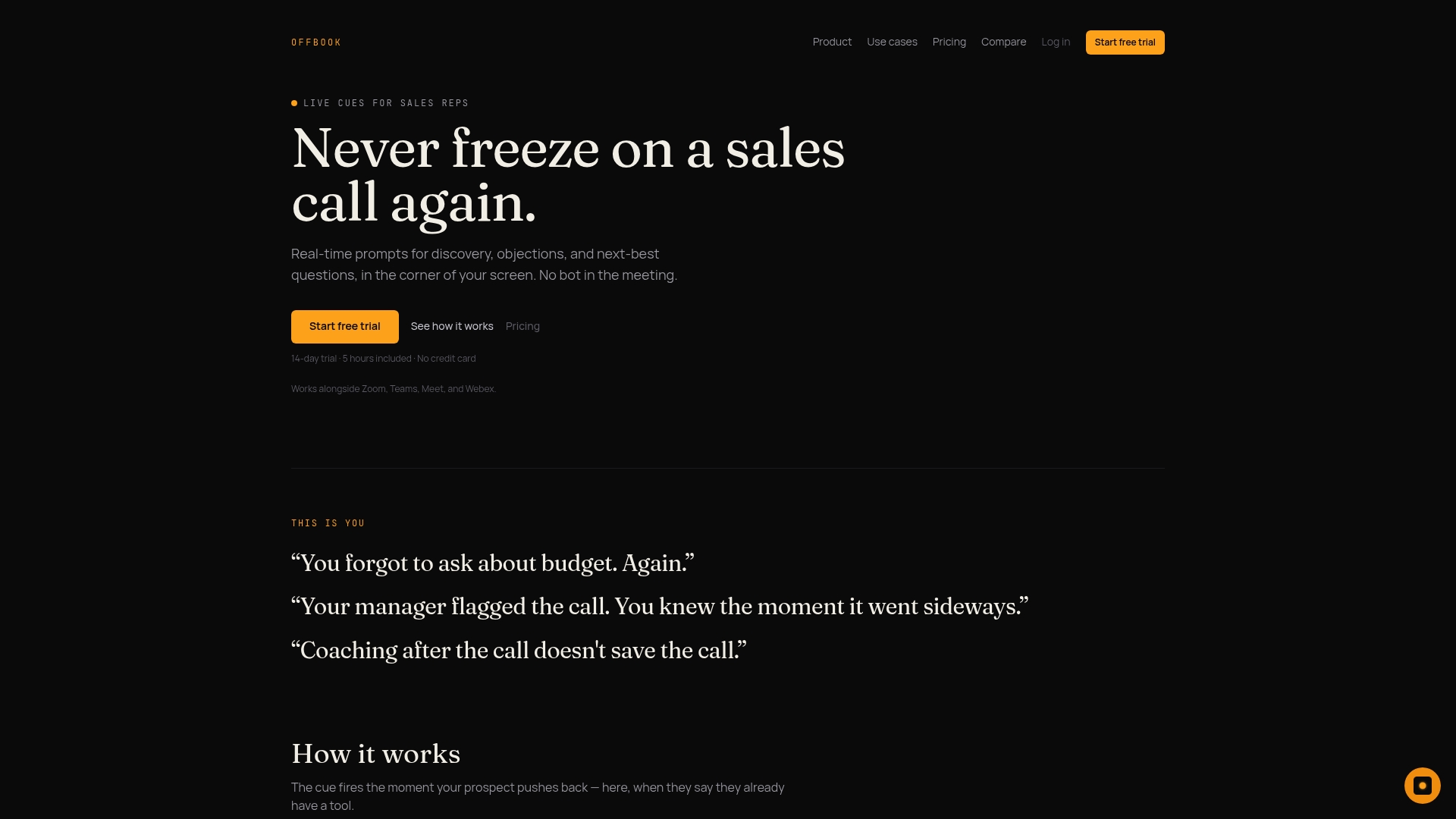
- We prompt the next question at the right moment, so you spend less effort recalling the script.
- We prepare pre-call briefs on the people and companies you are about to meet.
- We write instant debriefs and follow-up drafts after the call.
If you are ramping new reps or running a complex deal team, our Power plan is $59 per month, and you can see how AI call coaching for sales works before you commit.
FAQ
What are good sales questions?
Good sales questions are open-ended and tied to the buyer’s actual situation. They invite the buyer to explain reasoning rather than answer yes or no. Challenger’s guidance on constructive tension favors open, thought-provoking questions for this reason.
What is a challenger salesperson?
A challenger salesperson teaches the buyer something new, tailors the message to each stakeholder, and takes control of the buying process. Brent Adamson describes this as Teach, Tailor, and Take Control, while staying professional and empathetic.
What are Commercially Insightful Verifiers?
They are open-ended questions that let the buyer confirm or correct your insight, such as “How do you currently deal with X in the context of Y?” Challenger practitioners use them in place of closed discovery questions that shut the conversation down.
How do I question a buyer who has already done their research?
Ask why they believe that is what they need and what they did to reach that conclusion. Challenger recommends these probes to surface the buyer’s rationale and open a path for a reframe.