The Role of Questions in Sales Calls: A Proven Guide
Discover the vital role of questions in sales calls. Master strategic questioning to boost your closing rate and build buyer trust.
Published: June 19, 2026
Author: OffBook Editorial Team

Questions are the primary driver of sales call outcomes. Reps who ask structured, well-timed questions close 40% more deals than those who lead with pitches. The role of questions in sales calls goes far beyond gathering information. Strategic questioning, the formal term used in methodologies like Question-Based Selling and MEDDPICC, controls the conversation, builds buyer trust, and creates the conditions for a prospect to sell themselves. Data from over 519,000 B2B sales calls confirms this. The difference between won and lost deals often comes down to how many questions were asked, when they were asked, and how well the rep listened to the answers.
What role do questions play in sales calls?
Strategic questioning in sales is defined as the deliberate use of questions to uncover buyer needs, qualify opportunities, and guide prospects toward a decision. This is not the same as running through a checklist. The best reps use questions as a tool to control the direction of a conversation without the buyer feeling led.
Applying frameworks like MEDDPICC reduces average sales cycle length by 20–35% and limits deal ghosting. That result comes directly from asking better discovery questions about decision-making, budget authority, and implementation timelines. Reps who skip this structured approach tend to chase deals that were never real.

The importance of questions in sales also shows up in buyer psychology. When a prospect answers a question, they commit to a position. That commitment builds momentum toward a decision. A rep who pitches first removes that dynamic entirely and puts the buyer in a passive, evaluative role rather than an active, engaged one.
What types of questions are most effective during sales calls?
Four question categories cover the full arc of a productive sales call. Each serves a different purpose and works best at a specific point in the conversation.
| Question type | Purpose | Best timing |
|---|---|---|
| Probing questions | Uncover situation, pain, and root cause | Early discovery |
| Value-based questions | Quantify impact and urgency | Mid-call |
| Solution-focused questions | Align outcomes to your offering | Late discovery |
| Closed-ended confirmation | Validate understanding and next steps | End of call |
Probing questions dig beneath the surface. “What does your current process look like, and where does it break down?” forces the prospect to articulate a problem in their own words. That articulation is more persuasive than anything you could say. Probing ladders help reps peel beneath surface problems to root causes, which is where real buying urgency lives.
Value-based questions shift the conversation from problem to cost. “What does that issue cost you per quarter?” or “How many deals have you lost because of this?” forces the buyer to calculate the pain themselves. That number becomes your anchor for the rest of the call.
Solution-focused questions are where you begin to align. “If you could eliminate that bottleneck, what would that change for your team?” lets the prospect describe the outcome they want. You are not pitching. You are letting them describe your solution in their own language.
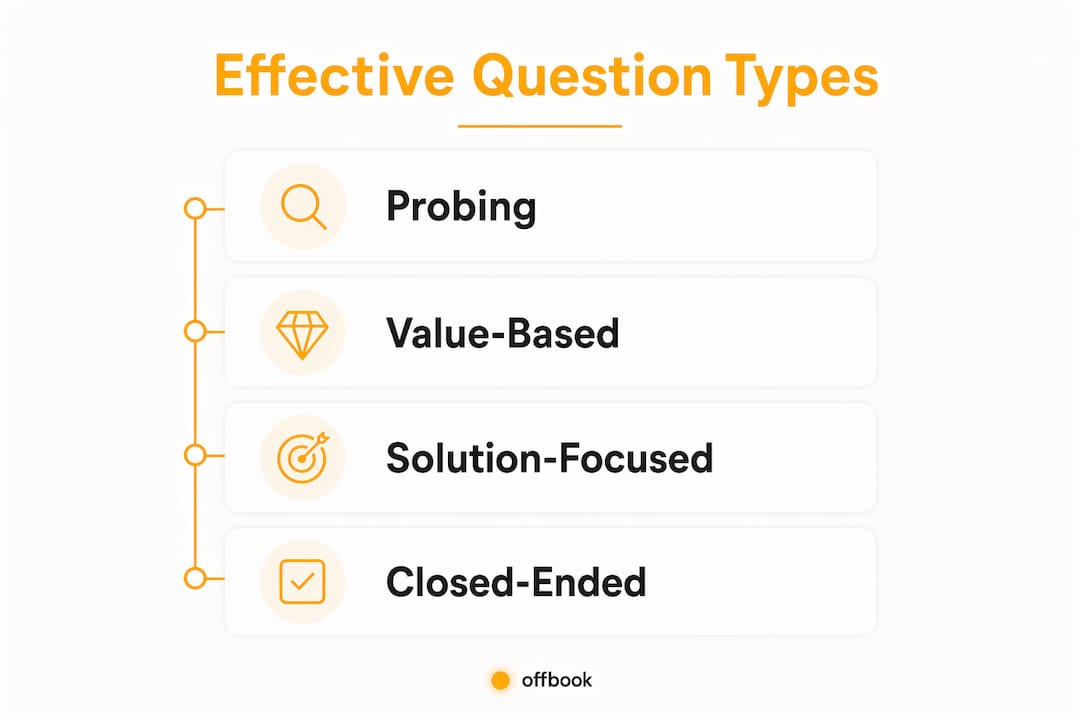
Closed-ended confirmation questions lock in shared understanding. “So the decision needs to happen before Q3, correct?” These prevent misalignment later and signal to the buyer that you are organized and trustworthy.
Pro Tip: Never ask two question types back to back without letting the prospect fully answer the first. Stacking questions signals impatience and kills the trust you just built.
How many questions should you ask, and when?
The optimal number of questions per discovery call is 11–14. Fewer than that and you miss critical nuances. More than 15 and the call starts to feel like an interrogation, which lowers win rates. Lost deals in that same dataset averaged around 20 questions. Won deals averaged 15–16. More questions do not mean better discovery.
Timing matters as much as volume. Average reps front-load their questions, firing most of them in the first ten minutes and then shifting into pitch mode. Top performers do the opposite. They spread questions evenly throughout the call, which keeps the buyer engaged and allows new information to surface naturally as the conversation develops.
Here is a practical distribution model for a 45-minute discovery call:
- Minutes 1–10: Two to three situational questions to establish context and rapport.
- Minutes 10–25: Four to five probing questions to identify pain, urgency, and impact.
- Minutes 25–35: Three to four value-based and solution-focused questions to quantify and align.
- Minutes 35–45: Two confirmation questions to validate next steps and decision criteria.
The follow-up question is the most underused technique in this entire framework. Follow-ups starting with “You just said…” signal active listening and force the prospect to elaborate on the exact point you need to understand. “You just said your team loses about two hours a day to this. Can you walk me through what that looks like?” That one sentence does more work than three new questions.
Pro Tip: Track your talk-to-listen ratio. Reps who let buyers speak more consistently outscore those who dominate the conversation. Aim for 40% talking, 60% listening on discovery calls.
Why is question quality more important than quantity?
Question quality determines whether a conversation builds trust or erodes it. The Question-Based Selling methodology, developed by Thomas Freese, is built on one core principle: questions are strategic tools that control the conversation and build credibility before you earn the right to probe deeper. You do not start with hard qualification questions. You earn your way into them.
The most common mistake reps make is shifting to solution mode too early. Jumping to solutions too quickly reduces trust and signals that you are more interested in closing than in understanding. The Sandler “reversing” technique addresses this directly. When a prospect asks “Can your product do X?”, a weak rep says yes and starts pitching. A strong rep says “That’s a great question. What’s driving that need for you?” The conversation stays on the buyer’s problem, not your solution.
Guiding questions are another high-quality technique that most reps never use. These are questions where the seller already knows the answer but asks them to lead the buyer to their own realization. “How much time does your team spend on manual reporting each week?” You know the answer is too much. The buyer saying it out loud makes it real for them in a way that your telling them never could.
“Discovery is not a phase. It is a continuous dialogue that runs through the entire call. The moment you stop asking questions, you start losing the deal.”
The practical implication is that discovery should be continuous dialogue, not a segmented block at the start of a call followed by a pitch. Reps who treat discovery as a checklist to complete miss the insights that only surface when a buyer feels genuinely heard.
Pro Tip: Before every call, write down three things you already know about the prospect’s situation and three things you need to find out. This forces you to design questions with purpose rather than improvising.
How to apply effective questioning techniques in your sales calls
Preparation is where effective questioning starts. Walking into a call without planned questions is the equivalent of a surgeon improvising the procedure. Use your pre-call preparation to map your questions against the MEDDPICC framework: Metrics, Economic Buyer, Decision Criteria, Decision Process, Paper Process, Identify Pain, Champion, and Competition. Each element has a corresponding question category.
Here is a practical approach to building your question flow:
-
Research first. Review the prospect’s LinkedIn, recent press releases, and company financials before the call. Your questions should reflect that you already know the basics. “I saw you expanded into the enterprise segment last quarter. How has that changed your sales process?” is far more effective than “Tell me about your company.”
-
Sequence by trust level. Start with situational questions that are easy to answer. Move to problem questions once the prospect is comfortable. Save impact and implication questions for after you have established rapport.
-
Use storytelling as a bridge. Storytelling combined with structured questioning boosts engagement significantly. Share a brief story about a similar customer before asking a parallel question. “We worked with a team that had the same challenge. They told us it was costing them about $200,000 a year. Is that in the range of what you’re seeing?”
-
Avoid rapid-fire questioning. Asking three questions in a row without pausing for answers is one of the fastest ways to lose a prospect’s trust. Ask one question. Wait. Let silence do its work.
-
Debrief your questions after every call. Which questions generated the most insight? Which ones fell flat? Reviewing your call quality patterns over time is how you build a question library that actually works for your specific buyer personas.
Real-time coaching tools now make it possible to get in-the-moment guidance on which questions to ask next, based on what the buyer just said. That kind of support closes the gap between knowing the framework and executing it under pressure.
Key takeaways
Strategic questioning is the single most reliable lever for improving close rates on B2B sales calls.
| Point | Details |
|---|---|
| Optimal question volume | Ask 11–14 questions per discovery call; more than 15 lowers win rates. |
| Spread questions evenly | Distribute questions throughout the call, not just at the start. |
| Follow-up questions win | “You just said…” follow-ups are the highest-impact, most underused technique. |
| Quality beats quantity | Guiding and reversing questions build more trust than rapid-fire probing. |
| Prepare before every call | Map questions to MEDDPICC criteria using prospect research before the call starts. |
The shift I had to make to actually get this right
I spent the first few years of my sales career believing that a great pitch was the goal. Questions were just the warm-up. That belief cost me deals I should have won. The shift happened when I started tracking my talk time and realized I was speaking for 70% of most calls. The prospect was barely involved. No wonder my close rate was stuck.
The change was not about asking more questions. It was about asking better ones and then actually shutting up long enough to hear the answer. The “You just said…” follow-up was the single technique that changed my numbers the fastest. It forced me to listen instead of planning my next move while the buyer was still talking.
What I have also learned is that questions need to be customized to the buyer persona, not just the product. A CFO needs value-based questions about financial impact. A VP of Engineering needs problem questions about technical debt and team capacity. Using the same question flow for every call is a shortcut that costs you the deal.
The reps I have seen improve the fastest are the ones who treat every call as a data point. They review what worked, cut what did not, and refine their question library over time. That is not a talent. It is a discipline.
— Neil
How Offbook helps you ask the right questions in real time
Knowing the right questions to ask is one thing. Remembering to ask them under pressure, in the middle of a live conversation, is another problem entirely.
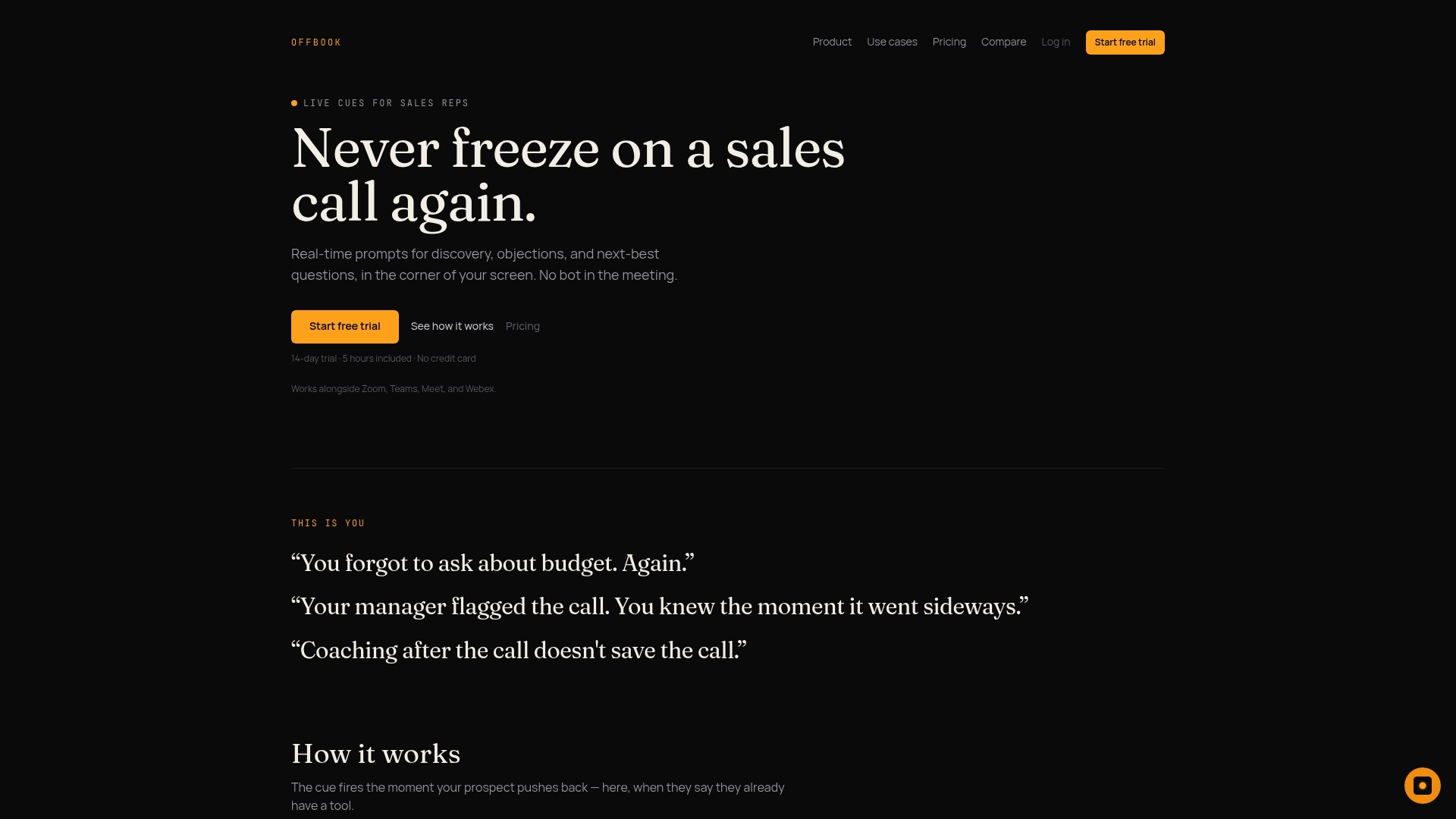
Offbook is built for exactly that moment. It listens to your sales calls in real time and surfaces live prompts on your screen, showing you which questions to ask next based on what the buyer just said, which MEDDPICC gaps you have not covered, and which objections need handling. No bot joins the meeting. No one on the other end knows it is there. If you want to see how AI call coaching changes the quality of your discovery calls, Offbook is the tool built for B2B SaaS teams at the seed and Series A stage who need to run more disciplined calls and close more deals.
FAQ
What is the ideal number of questions to ask on a sales call?
The optimal range is 11–14 questions per discovery call. Analysis of over 519,000 B2B sales calls shows that won deals average 15–16 questions while lost deals average around 20.
What are the most effective types of questions to ask in sales calls?
Probing, value-based, solution-focused, and closed-ended confirmation questions each serve a distinct purpose. The most underused type is the follow-up question, which starts with “You just said…” and forces the prospect to elaborate on critical pain points.
Why is jumping to solutions too early a problem in sales?
Shifting to solution mode too quickly reduces buyer trust and signals that the rep is more focused on closing than understanding. Staying in question mode longer keeps the conversation centered on the buyer’s needs.
How does MEDDPICC improve sales questioning?
MEDDPICC gives reps a structured framework for which questions to ask across Metrics, Economic Buyer, Decision Criteria, and other deal dimensions. Teams using this framework reduce sales cycle length by 20–35% and experience fewer deals going dark.
How can AI tools improve questioning on sales calls?
AI call coaching tools like Offbook surface real-time question prompts during live calls, helping reps stay on framework without breaking the flow of conversation. This closes the gap between knowing the right questions and actually asking them when it counts.