Weak Discovery Questions: Examples and How to Fix Them
Discover the pitfalls of weak discovery questions in sales. Learn effective replacements with our examples of weak discovery questions and improve your...
Published: May 29, 2026
Author: OffBook Editorial Team

Weak discovery questions are questions that fail to surface genuine buyer needs because they are generic, leading, or answerable by a 30-second Google search. In B2B SaaS sales, where deals hinge on understanding real business pain, internal politics, and financial urgency, these questions don’t just waste call time. They actively mislead you into thinking you understand a prospect when you don’t. This article breaks down the most common examples of weak discovery questions, explains exactly why they fail, and shows you how to replace them with layered, behavior-focused questions that actually move deals forward.
1. Examples of weak discovery questions every rep should recognize
The industry term for this category of questioning failure is “shallow discovery.” It describes any line of questioning that stays at the surface level and never reaches the business impact, internal drivers, or political urgency that actually close deals. Here are the most common offenders.
- “Can you tell me about your business?” This is the most common example of a poor discovery question. The answer is on the company’s website. Asking it signals you didn’t prepare, and asking questions answerable from LinkedIn wastes call time while damaging your credibility instantly.
- “Are you the decision maker?” This question insults the person sitting across from you. It implies their role is in question and forces a binary answer that rarely reflects how B2B buying committees actually work.
- “Do you need this feature?” Leading questions like this steer prospects toward a yes rather than revealing what they actually need. You get confirmation bias, not insight.
- “What do you want?” Direct preference questions invite socially desirable answers. Prospects tell you what sounds reasonable, not what’s true. Behavioral signals like current tools and workarounds reveal far more than stated preferences ever will.
- “What are your goals, challenges, and budget?” Compound questions confuse prospects and produce incomplete answers. Compound questions prompt incomplete responses, leaving you uncertain about what information you actually captured.
- “Is price a concern for you?” This is a leading yes/no question that tells you almost nothing. Every prospect will say yes. The real question is what they’re currently spending, on what, and what outcome they expect for that investment.
- “Would you say your current process is inefficient?” Loaded framing like this produces agreement, not truth. Prospects rarely push back on a question that implies they should have a problem.
Pro Tip: Before your next call, run every planned question through one filter: could a prospect answer this from your company’s own website or their LinkedIn page? If yes, cut it.
2. Why weak discovery questions undermine sales success

Shallow questions produce shallow data. When you don’t understand the real business impact of a prospect’s problem, you can’t build a compelling case for change. You end up pitching features to someone who hasn’t yet connected those features to a cost, a risk, or a missed opportunity they care about.
Simon Hazeldine’s “Questioning Gap” framework describes this precisely. Most reps stop at Situation questions and never reach Impact or Drivers. Situation questions tell you what exists. Impact questions reveal what it costs. Driver questions expose what’s forcing action now. Without the last two layers, you’re qualifying on surface criteria and missing the urgency that actually closes deals.
Quota pressure makes this worse. When a rep is behind on their number, they unconsciously shift from truth-seeking questions to steering questions. They ask “Does that sound like something you’d find valuable?” instead of “What would have to be true for you to prioritize this?” The first question gets a polite yes. The second gets a real answer.
“The biggest danger is not just asking too few questions but asking the wrong kind under quota pressure, leading to misleading yes answers instead of truthful exposure of needs.” — GTM Club, citing Gong research
Buyer perception matters too. Prospects in B2B SaaS are sophisticated. They’ve been through dozens of discovery calls. When a rep asks something generic or uninformed, the buyer mentally categorizes that rep as unprepared. That perception is almost impossible to reverse within the same call.
3. How to recognize and avoid ineffective questioning techniques
Recognizing bad discovery queries in your own process requires a structured self-audit. Here’s a practical framework for replacing weak questions with stronger ones.
- Map your questions to the Situation, Impact, Driver framework. If every question on your call plan sits in the Situation layer, you’re set up for shallow discovery. Layering from Situation to Impact to Drivers is the structural fix, not simply asking more questions.
- Audit for Googleability. Any question whose answer lives on the prospect’s website or Crunchbase profile should be cut from your call and answered in your pre-call brief instead.
- Replace yes/no questions with behavior-eliciting questions. “Do you use a CRM?” becomes “Walk me through how your team currently tracks pipeline.” The second version reveals process, tool usage, and gaps simultaneously.
- Spread questions across the call. Top reps spread questions evenly and use follow-ups like “You just mentioned X, can you elaborate?” rather than front-loading all questions into the first ten minutes.
- Limit compound questions. One question at a time. If you find yourself using “and” or “also” mid-question, stop and split it.
- Use active listening to generate follow-ups. The best follow-up questions come directly from what the prospect just said. This signals attention and produces the kind of layered insight that scripted questions never reach.
Pro Tip: Record yourself on three calls and count how many of your questions are yes/no versus open-ended. Most reps are shocked by the ratio.
4. Weak vs. strong questions: a side-by-side comparison
The fastest way to improve your discovery is to see the contrast directly. The table below shows common weak question examples alongside stronger alternatives and explains why the reframe works.
| Weak question | Why it fails | Stronger alternative | Why it works |
|---|---|---|---|
| “Are you the decision maker?” | Binary, insulting, ignores committee buying | “Who else will be involved in evaluating this?” | Reveals stakeholder map and political dynamics |
| “Can you tell me about your business?” | Answerable by Google, signals poor prep | “What’s driving your team’s focus for the next two quarters?” | Surfaces current priorities and urgency |
| “Do you need this feature?” | Leading, produces confirmation bias | “How does your team currently handle [specific workflow]?” | Reveals actual behavior and gaps |
| “What do you want?” | Invites socially desirable, not truthful answers | “What have you already tried to solve this, and what happened?” | Exposes real attempts, failures, and stakes |
| “Is price a concern?” | Every prospect says yes, tells you nothing | “What are you currently spending on this problem, and what’s that getting you?” | Reveals budget reality and ROI expectations |
The pattern across every stronger alternative is the same. Open-ended, behavior-focused questions that reference what the prospect is actually doing today produce richer, more honest answers. Exploring challenges, impact, goals, and budget with open-ended questions is the standard that separates top performers from average ones.
5. When weak questions slip in and how to course-correct
Even experienced reps fall into weak questioning patterns. These are the most common situations where it happens and how to recover.
- Quota pressure at month-end. When you’re behind, you unconsciously ask steering questions to manufacture urgency. Recognize the shift and deliberately slow down. Ask one open-ended question and wait through the silence.
- Over-reliance on a script. Rigid scripts and surface-level questioning produce weak qualification. If you’re reading from a list, you’re not listening. Treat your call plan as a guide, not a script.
- Shallow or guarded answers. When a prospect gives a one-sentence answer, don’t move on. Respond with “Tell me more about that” or “What does that look like in practice?” Guarded answers are almost always a signal that the question was too closed or too generic.
- Poor pre-call preparation. Many weak questions exist because the rep didn’t research the company before the call. Use pre-call briefs to answer the Googleable questions in advance so your call time goes toward Impact and Driver questions instead.
- Coaching team members on question quality. If you’re leading a team, build a call quality scoring system that explicitly grades question type and depth. Reps improve faster when they see their question patterns scored objectively.
The optimal window for discovery questions is between 11 and 14 per call, based on analysis of 519,000 B2B SaaS sales calls. Fewer than 11 misses critical nuance. More than 14 makes prospects feel interrogated. That’s a narrow target, which means every question has to earn its place.
Key takeaways
Weak discovery questions fail because they produce surface-level data that cannot reveal the business impact, internal urgency, or stakeholder dynamics that drive B2B buying decisions.
| Point | Details |
|---|---|
| Shallow questions stall deals | Generic or leading questions yield biased answers that create false confidence in your qualification. |
| Structure beats volume | Layering Situation, Impact, and Driver questions produces more insight than simply asking more questions. |
| Prep eliminates weak openers | Answering Googleable questions before the call frees your time for high-value Impact and Driver questions. |
| Optimal question count matters | Analysis of 519,000 calls shows 11 to 14 questions per call is the window that balances depth and rapport. |
| Behavior questions beat preference questions | Asking what prospects have tried and what happened reveals real needs better than asking what they want. |
The uncomfortable truth about discovery most reps won’t admit
I’ve reviewed hundreds of discovery calls across B2B SaaS teams, and the pattern is consistent. The weakest questions don’t come from inexperienced reps. They come from experienced reps who stopped being curious. They’ve heard the same answers enough times that they start asking questions they already know the answer to, just to check a box.
The real fix isn’t a better question list. It’s rebuilding the habit of genuine curiosity on every call. When I work with founders running their own sales, the discovery is often better precisely because they don’t have a script. They actually want to understand the problem. That curiosity produces follow-up questions that no playbook would generate.
The reps I’ve seen improve fastest are the ones who treat layered discovery techniques as a skill to practice, not a process to execute. They record calls, count their question types, and ask themselves after every call: “What did I learn that I couldn’t have found on their website?” If the answer is “not much,” the questions were weak.
The other thing worth saying directly: quota pressure is the single biggest driver of poor discovery questions. When you need the deal, you ask questions designed to get a yes, not questions designed to find the truth. That’s how you end up with pipeline full of deals that stall in late stages because the discovery was never real. Slow down in discovery. The time you spend asking better questions is the time that saves you three months of a stalled deal.
— Neil
How Offbook helps you ask better questions in real time
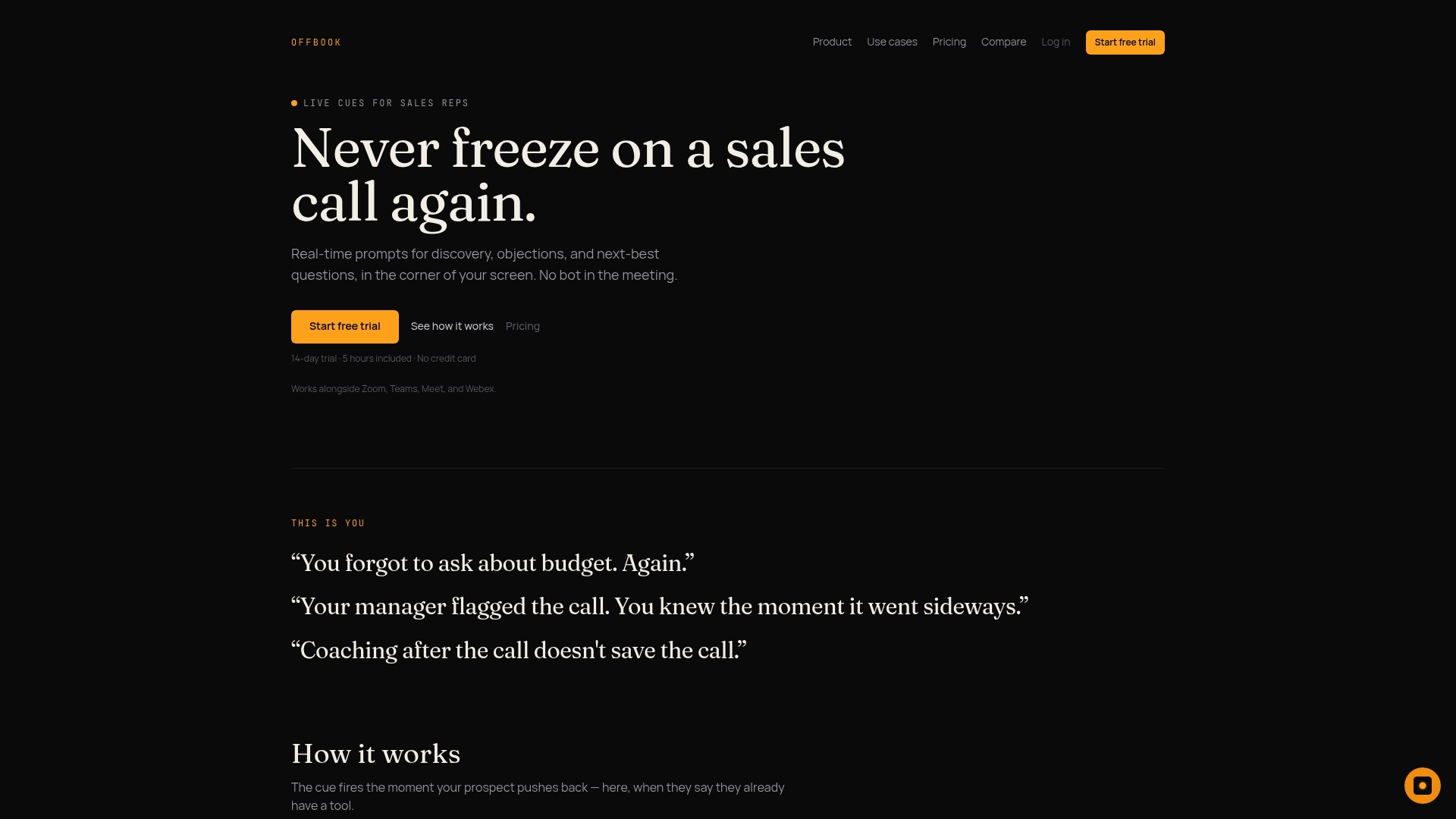
Offbook is built for exactly the moment when weak questions slip in. During live video calls, Offbook surfaces on-screen prompts that guide reps toward the right question for the moment, whether that’s an Impact question they skipped, a qualification gap in MEDDIC, or a follow-up the buyer’s last answer clearly called for. It does this without a bot joining the meeting, so the conversation stays natural. For founders and early-stage B2B SaaS teams running AI-powered sales coaching, Offbook also generates pre-call briefs so you walk in having already answered the Googleable questions. That means your call time goes where it matters. You can also explore coaching built for founders who are running discovery themselves and want to sharpen their questioning discipline fast.
FAQ
What are weak discovery questions?
Weak discovery questions are questions that fail to uncover genuine buyer needs because they are generic, leading, binary, or answerable through basic research. They produce surface-level or biased answers that leave critical qualification gaps.
How many discovery questions should I ask per call?
Analysis of 519,000 B2B SaaS sales calls shows the optimal range is 11 to 14 questions per call. Fewer than 11 misses important nuance, while more than 14 makes prospects feel interrogated and reduces conversion.
Why do leading questions hurt discovery?
Leading questions steer prospects toward a predetermined answer, typically a yes, rather than revealing their actual situation. This produces confirmation bias instead of genuine insight, which leads to false qualification and deals that stall later.
How do I replace weak questions with stronger ones?
Replace yes/no and preference questions with behavior-eliciting, open-ended questions. Ask what prospects have tried, what happened, and what it cost them. Use the Situation, Impact, Driver framework to ensure your questions reach beyond surface-level facts.
What causes reps to ask weak discovery questions?
The two most common causes are poor pre-call preparation and quota pressure. Under-prepared reps ask questions the prospect’s website could answer. Reps under pressure ask steering questions designed to get a yes rather than find the truth.