43% Conversion Gain Study: Call Recording vs Note Taking for Seed SaaS
Evidence-first look for Seed and Series A B2B SaaS: why live coaching during calls outperformed recordings and notes in a study (43.2% conversion lift)...
Published: October 6, 2026
Author: OffBook Editorial Team

For early-stage B2B SaaS teams, real-time in-call AI coaching tends to beat call recording plus post-call note taking when the goal is faster conversion lift on high-value calls. The core advantage is behavioral: live prompts change what a rep does mid-conversation, while notes and recordings only inform what happens next time. Privacy and consent still need deliberate handling, and a short pilot with clear KPIs is the fastest way to confirm the fit for your team.
TL;DR:
- Live in-call AI coaching can increase conversion rates by providing real-time prompts that directly influence caller behavior and qualification during high-value calls.
- Recording and note-taking support compliance, training, and dispute resolution but cannot impact ongoing calls as live coaching does, requiring separate management and privacy considerations.
- Reinforcement-learning systems modeling conversations as decision processes have shown a 43.2% increase in conversions, but pilot validation is essential as results vary by industry and context.
- Regulatory and privacy requirements demand explicit consent and careful data handling, especially since live coaching listens during calls, unlike recordings that are stored and reviewed later.
- Early-stage teams should prioritize live coaching for high-stakes calls and use recordings for training and compliance, integrating both approaches for comprehensive support and legal security.
Table of Contents
- Pros and cons: live in-call AI coaching vs post-call recording and note taking
- What the research says about conversion impact and safe deployment
- How to decide for your team: a concise decision framework
- Implementation checklist for a compliant pilot of real-time coaching
- What is call recording, exactly?
- Legal and compliance considerations for call recording and note taking
- Best practices for effective note taking during calls
- Technical requirements and tools for call recording and note taking
- Impact on customer experience and trust
- Author perspective: practical caveats and when to keep both workflows
- OffBook: real-time sales coaching that matches this decision
- FAQ
- Sources
Pros and cons: live in-call AI coaching vs post-call recording and note taking
Each method solves a different problem, and the right choice depends on whether you want to change the call happening right now or build a record to learn from later.
Live in-call AI coaching works because it intervenes while the deal is still live:
- It surfaces objection responses and qualification gaps while the rep can still act on them.
- It can generate pre-call briefs on the people and company a rep is about to meet.
- It prompts reps through structured frameworks like MEDDIC and MEDDPICC in the moment, rather than in a retrospective review.
- It compresses the skill-transfer loop, since reps practice the right move instead of just hearing about it later.
Call recording and note taking still earn their place. A full archive supports compliance audits, onboarding libraries, and dispute resolution in ways a live prompt never will. The trade-off is timing: by the time a manager reviews a recording, the call that needed help is already over.
Pro Tip: Treat recordings as your training archive and live coaching as your in-the-moment lever. They solve different problems, not the same one twice.
The operational costs differ too. Recording systems need storage, retention policies, and someone to actually review the tape, which eats manager bandwidth. Live coaching needs integration with your meeting platform and a clear consent process, since it listens to the conversation as it happens. Both raise privacy questions, but they raise different ones: a recording is a persistent record that can be subpoenaed, leaked, or mishandled long after the call ends, while live coaching’s exposure window is the call itself, provided the system is built with per-session consent and does not require a bot to visibly join the meeting.
A system built for real-time, in-call guidance is a different animal from a system built to produce a transcript, and the privacy architecture should reflect that difference.
What the research says about conversion impact and safe deployment
The strongest evidence for live coaching comes from reinforcement-learning research rather than generic chatbot add-ons. A reinforcement-learning approach to real-time sales guidance, described in the SalesRLAgent study, reported a 43.2% increase in conversion rates when used in evaluated sales deployments, modeling the conversation as a sequential decision problem rather than a one-shot summary task.
Related work on algorithmic stopping agents found that real-time guidance also saves time: a preprint on stopping agents for sales decision support found that algorithmic real-time guidance significantly reduced time spent on unsuccessful calls in field analysis, by recommending that reps quit low-probability calls earlier without ever interacting with the prospect.
Reinforcement learning approaches that model conversation as a sequential decision problem outperform generic LLM-based systems for conversion prediction and real-time guidance.
That evidence comes with real caveats:
- Results reflect specific study conditions, not a guarantee for every sales motion or industry.
- Fairness and bias audits matter before scaling any real-time system across a full team.
- Field validation through your own pilot is still the only way to confirm impact in your context.
On governance, the NIST Generative AI Profile recommends formal acceptable-use policies, documented human-AI configuration oversight, and feedback and recourse mechanisms for teams deploying generative AI systems. That framework is worth adopting before a live coaching tool touches a single customer call.
How to decide for your team: a concise decision framework
Start with four axes, not a gut feeling:
- Value per call. High-value discovery and demo calls justify live intervention more than low-stakes check-ins.
- Call cadence. Reps running several discovery or demo calls a week generate enough reps for live coaching to compound into measurable skill gains.
- Regulatory sensitivity. Highly regulated sectors need a documented consent and retention policy before any live listening tool touches a call.
- Manager bandwidth. Teams without time to review recordings get more leverage from a system that coaches automatically, in the moment.
Pro Tip: If your reps make fewer than two or three discovery or demo calls a week, a lightweight note-taking habit may deliver more value than standing up a live coaching pilot.
Before committing, ask your vendor and your own team a short set of questions: How is consent captured and logged? Does the system require a bot to join the meeting, or does it listen without a visible presence? What latency should reps expect between a prospect’s statement and an on-screen prompt? Who has admin visibility into flagged calls, and can a manager intervene or override a prompt?
Track a small set of KPIs during any pilot: conversion rate on coached versus uncoached calls, average call duration, rep adoption rate, and downstream revenue from coached deals. If those numbers move in the right direction within a few weeks, you have your answer.
Implementation checklist for a compliant pilot of real-time coaching
A pilot works best when it is small, time-boxed, and measured against a clear baseline.
- Align stakeholders on goals, then draft an acceptable-use policy following NIST’s governance guidance before any call is coached.
- Write clear consent language for prospects and reps, covering what is heard, stored, and shown on-screen; our guide to Zoom recording consent walks through the configuration steps.
- Integrate the tool with your meeting platform and configure role-specific profiles and MEDDIC or MEDDPICC prompts.
- Test audio reliability across the headsets and connections your reps actually use.
- Run the pilot with a coached group and a comparison group over two to four weeks.
- Review results against your baseline, gather rep feedback, and decide whether to iterate or scale.
A few habits keep the pilot honest:
- Log consent for every call, not just the first one.
- Set a firm data retention window before the pilot starts, not after.
- Review flagged edge cases with a human, not just the dashboard.
What is call recording, exactly?
Call recording is the practice of capturing audio, and sometimes video, of a sales or customer conversation for later playback. It has existed in some form since analog phone systems, and modern versions are usually built into video conferencing tools, dialers, or dedicated call recording software that stores files in the cloud.
The output of a recording is static: a timestamped file that a manager, rep, or auditor can replay after the fact. Teams pair recordings with transcription and note-taking tools to make them searchable, which turns a raw audio file into text that can be scanned for keywords, objections, or coaching moments.
Recording’s value is archival. It gives you a durable record for compliance, a training library for new hires, and a dispute-resolution tool when a customer disagrees about what was said. What it does not give you is influence over the call that was just recorded. The rep already said what they said, handled the objection the way they handled it, and the deal moved forward or stalled before anyone reviewed the tape. That gap between capture and action is the central limitation recording carries into any conversation about improving live sales performance.
Legal and compliance considerations for call recording and note taking
Recording a call without the right consent can create real legal exposure, and the rules are not uniform. Many jurisdictions require only one party to consent to a recording, while others require every participant’s consent, and the applicable rule often depends on where each participant is located, not just where your company is based. Our guide to call recording consent laws breaks down what to check before you record a single call.
Note taking carries fewer consent requirements since it does not capture verbatim audio, but it still touches data privacy obligations once notes include personal details about a prospect or customer, particularly in regulated industries like healthcare or finance.
Live in-call coaching sits closer to recording than to note taking from a compliance standpoint, because it listens to the conversation as it happens. The safer designs handle this with explicit per-session consent and by avoiding a visible bot joining the meeting, which reduces the footprint of what is captured and who can see it. Whichever approach you choose, document retention periods, who can access the data, and how a customer can request deletion. The NIST Generative AI Profile frames this as a feedback and recourse mechanism: customers and reps should have a documented way to raise concerns about how their conversation data is used.

Best practices for effective note taking during calls
Good notes capture decisions and commitments, not a transcript. Write down the prospect’s stated pain point in their own words, the specific objection raised, and the next step both sides agreed to, rather than a blow-by-blow account of the conversation.
A few habits separate useful notes from a pile of unreadable scribbles:
- Use a consistent template for every call, such as pain, budget, authority, timeline, next step.
- Capture direct quotes on pricing objections or technical requirements, since paraphrasing often loses the detail that matters later.
- Log the note within minutes of the call ending, before memory fades.
Manager coaching research reinforces this: the GROW model summarized by Google Re:Work emphasizes active listening and open questions as the foundation of useful feedback, which means notes are most valuable when they capture what the prospect actually said, not the rep’s own interpretation of how the call went.
For teams that want notes without the manual effort, our free meeting notes generator produces a structured summary after the call ends, which works well as a complement to live coaching rather than a replacement for it.
Technical requirements and tools for call recording and note taking
Call recording needs a capture point, usually your video conferencing platform’s native recorder or a third-party dialer integration, plus cloud storage with a defined retention policy and access controls. Transcription typically runs as a separate layer on top of the raw audio, converting it into searchable text.
Note taking has a lower technical bar: a shared CRM field, a dedicated notes app, or a structured template in a shared document is often enough. The friction usually comes from adoption, not infrastructure, since reps skip note taking when it feels like extra work layered on top of selling.
Live in-call coaching has the highest technical requirements of the three. It needs a reliable audio feed from the meeting platform, low enough latency that prompts appear while they are still useful, and integration with your CRM so pre-call briefs and post-call debriefs sync automatically. CRM integration also matters for reporting: pairing a coaching tool with your existing CRM automation setup, as outlined in this overview of CRM automation examples, makes it easier to tie coached calls back to pipeline movement. Admin controls matter too, since someone on your team needs visibility into which calls were coached, what was flagged, and how data is retained.

Impact on customer experience and trust
Prospects notice when a call feels scripted, but they also notice when a rep fumbles a question they should have been ready for. Live coaching aims at the second problem: a rep who gets a well-timed prompt on a qualification gap often sounds more prepared, not less natural, because the prompt is invisible to the person on the other end of the call.
Recording and note taking affect trust differently. A visible recording notice can make some prospects more guarded, particularly in sensitive conversations about budget or internal politics, while a system that requires a bot to visibly join the meeting adds a similar signal that the conversation is being captured. A coaching tool that listens without a bot joining and operates under clear per-session consent avoids that visible friction while still respecting the prospect’s right to know a conversation is being analyzed.
The common thread across both approaches is transparency. Prospects generally accept being recorded or coached when they are told clearly and given a real choice, and trust erodes fastest when they find out after the fact. Whichever workflow you run, disclosure and consent do more for customer trust than the technology itself.
Author perspective: practical caveats and when to keep both workflows
Early-stage teams tend to see faster return from live coaching because every rep is still building their pitch, and a well-timed prompt during a real call teaches faster than a debrief does. That said, I would not throw out recordings entirely. Compliance-heavy sectors still need a durable, auditable record, and legal teams will ask for one eventually.
The practical answer is usually both: live coaching for the calls where outcome matters most right now, recordings for the training library and the audit trail you will need later. Treat them as complementary systems solving different problems, not as competing bets on the same outcome.
— Neil
OffBook: real-time sales coaching that matches this decision
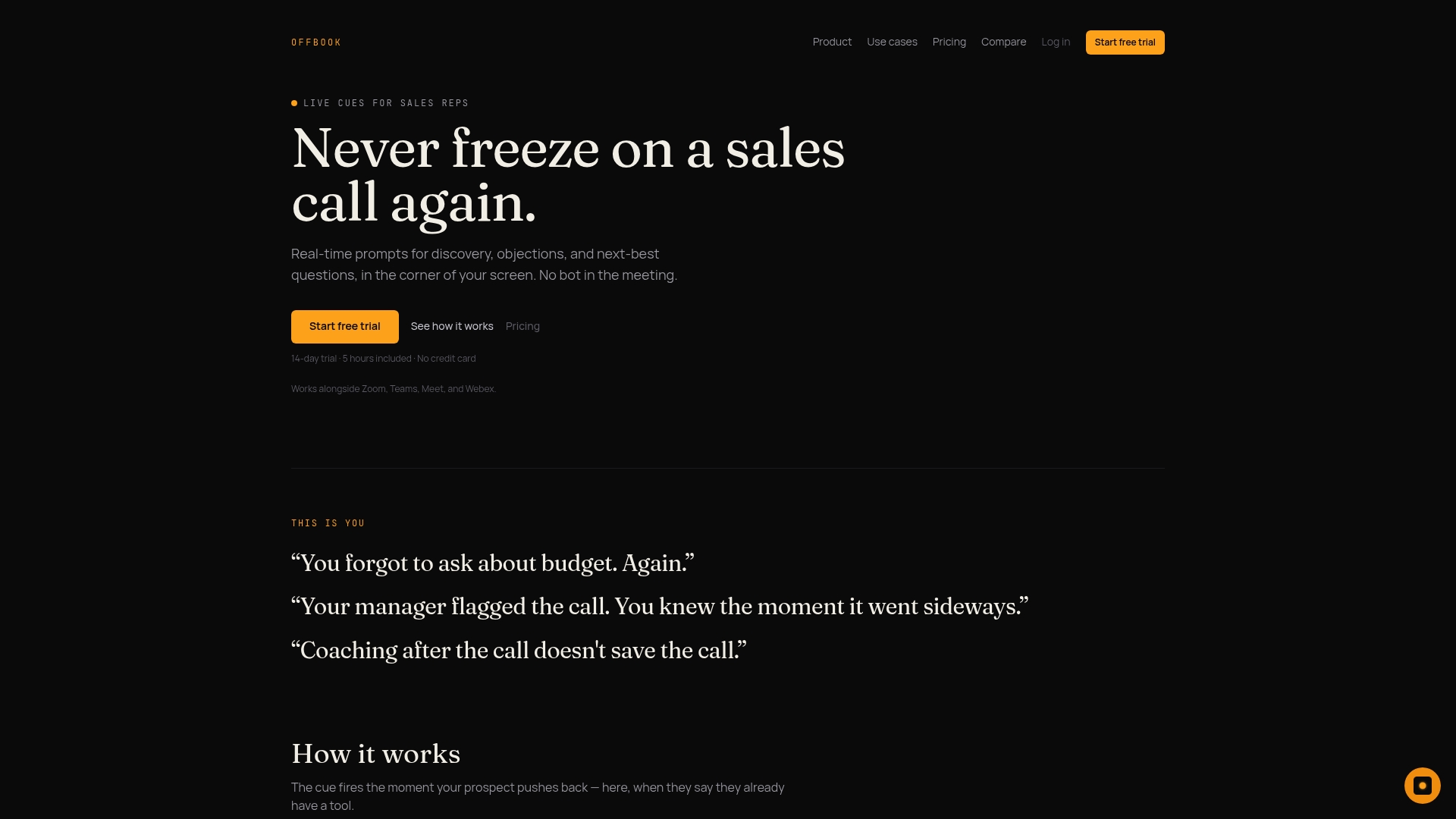
We built OffBook around the gap this article describes: a rep needs help during the call, not a summary after it. We provide live in-call prompts for objections, qualification gaps, and next questions, structured around sales methodologies, without a bot joining the meeting. We also generate pre-call briefs on the people and company a rep is about to meet, plus instant post-call debriefs when you want a record too.
For a seed or Series A team, we suggest piloting on your highest-value discovery and demo calls first, then tracking:
- Conversion rate on coached versus uncoached calls.
- Rep adoption within the first two weeks.
- Downstream revenue from deals that included a coached call.
Our Power plan starts individual reps at $59 a month or $590 a year, and our Team plan runs $1,000 a year per seat for teams that want shared profiles and admin controls. If you want a lower-friction first step, try our free objection handling generator or see the full feature set on our sales coaching page.
FAQ
Is live AI call coaching better than recording calls for sales?
For high-value B2B calls, live coaching tends to produce faster behavioral change because it intervenes during the conversation rather than after it. Recording still matters for compliance and training archives, so most early-stage teams benefit from running both rather than choosing one permanently.
Does call recording require consent from both parties?
Consent requirements vary by jurisdiction, with some requiring only one party’s consent and others requiring everyone on the call to agree. Check the rules that apply to each participant’s location before recording, and our guide to call recording consent laws covers the main distinctions.
How much can real-time coaching improve conversion rates?
A reinforcement-learning-based real-time guidance system reported a 43.2% increase in conversion rates in evaluated sales deployments. Results came from a specific study and should be validated against your own pilot before you treat that figure as a guarantee.
What does OffBook cost for a small sales team?
OffBook’s Power plan costs $59 a month or $590 a year per user, and the Team plan costs $1,000 a year per seat for teams that need shared admin controls. Pricing details and plan comparisons are available on our pricing page.
Can live coaching tools replace note taking entirely?
Live coaching changes what happens during the call, but it does not automatically produce the durable, searchable archive that compliance and onboarding teams often need. Many teams keep a lightweight note-taking or recording habit alongside live coaching rather than replacing one with the other.
Sources
- SalesRLAgent: A Reinforcement Learning Approach for Real-Time Sales Conversion Prediction and Optimization
- Artificial Intelligence Risk Management Framework: Generative Artificial Intelligence Profile (NIST)