Call Recording Consent Laws: What Every Business Must Know
Understand the essential call recording consent laws for businesses. Learn the federal and state requirements to ensure compliance.
Published: August 28, 2026
Author: OffBook Editorial Team

Federal law lets you record a call if just one person on it agrees. That’s the baseline under the Wiretap Act. But several states demand every participant sign off, and if your call crosses state lines, courts have applied the stricter rule to the whole conversation. The safe move: announce the recording out loud, every time, and keep a log of it.
TL;DR:
- Most states require all-party consent for recordings, meaning every participant must be informed and agree before recording an in-state call.
- Cross-state calls trigger complex jurisdiction issues, often leading courts to apply the stricter consent law of the participant’s state, especially California.
- Businesses should implement a standard policy of recording disclosures before the call begins, logging consent, and securely archiving recordings to stay compliant.
- Implied consent is generally accepted if the disclosure is clear and provided before recording, but the timing and method of disclosure are critical for legal validity.
- Relying solely on area codes or caller location is risky; treat every multi-state call as requiring all-party consent unless fully verified otherwise.
Table of Contents
- What Federal Law Actually Says About Call Recording Consent Laws
- One-Party, All-Party, and the Hybrid States in Between
- State-by-State Call Recording Consent Rules
- Interstate Calls and the Kearney Problem
- Building a Call Recording Compliance Program
- Consent Methods, IVR Design, and TCPA Overlap
- Recording Employees, Remote Teams, and Internal Calls
- Can You Use a Recording as Evidence in Court?
- Why Transparent Recording Policy Is a Sales Advantage, Not Just a Legal Shield
- A Privacy-First Way to Capture Consent and Coach Reps in Real Time
- Where to Verify Call Recording Consent Laws by State
- Sources
What Federal Law Actually Says About Call Recording Consent Laws
The federal floor is simpler than most people expect. Under 18 U.S.C. § 2511, you can lawfully record a phone call or conversation as long as one participant in that conversation consents, even if that participant is you. Lawyers call this the “participant exception.” It’s the reason a customer service rep can record a support call without asking permission first, and why a journalist can record their own interview.
But that exception has a hard limit, and it’s the part businesses tend to skip past. The moment a recording is made to commit a crime or a tort, the one-party defense disappears entirely. Recording a call to set up blackmail, extort a business partner, or gather material for a defamation campaign strips away the legal cover the statute otherwise provides. Prosecutors and civil plaintiffs both look at intent, not just consent.
The financial exposure runs in two directions: criminal penalties and civil damages. Federal statute provides civil remedies under 18 U.S.C. § 2520, and state statutes frequently layer felony charges and statutory damages on top of that. Plaintiffs in a successful wiretap claim can recover actual damages, statutory damages calculated per violation, punitive damages, and attorney’s fees. That last piece matters more than people think. A single unlawful recording claim can generate legal costs that dwarf whatever business value the recording had.
Here’s what typically triggers federal or state liability:
- Recording a call where no party has consented and no exception applies
- Recording for the purpose of blackmail, harassment, or extortion
- Disclosing or using an illegally obtained recording in business or litigation
- Recording in a state that requires all-party consent without notifying every participant
- Intercepting a call you aren’t a party to and have no legal authorization to monitor
The practical upshot: one-party consent is a genuine legal shield in the states that follow it, but it’s a narrower shield than the phrase suggests. It protects a business that discloses recording and records for a legitimate purpose. It does nothing for a business that hides the ball or uses recordings maliciously. Given how often calls cross state lines in a normal sales or support operation, treating federal law as the whole answer is where most compliance programs go wrong.
One-Party, All-Party, and the Hybrid States in Between
Most 50-state surveys split the country into two buckets, but the real picture has three. The majority of states follow the federal one-party consent standard: if you’re on the call, you can record it. A smaller group requires all-party consent, commonly called “two-party consent,” though that label undersells it since it applies even when five or six people are on the line. And a handful of states run hybrid rules that depend on context, like whether the call is in person, over the phone, or involves an expectation of privacy.
“Two-party consent” is the phrase most people search for, but “all-party consent” is the more accurate term, and the one you’ll see in legal filings. A conference call with four participants in an all-party state needs all four to agree, not just two. Using “two-party” as shorthand made sense decades ago when most recorded calls were one-on-one. It doesn’t map cleanly onto a modern sales call with a rep, a manager, and two people on the buyer’s side.
States commonly cited across authoritative surveys as requiring all-party consent include:
- California
- Florida
- Illinois
- Maryland
- Massachusetts
- Montana
- New Hampshire
- Pennsylvania
- Washington
Roughly a dozen states fall into this all-party category, though the exact count shifts depending on how a given survey treats hybrid or borderline statutes. That’s not sloppy research. It reflects real statutory ambiguity. Some states distinguish between electronic communications and in-person conversations. Others carve out exceptions for law enforcement, emergency calls, or situations where there’s no reasonable expectation of privacy. Connecticut, for example, treats unlawful recording primarily as grounds for civil liability rather than a criminal offense, which changes the practical risk calculus even though it still requires consent. Oregon has a split between phone conversations and in-person conversations that trips up businesses that assume one rule covers both. Delaware’s statutory language has drawn criticism from attorneys for containing what reads like an internal conflict between its wiretap and eavesdropping provisions, which is exactly the kind of ambiguity you don’t want to be the test case for.
The business implication is straightforward even when the statutes aren’t: hybrid rules mean you can’t rely on a single blanket assumption for every call type. A company that only handles phone calls with customers in one-party states might reasonably build a lighter compliance process. A company doing outbound sales calls across the country, running video meetings, and recording internal team calls with remote employees in multiple states needs a policy that assumes the strictest applicable rule until proven otherwise. That’s not caution for its own sake. It’s the only posture that scales when you don’t control who’s on the other end of the line.
State-by-State Call Recording Consent Rules
Consent standards vary enough by state that a quick reference table is more useful here than another paragraph of exceptions. This reflects commonly cited classifications from established 50-state surveys; always confirm against the current statute before relying on it for a specific call.
| State | Consent Standard | Practical Note |
|---|---|---|
| California | All-party | Kearney established this applies even to inbound calls from one-party states |
| Florida | All-party | Statute covers oral communications with a reasonable expectation of privacy |
| Illinois | All-party | Statute was amended after a prior version was struck down by the state supreme court |
| Maryland | All-party | Criminal penalties apply; civil suits are also common |
| Massachusetts | All-party | One of the stricter statutes; secret recording is a felony |
| Montana | All-party | Requires notification, which some courts treat as satisfying consent |
| New Hampshire | All-party | Applies to both in-person and telephone conversations |
| Pennsylvania | All-party | Wiretap Act requires consent of all parties to the communication |
| Washington | All-party | Requires that all parties have knowledge the call is recorded |
| Connecticut | Hybrid | Unlawful recording generally creates civil rather than criminal exposure |
| Oregon | Hybrid | Telephone calls follow different rules than in-person conversations |
| Delaware | Hybrid | Statutory language has been flagged by attorneys as internally inconsistent |
| Most other states | One-party | Follows the federal Wiretap Act baseline |
The Justia 50-state survey and RecordingLaw’s state-by-state breakdown are the two most cited references for this classification, and they’re a reasonable starting point for identifying which category your state falls into. Neither replaces reading the actual statute, especially if your business handles calls in Connecticut, Oregon, or Delaware, where the label alone doesn’t tell the full story.
Interstate Calls and the Kearney Problem
The moment a call crosses a state line, “which state’s law applies” stops being a hypothetical. It’s the single biggest source of legal uncertainty in this entire area, and the case every compliance officer should know is Kearney v. Salomon Smith Barney.
In that case, the California Supreme Court ruled that California’s all-party consent law applied to a call placed from a Salomon Smith Barney office in Georgia into California, even though Georgia only requires one-party consent. The court’s reasoning centered on protecting California residents under California’s own privacy standard, regardless of where the call originated. The practical rule that emerged: when call participants sit in different states with different consent standards, courts may apply whichever state’s law is stricter, particularly when that state has a strong public policy interest in protecting its residents’ privacy.
Kearney isn’t the only approach courts have used. Some look at where the recording device physically sits. Others focus on where the party being recorded is located, rather than where the recording equipment is. A few consider the terms of any contract between the parties. None of this is settled uniformly across circuits, which means a business operating nationally can’t count on any single rule holding up in every jurisdiction.
- Kearney’s rule: apply the law of the state with the stricter consent standard when its resident is a party to the call
- Device-location approach: some courts weigh where the recording actually happens
- Recipient-location approach: others focus on where the person being recorded sits
- No uniform federal rule: outcomes can still vary by circuit and by fact pattern
Given that uncertainty, the conservative and widely recommended posture for multi-state businesses is to treat every call as if it requires all-party notice, unless you can confirm with certainty that both the caller and every recipient are in one-party states. Area codes don’t help here. Mobile numbers, number porting, and remote work mean you often can’t tell where someone is physically sitting just from their phone number.
Pro Tip: Don’t try to build a lookup table that maps area codes to consent rules. It’ll be wrong constantly, and it creates a paper trail showing you knew the risk and gambled on it anyway. Default to disclosure instead.
Building a Call Recording Compliance Program
Legal knowledge doesn’t protect you if it never makes it into your actual call flow. Here’s how to turn the rules above into something your team executes without thinking twice about it.
- Set your company posture in writing. Decide, formally, that your business will treat all recorded calls as requiring all-party notice, regardless of where participants are located. Put this in a policy document, not just a Slack message.
- Script the announcement and place it correctly. The disclosure needs to play before the recording trigger fires, and before a caller connects to a live agent. An IVR message like “This call may be recorded for quality and training purposes” satisfies most one-party states and is the accepted floor for all-party states when paired with continued participation.
- Capture the announcement inside the recording itself. If the disclosure isn’t part of the recorded file, you have no evidence it was made. Configure your platform so the announcement plays into the same recording, not as a separate, unlogged system event.
- Log consent in your CRM. Add a timestamped field that records when and how disclosure occurred for every call, tied to the call record itself. This becomes your audit trail if a dispute ever surfaces.
- Set retention and access limits. Keep recordings only as long as you have a legitimate business reason, encrypt them at rest, and restrict access by role. A recording that ten people can pull up “just in case” is a liability sitting in storage.
- Write it into the employee handbook. Require every team member, including remote hires, to disclose recording before starting one, and train new hires on this before their first live call.
- Build a deletion policy and follow it. Old recordings that outlive their business purpose are pure downside risk with no upside. Set an automatic deletion schedule and actually run it.
Practitioners and legal guides consistently recommend this exact sequence, and the order matters. Announcement before trigger, trigger before connection, logging before archiving. If you’re evaluating platforms for VoIP and call center infrastructure, California Telecom’s rundown of professional services VoIP features covers the technical controls, like configurable recording triggers and consent management, worth checking for before you commit to a system.
Pro Tip: Run a test call through your own IVR every quarter. It’s the fastest way to catch a misconfigured trigger that started recording before the disclosure finished playing, which happens more often than you’d think after a platform update.
Consent Methods, IVR Design, and TCPA Overlap
Not every state demands the same kind of consent, and mixing up the categories is a common compliance mistake. Express consent means someone affirmatively agrees, verbally or in writing, often through an explicit “yes” or a signed agreement. Implied consent means the person continued the call after hearing a clear disclosure, and courts in several one-party and even some all-party contexts have accepted that as sufficient when the announcement was unambiguous and given a real chance to object.
The 50-state survey approach that most legal guides rely on stresses timing above almost everything else: the IVR announcement has to play before the call connects to a live agent and before the recording trigger activates. An announcement that plays mid-call, or one that’s tacked on after the recording already started, generally doesn’t satisfy the legal standard in any state that requires disclosure.
There’s a separate statute that trips up a lot of sales and marketing teams here: the TCPA. It governs automated dialing systems and prerecorded messages, and its consent rules run independently of state wiretap statutes. Getting call recording consent right doesn’t automatically clear you on TCPA compliance for autodialed or prerecorded outbound calls. Those need their own statutory analysis.
On the platform side, a few settings consistently separate compliant setups from risky ones:
- Delayed recording triggers that wait until after the disclosure plays in full
- Periodic beep tones, still required in a small number of jurisdictions for ongoing recordings
- Pause and resume controls so agents can stop recording during sensitive portions of a call
- Per-call jurisdiction flags that adjust disclosure language based on known caller and recipient location
Recording Employees, Remote Teams, and Internal Calls
Internal calls carry the same legal exposure as customer calls, and businesses miss this constantly. If a remote employee is sitting in California or Illinois and joins an internal team call that’s recorded without disclosure, that recording can violate state law even though it never touches a customer.
Remote work has made this genuinely harder to manage. A team that hired mostly in one state five years ago might now have people scattered across a dozen states, and nobody updated the recording policy to match. The safest posture, again, is an all-party default applied internally, not just externally.
- Require a spoken or written disclosure at the start of every recorded internal meeting, no exceptions for “it’s just the team”
- Add explicit recording-consent language to the employee handbook, and have new hires acknowledge it during onboarding
- Extend the same disclosure standard to remote and hybrid staff regardless of which state they work from
- Treat training calls, coaching sessions, and 1:1s the same as customer-facing recordings for consent purposes
- Apply extra caution around recordings involving minors or sensitive personal information, where additional privacy protections may apply beyond standard wiretap law
Can You Use a Recording as Evidence in Court?
Admissibility generally comes down to one question: was the recording lawfully obtained? A recording made in violation of an applicable all-party consent statute risks exclusion from evidence, on top of exposing whoever made it to civil or criminal liability. Courts don’t reward a party for building their case on an illegal recording, even when the content would otherwise be compelling.
A few habits meaningfully improve a recording’s evidentiary value if it ever ends up in litigation:
- Keep the consent announcement embedded in the recording itself, not stored separately
- Maintain timestamped logs showing exactly when disclosure occurred and who was on the call
- Preserve a clear chain of custody from recording to storage to retrieval
- Store recordings securely with restricted, role-based access to prevent tampering claims
And the exception carve-out still applies here: a recording made to further a crime or a civil wrong doesn’t get the benefit of the doubt just because one party consented. Courts look past the consent question straight to intent.
Why Transparent Recording Policy Is a Sales Advantage, Not Just a Legal Shield
Most compliance guides frame consent disclosure as risk mitigation. That’s true, but it undersells the upside. A sales rep who says “this call is being recorded so I can follow up accurately” upfront reads as more credible, not less, to a buyer who’s used to vague vendor promises.
Practitioners consistently note that full disclosure builds trust even in states where covert recording is technically legal, and that tracks with what happens in practice. Buyers who know they’re being recorded tend to be more precise about commitments, which cuts down on the “that’s not what we agreed to” disputes that stall deals later. Transparent recording policy isn’t just a legal checkbox. It’s a small trust signal that compounds across a sales cycle.
Tools built around real-time call coaching, Offbook among them, have started treating consent capture as core infrastructure rather than an afterthought, which is the direction this whole category should be heading.
— Neil
A Privacy-First Way to Capture Consent and Coach Reps in Real Time
Offbook is built for founder-led B2B sales teams who need every call to be both compliant and productive, without a bot sitting in the meeting to remind everyone it’s being watched. It listens live and surfaces on-screen prompts, structured around MEDDIC and MEDDPICC, so reps know what to ask next while the disclosure and consent trail get logged automatically in the background.
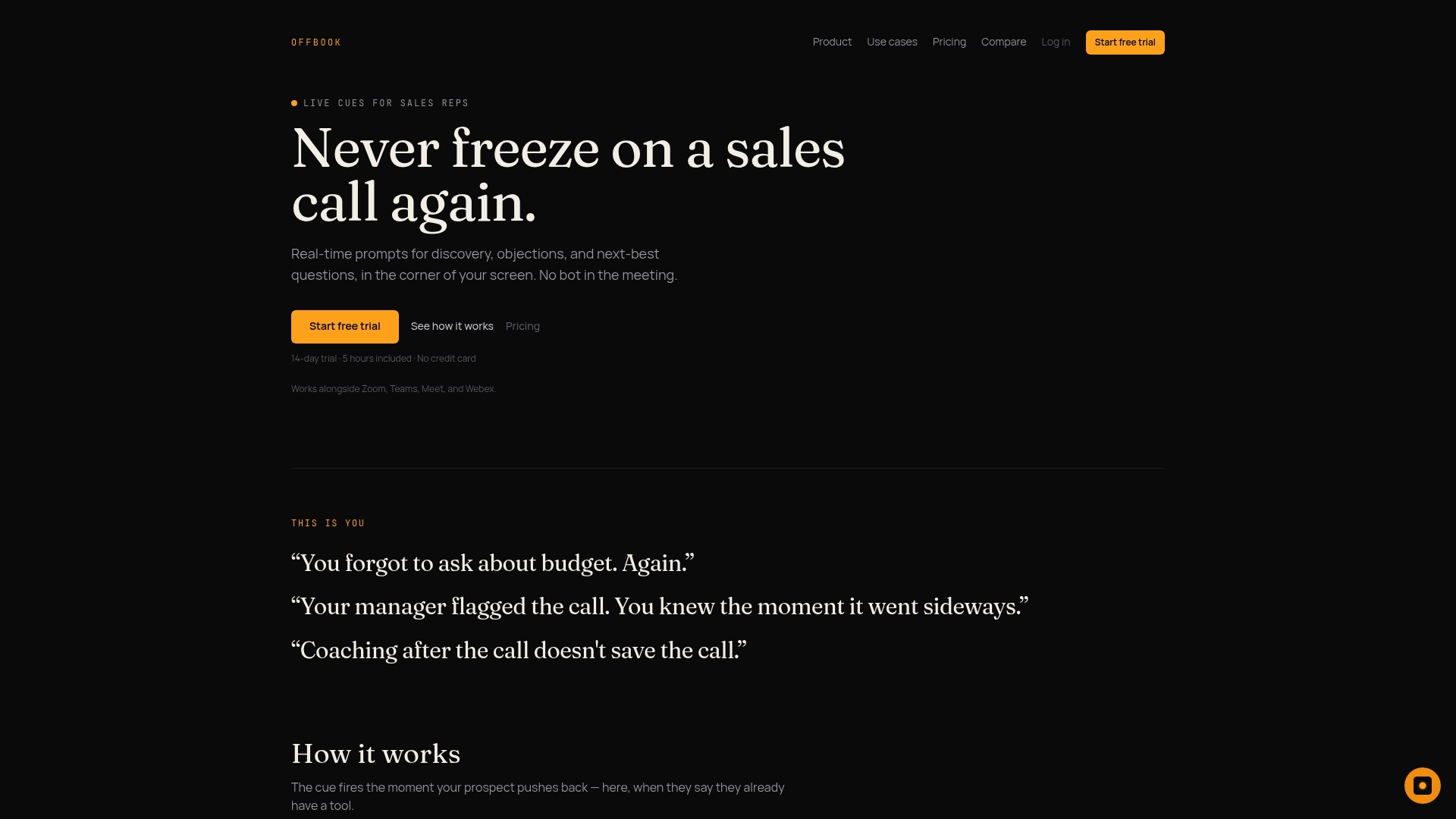
That combination matters more than it sounds. Instead of bolting a compliance step onto your call stack and a coaching tool onto a separate one, Offbook handles both in the same pass: it can help surface the consent announcement at the right point in the flow, keep a timestamped record of it, and then coach the rep through objections and qualification gaps for the rest of the call. Reps walk in with a pre-call brief on who they’re meeting and walk out with a debrief and follow-up draft ready to send. If your team runs recorded sales calls across multiple states and wants the consent side handled as cleanly as the coaching side, check out Offbook for sales teams and see how it fits your call flow.
Where to Verify Call Recording Consent Laws by State
Statutes change, and state legislatures amend consent language more often than most businesses realize. Before finalizing any compliance policy, check the primary sources directly: the federal Wiretap Act text, the FCC’s consumer guidance on recording telephone conversations, and the Justia 50-state survey on recording phone calls for state-specific statute citations.

None of these sources override each other. The FCC guidance explicitly works alongside state law rather than replacing it, and state statutes are what actually determine your exposure. When in doubt on a specific state, especially one with hybrid rules like Oregon or Delaware, read the current statute text directly rather than relying on any single survey’s summary.