B2B Objection Handling Frameworks: Match 10 Scripts to Buyer Intent
Learn five objection handling frameworks, choose the right response for buyer intent, and use 10 sales scripts and roleplay to build B2B reps’ skills.
Published: October 15, 2026
Author: OffBook Editorial Team

Several objection handling frameworks include LAER, CRAC, Feel-Felt-Found, Boomerang, and Empathetic Reframing, and the frameworks work best when matched to the objection type and the buyer’s mindset. Pick one script from the scripts section below and run it once before your next call. A 2025 field study on the match strategy found that aligning your response style to how a buyer is shopping more than doubled average sales per customer.
TL;DR:
- Name the objection category and assess buyer specificity in the first minute; use CRAC for practical questions and LAER for emotional concerns.
- On discovery calls, use question based scripts to diagnose; on demos, use statement first responses because buyers already have more context.
- Let buyers finish before responding; interrupting hurt sales outcomes, while too many questions made conversations feel interrogative, so ask fewer, stronger questions and allow pauses.
- Compare frameworks on similar calls using next step rates, conversion, close rates, and objection to win ratios; keep scripts unchanged during each test.
Table of Contents
- Five objection handling frameworks worth learning
- Which framework to use when
- Ten scripts for the objections you hear every week
- The listening skills that make every framework work
- Roleplay formats that turn scripts into habit
- Measuring whether your frameworks are actually working
- What live coaching taught me about objection handling
- Why teams choose real-time coaching over practice alone
- FAQ
- Sources
Five objection handling frameworks worth learning
A selection of frameworks can help reps handle many of the objections they hear in a sales cycle. Each one solves a different problem, so knowing which to reach for matters more than memorizing every technique.
- LAER (Listen, Acknowledge, Explore, Respond): a sequence built for emotional or trust-based pushback, where the buyer needs to feel heard before they will listen to a counterargument.
- CRAC (Clarify, Respond, Ask, Confirm): a tighter structure suited to practical, informational objections like price or timeline, where the buyer wants a direct answer followed by a check that it landed.
- Feel-Felt-Found: a classic reframing technique (“I understand how you feel, other clients felt the same way, here’s what they found”) that works well on authority and competition objections because it borrows social proof instead of arguing.
- Boomerang: turns the stated objection back into a reason to move forward, useful when the objection is really a disguised request for more information, such as “it’s too expensive” meaning “convince me it’s worth it.”
- Empathetic Reframing: restates the objection in a way that shifts the frame without dismissing the concern, strong for need or relevance objections where the buyer doubts the problem is urgent.
A quick example: on a price objection with Boomerang, you might open with, “That’s actually why most of our customers start here, the cost of staying with your current process is usually higher than switching.” On a trust objection with LAER, you start by just listening and reflecting the concern back before offering anything.
Which framework to use when
Matching the framework to the objection type is where most reps lose ground, not in knowing the techniques themselves. B2B objections can fall into categories such as price or budget, timing or priority, need or relevance, authority or decision process, competition or alternatives, and trust or credibility.
The match strategy research gives a useful lens here. The field study found that informational tactics outperform when a buyer’s shopping goal is specific (they know what they need and are comparing options), while emotional tactics perform better when the goal is exploratory (they are still defining the problem). The companion research in The Listening Advantage (McFarland) explains that diagnosing this specificity in the first minute of a call, through how precisely a buyer describes their requirements, lets you choose the right tactic before you’ve committed to a direction.
Use this flow to pick a framework in the moment:
- Name the category. Listen for whether the objection is about money, timing, relevance, authority, a competitor, or trust, since the category points directly at a framework.
- Read the specificity. If the buyer uses precise numbers, deadlines, or feature requirements, lean informational (CRAC, Boomerang). If they’re vague or emotional, lean relational (LAER, Feel-Felt-Found).
- Respond, then confirm. Deliver the matched response concisely and check for a next step instead of continuing to pitch.
Pro Tip: Write the six objection categories on a sticky note next to your screen until naming them becomes automatic.
Ten scripts for the objections you hear every week
These are copy-ready starting points. Adjust the wording to your product, but keep the structure, since the sequence is what makes each one work.
- Price is too high. Trigger: “This is more than we budgeted for.” Response: “I hear that a lot, and most teams who said that found the cost of the problem they were solving was higher than the price tag. What’s the budget gap we’re actually talking about?” Practice cue: roleplay this with a buyer who gives a number and with one who stays vague.
- Not in the budget this quarter. Trigger: “We don’t have room for this right now.” Response: “Totally fair. Would it help to structure this so the bulk of the cost lands in a later period, while we get started now?” Practice cue: have the roleplay partner push back with a hard no to test your follow-up.
- Bad timing, check back later. Trigger: “Can you follow up later?” Response: “Happy to, and I want to make sure that’s the right call. What has to be true for this to become a priority?” Practice cue: practice holding the pause after the question instead of filling the silence.
- This isn’t a priority for us. Trigger: “Honestly, this isn’t high on our list.” Response: “That makes sense given everything else you’re juggling. Can you walk me through what is at the top of the list right now?” Practice cue: run this on a discovery call, then again on a demo call, and notice how the follow-up question changes.
- I’m not the decision maker. Trigger: “I’d need to check with my team.” Response: “Of course. What would make this an easy yes for them, based on what you’ve seen so far?” Practice cue: roleplay the handoff to a second buyer persona in the same session.
- We’re already using a competitor. Trigger: “We’re happy with what we have.” Response: “Good to know. What’s working well, and is there anything you wish it did better?” Practice cue: practice resisting the urge to criticize the competitor by name.
- I don’t see the ROI. Trigger: “I’m not sure this pays for itself.” Response: “Let’s pencil it out together. What would a win look like in dollars or hours saved over a future period?” Practice cue: bring a real number from a past deal into the roleplay to make it concrete.
- Implementation looks like too much work. Trigger: “We don’t have the bandwidth to roll this out.” Response: “That’s the most common concern we hear, and many teams can get started with little effort on their end. What would a smooth rollout need to look like for you?” Practice cue: practice delivering this concisely.
- Security or compliance concerns. Trigger: “We’d need to check with IT or legal first.” Response: “Makes sense, and we can get you what you need for that review today. What’s the specific requirement your team usually asks about?” Practice cue: practice naming your actual compliance documentation instead of speaking in generalities.
- We don’t need this right now. Trigger: “I don’t think we have this problem.” Response: “That’s worth testing. What’s happening today when [specific scenario] comes up?” Practice cue: roleplay this one slowly since rushing it reads as pushy.
On discovery calls, lean toward the question-ended versions of these scripts since you’re still diagnosing. On demo calls, where the buyer has seen more, shift toward the statement-first versions that assume more context. Our objection handling generator is a quick way to test variations of any of these before you bring them into a live call, and if you want more language for surfacing the objection before it’s spoken, our guide on pain-focused discovery questions covers that groundwork.
The listening skills that make every framework work
A framework is just a structure. What makes it land is how well you’re actually listening before you use it. Two techniques do most of the work: reflective listening (repeating back the core of what the buyer said, “so what I’m hearing is…”) and paraphrase (restating it in your own words to confirm understanding, “it sounds like the real issue is X, is that right?”).
A direct response: research from Scholarworks found that crosstalking, interrupting the buyer mid-objection, consistently hurt sales outcomes, while a tactic like inquiring, when overused, started to feel interrogative rather than curious.
That same research points to a simple fix: ask fewer, better questions and let pauses sit instead of rushing to fill them.
- Reflective listening example: “It sounds like the timing issue is less about this quarter and more about team bandwidth, did I get that right?”
- Paraphrase example: “So the concern isn’t the price itself, it’s proving the ROI to your CFO. Is that the real blocker?”
- Diagnostic opener for the first minute: “What’s prompting you to look at this now?” The specificity of the answer tells you whether to lean informational or emotional, per the Listening Advantage research.
Our deeper breakdown of active listening techniques for sales calls covers more of these patterns if you want to build this into a weekly practice habit.
Roleplay formats that turn scripts into habit
Scripts only stick when they’re practiced out loud, not just read. Several formats can support team practice.
- Paired live roleplay: two reps alternate buyer and seller roles on a real objection scenario, with no script in hand after the first run.
- Recorded mock call with playback: one rep plays a skeptical buyer, the call is recorded, and the pair reviews the playback together to catch filler words, rushed pauses, and missed questions.
- Coach-observed live call: a manager silently observes a real call (with consent) and gives feedback immediately after on framework selection and delivery.
A practice session can include a warm-up reviewing the objection category and framework, a focused script run, a feedback anchor identifying what worked and what to improve, and a repeat with the adjustment applied.
Score each run on three things: did the rep listen fully before responding, did they correctly diagnose the objection category and buyer specificity, and did they deliver the matched framework cleanly without hedging. For more structured scenarios to pull from, the partner guide on case study frameworks for closing B2B deals offers additional templates worth adapting into roleplay drills.
Measuring whether your frameworks are actually working
Track relevant measures before and after introducing a new framework, such as next-step rate (did the call end with a confirmed next step), conversion to opportunity, close rate, and objection-to-win ratio (how many objections surfaced per deal that eventually closed).
A simple split test can compare frameworks on matched, comparable call types over a suitable period, using the same metrics. Keep the sample large enough that a handful of outlier deals doesn’t swing the result, and avoid changing the script mid-test. If a framework shows no movement after a full cycle, iterate the script wording before abandoning the framework itself.

What live coaching taught me about objection handling
Watching reps apply these frameworks in real calls instead of just training on them is where the gap shows up. A script read correctly in a roleplay often falls apart live because the rep freezes on diagnosis, not delivery. In-call cues that surface the right framework the moment an objection lands shorten that learning curve significantly, because the rep practices the real decision, not just the line. A price objection can be redirected into a scoped next step when the rep has the right prompt in view instead of hesitating.
— Neil
Why teams choose real-time coaching over practice alone
Roleplay builds muscle memory, but the gap between practicing a framework and using it correctly on a live call with a real buyer is where most reps still stumble. That’s the problem we built OffBook to close. We listen to your calls in real time and surface on-screen cues to help reps handle objections, without a bot ever joining the meeting, so the rep can respond in the moment instead of reconstructing it from memory afterward.
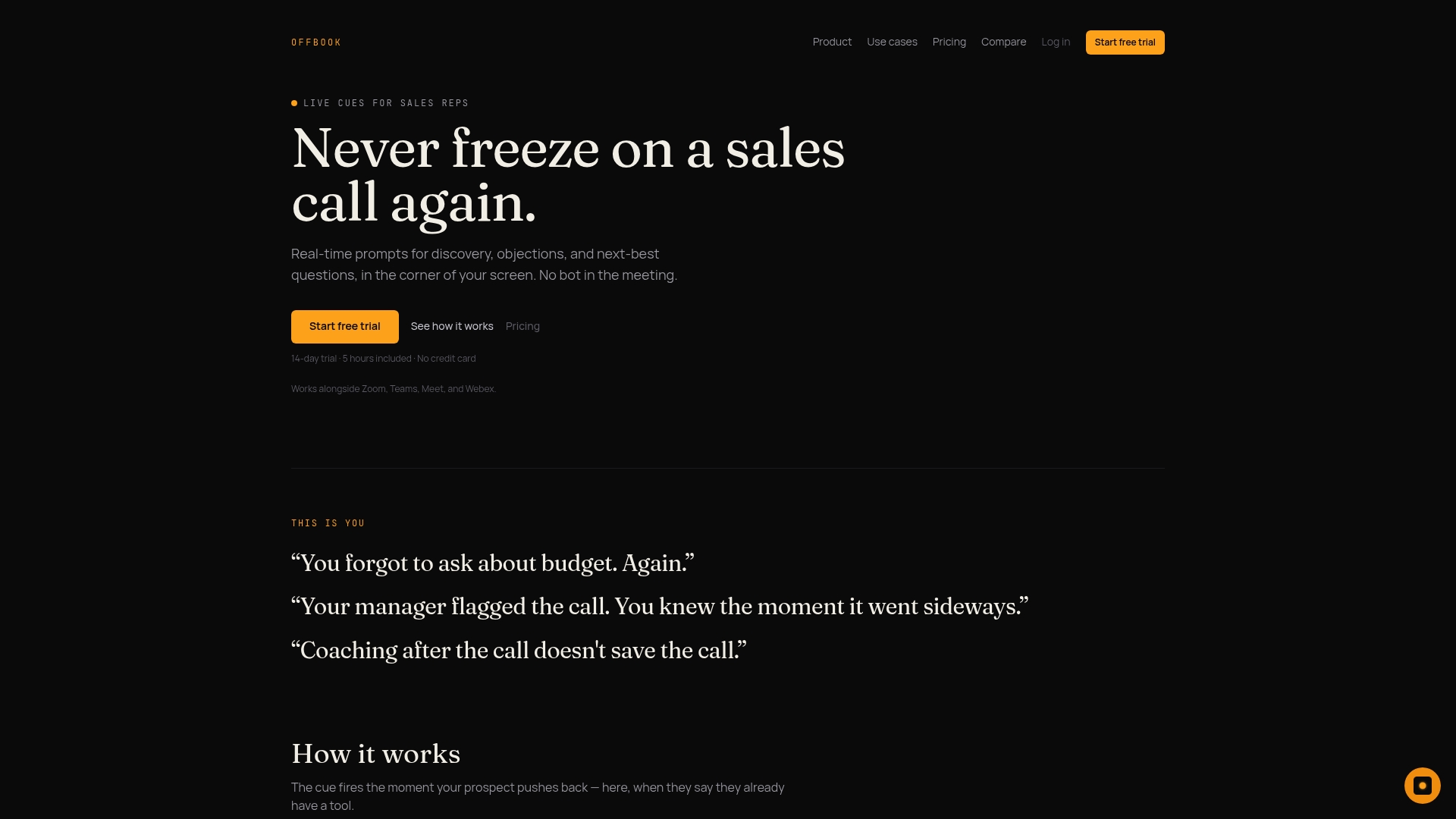
We also generate pre-call briefs on the people and companies you’re about to meet, and structure the whole flow around methodologies like MEDDIC and MEDDPICC, so objection handling fits into the broader call plan instead of running as a separate skill. If you want to see what that looks like on your own calls, check our AI call coaching for sales page, or go straight to pricing where the Power plan runs $59 per month or $590 per year, and Team plans run $1,000 per year per seat.
FAQ
What are the three golden rules for objection handling?
Listen fully before responding, acknowledge the concern as valid before countering it, and confirm the response landed with a question before moving on. These three rules sit underneath every framework covered above, from LAER to Boomerang.
What are the three steps to effectively handle objections?
Diagnose the objection category (price, timing, trust, and so on), match your response style to whether the buyer sounds informational or emotional, and close with a confirming question rather than more pitching. The match strategy research backs the second step specifically, showing it raises close rates by about 50% over mismatched responses.
What are the four types of objections?
Definitions vary across sales training sources, but a common version groups objections into price, need, trust, and authority, with timing and competition sometimes added as a fifth and sixth category. The scripts and frameworks above cover these categories.
What are the major three objection categories?
The three most frequently cited categories are price or budget, timing or priority, and trust or credibility, since these cover the bulk of pushback in a typical B2B sales cycle. Need and authority objections may also surface later in the conversation.