Command of the Message: 8 Components, 30 Minutes on a Discovery Call
See how Command of the Message maps 8 value components to a discovery call lasting 30 minutes. Live coaching and manager reviews keep the mantra consistent.
Published: October 14, 2026
Author: OffBook Editorial Team

Command of the Message is a value-messaging framework that trains sales teams to lead with the buyer’s business problem instead of product features, using a repeatable set of components and a short talk track called the mantra. Its payoff is consistency: reps across a team can describe the same value story in the same words, under pressure, on any call. The clearest sign a team has adopted it is whether reps can deliver that mantra out loud, unscripted, when a buyer pushes back.
TL;DR:
- Use the framework mainly for complex B2B deals involving economic buyers; low touch sales rarely need the full sequence when decisions face little scrutiny.
- Define a measurable positive business outcome before naming required capabilities; vague claims such as improved efficiency cannot support an economic buyer’s internal case.
- Build a framework for each buyer persona, then make its mantra connect the current problem, measurable outcome, and solution fit in two or three sentences.
- Pair the messaging framework with MEDDIC: record positive outcomes as Metrics, required capabilities as Decision Criteria, and the confirmed mantra for Economic Buyers absent from discovery.
- Pilot with 5 to 10 deals, a defined persona, and a baseline win rate, then inspect mantra playback and logged outcomes weekly.
Table of Contents
- What command of the message is and when to use it
- The 8 core components of the value framework
- Build a value framework for a buyer persona: template and examples
- A 30-minute discovery call mapped to the framework
- The mantra: making the framework audible-ready
- How command of the message pairs with MEDDIC and other qualification frameworks
- Operationalizing the framework without losing it to decay
- What sales leaders should do first
- How OffBook supports live adoption of command of the message
- FAQ
- Sources
What command of the message is and when to use it
Command of the Message, often shortened to the Value Messaging Framework, grew out of enterprise sales training built to fix a specific problem: reps who could demo a product beautifully but could not explain, in the buyer’s own terms, why the purchase mattered. Traditional pitches start with features and hope the buyer connects the dots to value. Command of the Message reverses that order. It starts with the buyer’s current state, walks through what happens if nothing changes, and only then brings in the product, framed as the thing that produces a measurable business outcome.
That sequence matters because of how buyers actually behave today. Gartner research finds a majority of B2B buyers would rather avoid talking to a sales rep at all, doing their own research instead. When a rep does get time on a call, that time has to earn its place. A generic product walkthrough wastes it. A sharp, specific articulation of the buyer’s problem and the business case for solving it does not.
The commercial case for this approach shows up in three places:
- Message consistency: every rep on the team describes the same value drivers the same way, so the story does not change depending on who answers the phone.
- Margin protection: when the conversation centers on business outcomes instead of features, price negotiations shift away from feature-by-feature comparisons that invite discounting.
- Clearer differentiation: reps can explain why their solution is structurally better suited to the buyer’s problem, not just cheaper or shinier.
This framework fits best in complex B2B sales where the buying committee includes an economic buyer who cares about dollars and outcomes, not just a technical evaluator who cares about specs. It is less useful for transactional, low-touch sales where the buying decision never reaches that level of scrutiny.
The 8 core components of the value framework
The framework is commonly broken into eight sequential components. Each one builds on the last, so skipping a step weakens everything that follows it. A rep who jumps straight to “required capabilities” without first establishing the negative consequences of inaction ends up pitching features again, just with better vocabulary.
Here is what each component does:
- Current state: a factual description of how the buyer operates today, free of judgment or sales spin.
- Negative consequences: what staying in the current state costs the buyer, in time, money, risk, or missed opportunity.
- Positive business outcomes (PBOs): the measurable result the buyer gets by fixing the problem, stated as a number or a rate wherever possible.
- Required capabilities: the specific capabilities a solution must have to produce those outcomes, described functionally rather than as a product name.
- Trap-setting questions: discovery questions constructed so that the honest answer leads the buyer toward the required capabilities the rep’s solution happens to deliver.
- Value drivers: the handful of reasons, from the buyer’s point of view, that this purchase matters more than competing priorities.
- Defensible differentiation: the specific, hard-to-copy reason this solution satisfies the required capabilities better than alternatives.
- Proof points: evidence, metrics, or case detail that backs up the differentiation claim and supports a premium price.
A short example shows how this plays out. Say a buyer’s current state is a manual, spreadsheet-based process for tracking sales pipeline health. The negative consequence is that deals slip through without anyone noticing until it is too late to save them. The positive business outcome might be framed as recovering a meaningful share of at-risk deals before they go cold. The required capability is real-time visibility into deal risk signals, not a dashboard that updates once a week. From there, a trap-setting question like “how do you currently find out a deal has gone quiet?” invites the buyer to describe exactly the gap the solution fills.
Force Management-derived training material treats positive business outcomes as the hinge point of the whole structure. A PBO that cannot be tied to a number or a rate rarely survives contact with an economic buyer, because vague benefits do not support a premium-pricing conversation. “Improves efficiency” is not a PBO. “Cuts the time to flag an at-risk deal from weeks to days” is closer, because it gives the buyer something concrete to defend internally when they champion the purchase.
The sequencing matters just as much as the content. A rep who leads with proof points before establishing negative consequences sounds like they are bragging. A rep who jumps to required capabilities before PBOs sounds like they are selling features again. The order forces the conversation to stay buyer-centered from the first sentence to the last.
Build a value framework for a buyer persona: template and examples
A value framework only works if it is written down, specific to a persona, and short enough that a rep can hold it in their head on a live call. The fastest way to build one is to fill in a simple template, one row per component, for each distinct buyer persona in the deal.
Use this structure as a starting point:
- Current state: one sentence, factual, no opinion.
- Negative consequences: two or three specific costs of inaction.
- Positive business outcome: one measurable result, ideally quantified.
- Required capabilities: two or three functional capabilities, no product names.
- Trap-setting questions: two questions that surface the gap naturally.
- Value drivers: the top two reasons this matters to this persona specifically.
- Differentiation: one sentence on why this solution fits better than the alternatives.
- Proof points: the evidence that backs the differentiation claim.
Example 1: Technical buyer persona. A VP of Engineering evaluating a new deployment tool cares about metrics like deployment frequency and rollback time. Current state: deployments happen manually, once a week, coordinated over chat. Negative consequence: a bad release sits in production for hours before anyone notices. PBO: cut mean time to detect a failed deployment. Required capability: automated rollback triggers tied to real-time health checks. Trap-setting question: “when a release goes wrong at 2 a.m., how do you find out?”
Example 2: Line-of-business buyer persona. A VP of Sales evaluating a coaching tool cares about outcomes like quota attainment and ramp time. Current state: new reps shadow calls for a few weeks and learn the pitch by osmosis. Negative consequence: inconsistent messaging means some reps win deals the company should be winning across the board. PBO: shorten new-rep ramp time to full productivity. Required capability: live, in-call guidance that reinforces the same talk track for every rep, every call. Trap-setting question: “how do you know, today, whether a new rep is actually using the value story you trained them on?”

For live discovery, pull directly from a list of proven discovery call questions rather than inventing trap-setting questions cold on every call.
Pro Tip: Write the mantra line for each persona before the call, not after. If you can’t say the value story in two sentences, the framework isn’t finished yet.
A 30-minute discovery call mapped to the framework
A discovery call built around Command of the Message has a clear shape, and reps who know the shape stop improvising under pressure. Here is a time-boxed agenda for a standard 30-minute call:
- Minutes 0 to 3: frame the call. State the agenda and confirm what the buyer hopes to get out of the conversation.
- Minutes 3 to 12: current state and negative consequences. Ask open questions about how the buyer handles the problem today, then layer in trap-setting questions that surface the cost of inaction.
- Minutes 12 to 18: positive business outcomes. Confirm what success looks like in the buyer’s own words, and push for a number wherever the buyer offers one.
- Minutes 18 to 24: required capabilities and differentiation. Walk through the capabilities that produce the outcome, tying each one back to something the buyer already said.
- Minutes 24 to 28: play back the mantra. Summarize the whole story in two or three sentences, checking that the buyer agrees with the framing.
- Minutes 28 to 30: next steps. Confirm who else needs to hear this story and schedule the next conversation.
Framing negative consequences well is often the hardest part of this call, since it requires turning a vague complaint into something the buyer can quantify. Guidance on pain-focused discovery questions is useful here, because the goal is converting pain into a positive business outcome the buyer can defend internally.
The signal that tells a rep it is time to play back the mantra is simple: the buyer starts finishing the rep’s sentences, or restates the negative consequence unprompted. That is the moment the story has landed, and playing it back cements it instead of moving past it.
Pro Tip: If a buyer can’t repeat the business outcome back to you in their own words by minute 20, the call needs more discovery before it needs more pitch.
The mantra: making the framework audible-ready
The mantra is the compressed, spoken version of the full value framework: a short talk track a rep can say out loud, unscripted, when a buyer asks “so what does this actually do for me?” Being audible-ready means a rep does not need slides or notes to answer that question well.
A solid mantra has three parts: a playback of the buyer’s current state and negative consequence, the positive business outcome in measurable terms, and a one-line statement of why this solution fits the required capabilities better than the alternatives.
For the technical buyer example above, a sample mantra might run: “Right now, a bad release can sit live for hours before anyone catches it. The goal is catching that in minutes instead, which means automated rollback tied to real-time health checks rather than a manual watch rotation.”
For the line-of-business buyer: “New reps are learning the pitch by osmosis right now, which means ramp time and win rates vary rep to rep. Shortening ramp time means every rep hears and repeats the same value story from day one, reinforced live, on the call, not just in a training deck.”
Managers checking whether a rep has truly internalized the mantra should listen for a few things:
- The rep states the negative consequence before the solution, not after.
- The positive business outcome includes a specific, defensible metric.
- The rep can deliver the mantra cold, without reading from a script or slide.
- The language matches the persona on the call, not a generic company-wide version.
How command of the message pairs with MEDDIC and other qualification frameworks
Command of the Message and MEDDIC solve different problems, and confusing the two is a common reason teams struggle to adopt either one well. Command of the Message is the narrative engine: it shapes what a rep says and in what order. MEDDIC is the qualification engine: it shapes what a rep needs to know and confirm before calling a deal real.
The two frameworks share data in both directions. The positive business outcomes a rep develops in the value framework often become the Metrics field in MEDDIC, the quantified proof a champion uses to justify the purchase internally. The required capabilities component maps directly onto Decision Criteria, since both describe what the buyer needs a solution to do. Explainers describing the two frameworks treat them as complementary rather than competing, with organizations using both reporting stronger qualification outcomes than teams relying on either one alone.
A practical handoff looks like this:
- Discovery call produces a PBO with a measurable outcome, which gets logged as the MEDDIC Metric.
- Required capabilities from the value framework populate the Decision Criteria section of the deal record.
- The mantra, once confirmed with the buyer, becomes the shorthand a rep uses when briefing an Economic Buyer who was not on the discovery call.
Teams choosing between frameworks, or deciding how much of each to run at a given deal size, benefit from matching the methodology to deal complexity rather than applying the heaviest framework to every opportunity. A broader guide to rolling out MEDDIC across a team covers the qualification side in more depth.
Operationalizing the framework without losing it to decay
The most common failure mode is not a bad framework. It is a good framework that nobody inspects after the training session ends. Explainer guidance on implementation notes that adherence to a value messaging framework decays significantly within months when there is no ongoing coaching or executive sponsorship behind it.
A few adoption traps show up repeatedly:
- Training the framework once and never revisiting it in deal reviews or call coaching.
- Letting reps write their own mantras without manager review, which lets weak PBOs slip through uncorrected.
- Treating the framework as a sales-only initiative instead of pulling in marketing and product to co-author the PBOs and required capabilities.
Cross-functional authorship matters more than it sounds. Force Management’s own guidance to portfolio companies frames a shared messaging framework as an alignment tool across sales, marketing, and product, not a sales-only document, which avoids the credibility problem that comes with a framework that feels imposed from one department.
A workable coaching cadence checks three things weekly: whether the mantra was played back on each discovery call, whether a PBO got logged for each active opportunity, and whether trap-setting questions were actually asked rather than skipped. Live, in-call prompts and pre-call briefs built around these same components, the kind we build into OffBook, give managers a consistent way to confirm the behavior happened instead of relying on a rep’s self-report after the fact.
Pro Tip: Run the pilot on 5 to 10 deals with a defined persona and a baseline win rate before rolling the framework out company-wide.
What sales leaders should do first
Start with one or two buyer personas, not a dozen. Write a mantra for each, test it on live calls, and revise it based on what actually lands with buyers rather than what sounds good in a training room.
Run a short pilot before a full rollout. Track whether reps actually play back the mantra, whether PBOs get logged with real numbers, and whether win rate moves against a baseline.
Set a coaching cadence from day one. A framework without manager inspection decays fast, so build the check-ins into the calendar before the training slides finish presenting.
— Neil
How OffBook supports live adoption of command of the message
Building a value framework is one project. Keeping reps using it, on every call, under real pressure, is a different one, and that second project is where most teams lose the thread. We built OffBook to close that gap directly, listening to live sales calls and surfacing on-screen cues in the moment, without a bot ever joining the meeting.
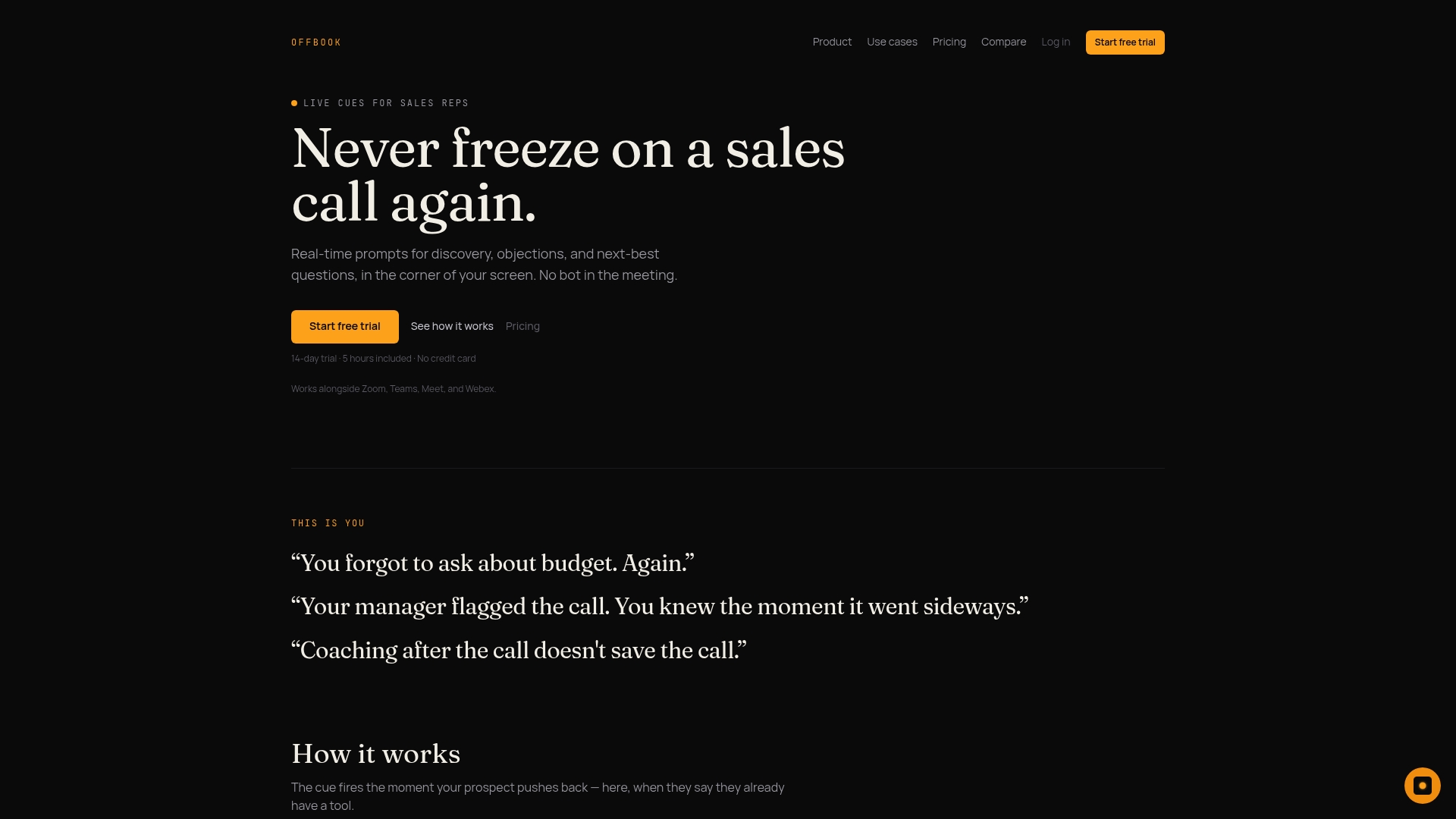
- Live, in-call prompts remind reps of questions or points to cover while the call is still happening.
- Pre-call briefs on the company and people a rep is about to meet help prepare the rep before the call starts.
- Instant post-call debrief drafts provide a summary for managers to review after the call.
Pairing a live coaching tool with a messaging program shortens the gap between training a framework and actually seeing it show up in calls, because the reinforcement happens in the moment it matters, not three weeks later in a deal review. If a team is piloting Command of the Message and wants that reinforcement built in, our plans and pricing are a reasonable place to start.
FAQ
What is Command of the Message in sales training?
Command of the Message is a value-messaging framework that trains sales reps to lead conversations with the buyer’s business problem and measurable outcomes rather than product features. It is structured around a sequence of components, from current state through proof points, designed to make reps audible-ready on live calls.
What is the mantra in Command of the Message?
The mantra is a short, spoken talk track that compresses the full value framework into two or three sentences a rep can deliver unscripted. It typically plays back the buyer’s current state and negative consequence, states the measurable positive business outcome, and names the solution’s fit against required capabilities.
How does Command of the Message differ from MEDDIC?
Command of the Message shapes the narrative a rep tells, while MEDDIC qualifies whether a deal is real and likely to close. The two frameworks are commonly used together, with outcomes developed in the value framework feeding directly into MEDDIC’s Metrics and Decision Criteria fields.
What are the 7 steps of the Sandler selling system?
The Sandler Selling System is a separate sales methodology built around a structured relationship between rep and buyer, distinct from Command of the Message’s focus on value messaging. Because it is a different framework with its own step structure, readers looking for Sandler specifically should consult Sandler’s own training materials rather than treating it as interchangeable with Command of the Message.
What is the 3-3-3 rule in sales?
The 3-3-3 rule is not a defined part of the Command of the Message or MEDDIC frameworks, and definitions of it vary across different sales training sources. Readers encountering this term should check the specific source using it, since it does not map to a single standard meaning within value-messaging or qualification methodology.
Sources
- Command of the Message Value Framework Explained
- Gartner press release: 61% of B2B buyers prefer a rep-free buying experience
- The framework new portfolio companies need to gain & sustain momentum