Why Structured Sales Calls Outperform Unstructured Ones
Discover why structured sales calls outperform unstructured ones. Learn how a clear framework boosts engagement and closes more deals.
Published: July 11, 2026
Author: OffBook Editorial Team

Structured sales calls are defined as conversations built around a repeatable framework that controls question sequencing, talk-listen ratios, and next-step commitments. Research across thousands of B2B sales calls confirms why structured sales calls outperform unstructured ones: reps who follow a deliberate call structure close deals at measurably higher rates than those who improvise. Frameworks like MEDDIC, MEDDPICC, and SPICED give sales professionals a purposeful path through discovery, objection handling, and close. Without that path, calls drift, prospects disengage, and pipeline stalls.
Why structured sales calls outperform unstructured ones
The core difference between structured and unstructured calls comes down to control. Structured calls give the rep a clear sequence to follow, which keeps the conversation focused on the prospect’s actual problems rather than the rep’s product features.
Discovery question count is one of the clearest performance signals. Analysis across thousands of B2B sales calls shows that asking 11–14 discovery questions produces a 74% success rate. That number drops sharply beyond 14 questions, when prospects feel interrogated rather than understood.
Structured calls also protect the talk-listen ratio. Top performers talk 43% of the time and listen 57%, which produces close rates three times higher than reps who talk more than 65% of the call. Unstructured calls tend to flip that ratio because reps fill silence with product pitches instead of questions.

Frameworks like SPICED and MEDDIC enforce this discipline by design. They sequence discovery questions to surface pain, urgency, and decision criteria before any solution is presented. That sequencing is what separates a productive call from a product monologue.
What key elements make structured calls more effective?
Three elements separate high-performing structured calls from everything else: the upfront contract, question sequencing, and the mix of open-ended and confirmatory questions.
The upfront contract
An upfront contract takes under 60 seconds at the start of a call. The rep states the agenda, confirms the time available, and sets a clear goal for the conversation. Upfront contracts reduce prospect defensiveness by shifting the dynamic from a sales pitch to a collaborative conversation. Prospects who know what to expect are far more willing to share real information.
Question sequencing and discovery depth
Top performers do not front-load all their questions in the first five minutes. They disperse discovery questions throughout the call to let pain emerge naturally. This approach feels like a conversation, not a checklist. Open-ended questions open the door; confirmatory questions close the loop on what the rep heard.
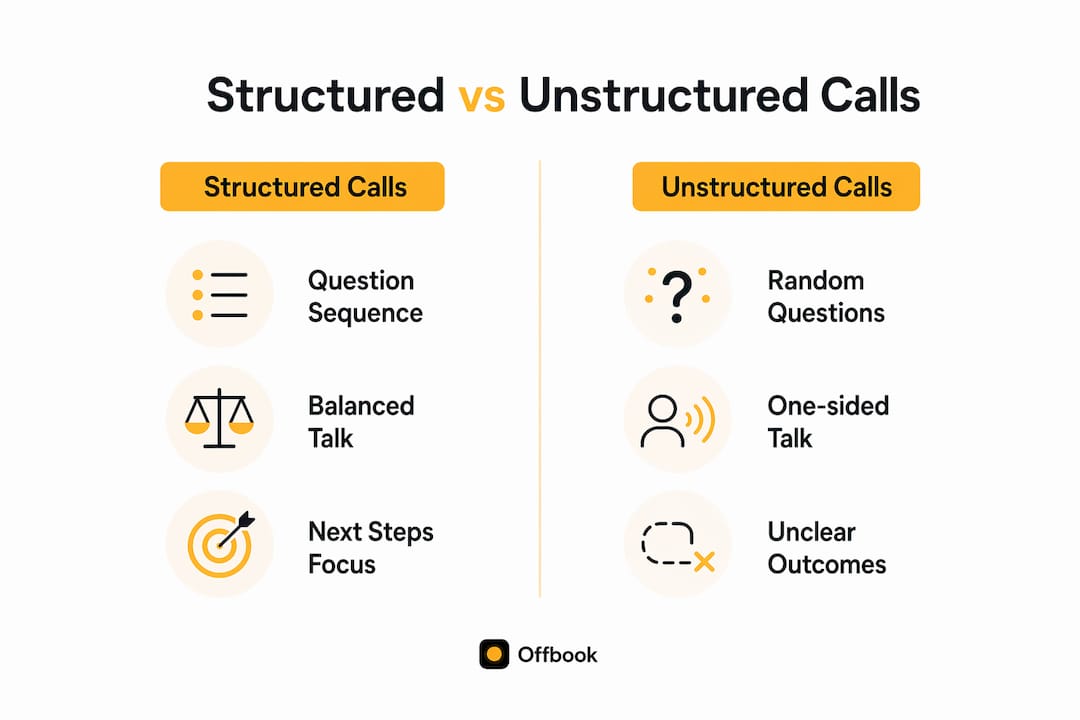
The goal of structured discovery is to surface real urgency, not just stated problems. A prospect might say they want better reporting. A structured sequence of follow-up questions reveals that the real issue is a board presentation in six weeks. That urgency changes the entire deal.
Pro Tip: Mix open-ended questions (“What does that cost you today?”) with short confirmatory ones (“So the deadline is end of quarter?”) to keep discovery feeling like a dialogue, not an interview.
- Set a clear agenda and time check at the start of every call
- Ask 11–14 discovery questions, spread across the call
- Use open-ended questions to open topics, confirmatory questions to lock in understanding
- Pause after answers. Waiting 2–3 seconds after a prospect finishes often yields the most diagnostic information
- Tailor your presentation to the exact language and pain points the prospect used
How does structure improve conversation flow?
Structure manages call momentum. Without it, reps jump between topics, pitch too early, and lose the thread of what the prospect actually cares about. With it, every stage of the call has a clear purpose and a natural transition to the next.
Prospects trust reps who reflect their language back to them during the presentation stage. When a rep says “You mentioned the board presentation in six weeks” instead of launching into a generic feature list, the prospect feels heard. That emotional connection is not a soft benefit. It directly increases the likelihood of a next step.
Structure also changes how reps handle objections. The instinct in an unstructured call is to defend the product with ROI data. Responding to objections with a question instead reveals the real concern underneath. “What would need to be true for that not to be a concern?” is more effective than a three-minute rebuttal.
Pro Tip: When a prospect raises an objection, pause and ask one clarifying question before responding. This buys time, shows respect, and almost always surfaces a more specific concern you can actually address.
Clear transitions between call stages also reduce prospect anxiety. Moving from discovery to presentation with a brief summary (“Based on what you’ve shared, here’s what seems most relevant”) signals competence and keeps the call from feeling like a random conversation.
- Avoid premature product pitches before discovery is complete
- Use brief summaries to transition between call stages
- Respond to objections with questions, not monologues
- Keep the call focused on the prospect’s stated priorities, not your product roadmap
What impact does structure have on measurable outcomes?
Structure produces outcomes you can measure, compare, and coach against. That is its most underrated advantage.
The talk-listen ratio is the clearest metric. Gong’s analysis of 25,537 sales calls confirmed that top performers maintain a 43/57 ratio, talking less and listening more. Reps who talk more than 65% of the call close at a fraction of that rate. Structured calls enforce this ratio by building in question sequences that require the prospect to speak.
Next-step commitments are equally measurable. Spending more time on next steps in a first meeting correlates with a 53% improvement in pipeline velocity. A vague “I’ll follow up next week” is not a next step. A booked meeting with the economic buyer for a specific date is.
| Metric | Unstructured calls | Structured calls |
|---|---|---|
| Discovery questions asked | Fewer than 7 or more than 14 | 11–14, spread across the call |
| Rep talk time | Often above 65% | 43%, with 57% prospect talk time |
| Objection handling | Defensive monologue | Clarifying question first |
| Next step quality | Vague follow-up | Specific, time-bound commitment |
| Coaching ability | Subjective, inconsistent | Objective, repeatable |
Without a documented call structure, performance varies widely across a team and managers cannot provide objective coaching. Call reviews focused on structure improve win rates more than full-day training sessions because they address specific, observable behaviors.
Pro Tip: Record and review one call per rep per week against a structured scorecard. Focus on question count, talk ratio, and next-step quality. Three data points beat a gut feeling every time.
How to implement structured calls across your team
Implementing structured sales calls is not about handing reps a script. It is about giving them a framework they can internalize and adapt.
-
Choose the right framework for your deal type. BANT works for short, transactional deals. SPICED fits mid-market SaaS deals where discovery needs to surface impact and urgency. MEDDIC and MEDDPICC suit complex, multi-stakeholder enterprise deals. Match the framework to the buying complexity your team faces.
-
Train on question sequencing, not scripts. Reps need to understand why questions are ordered the way they are, not just what to ask. A rep who understands that impact questions come after pain questions can adapt when a call goes off-script.
-
Practice the upfront contract. Most reps skip it because it feels awkward. Role-play it until it sounds natural. A well-delivered upfront contract sets the tone for the entire call.
-
Build in dynamic flexibility. Structure is a guide, not a cage. If a prospect volunteers critical information early, a good rep captures it and adjusts the sequence. The framework tells you where you are, not where you must go next.
-
Standardize next-step language. Every call should end with a specific, time-bound commitment. Train reps to name the next step, confirm it on the call, and send a calendar invite before the call ends.
Pro Tip: Use B2B call structure guides to build a question bank for each stage of your chosen framework. Reps can pull from the bank without sounding robotic.
Common myths about structured sales calls
The biggest myth is that structure kills authenticity. Reps resist frameworks because they fear sounding like a robot. Structure provides psychological safety that lets reps lead confidently without relying on personality or improvisation. A framework frees reps to listen better because they are not mentally scrambling for the next question.
The second myth is that more questions equal better discovery. Asking more than 14 questions turns a call into an interrogation. Prospects shut down. The goal is not to ask every question on your list. The goal is to ask the right questions in the right order.
- Structure is a flexible guide, not a word-for-word script
- Asking more than 14 questions reduces, not increases, close rates
- Objections are information, not obstacles. Treat them as diagnostic data
- Silence after a question is a tool, not a failure. Use it deliberately
Pro Tip: If a call feels robotic, the problem is usually delivery, not the framework. Record yourself and listen for where you sound like you’re reading. Fix the delivery, not the structure.
Key Takeaways
Structured sales calls outperform unstructured ones because they control question sequencing, talk-listen ratios, and next-step quality in ways that directly increase close rates.
| Point | Details |
|---|---|
| Optimal question count | Ask 11–14 discovery questions per call to hit a 74% success rate without triggering interrogation fatigue. |
| Talk-listen ratio | Keep rep talk time at 43% and prospect talk time at 57% to triple close rates versus high-talk reps. |
| Upfront contract | Set agenda, time, and goals in under 60 seconds to shift prospects from defensive to collaborative. |
| Next-step specificity | End every call with a booked, time-bound commitment to improve pipeline velocity by 53%. |
| Coaching advantage | Documented call structure makes performance reviewable, comparable, and improvable across the whole team. |
Structure is the edge most sales teams are leaving on the table
Sales leaders often chase new tools, new territories, or new messaging when the real gap is simpler. The reps who consistently close are not more charismatic. They are more disciplined. They ask the right number of questions, they listen more than they talk, and they end every call with a clear next step. That is not talent. That is structure.
What I have seen repeatedly is that teams resist frameworks until they see the coaching data. Once a manager can point to a call recording and say “you talked 68% of the time and asked only six questions,” the conversation changes. Reps stop defending their instincts and start working on their process. That shift is where real improvement lives.
The other thing worth saying plainly: structure scales and personality does not. A founder-led sales team can close deals on charisma and relationships. A team of ten reps cannot. The moment you need to hire, train, and replicate performance, you need a documented process. Frameworks like MEDDIC and SPICED give you that process. They also give newer reps the confidence to run a call without a safety net of experience they do not yet have.
Structure is not a cage. It is the thing that lets a rep walk into a difficult call and know exactly how to start, where to go, and how to close. That confidence shows up in the conversation, and prospects feel it.
— Neil
How Offbook reinforces structured calls in real time
Sales teams that commit to structured calls still face one persistent problem: the framework lives in training documents, not in the call itself.
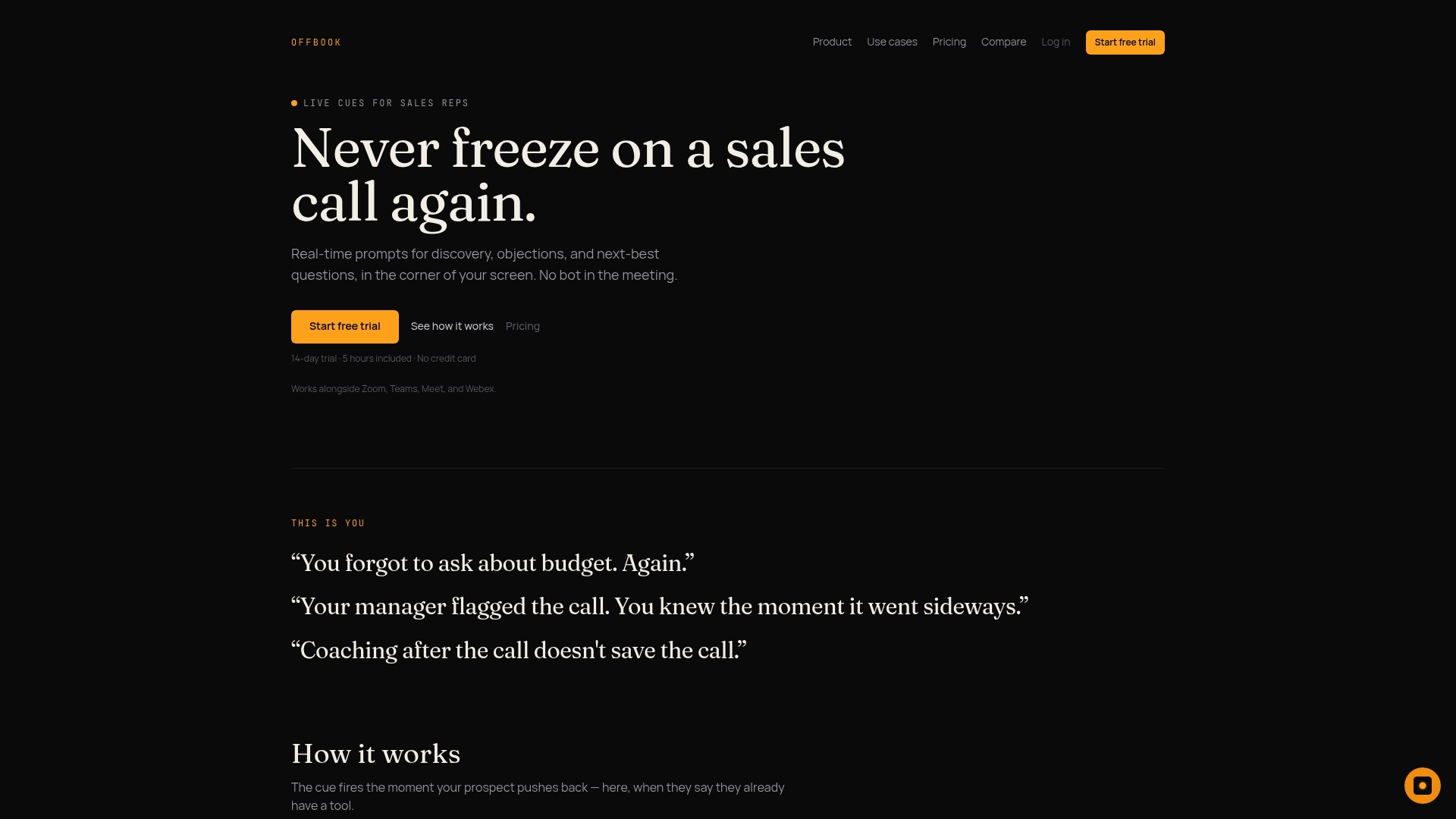
Offbook solves that problem by coaching reps live, during the call, without a bot ever joining the meeting. It listens to the conversation and surfaces on-screen prompts tied to frameworks like MEDDIC and MEDDPICC, flagging qualification gaps, suggesting the next question, and signaling when the talk ratio is drifting. Offbook also generates pre-call briefs so reps walk in prepared, not scrambling. For founder-led B2B SaaS teams at the seed and Series A stage, Offbook’s AI call coaching turns structured call training into consistent, in-the-moment execution. Sales teams using AI for sales close the gap between what reps know and what they actually do on a call.
FAQ
What is a structured sales call?
A structured sales call follows a repeatable framework that sequences discovery questions, manages talk-listen ratios, and ends with a specific next-step commitment. Frameworks like MEDDIC, SPICED, and BANT are common examples.
How many discovery questions should I ask per call?
Ask 11–14 discovery questions per call. Analysis of thousands of B2B sales calls shows this range produces a 74% success rate, while asking more than 14 questions causes close rates to drop.
What is the ideal talk-listen ratio for a sales call?
Top performers talk 43% of the time and let prospects talk 57%. Reps who talk more than 65% of the call close at significantly lower rates, according to Gong’s analysis of 25,537 sales calls.
Does structure make sales calls feel scripted?
No. Structure provides a flexible guide, not a word-for-word script. Reps who internalize a framework can adapt dynamically while still hitting the key stages that drive outcomes.
How does call structure improve sales coaching?
Documented call structure gives managers objective data to review, including question count, talk ratio, and next-step quality. Call reviews focused on these metrics improve win rates more than generic training sessions.