What Is the Next Step in a Sales Call?
Discover what is next step in sales call and how to create clear commitments. Transform vague promises into driven actions to close deals.
Published: June 23, 2026
Author: OffBook Editorial Team

The next step in a sales call is a concrete, mutually agreed action with a named owner, a specific date, and a defined deliverable that keeps the deal moving forward. Without it, calls end in vague promises and deals stall. Most sales professionals understand follow-up, but far fewer treat the next step as a co-created commitment rather than a favor they are asking. Frameworks from Sandler, ZoomInfo, and YourSalesTutor all point to the same truth: clarity at the end of a call determines whether a deal advances or drifts.
What is the next step in a sales call?
The next step is not a task you assign yourself after hanging up. It is a mutually agreed action that both parties confirm before the call ends, with a clear owner, a calendar date, and a specific outcome attached. Sandler defines it as something the buyer co-created, not something the rep imposed. That distinction matters because buyer-owned commitments are far more likely to happen.
The industry term for this practice is “advancing the sale.” The phrase “next step” is the everyday shorthand, but the concept lives inside a broader discipline of deal progression. Every call should end with a defined advance, not just a vague intention to reconnect.
A weak next step sounds like “I’ll send over some info.” A strong one sounds like “You’ll review the proposal by thursday and we’ll reconnect friday at 2 PM to discuss your questions.” The difference is accountability. One has an owner, a date, and a deliverable. The other has none of those things.

What makes a next step strong vs. weak?
YourSalesTutor’s Owner + Date + Deliverable rule is the clearest framework for evaluating any next step. If any one of those three elements is missing, the next step does not exist in any meaningful sense. A rep who says “I’ll follow up next week” has no owner on the buyer’s side, no date, and no deliverable.
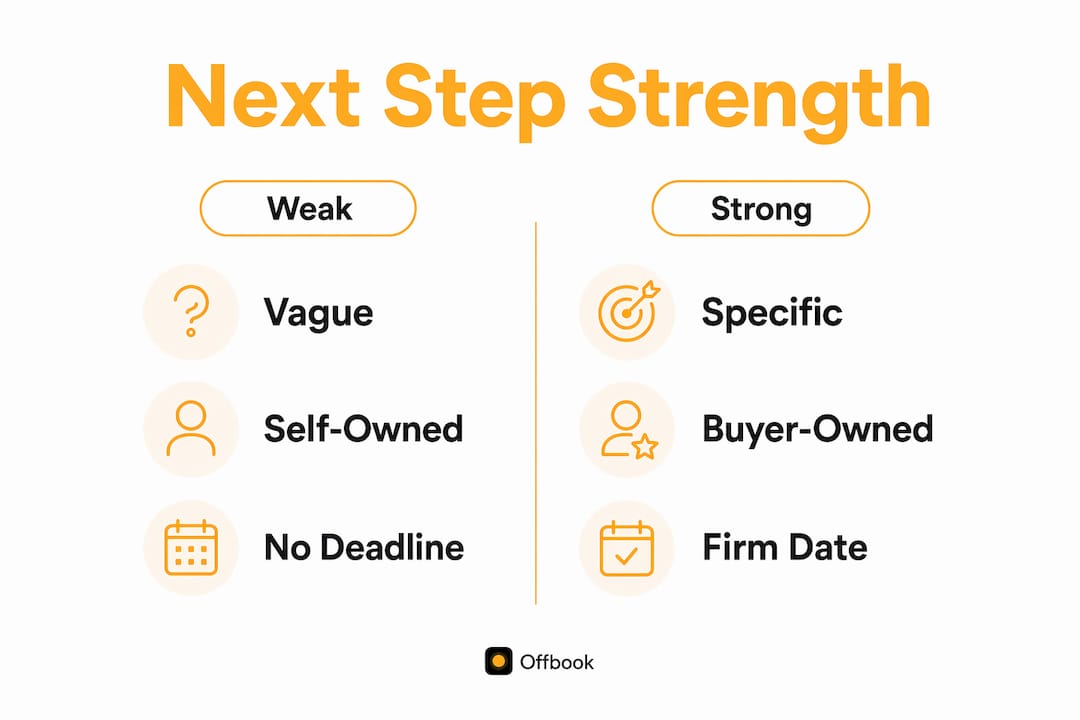
Here is how weak and strong next steps compare in practice:
| Weak next step | Strong next step |
|---|---|
| “I’ll send you some info.” | “I’ll send the proposal by Wednesday. You review it and we reconnect Friday at 10 AM.” |
| “Let’s circle back soon.” | “We schedule a 30-minute call for tuesday, march 4th, to walk through your security questions.” |
| “Reach out when you’re ready.” | “You confirm budget approval with your CFO by friday and email me the outcome.” |
| “I’ll check in next week.” | “I call you thursday at 3 PM to confirm your team’s decision.” |
ZoomInfo SVP Steven Bryerton presents the P.L.A.N. framework for wrapping up calls: Pivot, Logistics, Agenda, and Next Steps. The logistics piece covers who attends the next meeting, the date and time, and what each party is responsible for. Skipping logistics is where most reps lose the thread.
Pro Tip: “Send it over” is a deliverable you own, not a next step. The actual next step is the buyer’s review, decision, or feedback by a specific date. Always book the reconnect call before you hang up.
How do you co-create next steps during the call?
Co-creation is the practice of building the next step with the buyer rather than presenting it to them. Sandler’s approach frames the next step as a joint decision: the rep invites the buyer to shape what happens next, which increases the buyer’s sense of ownership and reduces the chance of a no-show or a ghosted email.
The mechanics of co-creation are straightforward:
- Ask the buyer what they need to move forward: “What would need to be true for you to feel confident taking this to your team?”
- Propose a specific next step and invite adjustment: “I was thinking we schedule a 30-minute technical review with your IT lead on thursday. Does that work, or would a different day be better?”
- Confirm the step out loud before ending the call: “So to confirm, you’ll share the proposal with your CFO by wednesday, and we reconnect friday at 11 AM. Does that sound right?”
- Resolve any open concerns before locking the step: do not move to next steps while the buyer still has unaddressed objections.
GradeMyClose recommends a recap, resolve, roadmap sequence for the call wrap-up. Recap what was discussed, resolve any remaining concerns, then roadmap the next moves with deadlines and accountability. That sequence prevents the common mistake of rushing to close the call before the buyer is actually aligned.
The last five minutes of any call carry disproportionate weight. ReplySequence recommends dedicating that window specifically to confirming who does what by when. Reps who treat the final minutes as a formality lose deals that were otherwise winnable.
Pro Tip: Never frame the next step as a request. Frame it as a plan with a purpose. “I’d like to suggest we…” signals confidence. “Would it be okay if maybe we…” signals uncertainty and invites the buyer to say no.
How to document and follow up on next steps after the call
Documentation is where most sales professionals lose the gains they made on the call. The best next step in the world disappears if it never makes it into your CRM. ReplySequence flags this as a “system failure”: commitments get lost not because reps forget them, but because they never logged them with task reminders and deadlines attached.
Follow these steps immediately after every call:
- Log the next step in your CRM within 15 minutes. Use dedicated task fields, not free-text notes. Set a reminder for one day before the deadline.
- Send a follow-up email within 2 hours. Grammarly and Sendspark recommend keeping it under 200 words with a single, clear call to action. Long emails dilute the next step.
- Recap in the buyer’s words. Summarize the call using the language the buyer used, not your internal sales terminology. This signals that you listened.
- Name every owner and deadline explicitly. “You will review the proposal by thursday, march 6th. I will send the technical spec sheet by wednesday, march 5th.” No ambiguity.
- Expand beyond your primary contact. Intriq highlights that multithreading stakeholders in follow-up prevents you from restarting the conversation if your contact goes dark. Copy the economic buyer or technical lead where appropriate.
The follow-up email is not a courtesy. It is the written record of the commitment both parties made. Treat it that way.
| Follow-up element | Why it matters |
|---|---|
| Sent within 2 hours | Keeps momentum while the call is fresh in the buyer’s mind |
| Under 200 words | Forces clarity and prevents the next step from getting buried |
| Single call to action | Removes ambiguity about what the buyer needs to do next |
| Named owners and dates | Creates accountability that a vague “let’s reconnect” never does |
| Stakeholder expansion | Builds relationship memory across the buying team, not just one contact |
A well-structured sales call preparation checklist can help you build the habit of planning your next step before the call even starts, so you are not improvising at the end.
What are the most common next step mistakes?
The most common mistake is ending a call with no next step at all. “Let’s circle back” is not a next step. It has no owner, no date, and no deliverable. YourSalesTutor warns that partial information causes deal drift, and deal drift is where pipelines go to die.
Watch for these specific failure patterns:
- No owner on the buyer’s side. If only the rep has an action item, the buyer has no skin in the game. The deal stalls the moment the rep stops pushing.
- Vague timing. “Next week” or “soon” are not dates. A date is “tuesday, march 11th at 2 PM EST.”
- Skipping mutual confirmation. Saying the next step out loud is not the same as the buyer agreeing to it. Confirm explicitly: “Does that work for you?”
- Treating “send it over” as the next step. Sending a document is your task. The next step is what the buyer does with it and by when.
- No preparation for the next interaction. Showing up to the follow-up call without reviewing what was agreed signals to the buyer that the commitments were not real.
How a call ends directly shapes buyer accountability and internal stakeholder engagement. A clean, confirmed next step signals professionalism. A vague close signals that the rep is not in control of the process.
The fix for most of these mistakes is simple: build a 5-minute wrap-up routine into every call. Recap, resolve, confirm the next step, and log it before you close your laptop.
Key Takeaways
The next step in a sales call is only effective when it includes a named owner, a specific date, and a defined deliverable confirmed by both parties before the call ends.
| Point | Details |
|---|---|
| Define the three components | Every next step needs an owner, a date, and a deliverable to be real. |
| Co-create with the buyer | Invite the buyer to shape the next step so they own the commitment. |
| Wrap up with structure | Use recap, resolve, and roadmap to close every call with clarity. |
| Follow up within 2 hours | Send a concise email under 200 words with one clear action item. |
| Log it immediately | Enter next steps in your CRM with task reminders before you move on. |
Why I think most reps treat next steps as an afterthought
After watching hundreds of sales calls, the pattern is consistent. Reps spend 45 minutes building rapport, qualifying the opportunity, and handling objections with real skill. Then the last two minutes arrive and everything falls apart. “I’ll send something over” becomes the close. The deal that looked promising on the call goes cold within a week.
The problem is not effort. It is that most sales training focuses on the middle of the call and treats the end as a formality. That is backwards. The end of the call is where the deal either advances or stalls. A strong discovery call structure builds toward a confirmed next step from the first question, not as an afterthought at the end.
What I have found actually works is treating the next step as a design constraint, not a closing technique. Before the call starts, I know what advance I am aiming for. That shapes every question I ask and every piece of information I share. When the wrap-up arrives, the next step feels like the natural conclusion of the conversation, not a sales move.
The reps who close the most deals are not the most persuasive. They are the most organized. They end every call with a written commitment, a date on the calendar, and a follow-up email in the buyer’s inbox before the buyer has even opened their next Slack message. That discipline compounds over a full pipeline.
— Neil
How Offbook helps you nail every next step
Offbook is built for exactly the moment when most reps lose control of the call. Its AI call coaching platform surfaces live cues during video calls, prompting reps on the right questions to ask, qualification gaps to close, and commitments to confirm, all without a bot joining the meeting.
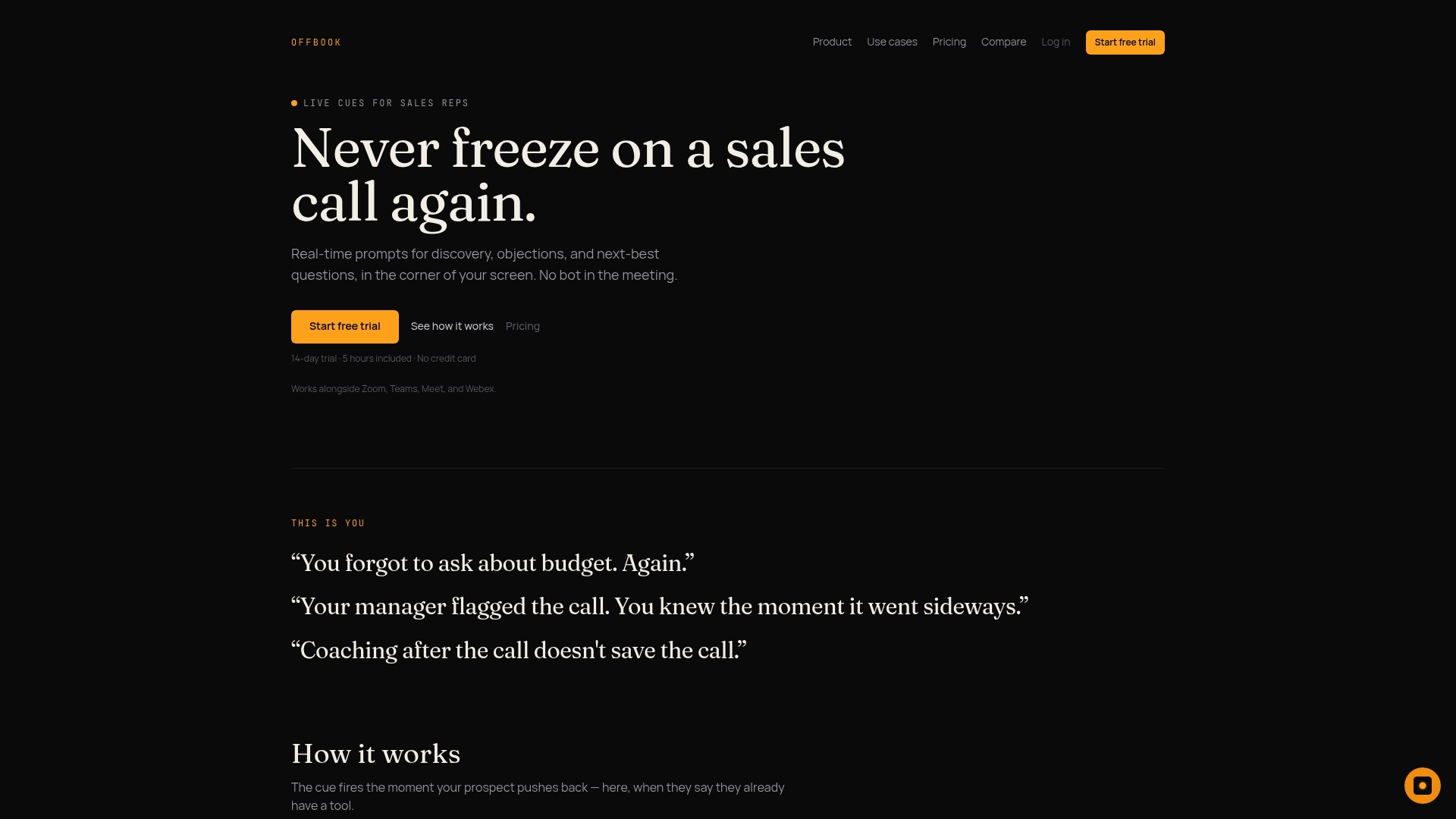
For B2B SaaS teams at the seed and Series A stage, Offbook structures calls around MEDDIC and MEDDPICC so reps never leave a call without a confirmed next step. Pre-call briefs prepare reps on the people and companies they are about to meet. The result is a rep who walks into every call knowing what advance they need and walks out with it confirmed. If you want to run more disciplined calls and close more deals, see how Offbook works.
FAQ
What is the next step in a sales call?
The next step is a mutually agreed action with a named owner, a specific date, and a defined deliverable confirmed before the call ends. Without all three elements, the deal has no clear path forward.
How do you ask for the next step without sounding pushy?
Frame it as a plan, not a request. Propose a specific next step, invite the buyer to adjust it, and confirm it out loud. Co-created next steps feel natural because the buyer helped design them.
When should you send a follow-up email after a sales call?
Send the follow-up within 2 hours of the call. Keep it under 200 words, recap the discussion in the buyer’s language, and include one clear action item with a named owner and deadline.
What is the P.L.A.N. framework for sales calls?
P.L.A.N. stands for Pivot, Logistics, Agenda, and Next Steps. ZoomInfo SVP Steven Bryerton developed it to give reps a structured way to wrap up calls with clear accountability and defined follow-through.
Why do deals stall after a sales call?
Deals stall when the call ends without a confirmed next step. Vague closes like “let’s circle back” leave no owner, no date, and no deliverable, so neither party has a reason to act before the other one does.