Sales Rep Onboarding: A Practical Guide for Managers
Discover effective sales rep onboarding strategies to boost performance, reduce ramp time, and increase quota attainment in your team.
Published: August 10, 2026
Author: OffBook Editorial Team

Sales rep onboarding is the structured process that takes a new seller from hire date to independent, revenue-producing rep. It is not HR orientation, and it is not a one-time product training. Done well, it compresses ramp time, raises 90-day quota attainment, and cuts early attrition before it costs you an entire recruiting cycle.
The five essentials every program needs:
- Preboarding: system access, pre-work, and context before day one
- Curriculum and certification: structured learning with a pass condition, not just attendance
- Role-specific practice: recorded role-plays, discovery drills, and objection handling tied to your actual ICP
- Tools access and CRM basics: scoped to pipeline actions, not every feature
- Everboarding: ongoing reinforcement after the formal program ends
Timeline reality: most B2B SaaS reps need 60–90 days to reach first revenue and 90–120 days to hit consistent quota. The exact window depends on deal complexity, not the calendar. The concept worth knowing here is the competency gate: a rep advances when they can demonstrate a skill, not when a week ends.
Key Takeaways
Effective sales rep onboarding requires a structured curriculum with competency gates, a 30/60/90 milestone framework, and ongoing reinforcement to drive measurable ramp outcomes.
| Point | Details |
|---|---|
| Start with architecture, not a bootcamp | Design curriculum, certification, and measurement before the first rep starts. |
| Use competency gates, not calendar dates | Advance reps when they can demonstrate a skill, not when a week ends. |
| Measure three signal types | Combine activity, competency, and revenue signals in a single weekly ramp scorecard. |
| Reinforce after the formal program ends | Spaced practice and everboarding prevent skill decay past the 30-day mark. |
| Offbook coaches reps live during calls | Real-time cues during video calls accelerate ramp without adding manager time. |
Table of Contents
- Why sales rep onboarding matters to your revenue and retention
- The core phases of a sales onboarding program
- How to build a 30–60–90 day onboarding plan
- Your sales onboarding checklist, grouped by timeframe
- KPIs and scorecards that measure onboarding success
- Best practices that accelerate ramp and mistakes that kill it
- Which tools support a modern sales onboarding program
- How real-time call coaching shortens ramp
- What enablement teams actually prioritize during onboarding
- Offbook can coach your new reps live, from day one
- Sources
Why sales rep onboarding matters to your revenue and retention
The business case is straightforward. A rep who ramps two weeks faster is generating pipeline two weeks sooner. Multiply that across a class of four new hires and you have recovered a meaningful amount of selling time before the quarter closes.
Structured onboarding programs translate directly to lower early attrition and higher quota attainment compared to ad-hoc orientation. The functions that benefit go beyond sales: enablement gets a repeatable program they can improve each cycle; finance gets a more predictable ramp curve; product gets earlier, better-quality feedback from reps who actually understand the positioning; and customers get a rep who arrives prepared rather than learning on them.
Pro Tip: When pitching onboarding investment to leadership, frame it in ramp cost, not training hours. Calculate the fully-loaded cost of one extra month of ramp (salary, benefits, lost pipeline) and the math usually closes the conversation fast.
The Gartner analysis of sales training and coaching technology reinforces this: tying onboarding to measurable revenue outcomes, not just activity completion, is what separates programs that move the number from programs that just check a box.
The core phases of a sales onboarding program
Apollo’s architecture-first framework treats onboarding as a designed curriculum aligned to segment and motion, not a two-week bootcamp followed by silence. Here is how the phases break down in practice.
1. Preboarding (before day one)
Objective: Remove friction so the rep can learn on day one instead of waiting for a laptop.
Activities: Send system access requests, share a pre-work packet (company deck, ICP overview, top three competitor positioning cards), and assign a buddy or mentor. Owner: IT + enablement. Do: get Salesforce or HubSpot access live before the first morning. Don’t: dump a 40-page handbook and call it preparation.
2. Curriculum and classroom (days 1–14)
Objective: Build foundational knowledge of product, market, process, and methodology.
Activities: Product demos, competitive landscape review, sales methodology training (MEDDIC, MEDDPICC, or your chosen framework), and ICP deep-dives. Allston Labs recommends sequencing this as pre-work, live sessions, collateral review, and drilling before any certification attempt. Owner: enablement. Do: use recorded sessions so reps can revisit. Don’t: schedule eight hours of slides per day.
3. Role-specific practice and certification (days 10–25)
Objective: Verify the rep can execute, not just recall.
Activities: Recorded role-plays graded against a rubric, live objection-handling drills, and a certification scenario (e.g., run a qualified discovery call with a manager playing the buyer). Certification is the competency gate: the rep does not move to shadowing until they pass. Owner: enablement + manager. Do: use a consistent rubric so feedback is fair. Don’t: pass everyone automatically because the calendar says it is time.
4. Shadowing and ride-alongs (days 15–30)
Objective: Bridge classroom to real selling through observation and guided participation.
Activities: Shadow two to three live calls per week, debrief with the manager or mentor after each, and take over one section of a call (discovery questions, for example) before running a full call independently. LeadSquared’s onboarding template recommends role-appropriate ride-alongs before independent selling begins. Owner: manager + mentor. Do: debrief within 24 hours while the call is fresh. Don’t: let shadowing become passive observation with no accountability.
5. Live selling with manager backup (days 25–60)
Objective: Generate first pipeline under a safety net.
Activities: Rep runs their own calls with manager available for backup, submits first opportunities to CRM, and completes a post-call self-assessment after each. The sales call preparation checklist becomes a daily habit here. Owner: manager. Do: review the first five deals together. Don’t: disappear and assume the rep is fine.
6. Everboarding (month 3 onward)
Objective: Prevent skill decay and keep the rep current as product and market evolve.
Activities: Monthly skill refreshers, updated competitive cards, quarterly certification re-checks, and spaced practice on new objections. The forgetting curve research shows most unreinforced training is forgotten within 30 days, which is the core argument for treating onboarding as continuous rather than time-boxed. Owner: enablement. Do: build a content library the rep can pull from just in time. Don’t: treat graduation from the formal program as the end of enablement.
Note on role-specific sequencing: A new grad needs more time in phases 2 and 3. An experienced enterprise hire may compress phases 2 and 3 to five days and move faster to live selling, but should still pass the same certification gate.
How to build a 30–60–90 day onboarding plan
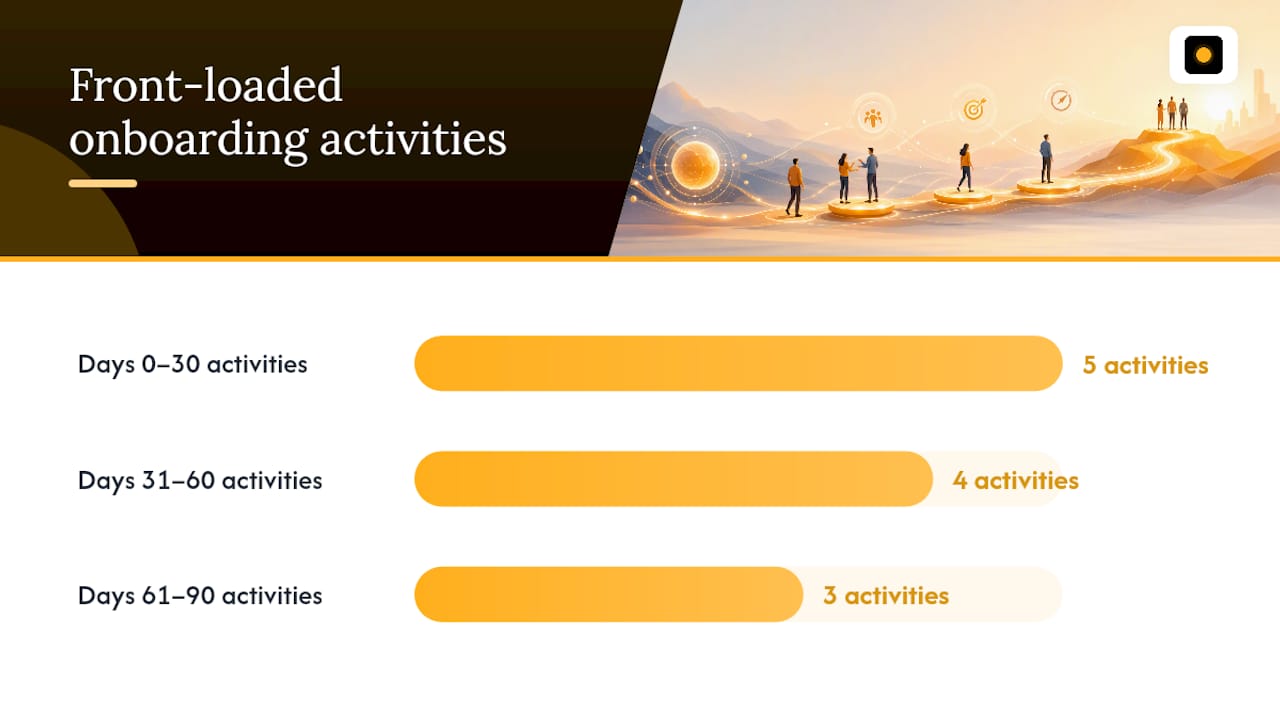
A 30/60/90 framework mapped to KPIs gives managers a coachable milestone structure instead of a vague ramp window. The table below shows milestone goals, example KPIs, and go/no-go checkpoints for each phase.
| Phase | Milestone goal | Example KPIs | Go/no-go checkpoint |
|---|---|---|---|
| Days 0–30 | Foundation complete, certified on discovery | Certification passed; first shadow call completed; CRM set up with 10+ accounts | Can the rep run a qualified discovery call independently? |
| Days 31–60 | First pipeline generated, methodology applied | First opportunity created; 3+ discovery calls logged; activity-to-opportunity conversion tracked | Has the rep generated at least one qualified opportunity? |
| Days 61–90 | Independent selling, quota progress visible | 30% of 90-day quota attainment; pipeline coverage at 3x quota; call-to-demo conversion rate established | Is the rep on track for quota attainment by day 90? |
Milestone activities by phase:
- Days 0–30: Complete pre-work packet, attend all curriculum sessions, pass discovery certification, shadow three live calls, set up CRM pipeline view
- Days 31–60: Run first five discovery calls independently, submit first opportunities, complete a recorded objection-handling drill, debrief weekly with manager
- Days 61–90: Carry a partial quota, run full sales cycles with manager available for escalation, complete a 90-day self-assessment
Competency-gated programs consistently outperform time-based advancement. If a rep cannot pass the discovery certification by day 25, the answer is targeted coaching, not advancing them to live selling on schedule.
Compressing or expanding the timeline: For experienced hires, compress days 0–30 to two weeks by skipping foundational product content they can pre-read and fast-tracking to certification. For enterprise cycles with 90-day average deal lengths, extend the live-selling phase through month 4 and adjust quota expectations proportionally.
Your sales onboarding checklist, grouped by timeframe
A structured checklist keeps every stakeholder accountable and removes the coordination gaps that slow ramp. Assign an owner to every item before the rep starts.
Preboarding (before day one) — Owner: IT + enablement
- CRM access provisioned and tested
- Email, Slack, and video conferencing accounts created
- Pre-work packet sent (ICP overview, product one-pager, top objections doc)
- Buddy or mentor assigned and briefed
- First-week calendar blocked with sessions
Week 1 — Owner: enablement
- Complete product and market curriculum sessions
- Review competitive positioning cards
- Attend first shadow call with debrief
- Complete CRM basics training (pipeline-relevant fields only)
- Read the sales playbook and flag questions
Weeks 2–4 — Owner: manager + enablement
- Complete recorded role-play (discovery call scenario)
- Pass discovery certification with rubric score above threshold
- Shadow two additional live calls
- Take over one section of a live call (with manager present)
- Set up personal pipeline view in CRM with first 10 target accounts
Months 2–3 — Owner: manager
- Run first five independent discovery calls
- Submit first qualified opportunities to CRM
- Complete weekly one-on-one with call review
- Complete sales rep self-assessment at day 60 and day 90
- Attend first everboarding session (product update or new objection drill)
Track completion in your LMS if you have one. A shared Google Sheet with owner columns works fine for teams under ten reps. The key is that every item has a named owner and a due date, not just a checkbox.
KPIs and scorecards that measure onboarding success
Measuring activity alone (calls made, emails sent) tells you a rep is busy. Measuring outcomes tells you whether the program is working. Tying onboarding metrics to revenue outcomes is what separates a scorecard from a participation trophy.
| Metric | What it measures | Target range | Warning sign |
|---|---|---|---|
| Time-to-first-revenue | Days from start date to first closed deal | Varies by cycle length | No pipeline by day 45 |
| Time-to-qualified-discovery | Days until rep passes discovery certification | Days 20–25 | Failing certification twice |
| 90-day quota attainment | % of quota hit in first 90 days | 30% | Below 20% by day 90 |
| Activity-to-opportunity conversion | % of outreach that becomes a qualified opp | Benchmark against tenured reps | Significantly below team average |
| Call quality score | Rubric score on recorded calls | Above certification threshold | Declining scores after week 4 |
Building a ramp scorecard: Combine three signal types into a single weekly view: activity signals (calls, emails, meetings booked), competency signals (certification status, call quality scores), and revenue signals (pipeline created, opportunities advanced). A rep who is high on activity but low on competency needs coaching on skill, not motivation. A rep low on activity but high on competency may have a territory or targeting problem.
Reporting cadence:
- Weekly check-ins for the first 30 days, focused on certification progress and early call quality
- Biweekly reviews from days 31–90, focused on pipeline health and conversion rates
- Monthly scorecard review with enablement and manager together through month 3
Early warning signs and corrective actions:
- No pipeline by day 45: revisit ICP targeting and prospecting sequence
- Failing certification twice: assign targeted coaching sessions before re-attempting
- Call quality declining after week 4: schedule a live call review with manager and check for skill regression
- Activity high but conversion low: review discovery call recordings for qualification gaps
For a deeper look at rep accountability frameworks, the same scorecard logic applies beyond onboarding.
Best practices that accelerate ramp and mistakes that kill it
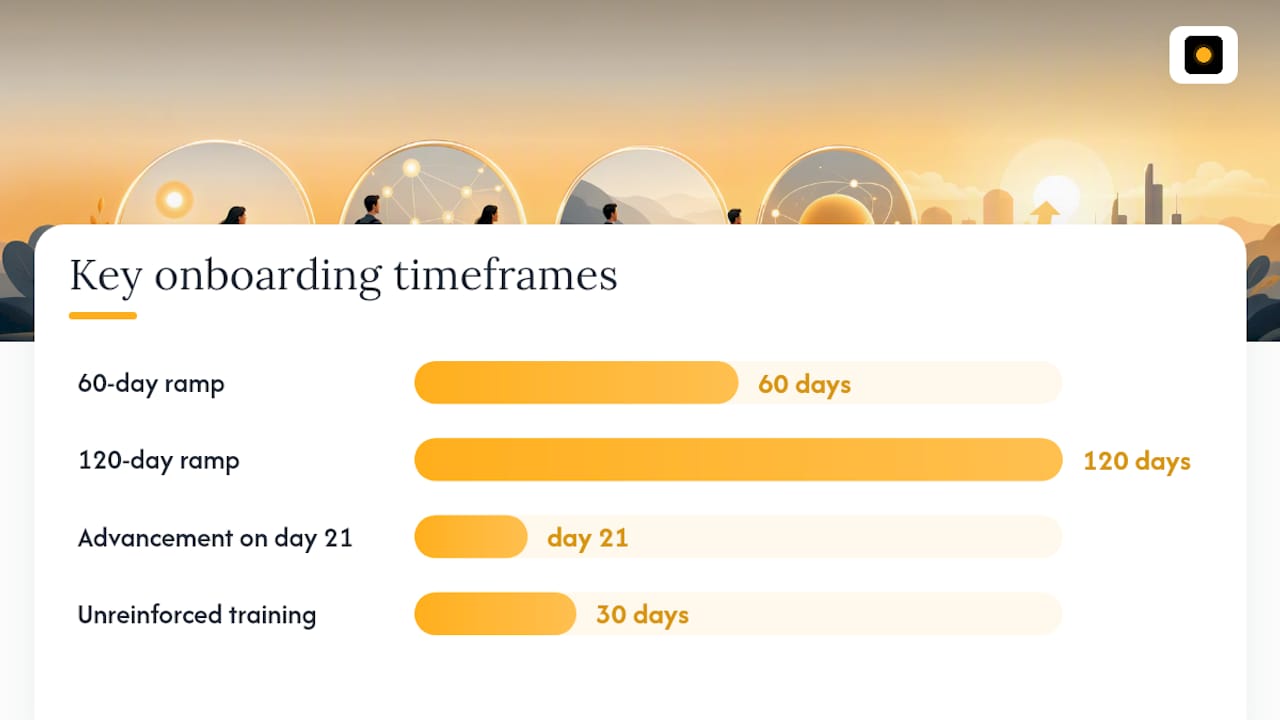
The gap between a 60-day ramp and a 120-day ramp usually comes down to a handful of structural decisions made before the rep starts.
Architecture-first vs. the bootcamp trap. Most programs fail because they are built as a two-week information dump followed by a sink-or-swim handoff. Architecture-first onboarding aligns curriculum, certification, and measurement to your specific segment and motion. The bootcamp model treats every rep the same regardless of experience, role, or territory. The result is predictable: experienced hires are bored, new grads are overwhelmed, and nobody retains much.
Competency gates vs. calendar advancement. Advancing a rep to live selling because it is day 21 is one of the most common and costly mistakes in sales onboarding. Competency-gated programs measure demonstrated readiness. The gate does not have to be elaborate: can the rep run a qualified discovery call without prompting? If yes, advance. If no, coach and re-test.
Everboarding vs. one-and-done training. The forgetting curve is not a metaphor. Most unreinforced training is gone within 30 days. Spaced reinforcement, monthly skill refreshers, and updated competitive content are not nice extras. They are the difference between a rep who can handle a new objection in month four and one who reverts to the script they half-remember from week one.
Pro Tip: Build a “compression path” for experienced hires from day one. Let them test out of foundational modules by passing the certification gate early. It respects their experience, keeps them engaged, and gets them to live selling faster without skipping the quality check.
Three more manager-level practices worth building in:
- Run a weekly 30-minute call review in the first month, not a status update. Listen to a real call together and give specific feedback against the rubric.
- Set certification standards before the first rep starts, not after. Retroactive standards feel arbitrary and erode trust.
- Trigger role-specific content automatically. An SDR and an AE share some curriculum but need different certification scenarios, different CRM workflows, and different ride-along structures.
Which tools support a modern sales onboarding program
The tech stack for onboarding does not need to be complex, but each category serves a distinct function. Gaps in the stack usually show up as gaps in the scorecard.
CRM (Salesforce, HubSpot, Pipedrive). The CRM is where ramp becomes visible. Scope onboarding to pipeline-relevant fields and workflows only: account creation, opportunity stages, activity logging, and forecast categories. LeadSquared’s onboarding guidance specifically recommends targeting CRM training to pipeline actions rather than every feature, which cuts the learning curve significantly.
LMS (Lessonly, Seismic Learning, Docebo). An LMS delivers curriculum, tracks completion, and hosts certification scenarios. For teams under 20 reps, a lightweight option works fine. The integration priority is a single source of truth: completion data from the LMS should feed the ramp scorecard, not sit in a separate system nobody checks.
Enablement platform (Highspot, Showpad). Enablement platforms host the content library: playbooks, competitive cards, objection-handling guides, and product one-pagers. The onboarding use case is just-in-time delivery: a rep about to run their first discovery call should be able to pull the relevant talk track in 30 seconds, not search through a shared drive.
Call recording and coaching (conversation intelligence tools). Recorded calls are the raw material for certification and ongoing coaching. Managers can review calls asynchronously, leave timestamped comments, and build a library of great and poor examples. For AI sales assistants that go beyond recording, real-time coaching tools surface live cues during the call itself, which is a different category entirely.
Analytics and reporting. Whether it is a CRM dashboard, a spreadsheet, or a dedicated analytics layer, you need a place where activity, competency, and revenue signals come together in one view. Without it, the ramp scorecard is a concept, not a tool.
How real-time call coaching shortens ramp
Post-call feedback is valuable. Live coaching during the call is faster. The practical difference: a rep who hears “ask about budget authority now” as an on-screen cue during a discovery call learns the behavior in context, not in a debrief 24 hours later.
Practitioner experience across early-stage B2B SaaS teams points to the same pattern: new reps who receive in-call prompts on qualification gaps, objection handling, and next-step questions close their first deals faster and with fewer coaching cycles than reps who rely on post-call review alone. The mechanism is straightforward. Real-time feedback ties the correction to the moment it matters, which is exactly what the forgetting curve research predicts: learning sticks when it is applied immediately.
Pilot blueprint for live coaching during onboarding:
- Scope: Three to five new reps in their first 60 days
- Evaluation window: Four to six weeks
- Success criteria: Improvement in call quality scores, reduction in time-to-qualified-discovery, and manager-reported reduction in post-call coaching time
- Privacy and consent: Inform all call participants that AI assistance is active; configure consent settings before the pilot begins; document your process
Pro Tip: Measure manager time saved, not just rep performance. If managers spend 30% less time on post-call coaching because the rep self-corrected during the call, that is a concrete ROI signal you can take to leadership.
For teams building a sales coaching program from scratch, live coaching tools work best when they are layered on top of a structured curriculum, not used as a substitute for one.
What enablement teams actually prioritize during onboarding
Three things consistently separate programs that work from programs that look good on paper.
Curriculum readiness before the rep starts. The most common failure mode is not a bad program. It is an incomplete one: the playbook is 60% done, the certification rubric does not exist yet, and the first week is improvised. Reps notice. The fix is simple: nothing goes live until the curriculum, the certification gate, and the first-week calendar are complete. That means building the program before you post the job, not after you make the offer.
Manager coaching as a program component, not an afterthought. Enablement can build the best curriculum in the world and still lose to a manager who does not debrief calls, skips one-on-ones, or advances reps because they like them. The manager’s role in onboarding is specific: run weekly call reviews, enforce the certification gate, and escalate to enablement when a rep is stuck. That role needs to be written down and agreed to before the rep starts.
Certification gates that mean something. A certification that everyone passes on the first try is not a gate. It is a formality. Set the bar at the level of a real discovery call with a real buyer, use a rubric the rep can see in advance, and give specific feedback when someone does not pass. The goal is not to fail people. It is to send only prepared reps to live prospects.
The balance between standardization and individual differentiation matters here. A new grad and a ten-year enterprise veteran should follow the same certification standard but take different paths to get there. The experienced hire compresses the curriculum; the new grad gets more drilling time. The gate is the same. The journey to it is not.
Offbook can coach your new reps live, from day one
Most onboarding programs invest heavily in pre-call preparation and post-call review, then leave reps on their own during the actual call. That is the gap where deals slip and bad habits form.
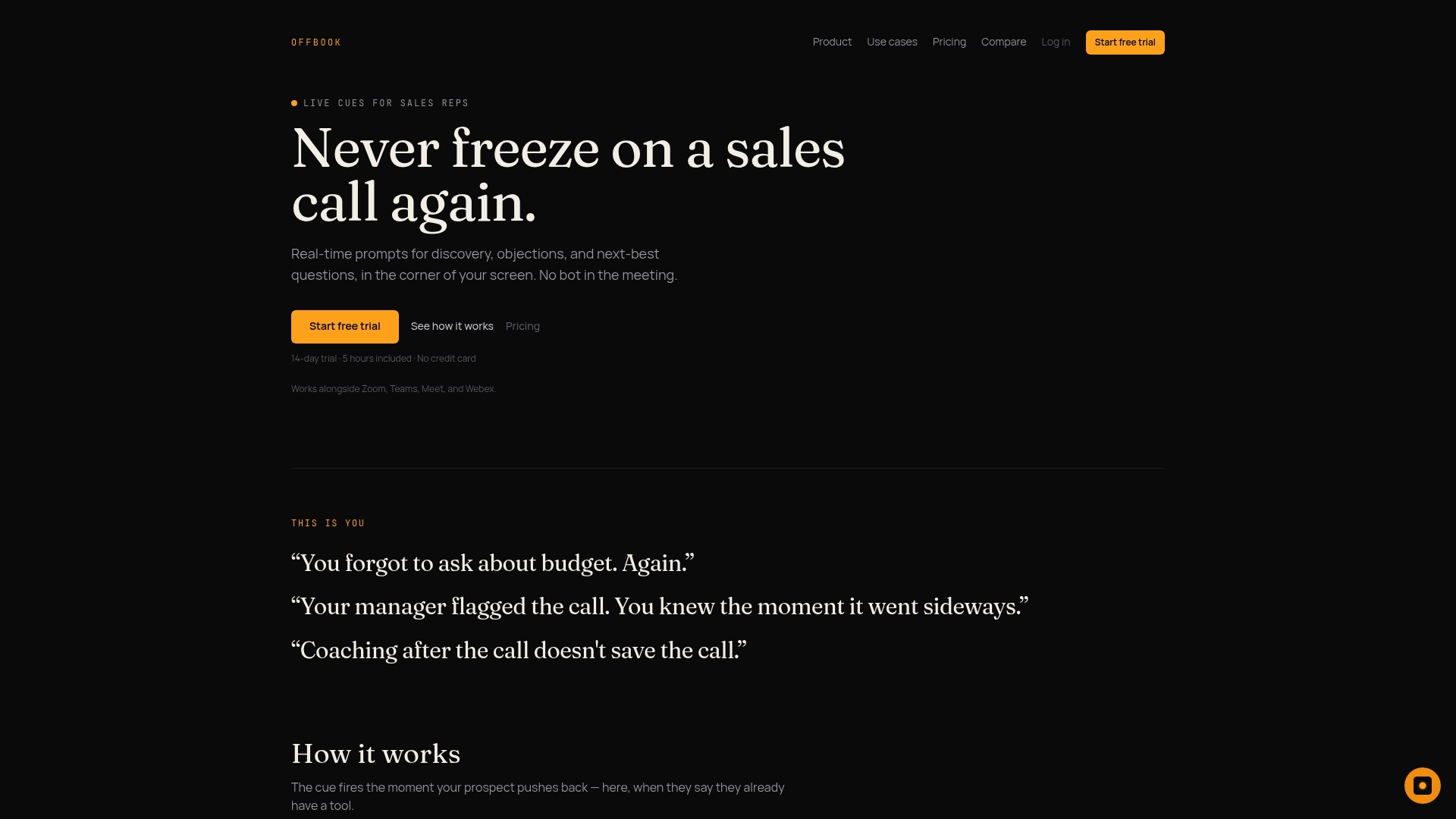
Offbook fills that gap with real-time AI coaching during video calls. No bot joins the meeting. Instead, Offbook listens and surfaces live on-screen cues: qualification gaps to close, objections to handle, and questions to ask, all structured around MEDDIC and MEDDPICC. Before the call, reps get a pre-call brief on the company and the people they are meeting. After it, they get an instant debrief and follow-up draft. For a new rep in their first 60 days, that combination means every call is a coached call, not just the ones where a manager happens to be listening.
Running a pilot is straightforward: scope it to three to five reps in their first 60 days, run it for four to six weeks, and measure call quality scores, time-to-qualified-discovery, and manager coaching time. Set up consent infrastructure before you start. The Offbook sales coaching platform supports role-specific profiles, so SDRs and AEs get different cue sets from day one. Founders running their own sales motion can start at Offbook. Start a free trial and run the pilot against your current 30/60/90 scorecard.
Sources
The sources below are the most useful references for managers building or improving a sales onboarding program.
- What Is Sales Onboarding? Architecture-First Guide | Apollo
- 30-60-90 Day Sales Ramp Program: Stop Training Your Best Hires Out of What Made Them Great
- Sales rep onboarding checklist: 17 steps to ramp faster | AlphaRun
- The Onboarding Curriculum — Pre-Work to Certification to Ride-Alongs — Allston Labs
- Forgetting curve (Auburn engineering PDF)
- The evolution of sales training and coaching technology | Gartner
- Sales Onboarding: Preparing New Hires For Success Template | LeadSquared
- A strong sales rep onboarding plan goes beyond product training | Gain