What Is a Sales Process? A B2B Team Guide
Discover what is sales process and learn how a structured approach boosts your B2B team's efficiency and closes more deals.
Published: June 22, 2026
Author: OffBook Editorial Team

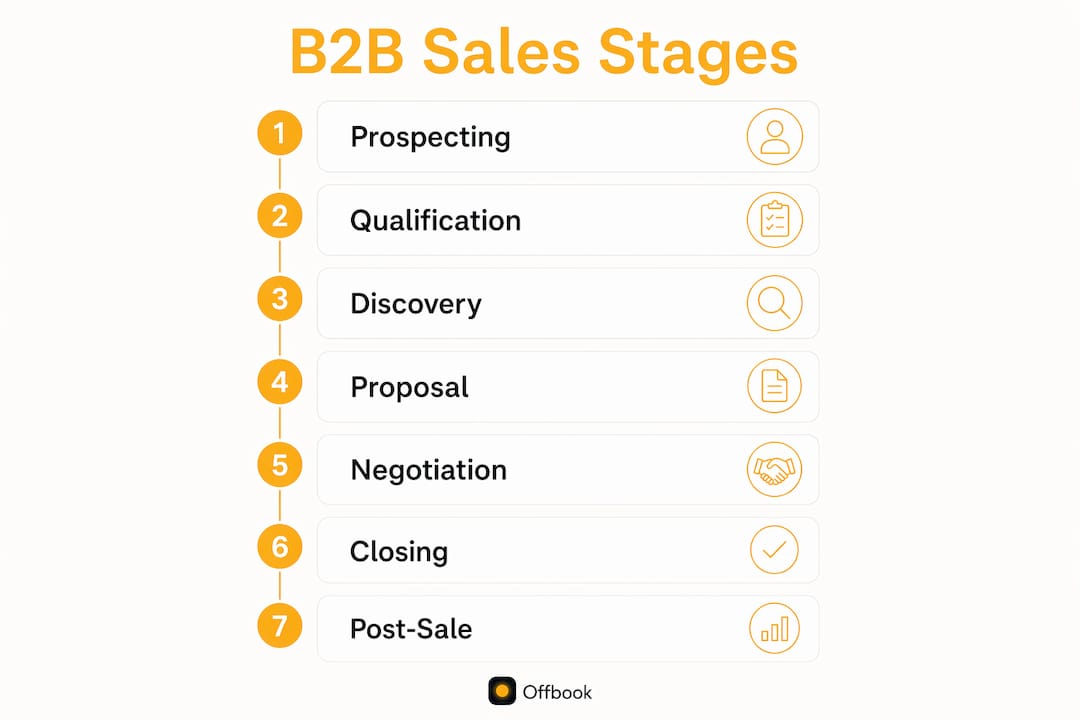
A sales process is a repeatable, step-by-step sequence of actions a sales team takes to move a prospect from initial awareness to a signed contract, including post-sale nurturing. The term is often used interchangeably with “sales methodology” or “sales cycle,” but each concept means something different. Salesforce, Zendesk, and DealHub all describe the core sales process stages consistently: prospecting, qualification, discovery, proposal, negotiation, closing, and post-sale nurturing. Getting this definition right is the foundation of every forecast, coaching conversation, and pipeline review your team will ever run.
What is a sales process in B2B, and why does it matter?
A sales process gives your team a shared map. Without one, every rep invents their own path, and your pipeline data becomes noise. A well-defined sales process improves predictability by standardizing stage goals, entry and exit rules, and expected outcomes for every deal. That predictability is what separates teams that hit quota consistently from those that scramble at the end of every quarter.
The sales process definition also matters for onboarding. A new rep who joins a team with a documented process can ramp faster because the steps are explicit. They know what to do at each stage, what evidence to gather, and what needs to happen before a deal advances. Without that structure, ramp time stretches and early deals get lost to avoidable mistakes.

For sales leaders, a defined process is the only way to coach at scale. When every rep follows the same stages, you can identify exactly where deals stall and fix the root cause instead of guessing.
What are the core stages of a B2B sales process?
Salesforce, Zendesk, and DealHub describe a consistent seven-stage model for B2B sales. Each stage has a distinct goal and a clear handoff point to the next.
- Prospecting. Reps identify potential buyers through outbound outreach, referrals, inbound leads, or social selling on LinkedIn. The goal is to build a pipeline of qualified targets.
- Lead qualification. Reps assess whether a prospect is worth pursuing. Frameworks like BANT and MEDDIC provide objective criteria: budget, authority, need, timeline, and for MEDDIC, the economic buyer and decision process.
- Discovery. Reps run structured conversations to uncover the buyer’s pain points, goals, and constraints. This stage produces the insight that makes every later conversation relevant.
- Presentation or demo. Reps show how the product or service solves the specific problems uncovered in discovery. A generic pitch here wastes the work done in stage three.
- Proposal. Reps deliver a formal offer with pricing, scope, and terms. The proposal should reflect what the buyer said they needed, not a standard template.
- Negotiation and closing. Reps handle objections, adjust terms if needed, and move toward a signed contract. This stage ends when the deal is won or formally lost.
- Post-sale nurturing. Reps or customer success teams onboard the new customer, track adoption, and identify expansion opportunities.
Pro Tip: Map each stage to a specific buyer action, not just a rep action. “Sent proposal” is a rep action. “Buyer confirmed budget and timeline” is a buyer action. Buyer actions are far more reliable signals of real progress.
The importance of a sales process becomes clearest at stages three and seven. Discovery is where most reps underinvest, and post-sale nurturing is where most teams stop tracking entirely. Both gaps cost revenue.
How does a sales process differ from a sales methodology and a sales cycle?
These three terms describe related but distinct things. Mixing them up creates confusion in training, forecasting, and CRM design.
- Sales process defines the what: the specific stages a deal moves through and the exit criteria required to advance. It is the structural backbone of your sales operation.
- Sales methodology defines the how: the tactics, questions, and philosophies reps use within each stage. SPIN Selling, Challenger Sale, and MEDDIC are methodologies. They inform behavior inside the process but do not replace it.
- Sales cycle refers to time: the duration from first meaningful contact to close. An enterprise sales cycle may run six months or longer. An SMB deal may close in two weeks. Both can follow the same seven-stage process.
The practical implication: your process stays stable across deal types, but your methodology and cycle length adapt. A rep selling a $200,000 enterprise contract uses the same stages as a rep closing a $5,000 SMB deal. The tactics, depth of discovery, and number of stakeholders differ. The process does not.
Pro Tip: When building a sales training program, separate process training from methodology training. Teach the stages first. Then teach how to execute within each stage using your chosen methodology.
Salesforce and Zendesk both highlight this distinction as a common source of confusion for growing sales teams. Getting it right early prevents costly retraining later.
Why are stage exit criteria critical for a healthy pipeline?
Exit criteria are the specific, objective conditions a deal must meet before it advances to the next stage. Without them, reps move deals forward based on optimism rather than evidence.
The consequences are predictable. Pipelines fill with stalled deals. Forecasts miss. Managers spend one-on-ones debating whether a deal is real instead of coaching on how to close it. Sendspark research identifies skipping stages without meeting exit criteria as one of the most common pipeline problems in B2B sales.
Strong exit criteria look like this:
| Stage | Weak criterion | Strong exit criterion |
|---|---|---|
| Qualification | “Had a good call” | Confirmed budget range, identified economic buyer |
| Discovery | “Understood their needs” | Documented three specific pain points in the buyer’s words |
| Proposal | “Sent the deck” | Buyer confirmed they reviewed it with their team |
| Closing | “Following up” | Verbal agreement on terms, legal review started |
The difference between weak and strong criteria is verifiability. A manager can check whether the economic buyer was identified. They cannot check whether a call “went well.”
Pro Tip: Write exit criteria as questions the rep must answer with evidence, not checkboxes they can tick without proof. “Who is the economic buyer and what did they say about budget?” forces a real answer.
Salesforce emphasizes that exit criteria are the mechanism that turns a documented process into a working one. Without them, the process exists on paper only.
How do you embed the sales process into your CRM and daily workflows?
A sales process that lives in a slide deck gets ignored within 90 days. The only way to make it stick is to build it into the tools reps use every day. Embedding exit criteria as required fields in your CRM prevents reps from advancing a deal without capturing the evidence that the stage was actually completed.
Practical steps for CRM integration:
- Map each stage to a CRM pipeline stage. The names should match exactly so there is no ambiguity between what the process says and what the system shows.
- Make exit criteria fields required. If the economic buyer must be identified before a deal moves to “Proposal,” the CRM should not allow that stage change without a completed field.
- Build pipeline health reports. Track how long deals sit at each stage. Deals that stall in the same stage repeatedly signal a coaching problem, not a market problem.
- Use stage data in forecast calls. Replace “I think this deal will close” with “This deal has a confirmed economic buyer, a signed NDA, and a legal review in progress.” Data replaces gut feel.
Consistent CRM mapping also separates pipeline stages from forecast categories. Many teams conflate the two, which produces forecasts that are neither accurate nor useful. A deal in “Proposal” is not automatically a forecast commit. The exit criteria tell you whether it is.
The early-stage B2B sales motion for seed and Series A companies often skips this step because it feels like overhead. It is not. It is the difference between a repeatable process and a collection of individual rep habits.
What adjustments should B2B teams make for enterprise vs. SMB deals?
The seven-stage process applies across deal types, but the depth and complexity of each stage changes significantly based on deal size and buyer complexity.
For enterprise deals, the discovery stage expands. A single buyer becomes a buying committee with five to ten stakeholders, each with different priorities and veto power. MEDDIC’s Decision Process component specifically addresses this: reps must map the formal procurement steps, identify the champion, and understand how the organization makes decisions internally. Skipping this in an enterprise deal is the fastest path to a deal that stalls at legal for six months.
Key adjustments by deal type:
- Enterprise deals: Add a stakeholder mapping step inside discovery. Track each stakeholder’s role, concern, and level of support. Use MEDDIC or MEDDPICC to structure qualification.
- SMB deals: Compress the timeline but keep the stages. A two-week SMB deal still needs qualification, discovery, and a proposal. Skipping discovery because the deal is small is how you lose to a competitor who asked better questions.
- Product-led growth (PLG) motions: The process starts later, after the buyer has already tried the product. Discovery focuses on expansion triggers rather than initial pain points.
Enterprise B2B buying involves formal and informal decision layers that most reps underestimate. The rep who maps both wins more often than the rep who only talks to the main contact.
Forecasting accuracy also depends on this calibration. A deal that looks like a two-week SMB close but actually involves a procurement committee is a six-month enterprise deal in disguise. Exit criteria catch this mismatch early.
Key Takeaways
A defined sales process with clear exit criteria at every stage is the single most reliable way to improve forecast accuracy and coaching effectiveness in B2B sales.
| Point | Details |
|---|---|
| Sales process definition | A repeatable sequence of stages from prospecting to post-sale nurturing, shared across the entire team. |
| Process vs. methodology | The process defines the stages; methodologies like MEDDIC or SPIN define how reps act within them. |
| Exit criteria matter | Objective, verifiable criteria at each stage prevent pipeline stagnation and bad forecasts. |
| CRM integration is non-negotiable | Required fields and stage-locked workflows are what turn a documented process into a practiced one. |
| Adjust depth, not structure | Enterprise deals need deeper discovery and stakeholder mapping; the seven stages themselves stay constant. |
What I’ve learned from watching sales processes break in practice
The most common failure mode is not a bad process. It is a process that exists in a document but not in behavior. I have seen teams with beautifully designed seven-stage processes where every rep still runs deals their own way because no one enforced the exit criteria in the CRM.
The second most common failure is confusing methodology with process. A team adopts MEDDIC and thinks they now have a sales process. They do not. MEDDIC tells reps how to qualify. It does not tell them what stages a deal moves through or what evidence is required to advance. Without the structural backbone of a process, MEDDIC becomes a qualification checklist that gets applied inconsistently.
The fix is less glamorous than most sales leaders want to hear: build the exit criteria, put them in the CRM, and inspect them on every pipeline review. Leadership attention is the enforcement mechanism. When managers stop asking “how do you feel about this deal?” and start asking “what did the economic buyer say about budget?”, behavior changes fast.
The teams I have seen scale successfully treat their sales coaching programs as a direct extension of their process. Coaching is not a separate activity. It is what happens when a manager reviews stage data and asks the right questions about why a deal is stuck.
— Neil
How Offbook reinforces your sales process on every call
A defined process only creates value when reps execute it consistently in live conversations. That is where most teams lose the gains they built in planning.
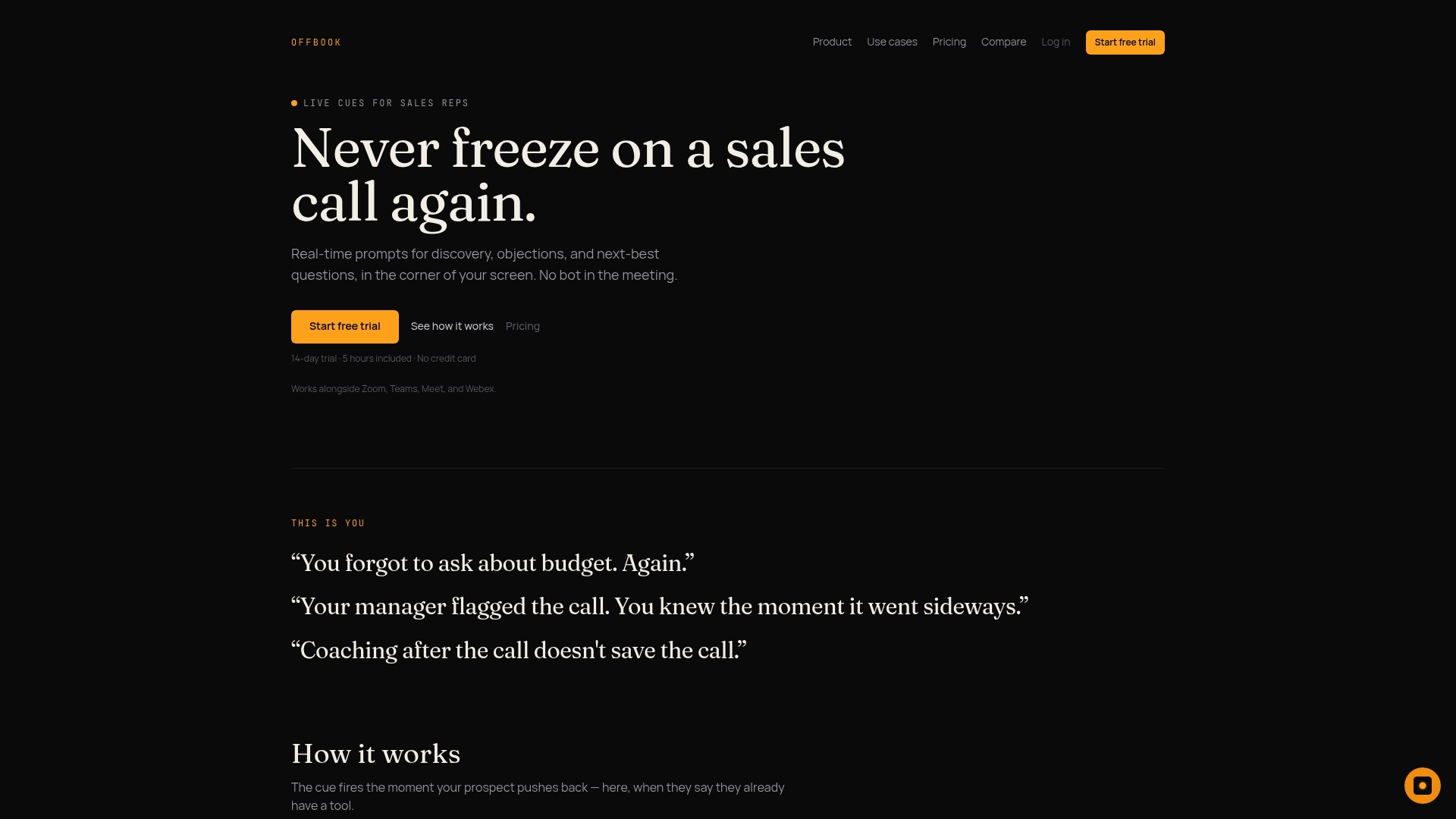
Offbook is AI call coaching for sales teams that surfaces live cues during video calls, without a bot joining the meeting. It prompts reps on-screen with the right qualification questions, objection responses, and discovery gaps based on frameworks like MEDDIC and MEDDPICC. Reps walk into every call with a pre-built brief on the company and the people they are about to meet. The result is a team that runs the process you designed, not the one each rep improvises under pressure. For founder-led B2B SaaS teams at seed and Series A, Offbook turns a documented process into a practiced one, call by call.
FAQ
What is a sales process in simple terms?
A sales process is a repeatable series of steps a sales team follows to move a prospect from first contact to a closed deal. It typically includes prospecting, qualification, discovery, proposal, negotiation, closing, and post-sale nurturing.
How many stages does a typical B2B sales process have?
Most B2B sales processes follow seven stages, as described by Salesforce, Zendesk, and DealHub. The exact number can vary based on deal complexity, but the core sequence from prospecting to post-sale nurturing stays consistent.
What is the difference between a sales process and a sales methodology?
The sales process defines the stages a deal moves through and the exit criteria for each. A sales methodology like MEDDIC or SPIN Selling defines the tactics and questions reps use within those stages.
What is sales process compliance?
Sales process compliance means reps follow the defined stages and meet the required exit criteria before advancing a deal. CRM enforcement through required fields is the most reliable way to maintain compliance across a team.
Why do exit criteria matter in a sales process?
Exit criteria are objective conditions a deal must meet before moving to the next stage. Without them, reps advance deals based on optimism rather than evidence, which produces inaccurate forecasts and stalled pipelines.