Types of Sales Call Structures for B2B Reps
Discover the types of sales call structures crucial for B2B success. Learn effective frameworks to boost your sales conversations and outcomes.
Published: June 20, 2026
Author: OffBook Editorial Team

Sales call structures are repeatable frameworks that guide a conversation through defined stages to maximize the chance of a clear outcome. The industry term is “call framework,” and the types of sales call structures you choose determine whether a rep earns a next meeting, qualifies a deal, or closes one. Frameworks like SPIN Selling, BANT, and MEDDIC each serve a different moment in the funnel. Choosing the wrong one for the wrong call type is one of the most common reasons deals stall before they start.
What are the most effective types of sales call structures?
A complete B2B sales call typically moves through seven stages: pre-call preparation, an opener with agenda-setting, structured discovery, a tailored pitch, objection handling, a clear close with a next step, and post-call follow-up. That seven-stage model is the backbone most other frameworks build on or compress. The key variable is which stages get the most time, and that depends entirely on the call type.
Three foundational frameworks dominate B2B sales today:
- SPIN Selling structures discovery around four question types: Situation, Problem, Implication, and Need-payoff. Neil Rackham developed it from analysis of 35,000 calls. Top performers spend the most time on Implication and Need-payoff questions because those are what create urgency.
- BANT (Budget, Authority, Need, Timeline) is a fast qualification filter. Use it at first touch to decide whether a prospect deserves a full discovery call.
- MEDDIC (Metrics, Economic Buyer, Decision Criteria, Decision Process, Identify Pain, Champion) goes deeper. It maps the full buying environment and is built for complex, multi-stakeholder enterprise deals.
Pro Tip: Never apply MEDDIC on a cold call. It requires a relationship and context that simply does not exist yet. Use BANT to qualify, then shift to MEDDIC once you have a real opportunity.
The right call framework is not the most sophisticated one. It is the one that matches the buyer’s stage and the call’s objective.

How do structured discovery calls work?
Discovery calls have one job: uncover needs, pain, urgency, and decision factors before you pitch anything. A rep who pitches before completing discovery is guessing. Guessing loses deals.
The most effective discovery call structures use a deliberate question sequence. One proven pattern runs three situational questions, two layered pain questions, and one impact question. Structuring discovery this way improves engagement and sharpens clarity on what the buyer actually cares about. The impact question is the most important. It forces the buyer to quantify the cost of doing nothing.
Seasoned reps limit situational questions to avoid burning time on context that does not move the deal forward. Every extra situational question is a missed opportunity to surface pain. The rep should be talking less than 40% of the time during discovery. If you are talking more, you are pitching, not discovering.
- Open with agenda confirmation and time check.
- Ask three situational questions to establish context.
- Ask two pain questions to surface the real problem.
- Ask one impact question to quantify the cost of that problem.
- Summarize what you heard before moving to any solution discussion.
- Close the call with a defined next step, not an open-ended “I’ll follow up.”
Pro Tip: Read the Offbook guide on discovery call structure before your next call. It maps the exact question flow that keeps reps in control without sounding scripted.
The commitment you earn at the end of a discovery call tells you everything. A “yes to next meeting” means you surfaced real pain. A vague “send me some info” means you did not.
What distinguishes cold calls, follow-up calls, and closing calls?
Call structure should flex based on the call’s objective. A cold call, a follow-up call, and a closing call are three entirely different conversations. Running the same structure across all three is a reliable way to underperform on all three.
Cold calls use a compressed structure. The goal is not to close. The goal is to earn a follow-up conversation. A cold call that runs longer than four minutes without a clear next step is already off track. The structure is: quick opener, one strong problem-led statement, one question, then a direct ask for a follow-up meeting.
Follow-up calls shift the emphasis. Discovery is mostly done. The rep’s job is to reinforce value, address any objections that surfaced since the last call, and nudge the buyer toward a decision. These calls should open with a recap of agreed pain points, not a re-pitch of features.
Closing calls focus on summarizing agreed value, resolving final objections, and asking directly for commitment. Top reps spend 53% more time discussing next steps in first meetings, and that habit carries through to closing calls. The ask must be explicit. Vague closes produce vague outcomes.
| Call type | Primary goal | Structure emphasis | Typical length |
|---|---|---|---|
| Cold call | Earn a follow-up | Opener, problem statement, one question, ask | 3–5 minutes |
| Discovery call | Uncover pain and fit | Questioning sequence, talk ratio control | 30–45 minutes |
| Follow-up call | Reinforce value, handle objections | Recap, objection resolution, next step | 20–30 minutes |
| Closing call | Secure commitment | Value summary, final objections, direct ask | 30–60 minutes |
The structure does not change because the rep feels like mixing things up. It changes because the buyer’s stage has changed.
What are the best practices and common pitfalls in sales call structures?
Pre-call preparation is the single most controllable variable in call performance. Research tailored to the call type and the specific prospect improves conversion rates. A rep who walks into a discovery call without knowing the prospect’s industry, company size, and likely pain points is starting from a deficit. Use the B2B SaaS prep checklist to build a consistent pre-call routine.
Effective call structures sit between rigid scripts and loose playbooks. A script kills authenticity. A loose playbook produces inconsistency. The goal is a flexible flow that gives reps guardrails without locking them into exact words. Reps should know the stages cold, then adapt the language to the buyer in front of them.
The most common mistakes in applying call frameworks:
- Too many situational questions. Three is the ceiling. More than that and you sound like you are filling out a form, not having a conversation.
- Ignoring implied objections. When a buyer says “we’re pretty happy with our current setup,” that is an objection. Treat it as one. Objections around price, timing, trust, and decision-making are opportunities for dialogue, not dead ends.
- Weak closes. “Does that sound good?” is not a close. “Can we schedule the next call for Thursday?” is a close.
- Skipping the agenda. Starting a call without setting an agenda hands control to the buyer. Set it in the first 60 seconds.
“Top performers succeed not by pitching harder but by asking better questions in an effective sequence, particularly emphasizing the implication and need-payoff stages.” — Huthwaite International
Coaching matters as much as the framework itself. Consistent coaching and behavioral pattern recognition are what turn a framework into a repeatable skill. A rep who reads SPIN Selling once and never gets feedback will not outperform a rep who gets weekly call reviews. The framework is the map. Coaching is the practice of reading it.
Key takeaways
The most effective sales call structure is the one matched to the call type, the buyer’s stage, and the specific outcome the rep is trying to achieve.
| Point | Details |
|---|---|
| Match structure to call type | Cold, discovery, follow-up, and closing calls each require a different framework emphasis. |
| Limit situational questions | Cap situational questions at three to preserve time for pain and impact questions. |
| Use BANT before MEDDIC | Apply BANT at first touch to qualify fast, then shift to MEDDIC for complex deals. |
| Close with a specific next step | Vague closes produce vague outcomes. Always name the next action explicitly. |
| Prepare before every call | Pre-call research tailored to the prospect and call type directly improves conversion. |
What I’ve learned from watching reps ignore their own frameworks
Sales call frameworks are not the problem. The problem is that most reps treat them as a checklist to complete rather than a conversation to lead. I have watched reps run through MEDDIC questions in order like they are reading from a form, and the buyer checks out by question three. The framework is supposed to be invisible to the buyer. It should only be visible to the rep.
The B2B sales environment is shifting fast. Evolving buyer expectations mean that reps who sound scripted get tuned out faster than ever. Buyers have been through enough sales calls to recognize a canned opener from the first sentence. The reps who win are the ones who know their framework so well that they can run it without thinking about it, which frees them to actually listen.
The other thing I would push back on is the idea that more structure equals better calls. A closing call does not need seven stages. It needs three: confirm agreed value, resolve final objections, ask for the deal. Adding stages to a closing call is usually a sign that the rep is nervous and stalling. Structure should create clarity, not complexity.
The best investment a founder-led sales team can make is not a new framework. It is consistent call review against the framework they already have. Pick one structure, run it on every call, and review recordings weekly. The gaps will become obvious fast.
— Neil
How Offbook helps reps run better-structured calls
Running a disciplined call structure under real pressure is harder than it looks in training. Offbook is AI call coaching for sales that surfaces live prompts during video calls, without a bot joining the meeting. It listens to the conversation and cues reps on-screen with the right questions to ask, qualification gaps to close, and objections to handle, all mapped to frameworks like MEDDIC and MEDDPICC.
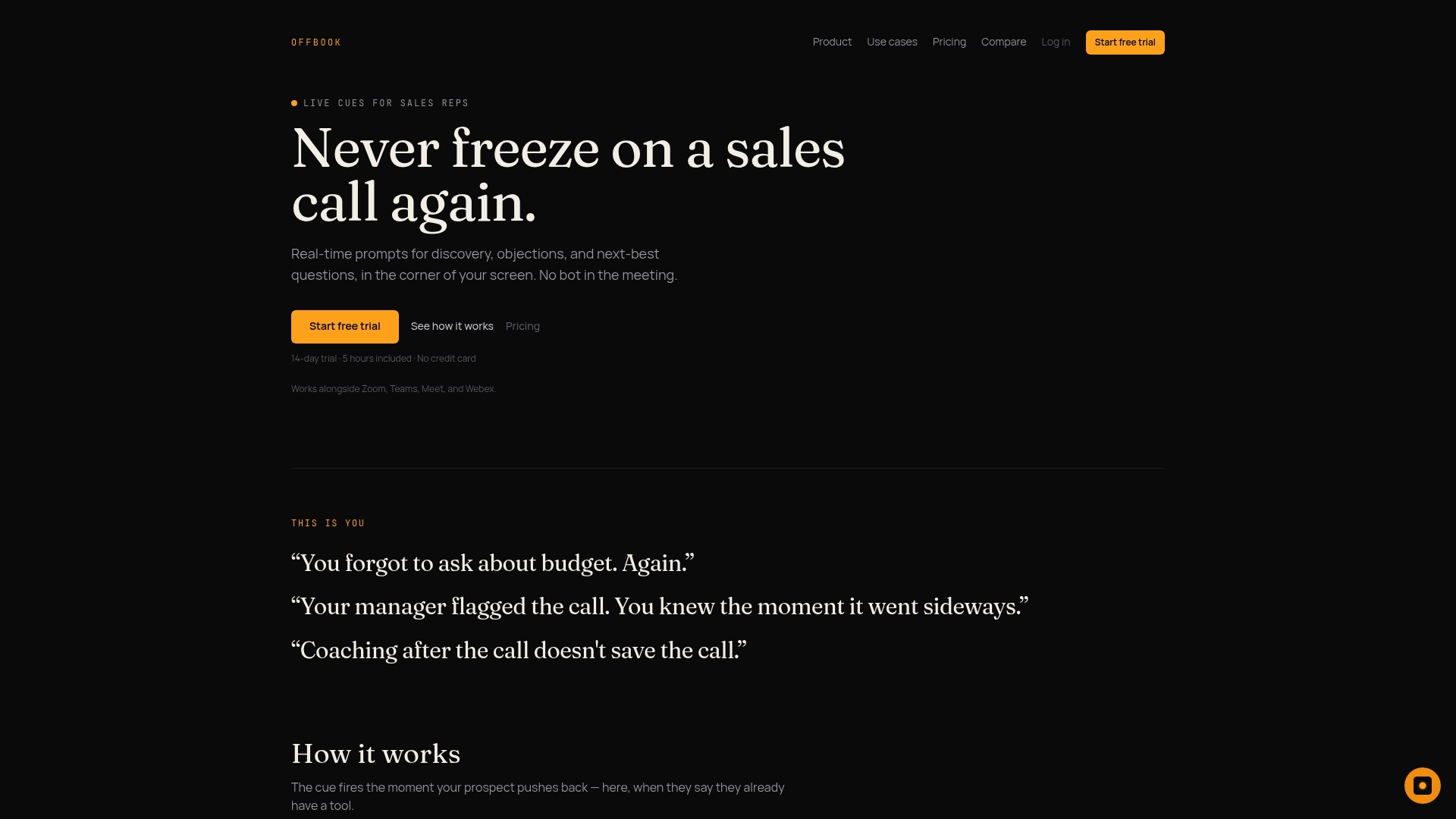
Offbook also generates pre-call briefs on the companies and people a rep is about to meet. That means reps walk in prepared, not scrambling. For founder-led B2B SaaS teams at seed and Series A, Offbook is the difference between a call that follows a structure and one that actually closes.
FAQ
What is a sales call structure?
A sales call structure is a repeatable framework that guides a sales conversation through defined stages, such as discovery, objection handling, and closing, to produce a clear outcome.
Which call structure works best for cold calls?
Cold calls use a compressed structure: a quick opener, one problem-led statement, one question, and a direct ask for a follow-up meeting. The goal is to earn the next conversation, not close the deal.
What is the difference between BANT and MEDDIC?
BANT qualifies prospects quickly at first touch by checking Budget, Authority, Need, and Timeline. MEDDIC goes deeper for complex enterprise deals, mapping metrics, decision processes, and internal champions.
How many questions should a rep ask in a discovery call?
A proven sequence uses three situational questions, two pain questions, and one impact question. Limiting situational questions keeps the conversation focused on uncovering real pain rather than gathering background context.
How do I stop reps from going off-script in the wrong direction?
Structure should be a flexible flow, not a rigid script. Reps who know the stages well enough to adapt language to the buyer stay on track without sounding robotic. Consistent coaching against a defined framework is what builds that fluency.