The Role of Demo in B2B Sales: A 2026 Guide
Discover the vital role of demo in B2B sales and how mastering it can boost your sales success in 2026. Transform prospects into buyers!
Published: June 11, 2026
Author: OffBook Editorial Team

A demo in B2B sales is a structured presentation that shows how a product solves a prospect’s specific business challenges, giving buyers the evidence they need to justify a purchase decision. The role of demo in B2B sales has expanded well beyond a simple product walkthrough. Today, 40% of software buyers rank the demo as the most critical element in their decision-making process. That number alone tells you this is not a formality in the sales process. It is the moment where abstract value claims become concrete proof. Platforms like Walnut, Apollo, and Karumi have built entire product lines around this reality, and the data from 2026 confirms that teams treating demos as strategic assets close faster and convert more.
What makes a demo effective in modern B2B sales?
The most common demo failure is the feature dump. A rep opens the product, clicks through every screen, and narrates what each button does. The prospect nods politely and never replies to the follow-up email. This happens because the demo answered questions the buyer never asked.
Effective B2B product demonstrations are built around buyer pain points, not product capabilities. The distinction sounds subtle but changes everything about how you structure the call. You lead with the problem the buyer told you about in discovery, then show exactly how the product removes that problem. Nothing more.

Personalization is the second lever. Personalizing 50% or more of demos yields 40%+ higher conversion rates compared to generic demos, and AI-driven personalization compresses sales cycles by 34%. That means swapping out the company name in a slide deck is not personalization. Real personalization means showing a CFO the financial reporting module and showing a VP of Operations the workflow automation view, even within the same deal.
Three practices separate high-converting demos from forgettable ones:
- Discovery first. Pre-demo research and discovery make demos more relevant and directly improve conversion. Know the buyer’s role, their stated problem, and their internal pressure before you share your screen.
- Embed a clear next step. Failing to include clear CTAs in demos leaves them as mere content. Every demo should end with a specific, agreed-upon action, whether that is a technical evaluation, a procurement call, or a pilot proposal.
- Treat it as a sales tool, not a training session. The goal is to advance the deal, not to teach the prospect how to use the product. Keep the scope tight.
Pro Tip: Build a modular demo library with separate flows for each buyer persona. A two-minute CFO-focused clip shared asynchronously after the live call reinforces the financial case without requiring another meeting.
How do different demo formats fit into the B2B sales process?
Not every deal needs a live 60-minute walkthrough. The format you choose should match the buyer’s stage, the deal complexity, and the number of stakeholders involved. Getting this wrong wastes everyone’s time.
| Format | Best use case | Key benefit | Main limitation |
|---|---|---|---|
| Live demo | Complex, high-value deals | Real-time Q&A and objection handling | Requires scheduling; hard to scale |
| Pre-recorded demo | Top-of-funnel awareness | Always available; zero rep time | Low interactivity; no personalization |
| Interactive demo | Mid-funnel evaluation | Self-serve exploration; shareable across stakeholders | Requires upfront build investment |
| Agentic AI demo | Personalization at scale | Autonomous guidance tailored to each viewer | Newer format; buyer familiarity varies |
| Hybrid approach | Multi-stakeholder deals | Covers all buyer preferences and buying stages | Requires coordination across formats |
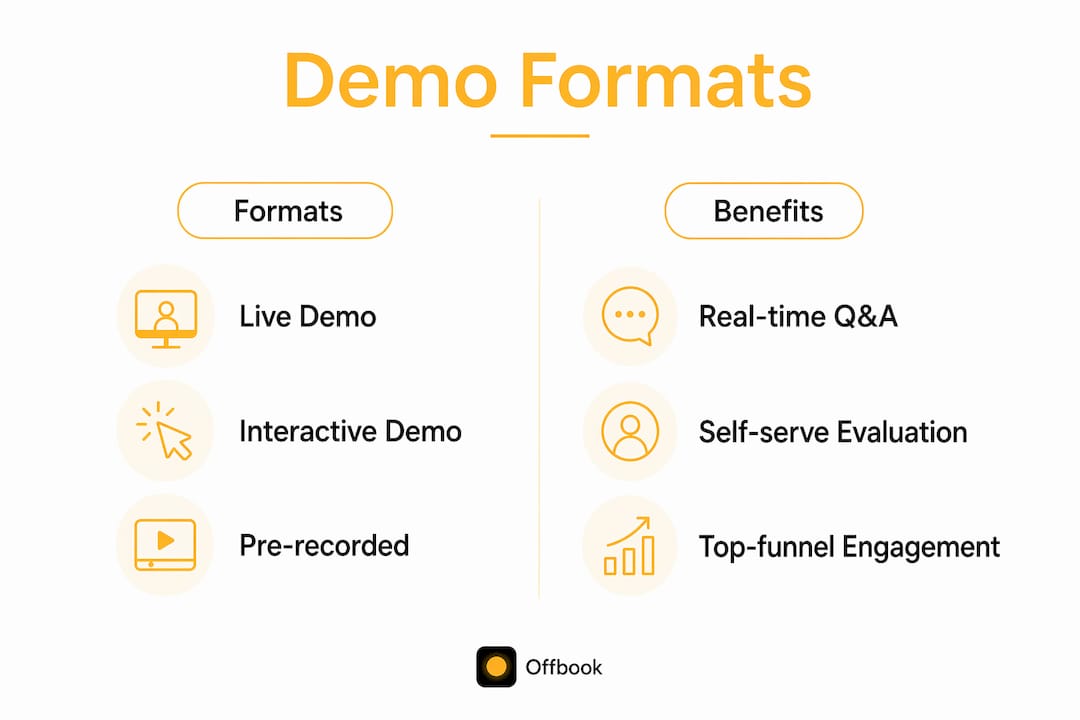
Live demos excel at relationship building and handling objections in real time. They are the right call when the deal is large, the buying committee is engaged, and you need to read the room. Combining live and interactive formats produces higher close rates than using either format alone, which is why the hybrid approach has become the default for serious B2B sales teams in 2026.
Interactive demos solve a specific problem: 75% of B2B buyers prefer self-serve, rep-free evaluation paths before engaging sales reps. An interactive demo lets a skeptical VP of Engineering explore the product on their own terms, at 10pm, without a rep hovering. That exploration builds conviction before the live conversation even happens.
Agentic AI demos take this further by guiding each viewer through a personalized path based on their role and behavior. A buyer who clicks on the integration section gets a deeper dive into APIs. A buyer who lingers on the reporting dashboard gets more data visualization content. This format is still maturing, but early adopters are reporting meaningful lifts in engagement time and qualified meeting rates.
Pre-recorded demos belong at the top of the funnel, on your website, and in outbound sequences. They are not closing tools. Using them late in a complex deal signals that you are not paying attention to the buyer’s actual needs.
Why are demos critical for multi-stakeholder buying committees?
B2B buying committees average 6 to 13 stakeholders, each with different priorities, different objections, and different definitions of success. A live demo with one champion does not reach the security lead, the finance approver, or the end users who will actually use the product every day. This is where most deals stall.
Demos solve the multi-stakeholder problem by creating a shared, referenceable artifact. When your champion can send an interactive demo to the CISO and the CFO independently, each person evaluates the product through their own lens without requiring another live session. Omnichannel demo strategies deliver 287% higher purchase rates compared to single-format approaches. That number reflects what happens when every stakeholder gets the information they need in the format they prefer.
The concept of internal defensibility matters here. Demos built with internal defensibility in mind give your champion the language and evidence to advocate for the purchase internally. They are not just watching a demo. They are collecting ammunition for the internal approval process. A well-designed demo answers the objections your champion will face in the room you will never be invited into.
Four things a multi-stakeholder demo strategy must accomplish:
- Reach every role. Build separate demo flows for economic buyers, technical evaluators, and end users. One size does not fit a committee of ten.
- Enable asynchronous review. Not every stakeholder will attend a live call. Interactive demos let the deal progress even when you are not in the room.
- Reduce cognitive load. Demos that try to show everything overwhelm committees. Focus each demo on the two or three outcomes that matter most to that specific audience.
- Create a common reference point. When all stakeholders have seen the same core demo, internal alignment conversations start from a shared baseline rather than conflicting secondhand accounts.
Understanding how enterprise B2B buying works in 2026 makes it clear that the demo is not a single event. It is a system of touchpoints designed to move every stakeholder toward consensus.
How can demo engagement data sharpen your pipeline?
Most sales teams track whether a prospect attended a demo. The teams closing faster track what the prospect did during the demo. These are fundamentally different signals.
Demo tracking data predicts real intent better than form fills. A prospect who spent 12 minutes on the security and compliance section of your interactive demo and then forwarded it to three colleagues is a different conversation than a prospect who clicked through in 90 seconds. The first buyer is evaluating seriously. The second may just be doing due diligence for someone else.
Granular engagement tracking tells you which features generate excitement, where prospects drop off, and which demo paths correlate with closed deals. That data has two uses. First, it tells your reps exactly where to focus the follow-up conversation. Second, it tells your team which demo content is working and which sections need to be rebuilt. Tracking demo engagement at granular steps is the mechanism that turns demo delivery into a repeatable, improvable system.
Pro Tip: Centralize demo engagement data in your CRM so both sales and marketing can see it. Marketing learns which features resonate with which segments. Sales prioritizes follow-up based on actual behavior, not gut feel. The alignment this creates is worth more than any individual demo improvement.
The pipeline impact is measurable. Full-funnel demo deployment yields pipeline increases of 40 to 50% over 90 days when engagement data is used to refine content and prioritize outreach. That is not a marginal gain. It is the difference between a pipeline that feels random and one that feels predictable.
Pairing demo engagement signals with strong discovery questions before the call creates a feedback loop. What you learn in discovery shapes the demo. What the demo engagement reveals shapes the follow-up. Deals move faster because every interaction is informed by the one before it.
Key takeaways
The demo is the single most influential touchpoint in the B2B sales process, and teams that treat it as a system rather than a one-time event close more deals and close them faster.
| Point | Details |
|---|---|
| Demos drive decisions | 40% of software buyers rank the demo as the most critical factor in their purchase decision. |
| Personalization multiplies conversion | Personalizing 50%+ of demo content yields 40%+ higher conversion rates versus generic presentations. |
| Format must match the buyer’s stage | Live demos close complex deals; interactive demos enable self-serve evaluation for multi-stakeholder committees. |
| Engagement data is a pipeline signal | Tracking feature-level demo interactions predicts buyer intent more accurately than form fills or email opens. |
| Internal defensibility wins deals | Demos designed to help champions advocate internally accelerate consensus and reduce stall time. |
Why I think most teams are still underusing their demos
I have watched sales teams spend weeks perfecting their pitch deck and 20 minutes building their demo. That ratio is backwards. The pitch deck gets you the meeting. The demo gets you the deal.
The shift I have seen work consistently is treating the demo as a trust asset, not a presentation. A demo that shows a prospect exactly how their specific workflow improves is more credible than any case study or reference call. It is proof, not testimony. Interactive demos as trust assets build buyer confidence in a way that static marketing collateral simply cannot replicate.
The teams I respect most have built modular demo libraries. They have a two-minute clip for the CFO, a technical deep-dive for the engineering lead, and a workflow walkthrough for the end user. They mix and match based on who showed up to the call. That flexibility is what modular, role-specific demo design actually looks like in practice.
My honest concern for 2026 is that agentic AI demos will tempt teams to automate their way out of genuine buyer understanding. The technology is impressive. But a demo that adapts to behavior still needs to be built on real discovery. If you do not know what your buyer actually cares about, no amount of AI personalization will save a demo that starts from the wrong premise. Use the tools. Do the discovery first.
— Neil
Run better demo calls with Offbook
A great demo strategy falls apart if the rep on the call is not prepared to handle objections, qualify gaps, or ask the right follow-up questions in the moment. Offbook is real-time AI call coaching for sales that surfaces live prompts during video calls, without a bot joining the meeting. It listens to the conversation and cues reps on qualification gaps, objection responses, and next steps structured around MEDDIC and MEDDPICC. Before the call, Offbook generates a pre-call brief on the company and the people in the room so your rep walks in knowing exactly what to focus the demo on. For seed and Series A B2B SaaS teams, that preparation is what separates a demo that advances the deal from one that just fills a calendar slot.
FAQ
What is the role of a demo in B2B sales?
A demo in B2B sales proves that a product solves the buyer’s specific problem, giving decision-makers the evidence they need to justify a purchase. It is the most influential touchpoint in the sales process, with 40% of software buyers ranking it as the top factor in their decision.
How do interactive demos differ from live demos?
Live demos offer real-time Q&A and objection handling, making them best for complex, high-value deals. Interactive demos enable self-serve exploration that buyers can share across their buying committee without requiring a rep to be present.
How many stakeholders are typically involved in a B2B purchase?
B2B buying committees average 6 to 13 stakeholders, each evaluating the product from a different perspective. Shareable, role-specific demos are the most practical way to reach every decision-maker in the process.
Does personalizing a demo actually improve conversion rates?
Personalizing 50% or more of demo content yields conversion rates more than 40% higher than generic demos. AI-driven personalization also compresses sales cycles by 34%, making it one of the highest-return investments in demo strategy.
What demo engagement metrics should sales teams track?
Track which features prospects explore, how long they spend on each section, and whether they share the demo with colleagues. These signals predict buying intent more accurately than form fills and tell reps exactly where to focus their follow-up.