30–60 Day Pilot to Test Live Sales Coaching for Founder Led Startups
Run a focused 30–60 day pilot to see if live in call sales coaching improves qualification and close rates for founder led B2B SaaS teams.
Published: October 2, 2026
Author: OffBook Editorial Team

Live, in-call sales coaching is worth piloting for most founder-led B2B SaaS teams, provided it runs alongside manager coaching rather than replacing it. The fastest way to find out if it works for your team is a short, structured trial rather than a full rollout. Start with a 30 to 60 day pilot on a small group of calls, measure a few clear numbers, and decide from there.
TL;DR:
- A live sales coaching pilot should be limited to a small group of reps for 30 to 60 days to accurately measure its impact on qualification and conversion rates.
- Latency must be under 60 seconds and cues need to be accurate and seamlessly integrated into existing tools to ensure in-the-moment usefulness.
- Consent protocols are critical; prospects must be informed that calls are being coached to maintain trust and compliance.
- Focusing on a single sales methodology like MEDDIC or MEDDPICC and running micro-debriefs daily improves pilot effectiveness.
- Most startups see clear signals of improvement in qualification and pipeline metrics within the first month, especially when coaching is tightly scoped and well-managed.
Table of Contents
- What live sales coaching actually is
- Why founder-led teams adopt live coaching first
- How to choose a live sales coaching solution
- Running a 30-60 day pilot at your startup
- What the research says about real-time coaching
- Where most founders get the pilot wrong
- Getting started with OffBook
- Sources
- FAQ
What live sales coaching actually is
Live sales coaching is software that listens to a sales call as it happens and surfaces cues on the rep’s screen: a question to ask, an objection response, a qualification gap to close. It runs as an overlay, not a participant. No bot joins the meeting, and the prospect never sees or hears the software. That distinction matters to buyers who are wary of recording tools showing up as a visible attendee, and OffBook’s approach to real-time coaching is built around staying invisible to the other side of the call.
This is different from the tools most startups already have. Post-call note-takers and meeting recorders capture what happened after the fact, useful for a debrief but useless in the moment when a rep is fumbling a pricing objection. Chatbots that answer questions on demand require the rep to stop, type, and wait, which does not work at conversational speed. Live coaching is meant to fit inside the call’s actual rhythm.
A few technical details determine whether a tool is genuinely useful at that moment:
- Latency: cues need to arrive fast enough to matter mid-sentence, not thirty seconds after the moment has passed.
- Accuracy: prompts have to reflect what was actually said, not a generic script triggered by a keyword.
- Integration: the tool needs to sit inside the video platform and, ideally, the CRM the team already uses.
- Consent: every participant on the call needs to know coaching software is listening.
The typical feature set spans the whole call cycle: a pre-call brief on the company and people you are about to meet, in-call prompts for objections and qualification gaps, and a post-call debrief that turns the conversation into notes and follow-up drafts.
Why founder-led teams adopt live coaching first
Founder-led sales teams have a specific problem: the founder is often the best closer on the team, but has no time to shadow every call, and new reps have no one experienced to learn from in real time. Live coaching fills that gap directly rather than waiting for a weekly one-on-one to catch mistakes after the deal has already slipped.
The outcomes teams look for are practical and immediate:
- Tighter qualification: reps ask the MEDDIC or MEDDPICC questions they’d otherwise skip under pressure.
- Better objection handling: a prompt for a common objection beats an improvised answer.
- More consistent demos: every rep follows a similar structure instead of freelancing.
- Higher close rates on qualified opportunities: fewer deals stall from unanswered gaps.
The roles that benefit first are predictable: founders still running their own demos, new reps in their first 90 days, and small teams where no one has the bandwidth to coach a full pipeline. A five-person startup sales team rarely has a dedicated sales manager, so live cues substitute for coaching hours that don’t exist yet.
Focused, quality coaching per month around a few hours appears to be an effective cadence for moving underperforming sellers toward quota, according to large-scale analysis of coaching minutes, with diminishing returns past about five hours. That’s a useful benchmark for founders deciding how much coaching time, human or software-assisted, their pilot actually needs.
Pricing for live coaching tools generally follows a subscription model with per-seat or per-user tiers, sometimes with usage limits on call hours. For exact pricing details, check the vendor’s official site. The ROI case is straightforward: if a tool helps close even one or two additional deals a quarter, it usually pays for itself many times over at early-stage deal sizes.
How to choose a live sales coaching solution
Evaluating vendors gets easier with a fixed rubric instead of a feature-by-feature comparison. Six criteria cover what actually matters for a startup team:
- Latency and response window: how fast does a cue appear after the trigger moment in conversation?
- Pre-call brief quality: does it generate a useful, specific brief on the company and attendees, or a generic summary?
- CRM and stack integration: does it connect to the tools your team already uses, or does it add a parallel workflow?
- Methodology support: does it structure prompts around a recognized framework like MEDDIC or MEDDPICC, or freelance its own logic?
- Data ownership and consent: who owns call data, and how is consent handled for every participant?
- Pricing model and scalability: does the plan scale sensibly from a two-person pilot to a full team?
When talking to a vendor, a short list of direct questions cuts through the sales pitch:
- What is the average time between something being said and a cue appearing on screen?
- Does your software join the call as a visible participant, or does it run invisibly?
- How do you handle consent when a prospect hasn’t been told the call is being coached?
- Which sales methodologies are built into your prompt logic?
- Can we export our call data if we cancel, and who owns it while we’re a customer?
- What CRM and video platforms do you integrate with today?
- What’s included in the base plan versus billed as overage?
- Can we run a paid pilot with a subset of the team before committing to a full rollout?
Pro Tip: Ask for a live demo on one of your own recorded calls, not a scripted example, before you sign anything.
A few answers should stop a pilot before it starts: a vendor that can’t explain consent handling, one that requires a bot to join the meeting when your buyers have made clear they don’t want that, or one that can’t name a specific latency figure.
For a quick side-by-side, score each vendor 1 to 5 on the six criteria above, weighting latency and manager integration most heavily since those affect whether reps actually use the tool day to day.
Running a 30-60 day pilot at your startup
A pilot works best when it’s scoped small and measured tightly. The goal isn’t to prove the tool changes everything: it’s to see whether it moves a few specific numbers in a way that justifies expanding it.
Track a short list of metrics rather than a long dashboard:
- Meeting-level metrics: percentage of calls where qualification questions were actually asked.
- Conversion lift: discovery-to-demo and demo-to-close rates before and during the pilot.
- Pipeline velocity: time from first call to closed deal.
- Rep confidence: a simple weekly check-in on how prepared reps feel walking into calls.
A practical rhythm: in the first week, select a small cohort of two or three reps, get consent workflows in place, and activate pre-call briefs. In the second week, run live coaching on a limited set of calls with a short daily debrief on what worked. In the third week, adjust the prompts based on what’s actually landing and expand to more call types. By the fourth week, you have enough data to decide whether to continue into an extended 60-day pilot with the full team.
Assign clear ownership before you start. The founder or sales manager acts as the coaching lead reviewing debriefs, pilot reps run the calls and flag friction, someone in ops handles integration and data flow, and one person owns privacy and consent so it isn’t an afterthought.
Pro Tip: Run daily micro-debriefs of five minutes rather than one long weekly review. Small, frequent feedback loops catch problems while they’re still cheap to fix.
At the end of the pilot, look for a real signal, not just enthusiasm. If qualification consistency and conversion rates moved and reps report feeling more prepared, expand. If the tool created friction, added noise, or reps stopped using it within two weeks, that’s a clear stop signal worth respecting rather than pushing through.

What the research says about real-time coaching
The strongest argument for live coaching isn’t intuition, it’s timing. Design research on multimodal coaching systems identifies a roughly 60-second optimal intervention window for live guidance, meaning a cue has to land within about a minute of the triggering moment to actually change how the rep responds, according to empirically-derived models for real-time coaching. That’s why latency isn’t a minor technical detail: a system that takes two minutes to surface a prompt has already missed the moment it was meant for.
Coaching-hours research backs up the pilot cadence recommended above. The analysis of a million minutes of sales coaching found that targeted, manager-delivered coaching correlates with higher quota attainment and lower attrition compared with outsourced coaching, and that quality coaching hours matter more than raw volume.
The nuance worth sitting with is that AI coaching works best as a complement, not a replacement. Experimental research comparing AI and manager coaching found AI coaching is most effective when it’s integrated into a strong relationship between rep and manager, and that manager involvement increases both adoption and perceived usefulness of the tool. Used as a distant, hands-off system, AI coaching sees less uptake. The practical takeaway: use live cues to handle in-call timing and reminders, but keep a manager or founder actively reviewing debriefs and coaching around what the tool surfaces.
Where most founders get the pilot wrong
The most common mistake is running the pilot too big. Founders roll live coaching out to the entire team in week one, generate a flood of data no one has time to review, and lose the signal in the noise. A pilot with two or three reps is more useful than one with ten.
The second mistake is treating consent as paperwork instead of infrastructure. If a prospect finds out mid-deal that a call was coached without their knowledge, that damages trust in a way no close rate improvement offsets.
The third is skipping manager buy-in. A tool that surfaces cues nobody reviews or reinforces in the next coaching conversation becomes background noise within a couple of weeks.
What works instead: pick one framework, MEDDIC or MEDDPICC, and stick to it rather than layering multiple methodologies into the prompts. Keep in-call scripts short enough to glance at without breaking eye contact on the call. And build in daily micro-debriefs from day one instead of waiting for a weekly retro to catch what went wrong.
— Neil
Getting started with OffBook
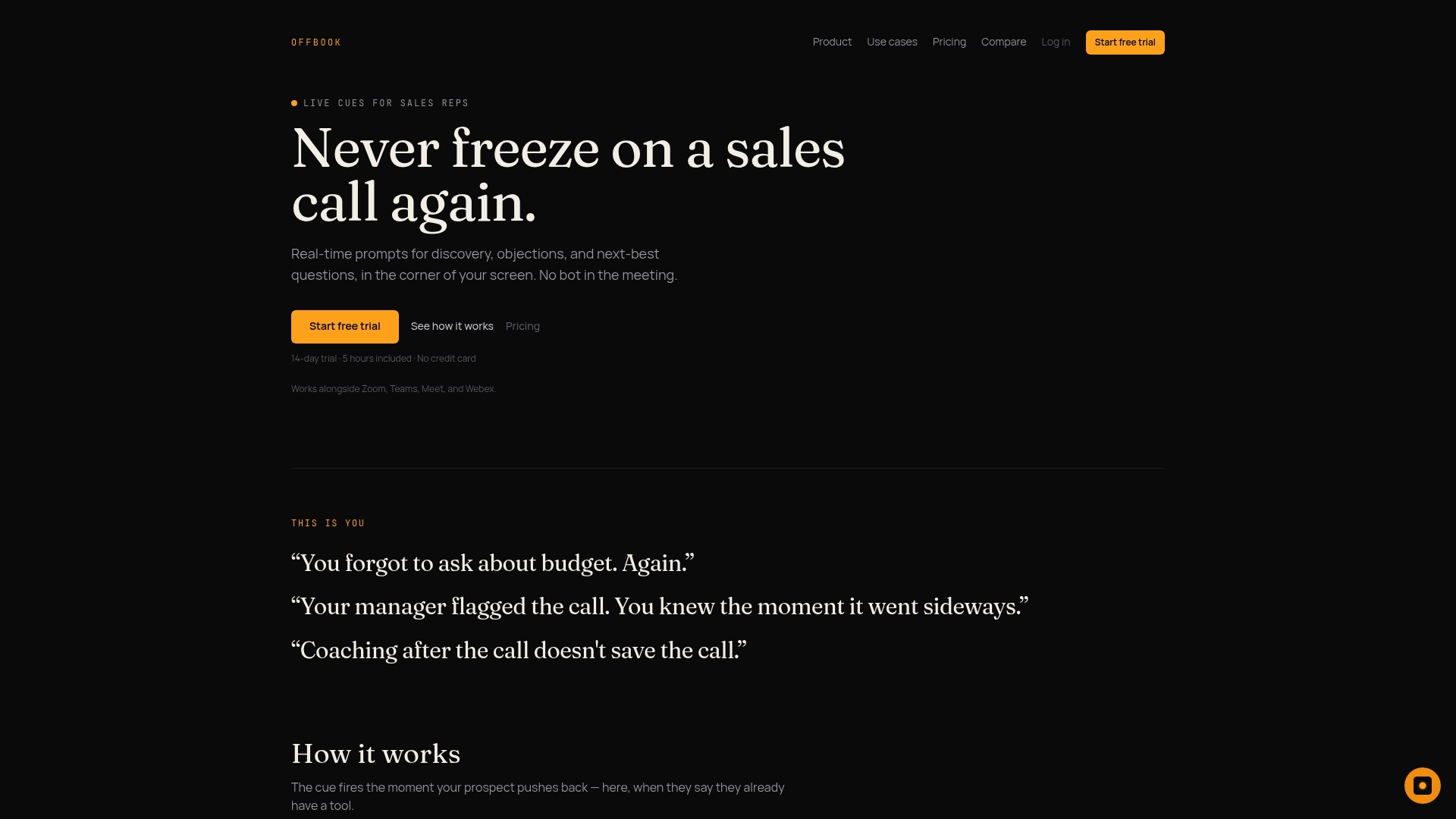
OffBook fits directly into the pilot plan above. It generates the pre-call briefs your reps use in week one, surfaces the in-call prompts for objections and qualification gaps during the live-coaching phase, and produces the post-call debriefs your coaching lead reviews each day.
A few ways to start:
- Review the Power, Power, and Team plans to see which fits a small pilot cohort.
- Check the product page for sales teams for a fuller look at how in-call cues work.
- Try the free objection handling tool as a low-friction first look at how the prompts are structured.
OffBook is built specifically for founder-led B2B SaaS teams at the seed and Series A stage, which makes it a direct fit for the pilot structure outlined above.
Sources
For deeper detail beyond this guide, these cover the research and product references used above:
- AI-assisted sales coaching framework: Empirically-derived models for B2B communication analysis
- Evidence from 1,000,000 minutes of sales coaching (Kent Academic Repository)
- Comparing AI coaching and sales manager coaching: A construal-level approach
FAQ
How much does sales coaching typically cost?
Cost varies widely by provider and format, from per-seat SaaS subscriptions to hourly consulting rates. For OffBook specifically, the Power plan runs $59 per month or $590 per year, while Team pricing is $1,000 per year per seat.
What is the 80/20 rule in coaching?
In sales coaching specifically, this often means prioritizing qualification consistency and objection handling over polish on lower-impact skills.
Can I use ChatGPT as a life coach?
General-purpose AI chat tools can offer reflective prompts and generic advice, but they aren’t built for real-time, in-call sales coaching and lack the live audio processing, methodology structure, and consent infrastructure that dedicated tools provide. For live sales coaching specifically, a purpose-built tool that listens during the call and surfaces timed cues works differently than a chat interface you consult afterward.
Do I need an LLC to be a life coach?
Business structure requirements depend on your local jurisdiction and the nature of the coaching services offered, so this is a question for a business attorney or accountant familiar with your situation. This guide focuses on sales coaching tools for startup teams rather than the legal setup for independent coaching practices.
How long until a startup sees measurable sales improvement from live coaching?
Most pilots start showing signal within the first 30 days on meeting-level metrics like qualification consistency, with conversion and pipeline velocity changes becoming clearer over a 60-day window. The research on coaching cadence suggests consistent, focused coaching hours matter more than the specific tool, so results depend heavily on how disciplined the pilot’s follow-through is.