How to Scale Your Founder Sales Playbook Into a Team
Learn how to turn your founder sales playbook into a successful team-driven process, saving time and money while boosting performance.
Published: August 13, 2026
Author: OffBook Editorial Team

You can scale founder-led sales into a repeatable, team-run motion — but only in one order: extract the founder’s tacit process first, encode it into CRM guardrails second, then hire against that documented motion third. Founders who reverse that sequence, hiring before documenting, routinely lose six months and $200,000+ on reps who fail not because they lack talent but because there was nothing concrete to run. The 90-day transition framework is blunt about this: documentation is not prep work for the real work, it is the real work.
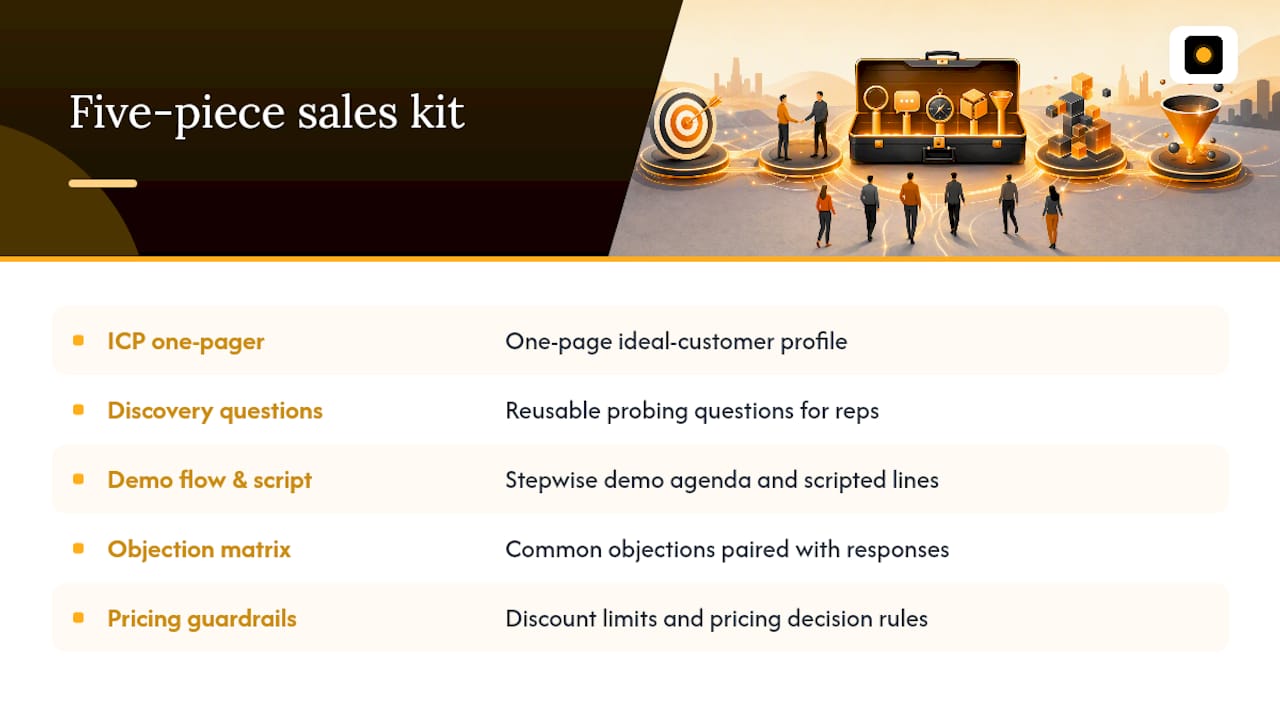
The playbook you need has five pieces: a one-page ICP, a discovery question bank, a demo script, an objection matrix, and pricing guardrails. Building those five artifacts before your first hire is what separates a handoff that sticks from one that quietly reverts to the founder reclosing every deal. Frameworks like MEDDIC and MEDDPICC give you the qualification spine; tools like HubSpot or Salesforce enforce stage exit criteria; and live in-call coaching software like Offbook surfaces your winning moves to new reps in real time, while the call is still happening.
Three steps to start this week:
- Record and transcribe 10 of your recent won calls.
- Write a one-page ICP and a 15-question discovery bank from what you hear.
- Add three required CRM fields (economic buyer confirmed, pain quantified, next step agreed) before you post a single job listing.
Your next 7 days:
- Pull your last 10 closed-won deals from CRM and tag the common thread (industry, pain, champion profile).
- Listen to two calls and write down every question you asked before the prospect said “yes.”
- Draft your ICP one-pager (problem, buyer title, company profile, disqualifiers).
- Map your demo flow as a five-slide outline.
- List your five most common objections and write one response to each.
- Pick one CRM stage and define its objective exit criteria (what evidence must exist before a deal moves forward).
Key Takeaways
Scaling founder-led sales into a repeatable team motion requires documenting the founder’s process first, enforcing it with CRM guardrails second, and hiring against that documented motion third.
| Point | Details |
|---|---|
| Document before you hire | Founders who skip documentation risk losing 6–12 months and $200K+ on reps who have nothing concrete to run. |
| Pass the standard-deal test | Three to five deals won from a repeatable channel at standard pricing signals a motion worth handing off. |
| Hire a builder, not a VP | The first hire should be a generalist AE who closes deals and refines the playbook, hired after 10–20 founder-closed deals. |
| Expect a 3–6 month ramp | First reps typically ramp over several months; plan with a written ramp plan so you coach to a standard, not anxiety. |
| Offbook coaches in the moment | For seed and Series A teams, Offbook surfaces live in-call cues that reinforce the playbook while the deal is still live. |
Table of Contents
- What should you document at each stage of founder-led sales?
- What are the five core components every founder playbook must include?
- Who should you hire first, and what triggers that decision?
- What tech stack does your playbook actually need to scale?
- How does live in-call coaching actually work during a sales handoff?
- How do you keep the playbook from becoming a dusty manual?
- Copyable templates and a 90-day handoff checklist
- What I wish I’d documented before hiring
- Offbook accelerates the hardest part of the handoff
- Sources
What should you document at each stage of founder-led sales?
The stage-based roadmap below answers a question most founders ask too late: “When is my process repeatable enough to hand off?” The honest answer is that repeatability is not a feeling. It is a test. The standard-deal test is concrete: three to five deals won from a repeatable channel, at standard pricing, with standard scope. Pass that test at each stage and you have earned the right to move to the next.
Pre-revenue: document the hypothesis
At this stage you have no deals, so you are documenting assumptions, not patterns. Write your ICP as a falsifiable hypothesis: “We win with VP-level buyers at 50–200-person B2B SaaS companies facing X pain.” Every conversation either confirms or breaks that hypothesis. Your only mandatory artifact is the ICP one-pager, and your handoff goal is simply to have something written down before you close your first deal.
First 10–20 customers: prove the motion
This is where most founders live when they first Google “how to scale founder sales.” You have closed deals, but you closed them with founder credibility, personal network, and instinct. The question is whether a stranger with your script could close the same deal. Write the discovery question bank, draft the demo script, and log every objection you handled. The readiness test: can you describe, in writing, exactly what a qualified prospect looks like and what you said to close them? If not, you are not ready to hire.

$1M–$3M ARR: enforce the motion
You now have enough pattern to enforce. Add stage exit criteria to CRM, build the objection matrix, and lock pricing guardrails. This is also when you run the standard-deal test formally. A CRM that enforces objective stage exit criteria is a precondition for hiring a team, not a nice-to-have you add after the first rep joins.
$3M–$10M ARR: scale the motion
You have a documented playbook, a CRM that tells the truth, and at least one rep who has run deals without you. Now you hire to scale, not to experiment. The handoff goal at this stage is that a rep can find, qualify, and close a standard deal without the founder stepping in at any point.
| Stage | Mandatory documents | Handoff goal | Typical timeline |
|---|---|---|---|
| Pre-revenue | ICP one-pager | Written hypothesis exists | Weeks 1–4 |
| First 10–20 customers | ICP, discovery bank, demo script | Rep can run a call from the script | Months 1–6 |
| $1M–$3M ARR | Objection matrix, pricing guardrails, CRM stage criteria | Rep closes standard deals without founder | Months 6–12 |
| $3M–$10M ARR | Full playbook index, coaching scorecards, ramp plan | Team closes predictably; founder is observer | Months 12–24 |
Diagnostic questions to decide your current readiness:
- Have you closed at least 10 deals yourself, with standard pricing and scope?
- Can you describe your ICP in two sentences without hedging?
- Does your CRM show why each deal was won or lost, not just that it closed?
- Have you written down the five most common objections and your best response to each?
- Has a non-founder run at least one full sales call using your materials?
What are the five core components every founder playbook must include?
The handoff fails most often because founders try to transfer intuition by osmosis. The fix is a five-piece sales kit that a new rep can open on day one and actually use. Here is what each piece does and what it looks like in practice.
1. ICP one-pager
This is the filter that stops reps from chasing the wrong deals. It answers four questions: who is the buyer, what pain do they have, what makes them qualified, and what disqualifies them immediately. A one-page format forces clarity. If you cannot fit your ICP on one page, you do not have an ICP yet; you have a wish list.
Example headline template: “We win with [title] at [company type/size] who are experiencing [specific pain] and have [budget signal / trigger event]. We disqualify if [hard no criteria].”
2. Discovery question bank
A bank of 15–25 questions organized by theme: pain, impact, buying process, timeline, and competition. The goal is not a script to read verbatim but a menu reps draw from so no critical qualification gap goes unasked. Map each question to a MEDDIC or MEDDPICC element so reps know what they are trying to learn.
Example question: “Walk me through what happens to your team if this problem is still unsolved six months from now.” (Targets: pain impact and urgency.)
For a deeper question bank, the founder-led discovery call guide covers question design by stage.
3. Demo flow and script
A five-to-seven-slide narrative that opens with the prospect’s pain (not your product), shows one “aha” moment per persona, and ends with a clear next step. The script does not need to be word-for-word, but the opening line and the transition to the close should be written out exactly. Those two moments are where reps most often improvise badly.
Example demo intro: “Before I show you anything, I want to confirm I’ve got the right problem. You mentioned [pain from discovery]. Is that still the number-one thing you need to solve?”
4. Objection-response matrix
A table: objection in column one, root cause in column two, best response in column three, follow-up question in column four. Aim for 10–15 objections. The root-cause column is what most founders skip, and it is the most important: a rep who understands why a prospect objects handles the next variation of that objection without needing to look it up.

5. Pricing and discount guardrails
A one-page document that states your standard price, the maximum discount a rep can offer without approval, the conditions that justify a discount (multi-year, reference customer, specific use case), and the language to use when a prospect pushes back on price. Without this, every rep negotiates differently and you lose margin and consistency simultaneously.
Must-have vs. nice-to-have:
- Must-have: ICP one-pager, discovery bank, demo script, objection matrix, pricing guardrails
- Nice-to-have: competitive battlecards, ROI calculator, case study library, persona-specific email sequences
- Skip for now: a 50-page playbook PDF nobody reads, a custom LMS, a full sales methodology certification program
Pro Tip: Before you hand any of these documents to a new rep, run them past one prospect. Ask: “If someone used this script on you, would you feel understood?” The answer will tell you more than any internal review.
Who should you hire first, and what triggers that decision?
Most founders hire too early or too senior. Both mistakes are expensive. Hiring the first salesperson after 10–20 founder-closed deals is the widely cited threshold, and the first hire should be a generalist who can carry a bag while helping refine the playbook, not a VP who builds org charts before there is a repeatable motion to organize.
The correct hiring sequence runs like this: one generalist AE who closes deals and writes the playbook alongside you, then two to three more reps to prove the motion is teachable, then a player-coach manager, then a VP of Sales once the model repeats without the founder’s involvement. Hiring a VP at step one is one of the most common and costly startup hiring mistakes.
For guidance on when the VP role actually makes sense, the VP of Sales timing guide is worth reading before you post that job description.
| Role | When to hire | Key attributes | Expected ramp |
|---|---|---|---|
| First AE (generalist/builder) | 10–20 founder-closed deals, standard-deal test passed | Coachable, process-disciplined, comfortable with ambiguity | 3–6 months |
| AEs 2–3 | Playbook documented, first AE hitting quota | Proven SaaS AE experience, playbook-ready | 2–4 months |
| Player-coach manager | 3+ reps, founder still in deal reviews | Former top AE, coaching instinct, low ego | 1–3 months |
| VP of Sales | Motion repeats without founder; $3M+ ARR | Operator, not just a closer; has built teams before | 3–6 months |
Trigger metrics to watch before each hire:
- First AE: 10–20 founder-closed deals, a written playbook exists, pipeline coverage is 3x quota.
- AEs 2–3: first AE at or near quota for two consecutive months, inbound volume exceeds what one rep can handle.
- Manager: three or more reps, deal reviews consuming more than five hours of founder time per week.
- VP: the motion repeats predictably, forecast accuracy is above 70%, and the founder needs to exit sales entirely.
Expect a temporary performance dip when the first rep joins. First reps typically ramp over several months, and the founder’s close rate will be materially higher during that window. Plan for it with a written ramp plan that defines what “on track” looks like at 30, 60, and 90 days, so you are coaching to a standard rather than reacting to anxiety.
Pro Tip: When interviewing your first AE, give them your objection matrix and ask them to handle your two hardest objections live. You will learn more in five minutes than in a full reference check.
What tech stack does your playbook actually need to scale?
The minimum viable stack has five layers. More than five layers before your third rep is usually a distraction. The goal is not a beautiful tech stack; it is a CRM that tells the truth and a call library that captures the founder’s best moves.
The five layers:
- CRM with enforced stage exit criteria. HubSpot or Salesforce both work. The configuration matters more than the brand. Every stage needs at least one required field that cannot be skipped. No evidence, no stage advance.
- Call recording and transcription. Gong, Chorus, or a lighter tool like Fathom. The purpose at this stage is not analytics; it is building a library of the founder’s best calls that new reps can study.
- Sequence and automation tool. Apollo, Outreach, or Salesloft for outbound. The sequence should mirror your playbook’s messaging, not run independently of it.
- Simple stage-conversion analytics. A dashboard showing conversion rate at each CRM stage, average deal size, and time-in-stage. You do not need a BI tool; a Google Sheets export updated weekly is enough at this stage.
- Live in-call coaching. This is where the category is maturing fast. AI meeting tools are expanding from post-call notetakers into enterprise workflows that support prospecting, call prep, and in-call assistance. The distinction matters: post-call coaching tells a rep what they did wrong after the deal is already lost. In-call coaching surfaces the right question or objection response while the conversation is still live.
CRM guardrails to add before your first hire:
- Required fields: economic buyer name, pain statement (one sentence), agreed next step with date.
- Activity minimums: at least two touches logged per open deal per week.
- Stage exit evidence: a written note confirming the exit criterion is met before the deal advances.
- Auto-tasks: a follow-up task created automatically when a deal enters each stage.
Post-call vs. in-call coaching: Post-call review is valuable for pattern recognition over time. In-call coaching changes the outcome of the specific deal in front of the rep right now. For a rep in months one through three, that real-time prompt, “you haven’t confirmed budget yet,” is worth more than a debrief the next morning. Encoding the playbook into automation and coaching tools is also what reclaims founder time: founders who do this report recovering 15–20 hours per week while maintaining pipeline volume.
Pro Tip: Before handing a deal to a new rep, run a two-minute pre-handoff check: Is the economic buyer named? Is the pain quantified? Is there a written next step with a date? If any of those three are missing, the rep is not inheriting a deal; they are inheriting a problem.
How does live in-call coaching actually work during a sales handoff?
Here is a concrete operational example of how the handoff works when live coaching is part of the process, rather than an afterthought.
The workflow:
- Record and tag founder calls. The founder records 10–15 won calls and tags the moments that mattered: the discovery question that opened up the real pain, the demo transition that landed, the objection response that closed the gap.
- Surface repeatable plays. From those tagged moments, extract the three to five moves that appear in every won deal. These become the core of the playbook and the prompts encoded into the coaching tool.
- Encode into live prompts. A tool like Offbook listens to the rep’s call in real time and surfaces on-screen cues: “You haven’t asked about the economic buyer yet,” or “This sounds like the pricing objection — here’s the response.” No bot joins the meeting. The rep sees the prompt; the prospect does not.
- Founder moves to observer. Instead of joining every call, the founder reviews call summaries and debrief notes. Coaching happens in a weekly session, not in the deal itself.
- Iterate the playbook. Every month, the rep and founder review which prompts fired most often and whether the suggested response worked. The playbook updates accordingly.
Roles and responsibilities as the handoff matures:
- Founder (weeks 1–4): Still on most calls, tagging moments, writing the playbook.
- AE (weeks 5–12): Running calls with live prompts, debriefing weekly with founder.
- Founder (months 3–6): Observer on one call per week, coaching from summaries.
- RevOps (ongoing): Maintaining CRM guardrails, tracking stage conversion, flagging anomalies.
The single biggest shift in a successful handoff is not the rep’s skill level — it’s the founder’s willingness to stop reclosing deals and start coaching from data instead. Founders who stay in deals “just to help” teach reps that the playbook is optional. Founders who coach from call summaries teach reps that the process is the job.
For a deeper look at standing up a coaching program, the sales coaching program guide covers cadences, scorecards, and how to structure the first 90 days of rep coaching.
How do you keep the playbook from becoming a dusty manual?
A playbook that does not update is a liability. Reps stop trusting it, then stop using it, then start improvising, and within six months you are back to founder-dependent selling. The fix is a cadence that makes iteration a habit, not a quarterly emergency.
Recommended cadences:
- Daily standup (first 60 days of a new rep): 10 minutes, three questions: What did you send yesterday? What are you calling today? Where are you stuck?
- Weekly deal review: 30 minutes, pipeline-focused. Every deal in stage two or later gets a 60-second update. The goal is not status reporting; it is catching qualification gaps before they become lost deals.
- Monthly playbook retrospective: One hour. Review which objections came up most, which discovery questions are underused, and whether the demo flow is landing. Update the playbook before the next month starts.
- Quarterly experiment: Pick one hypothesis (“If we lead the demo with the ROI slide instead of the pain slide, conversion improves”), run it for 30 days across five deals, measure the result, and bake the winner into the playbook.
Scorecard fields to track per rep:
- Activity minimums met (calls, emails, meetings booked)
- Demo quality score (self-assessed and manager-assessed, 1–5)
- Stage conversion rate (discovery to demo, demo to proposal, proposal to close)
- Objection handling score (did the rep use the matrix or improvise?)
- Ramp milestone status (on track at 30/60/90 days)
Experiment design guidelines:
- Write the hypothesis in one sentence before you start.
- Name the single metric you are trying to move.
- Set a minimum sample size (at least five deals, ideally ten).
- Set a fixed duration (30 days maximum for a single experiment).
- Document the result and update the playbook within one week of the experiment ending.
Coaching rituals that actually work:
- Shadow: New rep observes founder on two to three calls, taking notes on questions asked and transitions made.
- Flip: Founder observes rep on two to three calls, giving written feedback only (no live interruptions).
- Solo: Rep runs five to ten standard deals independently, with weekly debrief from call summaries.
The minimum sample for evaluating rep mastery is five to ten standard deals run solo. Evaluating a rep after two calls is like evaluating a pilot after two landings. The startup sales rep best practices guide covers how to structure these coaching phases in more detail.
Copyable templates and a 90-day handoff checklist
These are the artifacts you need to build and the milestones to hit. Use them as a working checklist, not a reading list.
Template index
- ICP one-pager: Buyer title, company profile, trigger event, pain statement, disqualifiers, and one-line value proposition.
- Discovery question bank: 15–25 questions organized by MEDDIC element (Metrics, Economic Buyer, Decision Criteria, Decision Process, Identify Pain, Champion).
- Demo script: Opening pain confirmation, three “aha” moments, transition to next step. Written intro and close; narrative bullets for the middle.
- Objection matrix: 10–15 rows, four columns: objection, root cause, best response, follow-up question.
- Pricing guardrails sheet: Standard price, maximum rep discount, conditions for exceptions, price-pushback language.
- Handoff email templates: Introduction email (founder to prospect introducing new rep), context-transfer email (founder to rep summarizing deal history).
For sales call structure and sample scripts, the dedicated guide has word-for-word templates you can adapt.
Copyable snippets
Discovery question: “What have you already tried to fix this, and why didn’t it stick?”
Demo intro: “Before I show you the product, I want to confirm I’ve got the right problem. You mentioned [pain]. Is that still the top priority, or has something shifted?”
Objection reply (pricing): “I hear you on price. Can I ask: if cost weren’t a factor, is this the solution you’d move forward with? [Wait for answer.] Then let’s figure out what makes the numbers work.”
Follow-up email subject line: “Next step from our call, [first name]” First sentence: “Wanted to send over the one thing we said would be most useful before our next conversation.”
90-day handoff milestones
- Day 7: 10 calls recorded and reviewed, ICP one-pager drafted, three CRM guardrails installed.
- Day 30: Full playbook index complete (all five documents), first AE hired or offer extended, sequence tool configured with playbook messaging.
- Day 60: First AE has completed shadow and flip phases, running solo deals with weekly debrief, stage conversion tracked for first time.
- Day 90: First AE has closed or advanced at least three standard deals solo, founder is observer not closer, monthly playbook retrospective completed.
Pro Tip: On day 30, run the standard-deal test on your own playbook: give it to someone who has never seen your product and ask them to run a mock discovery call using only your materials. Every gap they hit is a gap your new rep will hit on a live call.
What I wish I’d documented before hiring
The most common founder mistake is not hiring too early. It is hiring with confidence that the process is documented when it is actually still living entirely in the founder’s head. You think you have a playbook because you have a deck and a one-pager. What you actually have is a starting point, and your new rep will find every gap in it on a live call with a real prospect.
A few hard-won rules:
Do not reclose your rep’s deals. When a deal stalls, the instinct is to jump in and save it. Every time you do, you teach the rep that the playbook is optional and that the founder is the real closer. Observe the call, take notes, debrief afterward. That is coaching. Jumping in is dependency.
Hoard your objections on purpose. Most founders handle objections so automatically that they never write them down. Before you hire, spend one week logging every objection you hear, word for word, in a running document. The raw language matters. “It’s too expensive” and “we don’t have budget this quarter” are the same objection with different root causes, and a rep who only has a generic price-objection response will handle them identically and lose one of them.
The playbook exposes whether you have a motion or just luck. Writing the five documents is not bureaucracy. It is a diagnostic. If you cannot write a discovery question bank because every call feels different, that is signal: you do not yet have a repeatable motion, and hiring will not fix that.
Micro-checklist to avoid the most common handoff failures:
- Have you run the standard-deal test (three to five wins, standard channel, standard price)?
- Does your CRM show objective exit criteria at every stage, not just deal amounts?
- Have you written down your five hardest objections and your best response to each?
- Have you told your new rep explicitly: “Your job is to run the playbook and tell me where it breaks, not to improvise a better one”?
- Have you committed to not reclosing a deal for the first 30 days, no matter how uncomfortable it feels?
Offbook accelerates the hardest part of the handoff
The hardest 60 days of any founder handoff are the ones where the rep is running calls solo but the playbook is not yet second nature. That is exactly when deals slip, not because the rep is bad but because the gap between knowing the playbook and executing it under pressure is real.
Offbook is built for that gap. It listens to your rep’s video calls in real time and surfaces live on-screen cues: the qualification question they have not asked yet, the objection response from your matrix, the MEDDIC gap that is about to cost the deal. No bot joins the meeting. The prospect never sees it. The rep gets coached in the moment, when it changes the outcome, not in a debrief the next morning when the deal is already cold.
For seed and Series A teams with 10–100 customers and a founder still closing the majority of deals, a 30–60 day Offbook pilot gives you measurable ramp goals: track stage conversion before and after, measure how often reps use the objection matrix versus improvising, and watch time-to-close tighten as the prompts reinforce the playbook. Pre-call briefs mean reps walk into every meeting already knowing the company, the contact, and the likely objections. Post-call debriefs and follow-up drafts close the loop without adding to the founder’s review queue.
Start your Offbook pilot and see how fast a documented playbook becomes a coached one.
Sources
Pre-approved citations used in this article:
- Founder-Led Sales: 90-Day Transition Playbook | Scaling Tech
- From Solo Founder to Sales Team: The Complete Scaling Playbook
- The GTM Transition That Breaks Most SaaS · TSC
- The founder-led sales playbook: from first deals to repeatable revenue | Closing Foundry
Suggested next reads on the Offbook blog: