Sales Managers: Fix Qualification Gaps in One Quarter for 2026
Playbook for sales managers to close qualification gaps in one quarter: run a 1–4 week audit, enforce evidence fields in CRM, and use live call prompts.
Published: September 21, 2026
Author: OffBook Editorial Team

Sales qualification gaps are diagnosable and closable within a single quarter for most teams, provided you run a focused audit, enforce one checkable standard, and coach against evidence instead of gut feel. Fix them and you should see fewer late-stage surprises, a forecast that actually holds, and win rates that climb because reps stop chasing deals that were never really there. The rest of this guide shows you exactly how to find the leaks and plug them, starting with the diagnostic below.
TL;DR:
- Most qualification gaps involve stakeholder mapping, decision process documentation, and proper data enrichment, with nearly half of sales teams misaligning on lead definitions.
- A quick, focused diagnostic including deal-take sample checks and CRM analysis can reveal whether issues stem from skill, process, alignment, or data weaknesses.
- Enforcing a single qualification framework and embedding mandatory evidence fields in the CRM can significantly improve deal quality within 30 days.
- In-call prompts and pre-call briefs from tools like OffBook help reps gather evidence during live conversations, reducing human bias and improving qualification accuracy.
- Expect pipeline volume to decline initially as loose deals are filtered out, but win rates and forecast accuracy should improve within three months.
Table of Contents
- Common Sales Qualification Gaps: Skills, Process, Alignment, and Data
- Why Qualification Gaps Matter: Pipeline, Forecast, and Revenue Impact
- How to Audit and Diagnose Qualification Gaps (1–4 Week Diagnostic)
- Prioritized Strategies to Close Qualification Gaps (30–90 Day Playbook)
- How In-Call Coaching and Pre-Call Briefs Reduce Qualification Errors
- Implementation Timeline, Costs, and How to Measure ROI
- Qualification Frameworks and the Adherence Problem
- Measurement and Metrics to Track Progress
- Author Perspective: Why Inspection Beats Framework Shopping
- Where OffBook Fits Into Closing the Gap
- Primary Sources and Further Reading
- Sources
- FAQ
Common Sales Qualification Gaps: Skills, Process, Alignment, and Data
Most sales qualification gaps fall into four buckets, and almost every underperforming pipeline has at least two of them running at once.
Skill gaps show up first in discovery calls. Reps ask surface-level questions instead of digging into budget authority, decision timelines, and what happens if the deal doesn’t close. Stakeholder mapping is thin: a rep talks to one enthusiastic champion and never identifies the economic buyer. Value-based selling gets replaced by feature dumping, and objection handling turns into either capitulation on price or a scripted rebuttal that ignores what the buyer actually said. Academic skills-gap research on new sales hires backs this up: graduates and early-career reps consistently arrive with theoretical knowledge but little applied qualification skill, which is exactly why scenario-based coaching matters more than another onboarding deck.
Process gaps are structural. A team might have adopted MEDDIC on paper, but half the reps skip the “decision process” step because it’s uncomfortable to ask. Entry criteria for each pipeline stage are loose enough that almost anything qualifies as an “opportunity.” CRM fields that should hold hard evidence, like a named economic buyer or a documented next step, sit blank or filled with guesses.
Alignment gaps live at the marketing-to-sales handoff. Marketing defines a qualified lead one way; sales defines it another. This isn’t a minor definitional quibble. Gartner’s research found that 49% of sales organizations report their definition of a qualified lead differs significantly from marketing’s, which drives MQL rejection rates up and erodes trust between the two functions.
Statistic Callout: Nearly half of sales organizations disagree with marketing on what “qualified” even means. Every rejected MQL and every argument in the pipeline review meeting usually traces back to that gap.
Data and tooling gaps round out the list. Poor enrichment means reps don’t know a prospect just raised a funding round or churned a competitor. AI tools get bolted onto the CRM without governance, scoring leads on signals nobody validated. Required fields go unenforced because no one owns the audit.
Here’s how these four gaps typically surface on a scorecard:
- Skill gap signal: Discovery calls run long but produce no new information about budget or timeline.
- Process gap signal: Deals sit in “qualified” stage for weeks with no documented next step.
- Alignment gap signal: Sales rejects a large share of marketing-sourced leads without a shared reason code.
- Data gap signal: CRM fields for economic buyer or decision criteria are blank on most closed-lost deals.
Prioritize based on which signal shows up most often in your own pipeline. A team with strong process but weak discovery skills needs coaching, not a new CRM field. A team with tight discovery but constant MQL rejection has an alignment problem no amount of rep training will fix.
Why Qualification Gaps Matter: Pipeline, Forecast, and Revenue Impact
Inflated pipeline is the most expensive lie a sales team tells itself. A deal that never had a real budget or a real decision maker still counts toward the forecast until the moment it doesn’t, and that moment usually lands in the final week of the quarter when there’s no time left to replace it.
The data backs up what most sales managers already suspect from painful experience. Weak qualification doesn’t just cause the occasional lost deal. It predicts later-stage failure with real consistency. Objective Management Group’s research on sales competencies found a direct relationship between qualifying proficiency and closing effectiveness. Reps who are weak at qualifying tend to be weak at closing, because the deals they’re closing were never properly vetted in the first place.
A pipeline built on hope instead of evidence doesn’t fail randomly. It fails at exactly the stage where evidence was supposed to be collected and never was.
The measurable symptoms are consistent across teams: a rising share of “no decision” losses instead of losses to a named competitor, sales cycles that quietly lengthen because nobody flagged a missing decision-maker until month three, and a conversion drop-off concentrated at one specific stage rather than spread evenly across the funnel. Complicating the picture further, Forrester’s research shows 73% of B2B purchases involve three or more departments, with an average of 13 internal stakeholders and 9 external influencers shaping the decision. Qualification that stops at one contact is qualifying against a buying committee that doesn’t exist.
Statistic Callout: With 13 internal stakeholders and 9 external influencers typically involved in a B2B purchase, a qualification process built around a single champion is measuring the wrong thing from the start.
None of this shows up cleanly on a weekly pipeline review. It shows up three months later as a missed number nobody can fully explain, which is exactly why the audit below has to happen before the coaching does.
How to Audit and Diagnose Qualification Gaps (1–4 Week Diagnostic)
You can’t coach your way out of a gap you haven’t located. Run this diagnostic before you touch training content or CRM fields.
- Set your scope. Pick two or three representative deal segments, split by deal size, sales motion, or geography, so the audit reflects real variation instead of one lucky (or unlucky) rep’s pipeline.
- Pull step-to-step conversion data. For each stage boundary, calculate the conversion rate, the median time-in-step, and the top loss reason recorded at that step. Process-measurement research treats these three numbers as the primary diagnostic set, and for good reason: they show you exactly where deals stall or die, not just that they eventually did.
- Audit MQL rejection reasons. Sort every rejected lead from the last quarter by reason code. A spike in “not a real buyer” or “no budget” points to a sales-marketing definition gap, not a lead quality problem.
- Run a deal-sample check. Pull 15 to 20 closed-lost or stalled deals and check each one against four hard questions: Was there a named economic buyer? Was budget confirmed or just implied? Was the decision process documented? Was there a mutually agreed next step? Score each deal pass or fail on all four.
- Sample live or recorded calls. Score five to ten discovery calls per rep against a simple rubric: did the rep ask about budget authority, did they identify who else is involved, did they confirm a timeline tied to a business event.
- Map the failure shape. Once the data is in, most gaps sort into one of three patterns, described below.
The deal-sample checklist works best as a simple scorecard you can run in an afternoon:
| Evidence check | Pass criteria | Common failure mode |
|---|---|---|
| Economic buyer identified | Named person with budget authority documented | Rep names a champion, not the actual buyer |
| Budget confirmed | Number or range confirmed by buyer, not assumed | Rep infers budget from company size |
| Decision process documented | Steps and approvers listed in CRM | Field left blank or marked “TBD” |
| Next step agreed | Specific date and action confirmed with buyer | Vague “will follow up” with no owner |
Once you’ve scored enough deals, three failure shapes tend to explain almost everything:
Entry criteria too loose. Deals move to “qualified” the moment a prospect takes a second call, regardless of evidence. This is a process gap, and the fix is tightening the checklist, not retraining reps.
A required person is missing. The rep never got to the economic buyer or a key influencer. Given that the average buying group runs into double digits, this is often a skill gap in stakeholder mapping rather than a process failure.
Internal drag. The deal has real buyer evidence but stalls anyway because of internal handoffs, legal review, or a slow proposal process. This isn’t a qualification gap at all. Don’t waste coaching time on it; fix the internal workflow instead.
Pro Tip: Run the deal-sample check on closed-won deals too, not just losses. If your best reps are also skipping the economic-buyer field and still winning, your qualification standard may be measuring the wrong thing entirely.
The output of this diagnostic isn’t a report nobody reads. It’s a ranked list: which failure shape shows up most often, on which segment, tied to which specific deals. That list is what the next section acts on.
Prioritized Strategies to Close Qualification Gaps (30–90 Day Playbook)
Fixing qualification gaps in the order below matters more than the specific tactics you choose within each step. Sequence beats sophistication here.
- Pick one framework and enforce it, don’t shop for a new one. Teams that consistently inspect deals against a defined process hit quota at a meaningfully higher rate than teams that rarely inspect deals at all, according to research on qualification frameworks. Whether you run MEDDIC, BANT, or SPICED matters far less than whether every rep actually fills in every required field, every time.
- Embed the standard directly in the CRM. Make the economic buyer, budget confirmation, decision process, and next-step fields required before a deal can advance stages. If a rep can move a deal forward without answering these, the field is decoration, not a standard.
- Set a deal-inspection cadence. Weekly, review a sample of active deals with each rep and ask specifically about the evidence fields, not the story. “Who’s the economic buyer?” beats “How’s it looking?” every time.
- Run role-specific, scenario-based training. Generic sales training rarely changes behavior. Sessions built around your team’s actual deal types, with reps practicing discovery questions out loud against realistic objections, do.
- Cut non-filtering steps from the process. If a pipeline stage doesn’t require new evidence to pass through it, it’s not qualifying anything. Delete it or merge it.
- Tighten stage-entry criteria and document the change with a date. When you update what qualifies a deal for a given stage, note the effective date in your CRM or process documentation. Historical comparisons across a criteria change are meaningless without it.
- Add governed AI enrichment where it earns its place. Tools that flag funding events, headcount changes, or technology signals can sharpen qualification, but only with human-in-the-loop review on anything that affects lead routing or scoring. Ungoverned AI scoring just automates the guessing you’re trying to eliminate.
- Standardize consensus artifacts. Give reps a simple template for capturing multi-stakeholder buy-in, since buying committees average well into the double digits in most B2B deals, and a single champion’s enthusiasm won’t survive a committee review without documented support.
Pro Tip: When you tighten entry criteria, expect pipeline volume to drop before win rate improves. Warn your leadership team ahead of time, or the first monthly review after the change will look like a crisis instead of the correction it actually is.
The order here isn’t arbitrary. Standard and CRM enforcement come first because coaching against an undefined target wastes everyone’s time. Training comes after the standard exists, since reps need to know exactly what “good” looks like before you ask them to practice it. Tooling comes last, because AI enrichment applied to a broken process just produces broken data faster.
How In-Call Coaching and Pre-Call Briefs Reduce Qualification Errors
Most qualification failures aren’t a knowledge problem. Reps usually know they should ask about the economic buyer. They forget, or they flinch, in the moment the conversation is actually happening. This is the part of the gap that post-call reviews and CRM fields can’t touch, because by the time a manager reviews the call notes, the moment to ask the hard question is long gone.
Optimism bias is the real enemy here. A rep hears enthusiasm from a champion and unconsciously fills in the gaps: assumes budget exists, assumes the champion has authority, assumes the timeline is real. In-call behavioral nudges interrupt that bias at the exact moment it forms, which is why a simple on-screen prompt reminding a rep to confirm buyer evidence tends to change behavior faster than a coaching note delivered the next day ever could.
Concrete prompts that catch qualification gaps in real time look like this:
- A cue that fires when a rep hasn’t asked who else is involved in the decision, prompting a stakeholder-mapping question before the call ends.
- A prompt that flags when “budget” has been mentioned vaguely but never confirmed as a number or range.
- A nudge when a call is ending without a specific, dated next step agreed by the buyer.
Pre-call briefs solve a related but earlier problem: reps walking into calls without knowing who they’re about to talk to. A brief on the company and the specific person on the call means the rep spends the conversation gathering qualification evidence instead of asking questions Google could have answered.
This kind of live coaching fits best for founder-led B2B SaaS teams at seed and Series A, where there often isn’t a dedicated sales enablement function and every call carries outsized weight on the forecast. Reps who need applied, in-the-moment coaching, not another training module, get the most out of it.
Implementation Timeline, Costs, and How to Measure ROI
A 90-day window is realistic for most teams to move from diagnosis to measurable improvement, assuming leadership commits to the enforcement step and doesn’t skip straight to training.
Days 1 to 30: Make the four evidence fields required in the CRM. Run the deal-sample review described earlier on five separate deals per rep. Draft basic coaching scripts covering the questions reps consistently skip. This phase costs almost nothing beyond manager time.
Days 31 to 60: Deliver role-specific, scenario-based training built around the gaps the audit actually found. Tighten stage-entry criteria and document the change date. Introduce any AI enrichment tools with a human-review gate on routing decisions, rather than letting a score silently reassign leads.
Days 61 to 90: Expect measurable movement in the KPIs below. Pipeline volume may dip as loose deals get filtered out earlier, which is the process working correctly, not a red flag.
| KPI | What to watch | Why it matters |
|---|---|---|
| SQL to opportunity rate | Should rise as entry criteria tighten | Confirms fewer unqualified deals are entering the pipeline |
| No-decision loss rate | Should fall over the quarter | Signals better upfront evidence gathering |
| Time-in-stage (mid-funnel) | Should shorten or stabilize | Shows reps aren’t stalling on missing information |
| Win rate on sampled deals | Should trend upward | The ultimate proof the standard is working, not just documented |
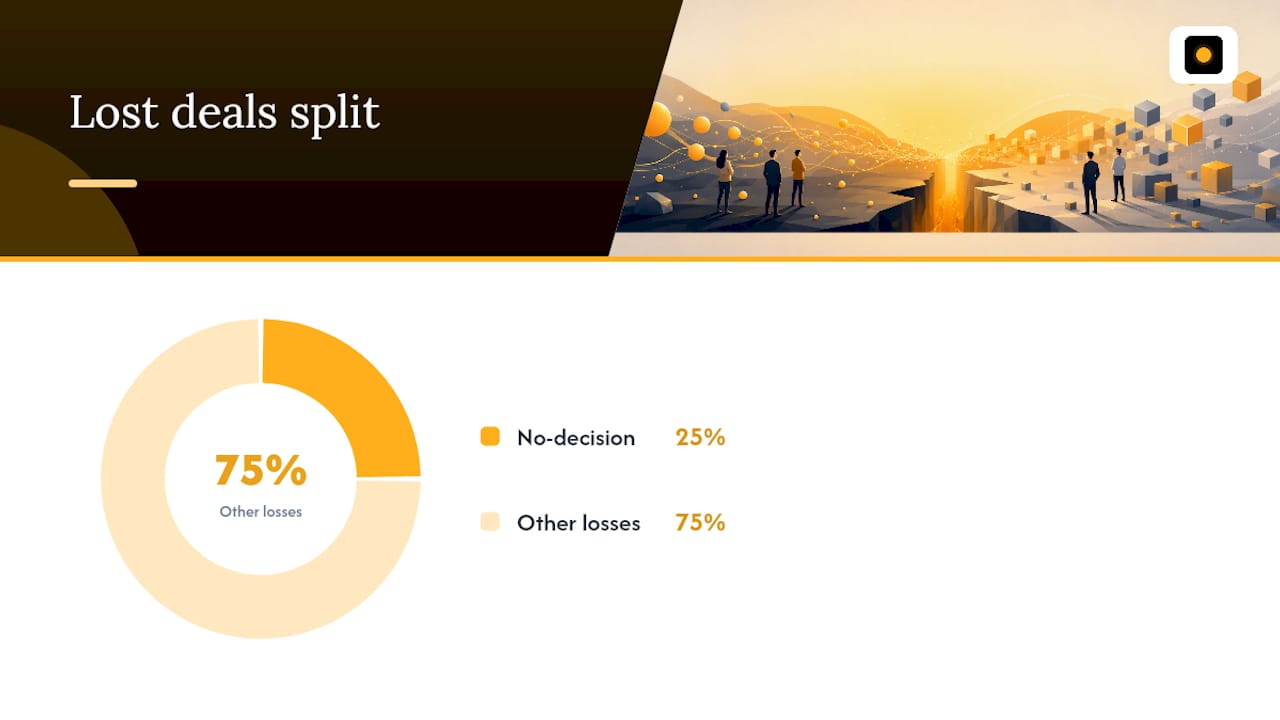
Estimating revenue impact starts with the no-decision loss rate. If a quarter of your “lost” deals are actually no-decisions rather than losses to a competitor, that’s pipeline capacity you can recover almost entirely through better qualification, without adding a single new lead. Payback on the effort is fast because the primary cost is manager time and a training session, not new software. Any tooling investment should be judged against that same baseline: does it shorten time-in-stage or lift SQL-to-opportunity conversion enough to justify its cost within one or two quarters.
Qualification Frameworks and the Adherence Problem
MEDDIC, MEDDPICC, BANT, and SPICED all aim at the same target from slightly different angles. MEDDIC and its extended cousin MEDDPICC force reps to document metrics, economic buyer, decision criteria, decision process, identified pain, and champion, adding paper process and competition in the PICC version. BANT is a leaner budget-authority-need-timeline check, popular precisely because it’s fast to teach. SPICED trades some of that rigidity for a situation-pain-impact-critical event-decision structure that fits consultative motions well.
None of them is inherently superior, and switching from one to another rarely fixes a struggling team. The real problem, as research on qualification frameworks makes clear, is adherence. Teams pick a framework, roll it out with a training deck, and watch adoption decay within a quarter because nobody enforces the fields and nobody inspects the deals against them.
The fix isn’t a better framework. It’s holding one framework in place long enough for it to become habit, and building enforcement into the CRM so a deal literally cannot advance without the evidence the framework requires. A mediocre framework applied consistently will outperform an excellent framework applied sporadically almost every time.
Measurement and Metrics to Track Progress
Four metrics tell you almost everything about whether your qualification gap is closing.
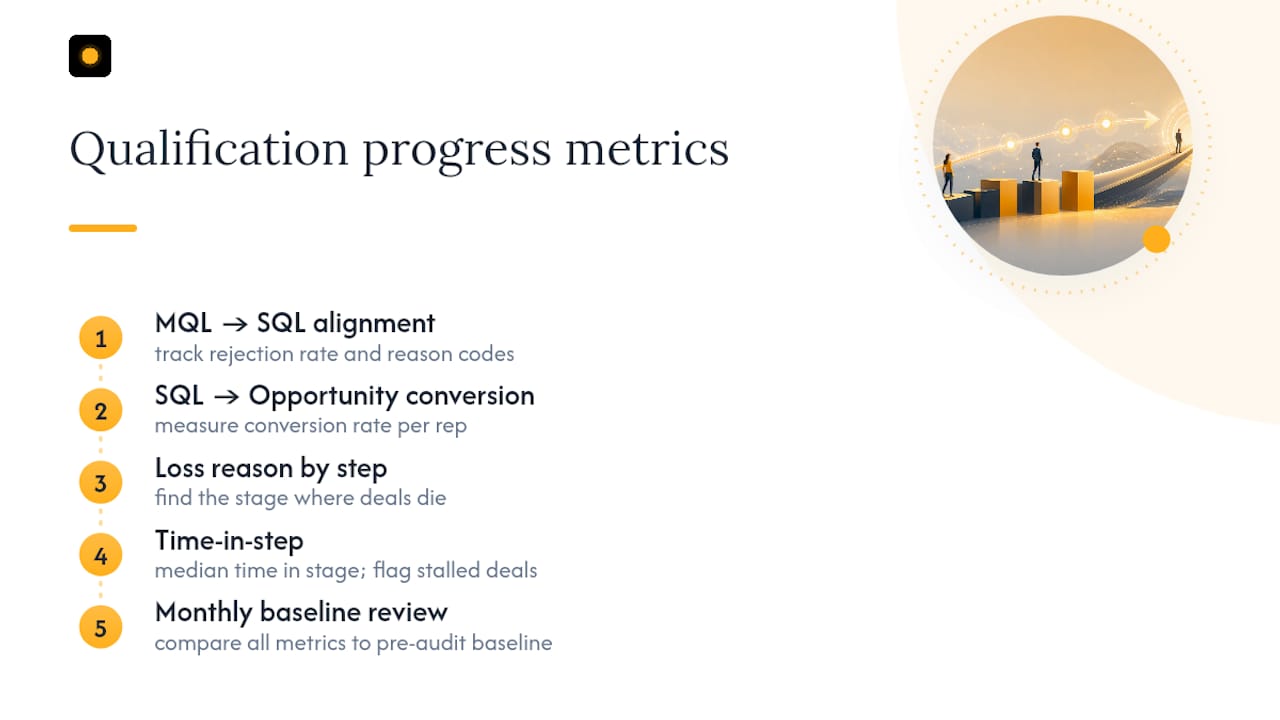
MQL to SQL alignment is the first check. Track the rejection rate and, more importantly, the reason codes behind rejections. A consistent reason code, like “no budget authority” or “not a decision maker,” points to a specific, fixable gap rather than a vague quality complaint.
SQL to opportunity conversion measures whether your qualified leads are actually turning into real pipeline. A flat or declining rate here, even as lead volume grows, usually means the qualification bar isn’t being enforced consistently across reps.
Loss reason by step matters more than an aggregate win rate. A team-wide win rate of 22% tells you nothing about where deals die. Loss reasons clustered at one specific stage tell you exactly where to focus coaching.
Time-in-step rounds out the set. A deal that lingers in “qualified” for six weeks with no CRM activity is either stuck on internal drag or was never really qualified. Track the median, not the average, since a handful of stalled outlier deals will otherwise distort the number.
Review these four together monthly, and compare them against a baseline pulled before you started the audit. Improvement in one metric while another worsens usually means you’ve fixed one gap while surfacing a different one, which is normal and worth investigating rather than ignoring.
Author Perspective: Why Inspection Beats Framework Shopping
Most sales leaders chase the wrong fix. They swap MEDDIC for BANT, or BANT for SPICED, hoping a new acronym solves what a lack of enforcement created. Pick one framework and hold the threshold. The framework is never the problem.
What actually moves the number is inspection: managers asking about evidence, not sentiment, on every deal review. “Who’s the economic buyer?” beats “How confident are you?” every single time. If you run one thing from this article, run the audit this quarter, before your next forecast call makes the gap someone else’s problem.
— Neil
Where OffBook Fits Into Closing the Gap
Once you’ve enforced a standard and identified where reps skip evidence, the harder part is changing behavior inside the call itself, not after it. OffBook is built for exactly that moment: it listens to live video calls and surfaces on-screen prompts, structured around MEDDIC and MEDDPICC, that flag missing buyer evidence while the conversation is still happening, not in a post-call recap nobody reads closely.
It also generates pre-call briefs on the people and companies a rep is about to meet, so discovery time goes toward qualification instead of basic research, and produces instant post-call debriefs so managers can inspect deals against the evidence fields discussed above without digging through a full transcript. This fits founder-led B2B SaaS teams at seed and Series A particularly well, since these teams rarely have a dedicated enablement function to run the coaching cadence manually. Plans start with the Power plan at $59 per month, with an annual option and a Team tier for organizations coaching a full roster of reps. If you want to see how the prompts map to your own qualification standard, the pricing and trial details are the place to start.
Primary Sources and Further Reading
- Gartner: strategic goals and sales/marketing alignment
- Forrester: three realities about B2B buying networks
- Objective Management Group: why strong pipelines still miss targets
- OffBook: sales call preparation checklist
Sources
- Gartner survey on strategic goals and sales/marketing alignment (press release)
- Forrester: three realities about B2B buying networks
- Lead qualification: frameworks and the real gap
- Objective Management Group: Why strong pipelines still miss revenue targets
FAQ
What Is a Sales Qualification Gap?
A sales qualification gap is a breakdown in a rep’s or team’s ability to confirm the evidence needed to know a deal is real, things like budget, decision authority, and timeline. It shows up as inflated pipeline, late-stage losses, and forecasts that miss because deals never had a real chance to close.
What Is the 2-2-2 Rule in Sales?
The 2-2-2 rule isn’t a standard qualification framework, and definitions of it vary widely across sales resources. If your team uses a version of it internally, treat it as a supplementary check rather than a substitute for a structured framework like MEDDIC or BANT.
Can You Give an Example of a Skill Gap in Sales Qualification?
A common example is stakeholder mapping: a rep builds rapport with one enthusiastic contact and never identifies the actual economic buyer. Since B2B buying groups average 13 internal stakeholders and 9 external influencers, stopping at one contact almost guarantees a late-stage surprise.
How Do I Know if My Team’s Qualification Process Is Actually Working?
Run the deal-sample audit described above on 15 to 20 closed deals, checking each for documented economic buyer, budget, decision process, and next step. If most deals fail on two or more of those four checks, the process has a real gap regardless of what the win rate currently shows.
Can OffBook Help Close Qualification Gaps During Live Calls?
Yes. OffBook surfaces live, on-screen prompts during video calls that flag missing buyer evidence, structured around frameworks like MEDDIC and MEDDPICC, so reps catch the gap while the conversation is still open rather than after the call ends. Current pricing is listed on the OffBook pricing page.