Sales Enablement Without a Big Budget: A Startup Playbook
Unlock effective sales enablement on a budget with simple strategies. Discover daily practices, shared resources, and coaching tips to boost your team.
Published: August 16, 2026
Author: OffBook Editorial Team

The fastest path to sales enablement without a big budget is three habits: daily practice, a shared playbook, and a lightweight coaching rhythm. You don’t need an LMS, a dedicated enablement team, or a six-figure platform contract. Start here, today:
- Audit one thing now. Pull recent lost deals and identify the most common qualification gap.
- Create one shared doc. A one-page call structure with your ICP, top objections, and MEDDIC qualification questions.
- Schedule one weekly coaching block. Thirty minutes, one rep, one recorded call reviewed together.
Tools like Offbook and frameworks like MEDDIC give you structure without overhead. The rest of this playbook shows you exactly how to build from there.
Key Takeaways
Sales enablement without a big budget works when you treat it as a weekly habit — practice, a shared playbook, and a coaching rhythm — rather than a tooling project.
| Point | Details |
|---|---|
| Start with a skills audit | Pull three lost deals and map where pipeline stalls before buying any tool. |
| Playbook before platform | A one-page ICP, call structure, and objection scripts outperform a course library for early-stage teams. |
| Measure from day one | Track ramp time, stage conversion, and qualified lead rate as your baseline before the pilot starts. |
| Lean stack beats bloated stack | Free tiers from HubSpot, Otter.ai, and Apollo.io cover pipeline, call capture, and outreach for most small teams. |
| Offbook for live coaching | Offbook surfaces real-time cues during calls and generates pre- and post-call briefs, scaling coaching without adding headcount. |
Table of Contents
- Sales enablement without a big budget: your 8-action checklist for this week
- How to audit your skills, process, and tech in under a week
- High-impact tactics that actually move your numbers
- Which affordable tools actually support practice and measurement?
- How to measure impact and build a business case for more budget
- Your practical 8-week enablement plan
- What actually works when you have almost nothing to spend
- Offbook makes live coaching affordable for small sales teams
- Sources
Sales enablement without a big budget: your 8-action checklist for this week
Run these eight actions in order. Each one is timeboxed, has a clear owner, and builds on the one before it.
- Pull your pipeline data (today, 30 min, sales leader). Export your last 90 days of deals. Flag where deals stall most often — discovery, demo, or close. That single data point tells you where to focus first.
- Record and review three calls (today, 1 hour, sales leader + reps). Listen for qualification gaps, missed objections, and moments where the rep lost control of the conversation. Write down the two most common patterns.
- Draft a one-page ICP and call structure (Day 2, 2 hours, sales leader). One page: your ideal customer profile, the three questions every rep must ask on every call, and your top five objections with responses. This is your first playbook artifact.
- Set up a free or low-cost CRM if you don’t have one (Day 2, 1 hour, ops or founder). HubSpot’s free tier handles pipeline tracking for teams under ten reps. No excuses for tracking deals in a spreadsheet.
- Run your first peer coaching session (Day 3, 30 min, two reps). One rep presents a recent call recording. The other asks: what went well, what would you do differently, what question did you forget to ask?
- Identify one internal champion (Day 3, 15 min, sales leader). Pick the rep who already runs the best discovery calls. They become your first playbook contributor and peer coach.
- Repurpose one piece of marketing content into a battlecard (Day 4, 1 hour, sales + marketing). Take your most recent case study or competitive comparison and strip it to a half-page format: problem, proof, objection response.
- Define three KPIs you’ll track for the next 30 days (Day 5, 30 min, sales leader). Ramp time to first deal, stage-to-stage conversion rate, and qualified lead rate. Write them down and share with the team. Small teams that focus on practice, a shared playbook, and a lightweight coaching rhythm report faster ramp times and improved conversion without enterprise-priced platforms.
How to audit your skills, process, and tech in under a week
You don’t need a consultant to find your biggest gaps. A structured self-audit takes less than five days and costs nothing but time.
Step 1: Collect call samples. Ask every rep to submit two recordings from the past two weeks — one win, one loss. Listen for the same three things across all of them: how they open discovery, how they handle the first objection, and whether they close for a clear next step.
Step 2: Map your pipeline stages to conversion rates. Pull stage-by-stage conversion from your CRM. If you don’t have a CRM, reconstruct it from memory or email threads. The stage with the biggest drop-off is your highest-leverage fix.
Step 3: Run a five-minute rep self-assessment. Ask each rep to rate themselves 1–5 on: product knowledge, discovery questioning, objection handling, and deal qualification. Compare their self-scores to what you heard in the call samples. The gaps between perception and reality are your training priorities.
Step 4: Audit your tech stack. List every tool you pay for. For each one, ask: does this directly help a rep prepare for or run a better call? If the answer is no, it’s a candidate for cancellation.
Sample goals to set from this audit:
- Reduce average ramp time to first closed deal by 20% within 60 days
- Improve discovery-to-demo conversion from current rate by 10 percentage points in 30 days
- Increase qualified lead rate (MEDDIC-scored) from baseline by 15% within 45 days
Forrester’s commentary makes the point plainly: a large course library is not revenue enablement. Relevance and practice beat volume every time.
High-impact tactics that actually move your numbers
The tactics below cost little or nothing. They work because they change rep behavior on the call, not just in a training module.
Manager-led micro-coaching. Ten minutes per rep per week, focused on one specific behavior from a real call. Not a performance review — a skill drill. Pick one moment from a recording, replay it, and ask the rep to handle it differently out loud. That repetition is what changes behavior. For a structured approach to building this cadence, the startup coaching program guide from Offbook walks through the setup in detail.

Peer practice sessions. Pair reps for 20-minute weekly roleplay. One plays the buyer, one plays the rep. Rotate scenarios from your objection list. The rep playing the buyer often learns as much as the one being coached — they start to hear what a confused prospect sounds like.
AI roleplay for scale. Simulation-based learning and AI roleplay can materially accelerate rep readiness compared with traditional coaching approaches. For small teams lacking a full-time enablement manager, this is how you get practice volume without burning the manager’s calendar.
- Shared playbook templates. Keep them short: ICP one-pager, call structure with MEDDIC qualification fields, objection scripts for your top five pushbacks, and a competitive battlecard. Four documents, one shared folder, updated monthly.
- Microlearning rituals. A five-minute Slack post every Monday with one objection and three ways to handle it. A Friday “win of the week” where a rep shares what worked. These compound over months.
- Content repurposing. Your marketing team’s case studies, competitive analyses, and product one-pagers are already written. Strip them to battlecard format. A half-page PDF a rep can pull up mid-call is worth more than a 20-slide deck they’ll never open. Intentional communication tied to buyer impact is the multiplier that lets lean teams punch above their weight.
- Internal champions. Find the rep who closes the most consistent discovery calls and make them a contributor. They write one section of the playbook. They run one peer session per month. They become the proof that the system works, and that proof recruits the next champion.
Pro Tip: Don’t skip the “win of the week” ritual. It takes five minutes and does two things: it surfaces what’s actually working in your specific market, and it gives the contributing rep visible recognition without a budget line.
For most teams under roughly 100 reps, an LMS is not the highest-leverage first purchase. Practice, a shared playbook, and a coaching rhythm consistently outperform course libraries in early-stage environments.
Which affordable tools actually support practice and measurement?
The goal is a minimal stack that covers four functions: pipeline tracking, call capture, practice, and scheduling. Everything else is optional until you’ve proven the basics work.
- Pipeline tracking. HubSpot’s free CRM handles deal stages, contact records, and basic reporting for small teams. You need this before anything else — you can’t measure conversion without it.
- Call recording and notes. Free tiers from tools like Otter.ai cover basic transcription. The point isn’t the transcript; it’s having a recording you can review in coaching sessions.
- Practice and simulation. AI roleplay tools democratize practice at scale — small teams now get the repetition and feedback loops that used to require enterprise programs. Offbook’s live AI coaching for sales goes further: it surfaces real-time cues during actual calls, not just in practice sessions.
- Scheduling. Calendly’s free tier eliminates the back-and-forth on meeting booking. One less friction point for reps.
- Outreach sequencing. A multi-channel outreach approach paired with qualification frameworks like MEDDIC can yield far higher meeting and close rates than unfocused outreach. Apollo.io’s free tier gives you basic sequencing and contact data to start.
Founders and small teams are closing larger deals using a lean stack of free tiers and focused process rather than expensive enterprise tooling. The discipline of a narrow ICP and a structured qualification framework does more than any software feature. For a deeper breakdown of which tools actually accelerate rep ramp, the top tools for ramping reps fast guide covers the current options in detail.
Guardrails before you buy anything:
- If a tool doesn’t directly help a rep prepare for or run a better call, skip it.
- Avoid annual contracts until you’ve used the tool for 60 days on a monthly plan.
- Feature-bloat is a real budget trap: a tool with 40 features you’ll use two of is not a deal.
You can also layer in lightweight customer communication automation for follow-up sequences without adding headcount.
How to measure impact and build a business case for more budget
You need a measurement plan before you start, not after. Without a baseline, you can’t prove anything moved.
Minimum viable measurement plan:
- Pick two or three reps as your pilot group. Keep the rest as a control.
- Run the pilot for 30 days. Track the same KPIs for both groups.
- At 30 days, compare. If the pilot group shows improvement on even one metric, you have a business case.
KPIs to track from day one:
- Ramp time to first closed deal (weeks from start date)
- Stage-to-stage conversion rate (especially discovery to demo)
- Meetings-to-demo ratio
- Average deal size
- Qualified lead rate (MEDDIC-scored)
Sample ROI logic. If your average deal size is $20,000 and your discovery-to-demo conversion improves by 10 percentage points across 20 monthly discovery calls, that’s two additional demos per month. The math doesn’t require a large improvement to justify the investment.
Pitch template for execs or finance:
- “We ran a 30-day pilot with three reps. Here’s what changed.” (Show the before/after KPI table.)
- “The cost of the pilot was $X. The projected annual revenue impact at current conversion rates is $Y.”
- “We’re asking for $Z to expand to the full team for 90 days.”
One note on revenue leakage: measurement doesn’t stop at closed-won. Post-close handoff problems can erode the gains you measure at the deal stage, so track retention and expansion alongside pipeline metrics.
Your practical 8-week enablement plan
Copy this into your calendar. Owners and time estimates are included so nothing sits unassigned.
| Week | Core Activity | Owner | Time Estimate |
|---|---|---|---|
| Week 1 | Skills and pipeline audit; collect call samples; set baseline KPIs | Sales leader | 4–5 hours |
| Week 2 | Draft ICP one-pager and call structure; identify internal champion | Sales leader + champion rep | 3 hours |
| Week 3 | First peer coaching session; repurpose one marketing asset into a battlecard | Champion rep + marketing | 2 hours |
| Week 4 | 4-week checkpoint: review KPIs vs. baseline; adjust playbook based on call review findings | Sales leader | 2 hours |
| Week 5 | Introduce AI roleplay or live coaching tool (pilot with 2–3 reps); run first structured objection drill | Sales leader + pilot reps | 3 hours |
| Week 6 | Expand playbook: add competitive battlecard and MEDDIC qualification checklist | Champion rep | 2 hours |
| Week 7 | Second peer coaching cycle; collect rep feedback on playbook gaps | All reps | 2 hours |
| Week 8 | 8-week checkpoint: compile KPI results; build business case for expanded budget | Sales leader | 3 hours |
What success looks like at 4 weeks: your baseline KPIs are documented, at least one playbook artifact exists and is being used, and the pilot reps have completed at least two coached call reviews.
At 8 weeks: stage-to-stage conversion has moved on at least one metric, the playbook has been updated at least once based on real call data, and you have a one-page business case ready to present. For a detailed week-by-week coaching program structure, the startup coaching program guide from Offbook covers the sequencing in depth.
What actually works when you have almost nothing to spend
The conventional wisdom says you need a platform, a dedicated enablement manager, and a content library before you can run real enablement. That’s wrong, and it’s expensive to believe.
The teams I’ve seen make the fastest progress share one trait: they treat enablement as a weekly operating rhythm, not a project. They don’t launch a program. They add one coaching block to the calendar, create one shared document, and review one call together. Then they do it again next week. That repetition, compounded over eight weeks, produces measurable results that no course library can replicate.

The pitfall I see most often is the tool-first trap. A founder spends two weeks evaluating platforms, signs an annual contract, and then realizes the reps still don’t know how to run a discovery call. The tool didn’t fix the behavior. Practice fixes the behavior. The tool just makes practice easier to scale.
If you can only do three things, do these: run one coached call review per week, keep a single shared playbook document that gets updated monthly, and track two pipeline metrics consistently. Everything else is optional until those three habits are locked in.
Offbook makes live coaching affordable for small sales teams
Most sales coaching happens after the call, when it’s too late to change anything. Offbook flips that. It listens to your video calls and surfaces live on-screen cues for your reps — the right question to ask next, the qualification gap to close, the objection to address — all structured around MEDDIC and MEDDPICC, without a bot ever appearing in the meeting.
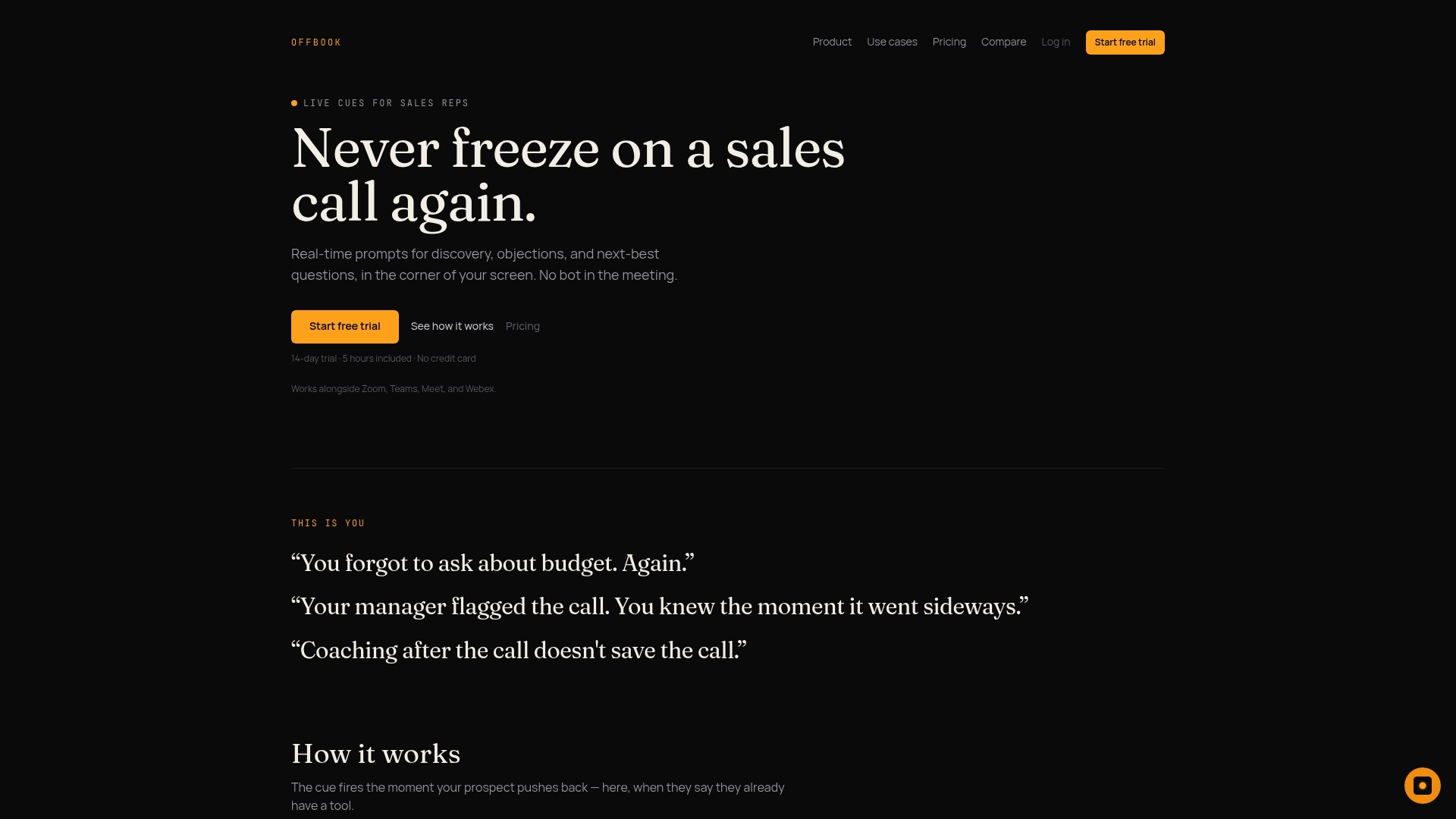
For a low-budget pilot, the setup is straightforward: run Offbook with two or three reps for two weeks. Track their discovery-to-demo conversion and qualified lead rate against the control group. Offbook’s pre-call briefs mean reps walk into every meeting prepared, and the post-call debriefs replace the 30-minute debrief your manager no longer has time for. The live AI coaching for sales page covers the full feature set and current pricing. Start a trial, run the two-week pilot, and let the KPI comparison make the budget case for you.
Sources
- Sales enablement for small teams (without the enterprise price tag) | Chambr